

27 January 2026
39,000 Trees for 2039: Get to know one of Commonwealth War Graves’ most exciting horticulture projects
Commonwealth War Graves' Director of Horticulture David Richardson takes us through 39,000 for 2039: a global horticulture and sustainability programme designed to transform some of our key war cemeteries.
39,000 Trees for 2039
What is 39,000 Trees for 2039?
As part of our commitment to long-term care for our sites worldwide , we are proud to be launching this incredible project to plant 39,000 trees all over the world by 2039, which marks a century since the start of the Second World War.
We have been caring for many of our sites for over 100 years, and we plan to continue caring for them into the future.
By planting more trees which are better suited to the extreme weather and temperature increases we are working with, we will be able to improve our overall resilience, resulting in healthier plants while also respecting and celebrating our global estate’s heritage, aesthetic, and geographical diversity.
We are uniquely placed in having cemeteries and memorials all over the world and in every conceivable climate.
Where we are able, we hope that this significant planting target makes our cemeteries and memorials better prepared to deal with the ongoing effects of climate change, remaining stunning places of peace and contemplation and hubs of biodiversity.
We are proud to be launching this incredible project to plant 39,000 trees all over the world by 2039, which marks a century since the start of the Second World War.
We are carefully selecting sites where we can enhance by adding trees, respecting the original architects’ intentions and not detracting from the headstones and burials, but adding to these incredible sites
As world leaders in commemoration and significant global employers of expert horticulturists, we want to ensure our cemeteries, memorials and their surrounding landscapes are beautiful, healthy, climate-resilient and biodiverse, whilst remaining places of deep meaning.
Discover 39,000 Trees for 2039
Project & planting: realising 39,000 Trees for 2039
The planting programme will be broadly split into two categories:
- Woodland Copse – The creation of woodland and copses- areas using young tree seedlings (whips)
- Specimen planting – The planting of carefully selected open-grown trees to complement the original architectural design.
We’ll be guided by leading data sources in choosing the species and also developing our tree-care skills, working with industry peers including Botanic Gardens Conservation International, The Tree Council, the Forestry Commission, and RBG Kew.
This way, we can ensure ecological suitability and long-term viability, keeping our sites healthy and beautiful for future generations to experience.
Where will the 39,000 trees be planted?
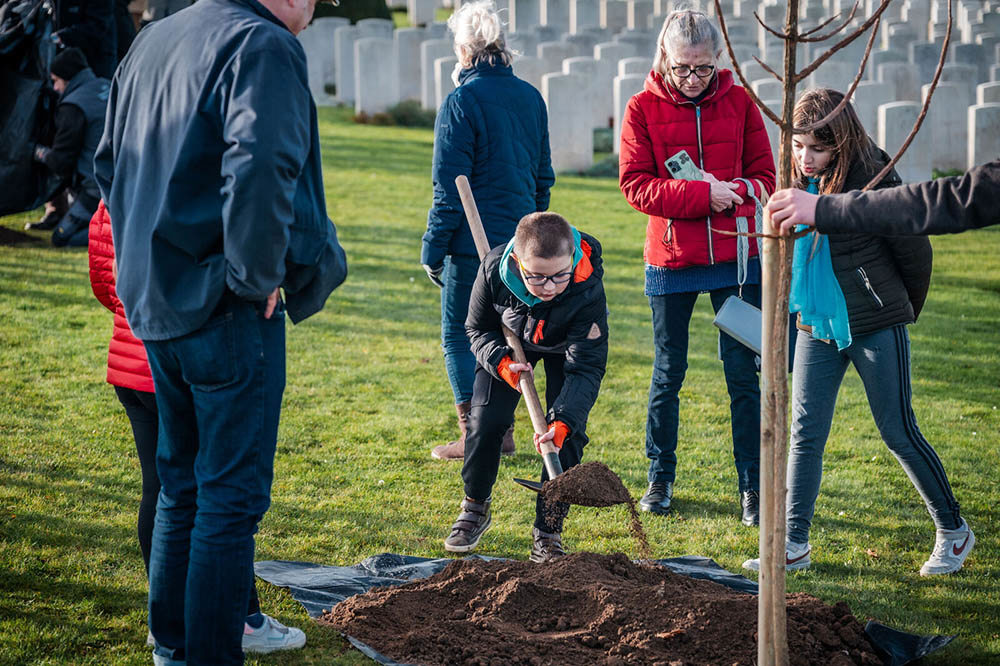
Image: The first 39,000 Trees plantings have already taken place, as seen here at Guillemont Road Cemetery, the Somme
The first plantings have already taken place!
On 10 December 2025, eight climate-resilient Field Maples (Acer campestre) were planted at Guillemont Road Cemetery on the Somme, Northern France.
Our horticultural workers were joined by local schoolchildren as well as local dignitaries to plant the first trees of this lengthy project. Guillemont Road represents the type of site where we can make a real impact; replacing planting that has struggled by introducing a new species that will thrive.
This site was designed by Herbert Baker, one of our most eminent architects and in planning the replant, we referenced historic documents in our archives to better understand the site.
We’ve also made progress in Italy, with the planting of 58 new trees at Coriano Ridge War Cemetery. With help from local schoolchildren and authorities, the most recent plantings were completed in January.
They form part of a wider overhaul of the irrigation system using better technology and water sensors to resolve long-standing challenges but also reduce our water consumption.
These plantings are just the beginning. Our global estate is truly worldwide, with sites in over 150 countries. 39,000 Trees will see new plantings, planning and research and a new focus of horticultural activity from our expert gardeners and teams worldwide.
We have identified several diverse locations around the world as we begin to roll out 39,000 Trees. Sites in France, Italy, the UK, Tunisia, Thailand, Nigeria, Kenya, and Malaysia are amongst those where we are set to welcome the first phase of new plantings and establishment of trees in our care.
Some of the key project sites to watch out for in the next year include:
- Brookwood Military Cemetery, UK – Sustainability has been carefully woven into each aspect of a newly landscaped environment commemorating First World War servicemen. 500 trees will be planted, providing a stunning setting for a new memorial.
- Medjez-El-Bab War Cemetery, Tunisia – Medjez-El-Bab War Cemetery is undergoing a regeneration as we reduce the dependence upon irrigation, and tree planting will form a large part of refreshing this Second World War site. Our planting will include olive, pomegranate and citrus species to symbolise the region’s economy and identity, whilst reducing watering after the trees have established, supporting pollinators, providing shelter for wildlife, and improving soil health.
Throughout the 39,000 Trees programme, we’re using our tree management software TreePlotter to map our current tree stock and to calculate the carbon sequestration potential of our new plantings.
Trees are a great way to capture CO2 and to store it from the atmosphere. It takes decades for this to happen, but it’s a really important part of combatting climate change. Every tree will help in this fight.
What are the benefits of the 39,000 Trees project?
39,000 Trees will bring a host of benefits to the Commission and our worldwide estate.
- Supporting local wildlife – By providing shelter and food for local wildlife, our new plantings will help ensure rich local biodiversity.
- Improving soil health – Trees help improve soil health and quality in numerous ways, such as enriching nutrient content, improving microbial activity, protecting from erosion, and managing water.
- Continuing our care for our unique heritage estate by developing and improving the landscapes and gardens
This planting initiative focuses on ‘the right species in the right place at the right time’, trees create habitats that can adapt and thrive in changing climates and support local wildlife. In doing so, we strengthen the climate resilience of our sites, while offering beauty and tranquillity for visitors.
39,000 by 2039 also provides huge opportunities for us within the Commission and outside. Having the right skills to plant and establish new trees has focused us on the training and development of our horticultural teams and will allow us to work closely with new and existing partners and stakeholders around the world.
Over time, the campaign will evolve to engage schools, learners and partners to build lasting awareness, support and understanding and practical skills for tree stewardship, and the importance of responsible, sustainable horticulture.
Sustainability & Horticulture at the Commonwealth War Graves Commission
The look and feel of our cemeteries was carefully laid out in the early days of the Commission. We employed some of the greatest architects and garden designers of the early twentieth century.
Influenced by the work of British horticulturalist Gertrude Jekyll, our cemeteries were to invoke the feel of cottage gardens with flowers, borders and paths.
The choice of plant species relies on our knowledge and research of local conditions, and we never forget the purpose of these sites and the 1.7 million Commonwealth men and women of the two World Wars that they commemorate.
That means we must take a careful, considered, and responsible approach to caring for the 23,000 burial places and nearly 2500 sites where we have gardening globally.
39,000 Trees for 2039 is the perfect example of utilising our current skilled teams and building new expertise to ensure that any new planting is more climate resilient.
More diverse planting will help encourage greater biodiversity and in many parts of the world, through tree planting, we will be creating shade for visitors who can better enjoy our sites as places of sanctuary and calm.
How can you find out more about the 39,000 Trees for 2039 project?
Regular programme updates will be shared on our website and social media channels. Make sure you’re following us to keep up to date on this and all our projects.
Sign up for the Commonwealth War Graves newsletter to get regular updates on 39,000 Trees and much more throughout the year.
David Richardson is Commonwealth War Graves’ Director of Horticulture. He has worked for CWGC for over 30 years in all our global areas, leading the care and development of our global estate. He is Current President and Chartered Fellow of the Chartered Institute of Horticulture, Freeman of the City of London and, and is a Liveryman of the Worshipful Company of Gardeners as well as a being a Trustee of the Royal Botanic Gardens, Kew.