


Medjez-El-Bab War Cemetery: Sustainability for the Future
Commonwealth War Graves is implementing a total landscape redesign project for Medjez-El-Bab War Cemetery in Tunisia, the largest Commonwealth war cemetery in the country.
PLEASE NOTE
Medjez-el-Bab Cemetery is temporarily closed until the end of November 2026 due to the ongoing construction works taking place. We apologise for any inconvenience.
In Tunisia’s Medjez-El-Bab War Cemetery, a stunning full transformation is taking place
The Commonwealth War Graves Commission is currently implementing a total landscape redesign at our largest Tunisian war cemetery.
Medjez-El-Bab is being reimagined and rejuvenated to honour its historical significance while also addressing environmental concerns such as water scarcity and climate stress.
The work at Medjez-El-Bab War Cemetery is part of an ongoing series of projects and developments designed to enhance and safeguard our sites worldwide to ensure they remain spaces of commemoration that delight and inspire.
Commonwealth War Graves is working with landscape architect Joe Perkins to implement this landscape redesign project for the Medjez-El-Bab War Cemetery in Tunisia, the largest Commonwealth war cemetery in the country.
Renders & images: Joe Perkins
Medjez-El-Bab War Cemetery
Why the landscape is changing
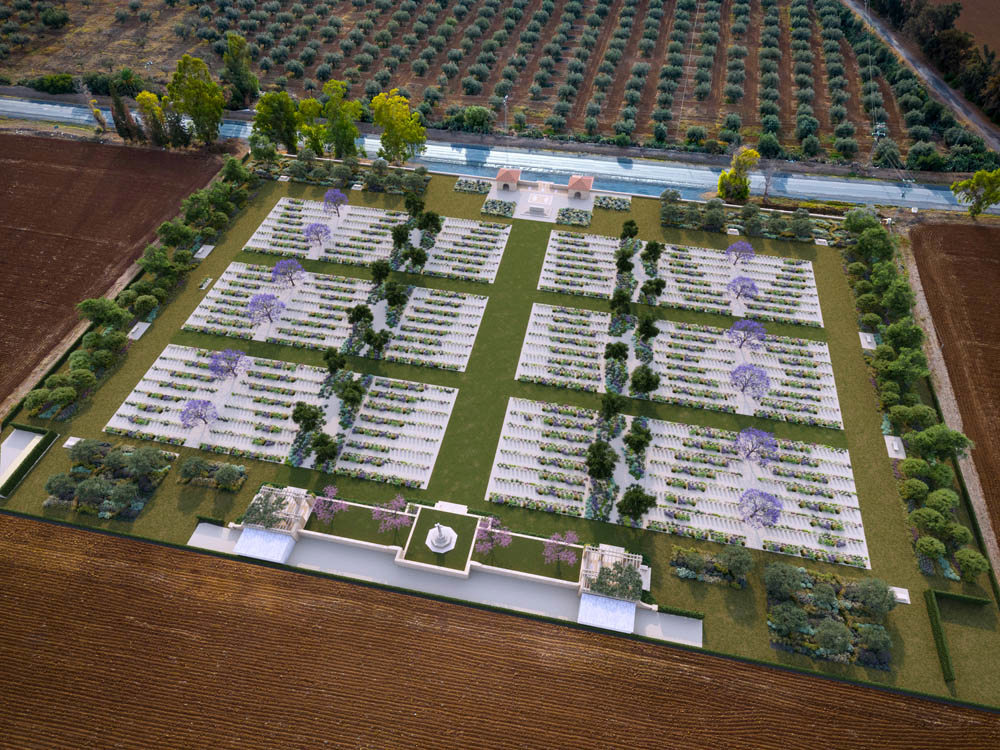
With rising global temperatures and shifting climates, protecting and adapting our sites for the future has taken on renewed importance.
Medjez-El-Bab War Cemetery showcases how we are working to change our sites to fit these climate challenges without sacrificing their character or significance.
The project is part of the Commonwealth War Graves Commission's ongoing efforts to create sustainable, climate-resilient landscapes while maintaining the dignity and purpose of war cemeteries. The redesign will reduce irrigated turf by 85%, increase biodiversity, and integrate the cemetery into its surrounding landscape.
Water scarcity and climate stress
Limiting water consumption is a vital part of our ongoing worldwide sustainability efforts at the Commonwealth War Graves Commission.
In climates such as Tunisia, traditionally hot and dry for much of the year, water preservation is vital. Though development of on-site irrigation systems and the selection of climate-appropriate plants, we will be able to drastically save water at Medjez-El-Bab.
With these changes, as much as 85% of the irrigated turf currently in the cemetery will be removed, allowing us to carefully save and manage water while improving the cemetery’s climate resilience.
Caring for a site a changing climate
The Medjez-El-Bab War Cemetery project signals how we are adapting to changing climate pressures in North Africa and the wider world.
In the project’s initial stages, we carefully examined what we could change to better care for this site in a world of changing weather patterns, hotter temperatures, and declining biodiversity.
We have moved from traditional high-maintenance lawns to sustainable, drought-tolerant plantings that reflect the local ecology and enhance biodiversity on-site.
The changes also effectively reduce the level of active on-site maintenance required by our teams, allowing us to focus our priorities elsewhere without compromising Medjez-El-Bab’s care.
Adapting without losing meaning
Commemoration of the Commonwealth’s war dead remains our absolute highest priority.
But part of that mission is ensuring the final resting places of the 1.7 million men and women we commemorate are healthy, beautiful and powerful spaces.
Medjez-El-Bab is being altered to better fit its local context while adapting to local conditions without ever losing sight of those commemorated within. All the alterations to the site are designed to protect their final resting places in perpetuity.
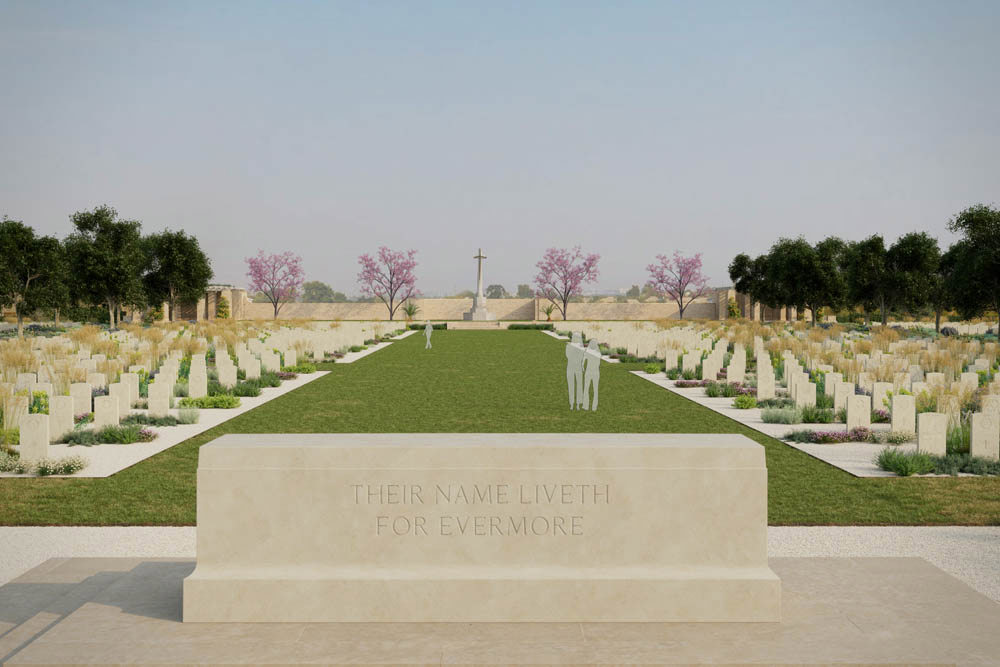
What’s Changing at Medjez-El-Bab War Cemetery?
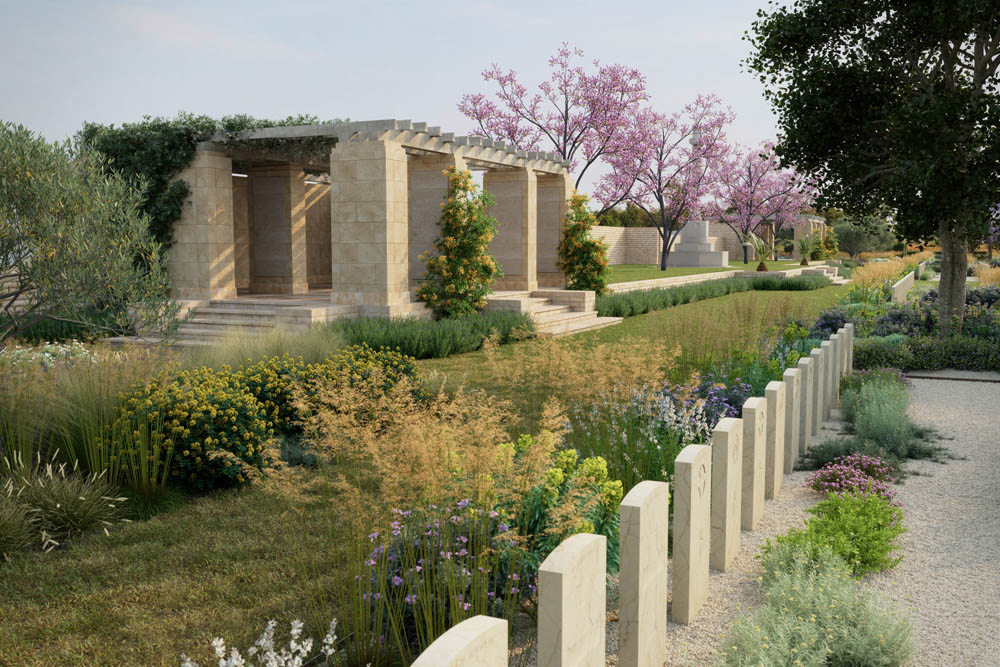
The redesign will replace large areas of high-maintenance lawn with a more climate-resilient landscape that uses drought-tolerant planting, gravel gardens, native species and retained areas of turf where they carry symbolic or visual importance.
Lawns, planting and pathing
The new design will form the transition from traditional high-maintenance lawns to sustainable, drought-tolerant plantings that reflect the local ecology and enhance biodiversity, including changes to:
- Entrance Area: Gravelled space with low, drought-tolerant planting to preserve open views and reduce maintenance.
- Central Avenue and Cross Axes: Retain irrigated turf for symbolic clarity and order.
- Grass Margins and Pathways: Transition to native, un-irrigated vegetation that will bloom in spring and remain dormant in summer.
- Burial Plots: Replace lawns with gravel gardens, low planting, and taller grasses to soften the geometry while maintaining legibility.
- Olive Groves: Introduce orchard-style planting underplanted with native species to enhance biodiversity and provide areas for reflection.
- Meandering Paths: Enhanced shaded corridors with drought-tolerant groundcovers and herbaceous plants for a textured, fragrant understorey.
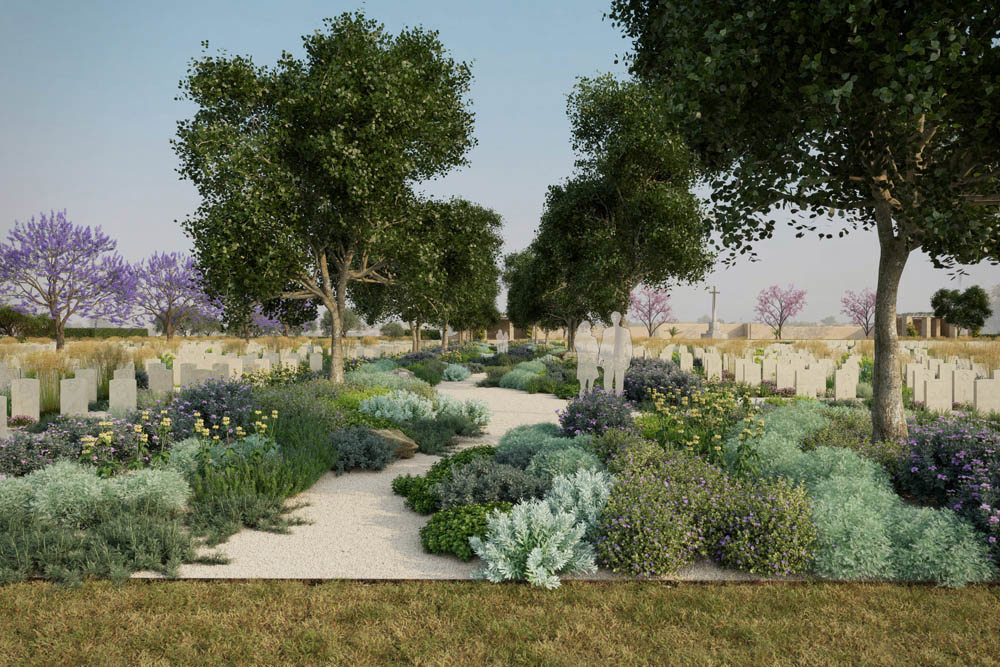
39,000 Trees for 2039: The right trees and plants for the location
Approaching horticulture with a “right plant, right place” philosophy means we are enhancing the Medjez-El-Bab landscape with hardy, climate-resilient and appropriate local tree and plant species.
The planting scheme draws inspiration from the surrounding Medjerda Valley and nearby Thuburbo Majus, incorporating native and resilient species such as olive trees, lavender, rosemary, thyme, and grasses.
These plants are chosen for their ecological benefits, including soil stabilisation, pest deterrence, pollinator support, and carbon sequestration.
The work at Medjez-El-Bab also folds into our worldwide 39,000 Trees for 2039 project. 39,000 new trees will be planted at select CWGC sites globally to boost climate resilience, enhance biodiversity and improve sustainability.
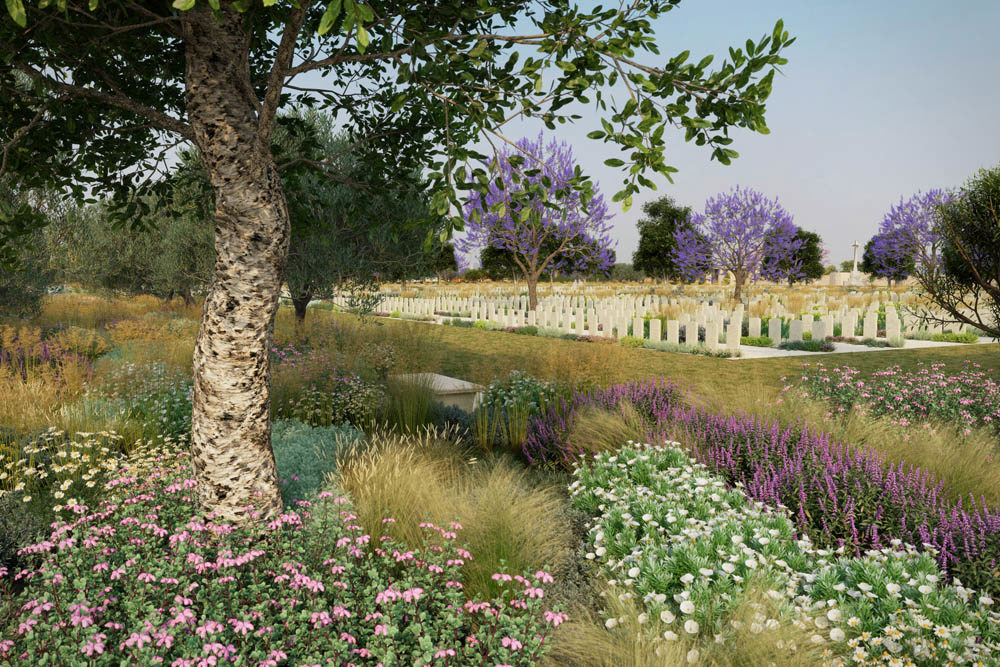
Planting for Tunisia’s landscape: Horticulture at Medjez-El-Bab
The planting at Medjez-El-Bab is designed to respond to Tunisia’s climate and local landscape.
Inspired by the Medjira Valley
As we touched on earlier, the planting at Medjez-El-Bab War Cemetery has been inspired by the local landscape, foliage and geography.
Species that thrive in the nearby Medjira Valley and Thuburbo Majus, such as olive trees, lavender, rosemary, thyme, and local grasses, have been incorporated into the updated cemetery planting scheme.
Native, resilient species that improve biodiversity
We’ve selected locally found species and plant varieties for numerous reasons.
Firstly, these plants are already adapted to Tunisia’s conditions, making them perfectly suited to our cemetery. Many are varieties that require less water, helping cut our water usage on-site.
The biodiversity within the cemetery is enhanced by a wide variety of plant species. As well as aiding with soil health and soil stabilisation, they will attract pollinators and wildlife.
This is an important aspect of healthy gardens and horticulture and something we are keen to develop at sites like Medjez-El-Bab.
What stays the same: Commemoration at Medjez-El-Bab War Cemetery
While the landscape is changing, the purpose of Medjez-El-Bab War Cemetery remains the same: to commemorate the people buried and named there with dignity and care.
War graves and names of the war dead
Medjez-El-Bab War Cemetery is the final resting place of more than 2,900 Second World War servicemen and five First World War casualties.
Within the cemetery sits the Medjez-El-Bab Memorial, commemorating a further 1,950 Commonwealth servicemen with no known war grave.
Since its inception, the cemetery has been the largest CWGC war cemetery in Tunisia and one of the primary points of commemoration for the fallen of the North African campaign.
All of the changes we’re making at Medjez-El-Bab are meant to ensure the site remains a peaceful place of quiet reflection and contemplation: a fitting resting place for the war dead of the Second World War.
As such, the headstones and memorials will remain constant and maintained alongside our preservation policies to ensure legibility and suitability as points for commemoration.
Why Medjez-El-Bab Matters
Medjez-El-Bab War Cemetery matters as it is our largest site in Tunisia, providing points of commemoration for more than 4,000 Second World War servicemen and a handful of First World War Casualties.
Medjez-El-Bab matters as it connects the Commonwealth to our shared global history, but is now also a pioneering site for how we adapt our sites to changing climates without comprising on its original purpose.
Together, Medjez-El-Bab represents our commitment to our past while adapting to the future.
Medjez-El-Bab Frequently Asked Questions
Medjez-El-Bab War Cemetery is in Tunisia, approximately 60 kilometres west of Tunis and around 5 kilometres west of Medjez-el-Bab on the road to Le Kef.
CWGC is redesigning Medjez-El-Bab War Cemetery in order to safeguard our largest war cemetery in Tunisia against the future. With climate pressures and water scarcity becoming larger issues, the redesign will save water while retaining a unique character in keeping with its location.
There are 2,903 Commonwealth servicemen of the Second World War buried or commemorated in Medjez-El-Bab War Cemetery. 385 of the burials are unidentified. Special memorials commemorate three soldiers buried in Tunis (Borgel) Cemetery and one in Youks-les-Bains Cemetery, whose graves are now lost.
Within the cemetery stands the Medjez-El-Bab Memorial, bearing the names of almost 2,000 men of the First Army who died during the operations in Algeria and Tunisia between 8 November 1942 and 19 February 1943, and those of the First and Eighth Armies who died in operations in the same areas between 20 February 1943 and 13 May 1943, and who have no known graves.
The cemetery is temporarily closed during construction works. Please check the official CWGC page before travelling for updates.
85% of the current irrigated turf will be removed and replaced with a combination of drought-tolerant planting of local plant species, gravel gardens, and olive groves in order to lower water use while promoting biodiversity.
Yes, while Medjez-El-Bab War Cemetery will change, it will still be clearly identifiable as a CWGC site, including our instantly recognisable headstones. It will remain a place that inspires and delights, while inviting quiet contemplation on the commemoration of nearly 3,000 Commonwealth servicemen.
Drought-tolerant planting is being introduced to lower our reliance on irrigation and overall water use on-site. These resilient plants are suited to the conditions, creating a sustainable site that fits seamlessly into the Tunisian landscape.
You can visit the cemetery page to find each of the named burials at Medjez-el-Bab. Likewise, you can use our Find War Dead tool and search by cemetery or memorial using the "Medjez-el-Bab" keyword.
Medjez-El-Bab is part of our wider global sustainability work. We are working hard to reduce water use, chemical use, and improve sustainability across the Commission, with projects such as 39,000 Trees for 2039.
Got a story of someone we commemorate at Medjez-El-Bab? Share it on For Evermore
For Evermore: Stories of the Fallen is our digital stories archive where we collect the stories of the war dead from both world wars commemorated by the Commonwealth War Graves Commission.
For Evermore: Stories of the Fallen is your opportunity to remember the stories that mean the most to you. Tell us about a relative, loved one or someone you have researched who today is commemorated at one of our cemeteries and memorials around the world.
We’ll collate your stories to create a single, searchable repository that honours the memory of the men and women across the Commonwealth who lost their lives during the world wars and ensure that these stories are available for the generations to come.
Head over to For Evermore to share your stories of those commemorated at Brookwood today.
Explore more: Medjez-El-Bab War Cemetery & Beyond
Medjez-El-Bab War Cemetery's renovation is just one part of our global work commemorating the Commonwealth’s fallen of the World Wars.
Here are some ways you can explore the Commonwealth War Graves Commission to learn more about who we are, what we do, and who we commemorate.
Find a name & search our recordsVisit usHow we care for war gravesGet involvedSupport the Commonwealth War Graves Foundation