

23 February 2026
Footballers Commemorated by CWGC: The Stories Behind the Names
Football can feel like a world of noise and colour, but some of its most enduring stories are held in quieter places.
In CWGC cemeteries and on memorials worldwide, you can find the names of footballers who died in the First World War and the Second World War, commemorated not as athletes, but as individuals in service.
The Commonwealth War Graves Commission commemorates 1.7 million Commonwealth war dead across more than 23,000 locations in over 150 countries and territories.
Whether a player was famous or little known, their commemoration follows the same equality principle - the same care, the same standards, the same permanence.
If you are researching a former player or local club member, you can begin by searching CWGC war records, exploring a story through For Evermore, or planning a visit to the place where they are commemorated.
At a glance: What's on this page
This page explores how football and wartime service intersect, and how those who died are commemorated today.
- Football before the First and Second World Wars and its role in community life
- How wartime disruption affected leagues, clubs and players
- Footballers who served in both world wars
- Individuals commemorated by CWGC because they died in service
- Equality in commemoration - no rank, no fame, no exception
- Where footballers are commemorated worldwide
- How to search CWGC records to verify details
- Frequently asked questions about football and wartime history
To understand how football and conflict became intertwined, it helps to look first at how the game continued, and changed, during wartime.
Footballers stories from the World Wars
Before the War: Football, Identity and Community
Before the First World War, football was already woven into daily life. For some, it was paid work. For many more, it was a local routine; Saturday afternoons, familiar faces, shared identity, and a sense of belonging that stretched beyond the pitch.
That’s why footballers’ stories can be a powerful entry point into commemoration today. A club badge, a hometown ground, a team photograph; these details help turn a record into a recognisable life. But CWGC records also remind us of something more important than sport: that each person commemorated had a family, a place, and a future interrupted.
If you are researching a footballer today, begin with the verified facts in CWGC records. From there, you can build a fuller picture of the life behind the name.
First World War
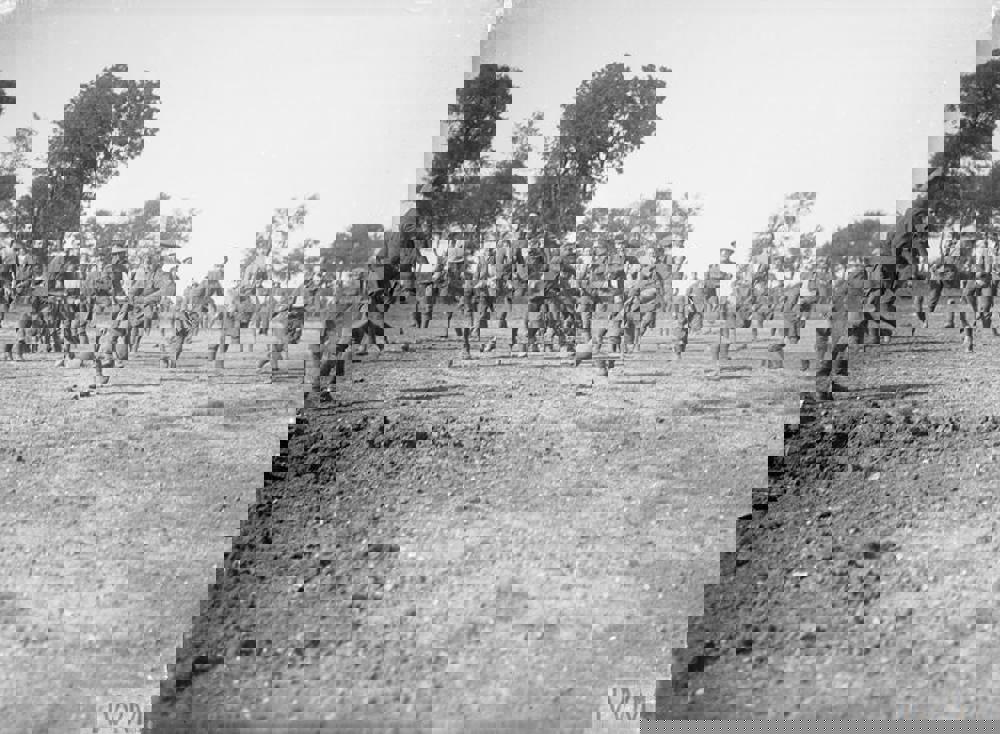
Image: Troops of the 1st Battalion, Wiltshire Regiment, playing football near Bouzincourt, September 1916 (© IWM (Q 1108))
The 1914-1015 professional football season was played in England, including the FA Cup. It was considered good for morale, a distraction from the growing conflict on the continent.
However, from 1915 to 1919, professional competitive football was banned in England and Wales. Smaller, regional leagues were created due to travel restrictions and player shortages.
Some stadiums and pitches were used as military training grounds, such as Swansea City’s home ground, The Vetch, in South Wales.
Elsewhere, football was used for recreation for troops in barracks and for men billeted close to the frontline. Interdivisional and service tournaments were organised and played, with the sport proving good for morale.
Thousands of footballs were sent to troops at the front. Some were even kicked into battle, becoming symbolic of courage and coolness in the face of oncoming fire.
At the Battle of Loos in late September 1915, Sergeant Frank Edwards of 1st Battalion, London Irish Rifles, dribbled a football with his comrades across No Man’s Land. The Battalion went on to take and hold its objectives before being forced to withdraw.
Likewise, men of the East Surrey Regiment booted balls in front of them on the First Day of the Somme.
At home, while the men’s game was paused, the women’s game flourished. Munitions factories set up their own teams, such as Dick, Kerr’s Ladies FC, and were soon drawing larger crowds than men’s matches. This would not last post-war, as women were banned from playing in Football League grounds in 1921.
In Scotland, professional competitive football continued for the duration of the war, but with teams usually severely depleted.
Second World War: Football put on hold again
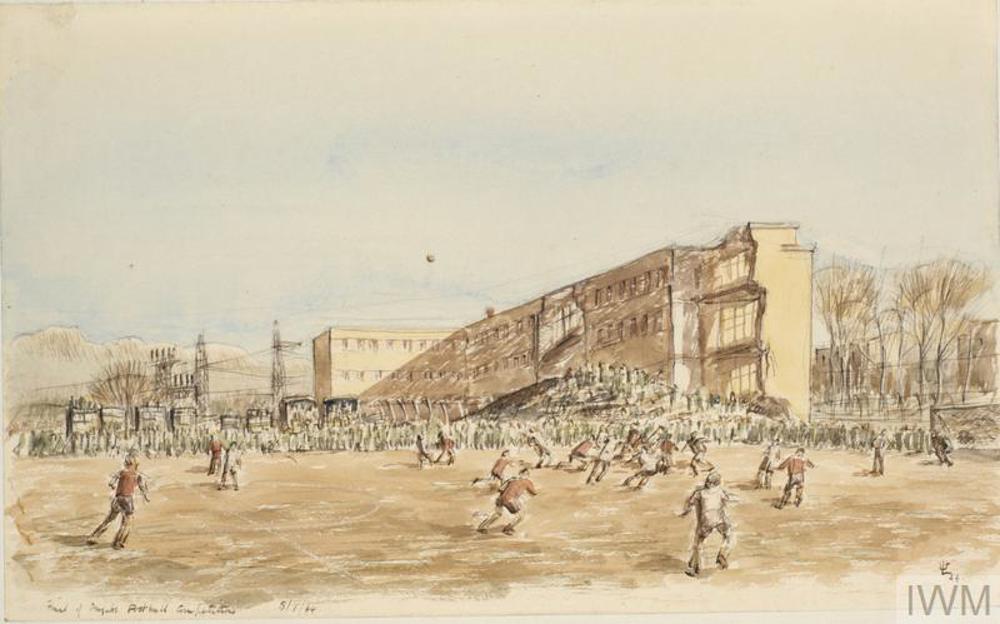
Image: The Final of the Brigade Association Football Cup, 8th January 1944 (© IWM (Art.IWM ART LD 3986))
Following the outbreak of war in September 1939, professional football was banned in England, Scotland, and Wales for the duration of the Second World War.
Once more, smaller regional competitions and leagues were organised, with exhibition and charity matches also proving important morale boosters for the public, players, and soldiers.
Football was once again used for exercise and recreation by servicemen in the billets and barracks. Interdivisional and unit matches and competitions were organised too, again important for maintaining morale.
Several stadiums were severely damaged by Luftwaffe bombing in the Second World War. Arsenal’s ground, Highbury, was struck by a bomb, causing damage to the pitch. Their arch-rivals, Tottenham Hotspur, allowed Arsenal to use White Hart Lane until repairs were made.
While leagues were reorganised and matches adapted, the lives of players themselves were changing far more dramatically.
Footballers in the Armed Forces
Recruitment
“I knew nothing of professional footballers when I took over this Battalion. I have learnt to value them. I would go anywhere with such men. Their esprit de corps was amazing.” - Colonel H.T. Fenwick
Around 2,000 or so professional footballers served in the British Armed Forces during the First World War. Fit, young, and used to working closely in teams, professional footballers boasted all the attributes of good soldiers.
Footballers initially faced public backlash for not enlisting, as clubs were loath to release their players, but many professionals volunteered in the war’s early stages.
The Football Battalions & McCrae’s Battalion
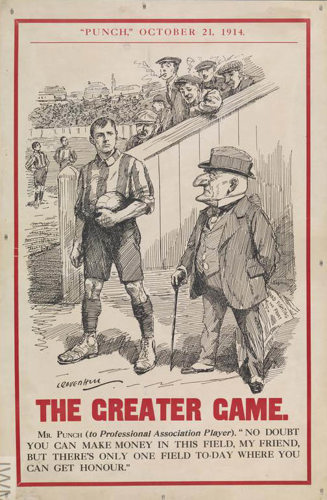 Image: A cartoon from the October 21 1914, edition of Punch magazine. Mr Punch, the figure in the top hat, says to the footballer: "No doubt you can make money in this field, my friend, but there's only one field to-day where you can get honour" - such pressure was put on professional footballers to enlist in the early war.
Politician William Joynson-Hicks organised the 17th (Service) Battalion of the Middlesex Regiment in December 1914, alleviating the pressure on the professional game.
The Football Battalion was born, with England international Frank Buckley being the first professional to enlist. A second Football Battalion, the 23rd (Service) Battalion, was founded the following year, under the command of former Tottenham Hotspur player Alec Haig-Brown.
In Scotland, former Liberal MP Sir George McCrae raised the 16th (Service) Battalion, Royal Scots, also known as “McCrae’s Battalion”. Like the Football Battalion, McCrae’s unit was composed of professional footballers, supplemented by sportsmen from other disciplines, trainers, and even supporters.
Famously, 11 players of Hearts of Midlothian, then the Scottish league leaders, volunteered to join McCrae’s Battalion, alongside 16 other members of Hearts staff. They were joined by players and staff from other Scottish sides, such as Hearts’ city rivals Hibernian, Raith Rovers, Falkirk, Dunfermline Athletic, and East Fife.
Professional footballers in the Second World War
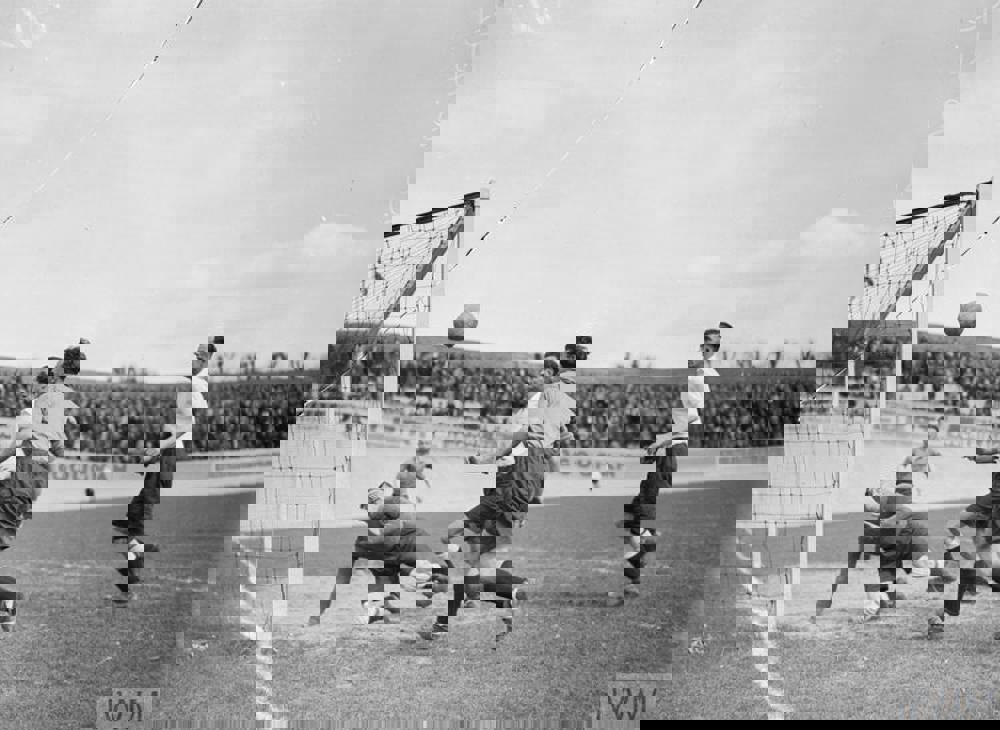
Image: The Royal Air Force playing football in France: the 'Air Components' scoring their first goal in a match against the 'Advance Air Striking Force' (IWM (C 1044))
With the suspension of football in September 1939, all professional footballers’ contracts were terminated, according to the Imperial War Museum.
As abled bodied young men of fighting age, footballers were ripe for conscription and enlistment. A report from Picture Post Magazine’s April 1940 edition states over 620 professional footballers had joined the Armed Forces in 1940.
The majority served in the Army, while more than 80 served in the RAF and just over 30 enlisted in the Royal Navy. War work proved another avenue for professional footballers to do their bit. A factory in Oldbury employed 18 West Bromwich Albion players, for example.
In one famous instance, several months before the outbreak of war at a match on Easter Sunday 1939, Bolton Wanderers captain Harry Goslin made an impassioned speech urging spectators to join up. The following Monday, he and the entire Bolton team enlisted.
Harry and his teammates served on the front with 53rd (Bolton) Field Artillery. Many footballers found themselves at the front, but some were given special dispensation to play in exhibition matches at home.
Others were employed as Physical Training Instructors, helping whip conscripted men into shape.

Want more stories like this delivered directly to your inbox? Sign up for our newsletter for regular updates on the work of Commonwealth War Graves, blogs, event news, and more.
Sign UpHow many professional footballers were killed in the World Wars?
Of the 2,000 or so professional footballers who served in the British Armed Forces in the First World War, 300 lost their lives.
In the Second World War, the death toll was much lower. Some 80 died in military service, while many more were prisoners of war.
Behind these figures are individual lives, each with its own story of family, work, football and service.
Stories of footballers from the World Wars
Professional footballers left their clubs to serve in both the First World War and the Second World War. Some returned to the game after conflict. Others did not. The individuals commemorated by CWGC appear in the records not as athletes, but as soldiers, sailors and airmen whose lives ended in service.
The following stories show how football formed one part of a wider life, and how commemoration ensures those lives are marked equally and permanently.
Private George Badenoch
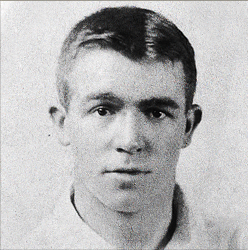 Image: Private George Badenoch
Born in Castle Douglas, Scotland, on 9 April 1882, George Badenoch was a professional footballer who made 125 appearances with numerous clubs.
George’s playing career began with Heart of Midlothian in Edinburgh in 1901, moving south to Derbyshire side Glossop, where he played for three seasons.
In 1903, George was signed by Watford. In his first season, Watford went unbeaten on their way to winning the Southern League Second Division. He stayed three seasons at Watford, scoring 9 times in 80 appearances.
George moved again in 1906, this time to Tottenham Hotspur. His Spurs debut came in a Southern League match against his former club Watford.
Unfortunately, George’s career was dogged by injuries and illness. He contracted appendicitis in 1907, limiting him to six reserve team appearances in the South Eastern League.
A change in managers saw George out of Spurs’ plans for the coming season, so George left to join Northampton Town in 1907. A serious knee injury ended his playing career in 1909.
With his playing days behind him, George, an engineer by trade, emigrated with his wife to Indian Head, Saskatchewan, Canada in January 1910.
While in Canada, George and his wife had two children, and George played for the town cricket team.
In 1913, the Badenochs returned to the UK, with George taking up work as a sales manager.
When war broke out in 1914, George volunteered for military service, enlisting as a Private in the 1st (West Ontario) Battalion of the Canadian Expeditionary Force (CEF).
In June 1915, George’s battalion was in action at the Second Action at Givenchy as part of the wider Second Battle of Artois.
The unit went forward on June 15 to take the German frontline trench network at Givenchy, initially taking the trench network alongside British troops and other Canadian units. However, a strong German counterattack eventually pushed the Commonwealth troops back.
George was one of the Canadian infantrymen killed in the close-quarters trench fighting at Givenchy, aged 33.
George has no known war grave and is commemorated on the Vimy Memorial, Pas de Calais, France.
Serjeant Thomas Cooper
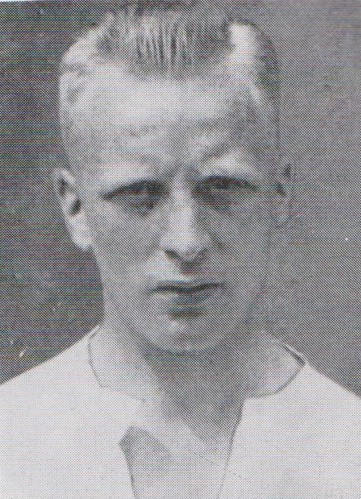 Image: Thomas Cooper in the 1920s (Wikimedia Commons)
The son of a bricklayer, Thomas Cooper was born on 9 April 1905 in Fenton, Staffordshire. He was the seventh of eight children born to parents Stephen and Sarah Cooper.
Before becoming a professional footballer, he worked as a haulage hand in a coal mine. Thomas was also a keen golfer, winning the Merseyside Professional Golf Tournament three years in a row.
Thomas married his wife, Beatrice, in 1931. Together, the pair had two children.
A right back, Thomas played for Longton and Trentham before being signed by Port Vale in August 1924. He played 21 times for Port Vale before moving to Derby County in March 1926.
Settling into the starting XI, he was part of the team that won promotion to the First Division in the 1925-26 season. He stayed at Derby until 1934, achieving a second-place finish with the Rams in the 1929-30 season.
After 267 appearances for Derby, Cooper moved to Liverpool in December 1934. He remained on Merseyside until the professional game was called to a halt in 1939, making 150 appearances.
Internationally, Thomas made just 15 appearances for England as injuries in his club career limited his time with the Three Lions. His first appearance came in a 2-0 loss to Ireland at Windsor Park, Belfast. Thomas captained England twice, the last of which was a 2-1 defeat to Czechoslovakia.
Thomas enlisted in the Armed Forces during the Second World War, joining the Royal Military Police.
In June 1940, Tomas was killed when he collided with a lorry while riding his despatch motorcycle.
After an inquiry, it was ruled despatch riders would no longer be allowed to ride their motorcycles without wearing crash helmets.
Thomas is buried at Derby (Nottingham Road) Cemetery. He was 35 years old at the time of his death.
Lance Corporal Leigh Richmond Roose MM
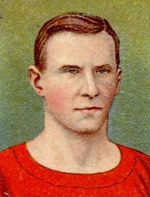 Image: A contemporary cigarette card portrait of Leigh Richmond Roose (Wikimedia Commons)
Welshman Leigh Richmond Roose, known as Dick, was one of the most important figures of Edwardian football.
A larger-than-life character, Dick was one of the first football celebrities. He was a sensation on and off the pitch. He used his impressive physical technique to bully and cajole opposition attackers to control and defend his goal.
He also used psychology and mind tricks to get one over on his opponents. At one point, he purposely wasted time holding the ball and chatting with the crowd until penalised. Hugely charismatic and skilled, whenever Leigh played, he attracted big crowds.
He was even responsible for a rules change.
At the time, goalies were able to handle the ball anywhere in their own half. As such, Dick would bounce the ball all the way to the halfway line and throw it deep into the opposition half, causing havoc.
So effective was this tactic that goalies were banned from handling the ball outside their penalty area after Roose’s retirement in 1912.
Despite his unorthodox approach, Dick played for some of the largest names in British football, including Everton, Stoke, and Celtic, as well as appearing for Wales.
Although technically an amateur, Leigh charged his clubs lavish “sporting expenses” which supported his playboy lifestyle. His income was supplemented by writing regular newspaper columns.
Dick was well above the age of enlistment when the First World War broke out but nonetheless volunteered for service. Initially, Dick served with the Royal Army Medical Corps in France and Gallipoli before becoming a Private in the Royal Fusiliers in 1916.
Thanks to his goalkeeping experience, Dick was noted as an exceptional grenade thrower.
He was awarded the Military Medal for bravery on the first time he saw action, with the Royal Fusiliers regimental history stating:
“Private Leigh Roose, who had never visited the trenches before, was in the sap when the flammenwerfer attack began. He managed to get back along the trench and, though nearly choked with fumes with his clothes burnt, refused to go to the dressing station. He continued to throw bombs until his arm gave out, and then, joining the covering party, used his rifle with great effect.”
Dick was promoted to the rank of Lance Corporal at some point before his death. He was killed, aged 38, at the Battle of the Somme but the exact circumstances of his death are unknown.
As Dick’s body was never recovered, he is commemorated on the Thiepval Memorial to the Missing of the Somme.
Major John James Tompkins
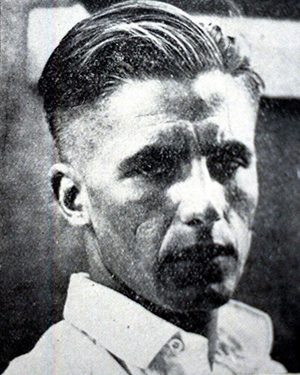 Image: Jimmy Tompkins in his Fulham days (Wikimedia Commons)
John James “Jimmy” Tompkins was born in Edmonton, North London, in 1914 to parents Arthur and Annie Tompkins.
A highly skilled footballer, his career began as an amateur with Woking while he worked as part of the ground staff with Arsenal at Highbury.
Arsenal’s legendary manager Herbert Chapman saw him play and was reportedly disappointed that Jimmy had already signed for Fulham FC, believing Tompkins had the potential to become an England international.
A one-club man, Jimmy played for Fulham between 1934 and 1939, making 164 appearances for the West London club. Jimmy started his time with Fulham as a centre back but was soon moved to the left back position, where he found his rhythm.
Jimmy was known as a brave tackler, skilled with the ball at his feet, and able to make darting attacking runs. He scored five goals for Fulham during his playing time. Towards the end of his playing career, Jimmy deputised as Fulham’s captain if regular skipper Mike Keeping was unavailable.
Jimmy married Cecilia Parker in 1939. The couple had two children, Neil and Jill. Cecilia sadly passed away from a liver infection in 1944.
Believing war was imminent, Tompkins enlisted in the Territorial Army before war broke out in September 1939. With the outbreak of hostilities, Jimmy was drafted into the regular army as a private with the Royal Fusiliers.
Jimmy quickly worked his way through the non-commissioned ranks before being commissioned as an officer in 1942. From there, his rapid rise through the ranks continued. By the time of D-Day in June 1944, Jimmy was a Major, seconded to the Hampshire Regiment, and held a provisional rank as a Lieutenant Colonel.
Sadly, Jimmy did not survive the Normandy Campaign, arriving in France shortly after the D-Day Landings.
On 10 July 1944, Jimmy was ordered to capture the village of Maltot. Unbeknownst to his commanders, the village’s surrounding depressions and woodland were full of enemy tanks.
Despite support from British armour, the attacking force sustained heavy casualties as the German panzers opened fire. 56 men of Major Tompkins’ battalion were killed before the withdrawal order was made.
Among them was Jimmy. The Major was last seen charging a machine-gun post, but his body was never recovered. Major Jimmy Tompkins is commemorated on the Bayeux Memorial.
These examples represent only a small number of footballers commemorated by CWGC. Many more are recorded in the Commission’s database, each entry preserving the factual details of service and commemoration.
If you would like to research a former player from your club or community, you can search for their name in CWGC war service records and confirm where they are commemorated. From there, you may choose to visit, share information locally, or contribute a story through For Evermore.
Share your stories of fallen sportsmen on For Evermore: our online stories archive
For Evermore: Stories of the Fallen is our online resource for sharing the memories of the Commonwealth’s war dead.
It’s open to the public to share their family histories and the tales of the service people commemorated by Commonwealth War Graves so that we may preserve their legacies beyond just a name on a headstone or a memorial.
If you have a story to tell, we’d love to read it! Head to For Evermore: Stories of the Fallen to upload and share it for all the world to see.
Footballers Across the Commonwealth
Football’s wartime story is not limited to one country. The individuals commemorated by CWGC came from across the Commonwealth, reflecting different leagues, cultures and local traditions of the game.
Some were established professionals. Others played at amateur or regional level while working in trades, industry or agriculture. In parts of the Commonwealth shaped by colonial structures, individuals did not always have full choice over the circumstances of their service. CWGC’s responsibility is to ensure that, regardless of background, their names are recorded and commemorated fairly.
Today, a footballer from Scotland, Canada, South Africa, India or New Zealand may be commemorated in a cemetery in France, on a memorial in Belgium, or in a burial ground closer to home. Together, these sites form part of a shared global record.
Across continents and cultures, one principle connects every site where these names appear.
Equality in Commemoration - No Rank, No Fame, No Exception
CWGC was founded on a principle of equality in commemoration. Rank, wealth, background and public recognition do not alter how an individual is commemorated.
In CWGC war cemeteries, this principle is visible in uniform headstones, consistent design, materials and inscription standards. On memorials to the missing, names appear without hierarchy. A well-known international footballer is commemorated in the same way as a miner, teacher, clerk or farm worker.
This consistency is not symbolic. It is maintained through ongoing standards of care, conservation and record accuracy. The equality visible in stone reflects the equality embedded in CWGC’s founding commitment.
That principle is not abstract. It is visible in the physical places where these individuals are commemorated.
Where Footballers Are Commemorated Today
Footballers who died in service are commemorated in CWGC cemeteries and on memorials across Europe and beyond.
Burials and Marked Graves
Where a burial location was identified, individuals are commemorated with a headstone bearing their name, rank, unit, date of death and often age. Visitors see maintained lawns, clear inscriptions and planted borders - part of CWGC’s ongoing care.
Memorials to the Missing
Where no grave could be identified, names are engraved on war memorials to the missing. These memorials ensure that absence of a burial site does not mean absence from commemoration.
If you want to locate a specific individual, a CWGC record will confirm whether they are buried in a cemetery or commemorated on a memorial, and where that site is located.
These places are carefully maintained, but commemoration does not stop at stone and inscription.
Why These Stories Still Matter Today
Football remains one of the most widely shared cultural languages across generations. That connection can make wartime stories accessible to new audiences, particularly when linked to a familiar club or place.
But the relevance does not rest on sporting fame. It rests on the individual. A record search today can reconnect families, clubs and communities with someone whose life might otherwise feel distant. A visit to a cemetery or memorial can turn a historical entry into a physical place of reflection.
By moving from record to story, and from story to shared knowledge, football communities can help ensure that individuals are remembered as people first, not as statistics.
Ultimately, it comes back to the individual.
Every Name Has a Story
Behind every footballer commemorated by CWGC was a life shaped by family, work, community and identity. Football may have been part of that life, but it was not the whole of it.
When you stand in front of a CWGC headstone or memorial panel, you see a name carved clearly and consistently. That name represents one of 1.7 million Commonwealth war dead commemorated across more than 23,000 locations worldwide. Each is marked with the same care.
If you are researching a former player, you can begin with a record, plan a visit, or contribute a story through For Evermore. In doing so, you help ensure that the life behind the name continues to be recognised.
FAQs - Footballers and War History
Below are answers to some of the most common questions about football, service and commemoration.
Football & The World Wars FAQs
Around 300 or so professional footballers who served in the British Armed Forces in the First World War lost their lives. A further 80 died in military service during the Second World War.
You can search for a named footballer using our online records database. The record will show whether the individual is buried in a cemetery or commemorated on a memorial to the missing, and it will provide the location to support visit planning.
Footballers are commemorated equally because the Commonwealth War Graves Commission on a founding principle of equality in commemoration. Profession and public recognition do not change the form of commemoration. Headstones and memorial inscriptions follow the same standards for every individual.
Professional football was heavily disrupted during both world wars. In England and Wales, competitive football was suspended between 1915 and 1919 during the First World War, and again in 1939 during the Second World War, with regional competitions replacing national leagues. Scottish leagues continued in the First World War with depleted teams.
Many amateur and local club players served in the First and Second World Wars, and some died in service. Their stories may be less documented in sporting records, but CWGC records confirm their service details and place of commemoration.
A grave marks a known burial location and is usually identified by a headstone in a CWGC cemetery. A memorial to the missing commemorates individuals whose burial place was not identified, with names engraved on panels or walls.
Author acknowledgements
Alec Malloy is a CWGC Digital Content Executive. He has worked at the Commonwealth War Graves Commission since February 2022. During that time, he has written extensively about the World Wars, including major battles, casualty stories, and the Commission's work commemorating 1.7 million war dead worldwide.