

04 March 2026
How Changing Climate Affects Cemeteries and Memorials
Discover how the Commonwealth War Graves Commission cares for cemeteries and memorials worldwide in the face of our changing climate.
Why Cemeteries and Memorials Are Vulnerable to Climate Change
The impact of climate change can be felt worldwide, and our cemeteries and memorials are not immune to shifting weather and climate conditions.
A global responsibility across 150 countries
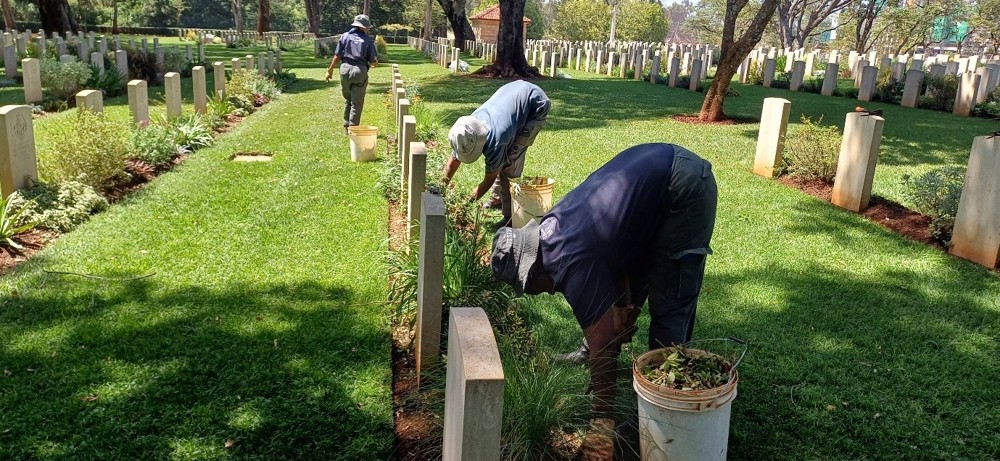
Image: CWGC gardeners hard at work in Nairobi War Cemetery
As the custodians of over 23,000 graves and memorials in more than 150 countries and territories, we are keenly aware of the impact of climate change on our global estate.
Our sites are part of a huge variety of different climates and geographies, from the Arctic Circle to tropical Pacific Islands, the deserts of North Africa and the Middle East, to Northwest Europe, and everywhere in between.
Changing weather patterns affect how we care for our sites now – and how we can enhance their climate resilience going forward.
Cemeteries as living, working landscapes
Since our Founding in the First World War, we have been charged with commemorating those who fell in the wars in perpetuity.
That means our cemeteries and memorials have always been living, working landscapes, responding to the climate and weather conditions of the day.
Take Brookwood Military Cemetery, for example. The largest and one of our oldest UK sites, Brookwood has withstood winter snows, spring showers, and summer heat for over a century.
But now the cemetery must withstand hotter, drier summers, and stormier, wetter autumns and winters.
As we construct a new memorial to the missing of the First World War at Brookwood, we’ve taken the opportunity to think about a more resilient landscape.
Notably, we’ve taken the opportunity to look at the plants and shrubs we use onsite at Brookwood to make sure they are more suited to the site’s weather patterns.
This is part of a wider, international effort to protect our global estate against changes to the climate and extreme weather.
From Medjez-El-Bab War Cemetery in Tunisia to Rome War Cemetery in the heart of Italy’s capital, horticulture and sustainable practices are being used to safeguard our sites against the effects of a changing climate.
Why Cemeteries and memorials respond differently to weather and climate
You can find a Commonwealth War Graves cemetery or memorial in almost every country and territory on Earth.
As such, our sites are exposed to a huge array of environments.
Many Commonwealth War Graves cemeteries or memorials are in rural locations. However, whether they’re sat amid the rolling fields of northern France or built in central Cape Town, they are affected by rain, heat, sleet, and snow.
Others are located in built-up areas and major cities, such as the Cape Town Labour Corps Memorial, which present their own maintenance challenges, relating to the effects of pollution and the surrounding environment, on top of climate and weather.
While our cemeteries and memorials have common shared design features and a distinct ‘look’, as outlined in the Commission’s earliest days, our sites feature horticulture in keeping with their location and geographic conditions. Such a variety of plant and tree species requires different care and will respond differently to climate shifts, affecting how we respond.
Soil is one of the most important factors in gardening and horticulture. Because we work across so many different geographies, there is nearly an infinite variation in soil types. This greatly affects planting, as we believe in using the right plants for the right conditions to ensure healthy, hardy plant life.
Many of our sites experience their own local microclimates, which require different approaches to maintenance and care. For example, Reichswald Forest War Cemetery in Western Germany will face differing climatic challenges than Kanchanaburi War Cemetery in Thailand, just by the nature of their settings and climates.
These factors combine to make our estate, cemeteries, memorials and burial grounds respond differently to a changing climate.
Changing climates
Changing climate and shifting weather patterns affect war graves, memorials and cemeteries in several ways:
- Cold and hot weather cycles affecting stone and masonry
- Water trapped in soil is affecting the structural stability of some CWGC cemeteries and memorials
- Dirt and staining from acid rain and pollution
- Plant species previously suited to conditions are no longer suitable for our sites
- Soil health is degrading or changing
- Wind damage and fallen trees from extreme weather patterns
What Types of Weather Affect Cemeteries and Memorials?
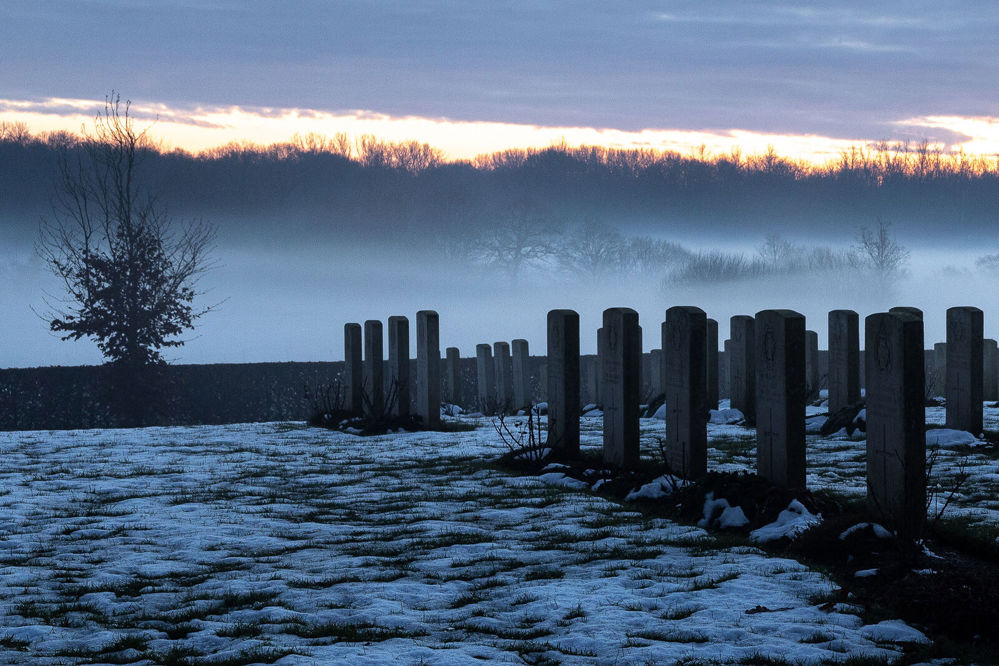
Image: Snow and frost blanket the ground at Prowse Point Cemetery
“Our commitment to excellent standards of care for cemeteries and memorials hasn't changed, but we are noticing and recording extreme heat and drought, and torrential rain, which will influence how we do things moving forward,” David Richardson, Commonwealth War Graves’ Director of Horticulture, said.
Because of the global nature of our work, our sites are affected by nearly all types of weather and climate conditions.
However, as global weather patterns change and evolve, it is likely the level of extreme weather events hitting our sites will increase.
At sites such as Railway Hollow on the Somme, France, or the sites occupying the former Battle of Passchendaele in Flanders, Belgium, our sites are becoming prone to flash flooding following very heavy rain.
Likewise, our sites in monsoon countries across South and East Asia are often prone to flooding. In 2021, flood defences were installed at Imphal Indian Army War Cemetery, for example, to further protect the site against deluges and flooding.
Other climes require different approaches. When it comes to planting, we select species suitable for the local conditions. This "right plant, right place" approach is driven by data supplied by organisations such as Botanic Gardens Conservation International and TreePlotter software to ensure healthy, thriving plantlife.
Elsewhere, we are seeing heavy winds continue to affect our sites. Heavy winds occur wherever storms form, and with our global estate, our sites can be affected by blustery conditions through to hurricanes and cyclones, depending on where they lie.
This can lead to issues such as greater maintenance of mature trees or potential damage to headstones. Rest assured, our cemeteries and memorials are closely monitored for such issues and damage.
Essentially, if you can name a set of weather conditions, a Commonwealth War Graves site has experienced it.
How Do Extreme Weather Events Damage Cemeteries Over Time?
Extreme weather and the effects of climate change all have an impact on Commonwealth War Graves war cemeteries and memorials.
Freeze-thaw cycles & stone erosion
Freeze-thaw cycles occur when water enters porous materials, such as the stone used for our headstones and memorials, and repeatedly freezes and thaws as temperatures change.
Water that gets into the stone expands as it freezes, creating further cracks. After the ice melts, water can penetrate deeper into the stone, creating larger gaps and damage.
Freeze-thaw cycles also create room for microorganisms and bacteria to get into the stone, which can result in further colonisation of the stone by lichen and other organisms.
We have clear standards regarding headstone cleanliness and legibility. The headstones are carefully designed in such a way as to clearly state who they commemorate, and any issues that affect legibility are of a deep concern to us.
Managing cleanliness is an important consideration for the Commission as our founding principle was that inscriptions must remain legible.
Trapping water below ground & structural instability
In some instances, our memorials or buildings, such as entrances or shelter buildings, have been subject to subsidence and other damage caused by ground movement.
During the extensive renovations to the Thiepval Memorial to the Missing of the Somme, its complex network of internal rainwater pipes was upgraded to protect against water damage.
We’re also seeing the effects of this at places such as the Bayeux War Memorial in Normandy, France. Ground movement has affected the foundations causing structural cracking. A renovation plan is in place to fix the issue.
The pattern of rainfall is changing, and we are observing more intense and dramatic rainfall which easily saturates the ground and has the potential to lead to damage to our cemeteries and memorials.
Acid rain & surface decay on memorials
Acid rain has been reduced in many parts of the world, but pollution in areas where coal or sulphur-rich fuels are still used presents a problem to our historic stonework.
Pollution can cause staining, for example, or cause inscriptions and carvings to erode over time, affecting legibility.
We are careful not to use acid-based cleaning solutions as these can mimic the effects of acid rain and open our headstones up to further damage.
What Is CWGC Doing to Respond to the Climate Emergency?
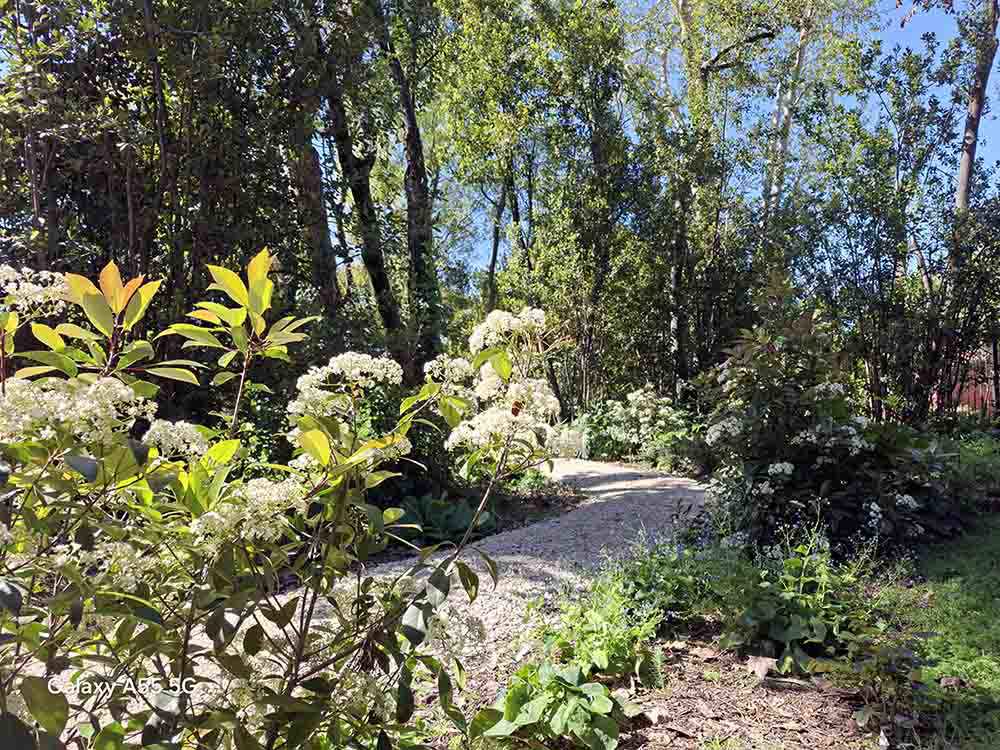
Image: Rome War Cemetery, where horticulture and sustainability meet
As the climate emergency deepens, we have had to take a proactive approach to maintaining our sites, interweaving sustainability into our operations and philosophy.
This includes a variety of measures, from changing working practices to upskilling staff, smarter horticulture and planting, and reviewing and upgrading our irrigation systems.
“We are very mindful of the impact of our work on the environment and for several years have been minimising the use of chemical products, which are now largely eliminated from our horticultural and structural operations,” David Richardson said.
“We are also monitoring how and where we use water for irrigation, particularly in the Mediterranean and North Africa, where our cemeteries have largely been created using irrigation.
“When we are looking at tree planting, we are referencing global data. This gives indications of which species are going to be at risk due to changing weather patterns and choosing plants which will survive and thrive.”
Specialist care – from horticulture to stone conservation
Our teams across the world are experts in horticulture and stone masonry to help us protect and care for our cemeteries long term.
Our horticulture teams are particularly expert in creating stunning landscapes that inspire and delight, but with a view to long-term care.
However, our work goes beyond simple planting and caring for the plants in our sites. When it comes to renovations and all our work, sustainability is interwoven throughout.
For instance, two of our major memorials, the Menin Gate in Ypres, Belgium and the Thiepval Memorial to the Missing of the Somme, France, recently underwent major renovations.
Where possible, the masonry and brickwork were conserved using the original materials, or small alterations were made using sustainably sourced materials to reduce our environmental impact.
This philosophy has likewise been applied to the new Brookwood 1914-1918 Memorial. Low-impact construction methods and a long-term ecological management plan ensure that this space will be preserved for generations to come. The stone from the previous memorial has been recycled for use in this project, for instance.
Creating climate-resilient, biodiverse landscapes
Through the intelligent use of our horticultural skills and planning, we can have a positive impact on our sites' climate resilience.
The 39,000 Trees Project is part of this ongoing effort. By selecting the “right plant for the right time and place”, we can introduce more climate-resilient plants where necessary, improving biodiversity while reducing water usage.
Take Rome War Cemetery, for example. The cemetery recently underwent a thorough horticultural renovation, designed to improve visitor experience with a revised planting scheme. The result is a site rich in biodiversity which retains a look and feel of a “secret garden”, interweaving sustainability with our original horticulture aesthetic.
We have been introducing areas of meadowing and longer grasslands around our sites in Europe, too. We are embracing lawns with a lot more broad-leaf species like daisies, clovers, and veronicas, as such plants encourage greater biodiversity.
We’ve noted an encouraging increase in the number of butterflies and other pollinators coming to our sites, something we are very keen to foster.
The presence of a variety of bugs and insects is important for our sites to remain blooming, beautiful and inspirational. We’ve installed bug hotels at some sites across the UK and northern Europe to encourage such visitors to foster a healthy and biodiverse environment.
Balancing remembrance sustainability & future needs
“Adopting an environmentally responsible approach to our work is a vital part of our core mission,” Lise Andreassen, CWGC Head of Environmental Sustainability, said. “Today, our climate is becoming more unpredictable, and biodiversity is in widespread decline, and it is important for us to play our part.”
We are charged with the care of the final resting places and points of commemoration of 1.7 million men and women of the Commonwealth in perpetuity.
That means we have a duty to all those in our care to maintain and look after the war cemeteries and memorials that commemorate them forever.
As Lise points out, we have a responsibility to deliver on the positive potential of our estate, in terms of making use of our sites to promote greater biodiversity and sequester more carbon dioxide.
By taking proactive steps and integrating sustainable working practices into our horticulture and maintenance strategies, we are creating sites that, while still beautiful, are better protected against climate impacts.

Want more stories like this delivered directly to your inbox? Sign up for our newsletter for regular updates on the work of Commonwealth War Graves, blogs, event news, and more.
Sign UpWhat Visitors May Notice as the Climate Changes
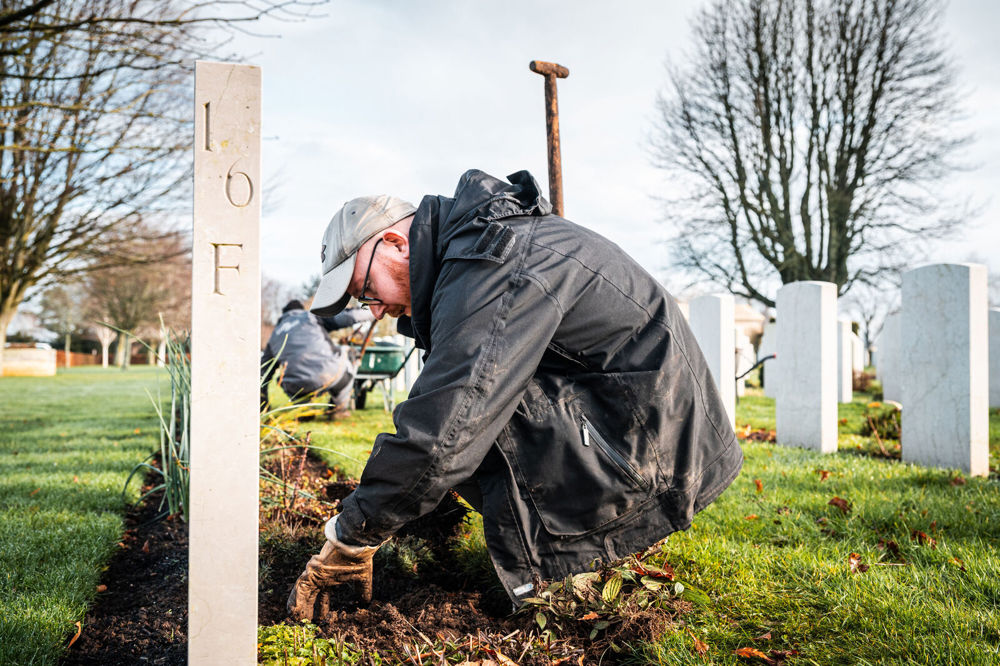
Image: Bayeux War Cemetery enjoy attention from CWGC gardeners
Changes in Landscapes, planting and seasonal appearance
Even now, when visiting one of our cemeteries or memorials, you may notice some changes in the landscape.
Grass may be left longer, more daisies and similar plants may spring up on our lawns, trees may be removed and replaced, and so on.
However, you may have also noticed dark staining at sites in France and Belgium. A specific biofilm has affected some of our headstones, and we are working hard with the scientific community to rectify this situation.
Conservation work you may see on site
Whatever the weather, you will often find CWGC gardeners stonemasons, and our other experts at work in our cemeteries.
In winter in Europe, we will be checking for storm damage, the effects of freeze-thaw cycles on our headstones and preparing the ground for further planting.
Likewise, the masonry and memorial panels on our memorials will be inspected with any repairs or amendments noted for future work.
Why Protecting Cemeteries Matters for the Future of Remembrance
Cemeteries as places of life, learning and reflection
Our cemeteries and memorials are not static places of commemoration. They are real, working sites, where change is constant.
Their ongoing care and maintenance is a top priority. Our mission is to look after all of our sites in perpetuity so everyone may learn the human cost of war and those we commemorate are never forgotten.
The final resting places of over 1.7 million men and women of the commonwealth tell a shared global story of remembrance.
Caring for them sustainably through intelligent horticulture and maintenance will protect them against the adverse effects of weather and climate in tribute to those who lost their lives in the two World Wars.
Author acknowledgements
Alec Malloy is a CWGC Digital Content Executive. He has worked at the Commonwealth War Graves Commission since February 2022. During that time, he has written extensively about the World Wars, including major battles, casualty stories, and the Commission's work commemorating 1.7 million war dead worldwide.
This article was written with the help of David Richardson and Claudia Scimonelli. David Richardson is CWGC's Director of Horticulture. He has worked for CWGC for over 30 years in all of our global areas, leading the care and development of our global estate.