

22 December 2025
“It’ll All over by Christmas”? Christmas on the World War frontlines
Wherever possible, World War Commonwealth soldiers who observed the holiday made the most of Christmas on the frontlines.
Christmas and the World Wars
Christmas and the First World War
A fleeting peace: The Christmas Truce 1914
"I know this sounds like a fairy tale, but I assure you it is perfectly true...”
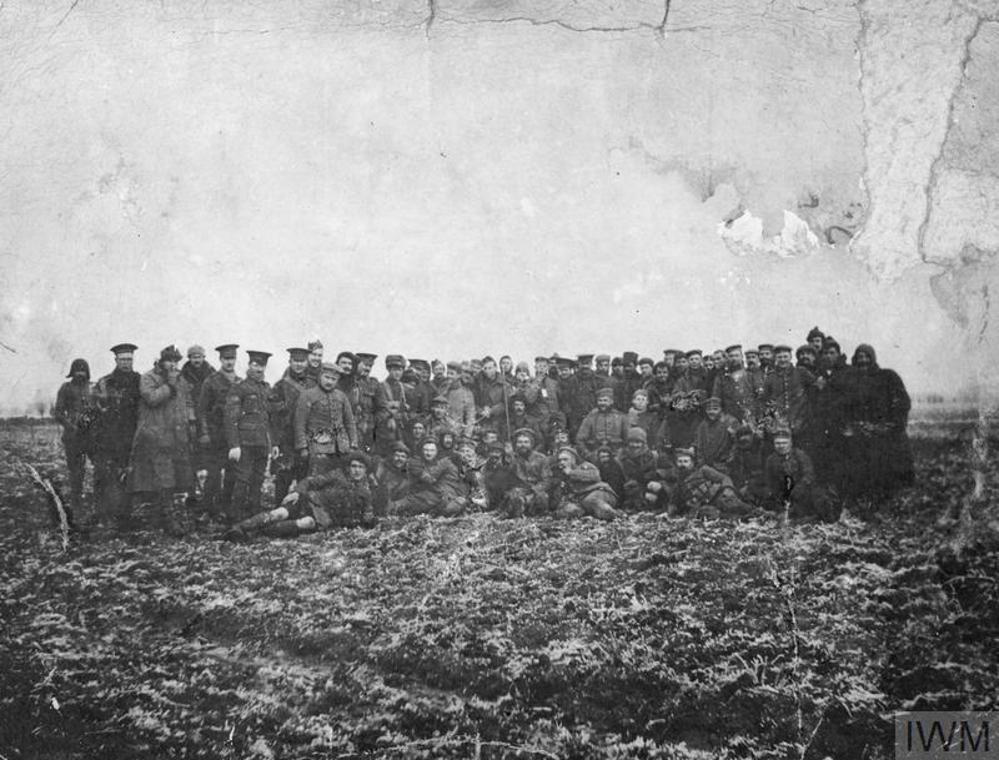
Image: Members of the 2nd Battalion, Gordon Highlanders fraternising with German soldiers on the Rue de Quesnes sector of the front during the Christmas Truce, 1914 (IWM (Q 64568))
The simple words of Acting Corporal F. Edwards of the 3rd Rifle Brigade encapsulate one of the most extraordinary events of the First World War: The Christmas Truce of December 1914.
Despite the ferocity and violence of the early months of the First World War, in which hundreds of thousands of servicemen perished around the world, spontaneous moments of festive peace broke out on the Western Front.
Reports vary, but on some sections of the line, gunfire and shelling halted on Christmas Eve. An uneasy truce, and in some places an eerie silence, fell over the line. Soon, the quiet was punctuated by German, French and British voices as carols and songs drifted over No Man’s Land.
British Private Marmaduke Walkinton described the scene to the Imperial War Museum:
“We were in the front line; we were about 300 yards from the Germans. And we had, I think, on Christmas Eve, we’d been singing carols and this that and the other, and the Germans had been doing the same. And we’d been shouting to each other, sometimes rude remarks, more often just joking remarks.
“Anyway, eventually a German said, ‘Tomorrow you no shoot, we no shoot.’ And the morning came, and we didn’t shoot, and they didn’t shoot. So, then we began to pop our heads over the side and jump down quickly in case they shot, but they didn’t shoot. And then we saw a German standing up, waving his arms, and we didn’t shoot and so on, and so it gradually grew.”
As the sun rose over the snow-dappled fields of the Western Front on a strange Christmas Morning, opposing soldiers gradually began to emerge from their trenches.
British and German soldiers mingled in No Man’s Land, exchanging gifts of food, cigarettes, and drinks, sharing stories of families and sweethearts at home, and generally coming together as people, rather than soldiers.
For a small while, on small sections of the line, peace reigned. However, this was by no means universal. At Festubert, for example, the Coldstream Guards were in action, losing several men killed in the build-up to Christmas and on the day itself.
One Guardsman wrote a letter home saying, “Perhaps you read of the conversation on Christmas Day. It is all lies. The sniping went on just the same; in fact, our Captain was wounded, so don’t believe what you see in the papers.”
Likewise, even on Christmas Eve, some British units refused to fraternise. Clifford Lane of the 1st Hertfordshire Regiment reported that his battalion replied to German overtures for peace with a volley of rapid gunfire. The Germans, according to Lane, didn’t retaliate and simply went back to their festivities.
The truce, as we know, did not last long. British High Command was furious. Officers were dispatched to order their men back into the trenches, and soon the tell-tale rumble of artillery fire and crack of machine-guns rang out over the Western Front.
No more truces of this size or significance took place during the First World War. Since then, the Christmas Truce has taken on a near-mythical status, offering a rare glimpse of humanity amid a devastating conflict.
Presents and puddings: life for First World War soldiers at the Front At Christmas
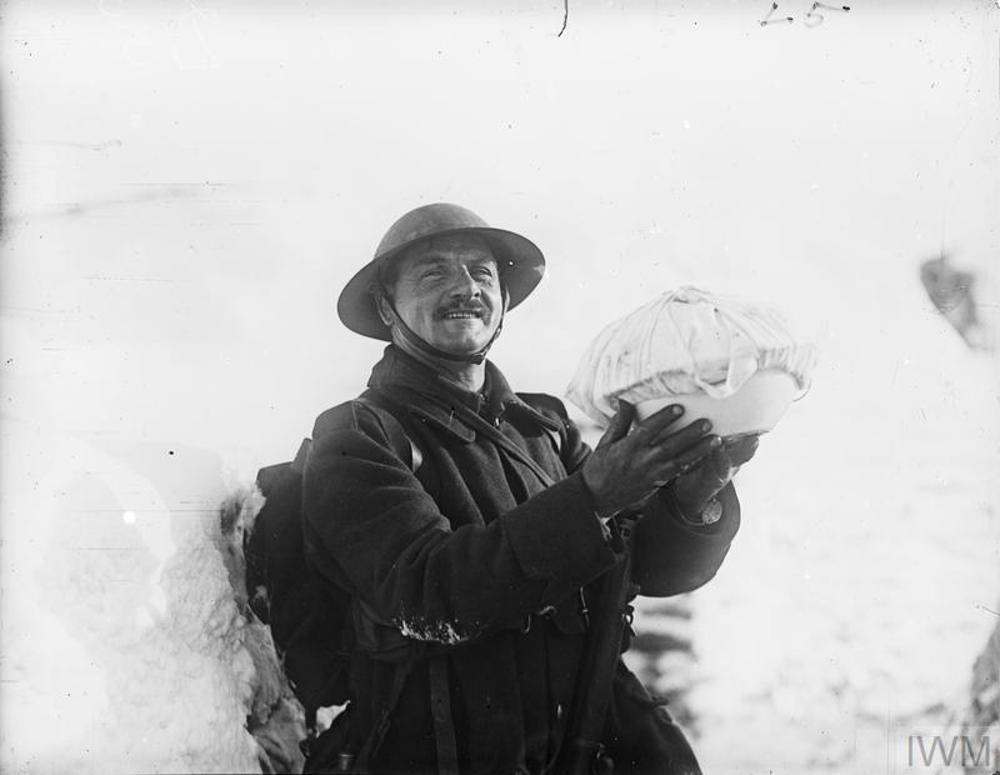
Image: A happy Tommy holds aloft his Christmas pudding on a snowy section of the Western Front (IWM (Q 8337))
Whatever conditions First World War soldiers found themselves in, they were determined to enjoy Christmas in whatever way they could. High Command was well aware of their men's morale and knew that a comfortable Christmas could keep spirits high.
And what is Christmas without Christmas Dinner? For men at the front, that usually meant their regular rations: Bully beef, Maconocie’s beef and vegetable stew, and notoriously hard biscuits. If lucky, a turkey or a chicken could be scrounged and cooked up in an improvised manner. On some fronts, such as Italy, mess officers and staff rounded up turkeys and geese to prepare for their men.
For British officer William Richards, his Christmas meal in 1916 wasn’t particularly glamorous:
“Christmas 1916 was an awful winter. My Christmas dinner was a tin of bully beef which I’d dug out of the snow, because it had been discarded by the previous occupants of the gun pit. The cook, together with other people – the commissariat – the ration lorry couldn’t come because the roads were in such a state on account of ice and snow.”
But one essential was Christmas pudding. According to NCO Frederick Higgin, every effort was made to supply soldiers with the festive dessert:
“I had four Christmases there and the only thing I can remember about the Christmases was that we had Christmas pudding every Christmas. We had a ration of Christmas pudding, but what else we had I really don’t know! But Christmas pudding always remained in my mind. It didn’t matter where you was, there was a ration of Christmas pudding for you every Christmas.”
To help out their boys at the front, citizens around the Commonwealth sent treats and creature comforts. In December 1915, over 700 tonnes of Christmas puddings were sent to the Western Front by the readers of the Daily News.
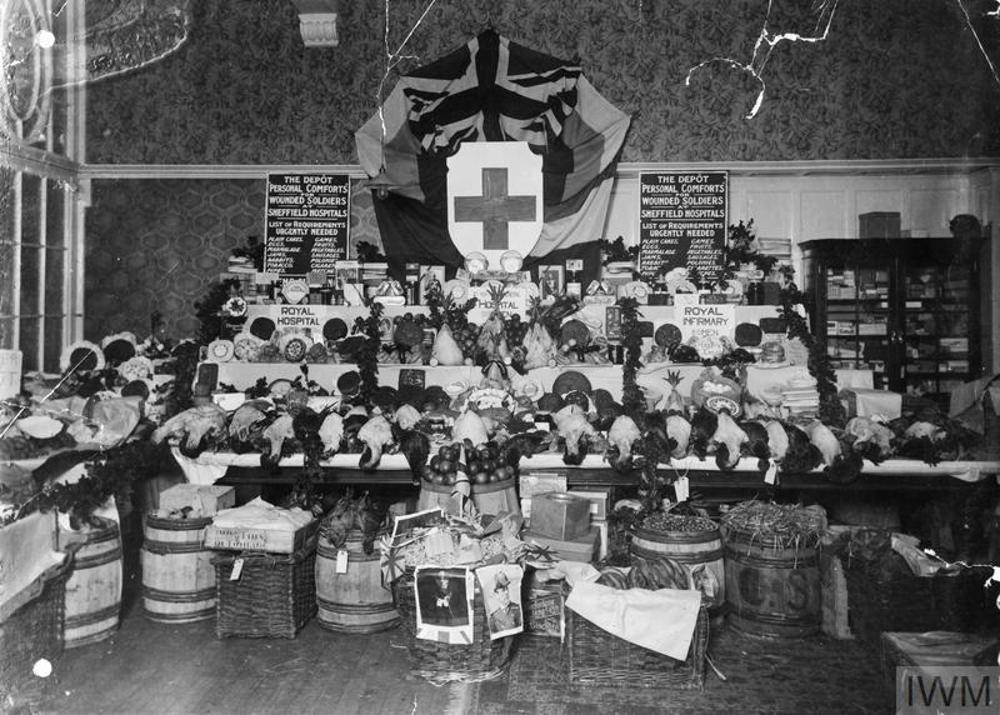
Image: People at the home front donated huge quantities of gifts for their men at the front or in medical facilities; this collection was raised by Leicester Mail's Santa Claus Fund, 1914, destined for wounded soldiers in Sheffield hospitals (IWM (Q 108312))
Home-baked goods, chocolates, and more sweets were very popular among soldiers at the front, but other gifts, like cigarettes, rum, whisky and brandy, were very welcome.
The Royal Family was intimately involved in treating frontline soldiers. Princess Mary developed gift tins. These were metal cases engraved with an outline of the princess and filled with chocolates, sweets, cigarettes and tobacco.
A very welcome treat, over 2.6 million Princess Mary Tins were distributed to troops by the war’s end.
Where possible, entertainment was laid on for the troops. Concert parties were held, and in some cases, officers served their men, as was traditional in the British Army.
Wherever they found themselves around the world, in whatever conditions, First World War soldiers of the Commonwealth could still enjoy some Christmas cheer, as Arthur Wagstaff of the London Regiment noted while in the bleak Gallipoli winter:
“Some of our boys who were off duty were in a shelter at the back of the trench; they were singing carols. That was on Christmas Day. I was on the firing step, looking over the no man’s land. And two officers came along, and they heard these carols, and one said to the other, ‘Could you believe it: conditions such as these, and the boys were singing carols…’”
Christmas in the Second World War
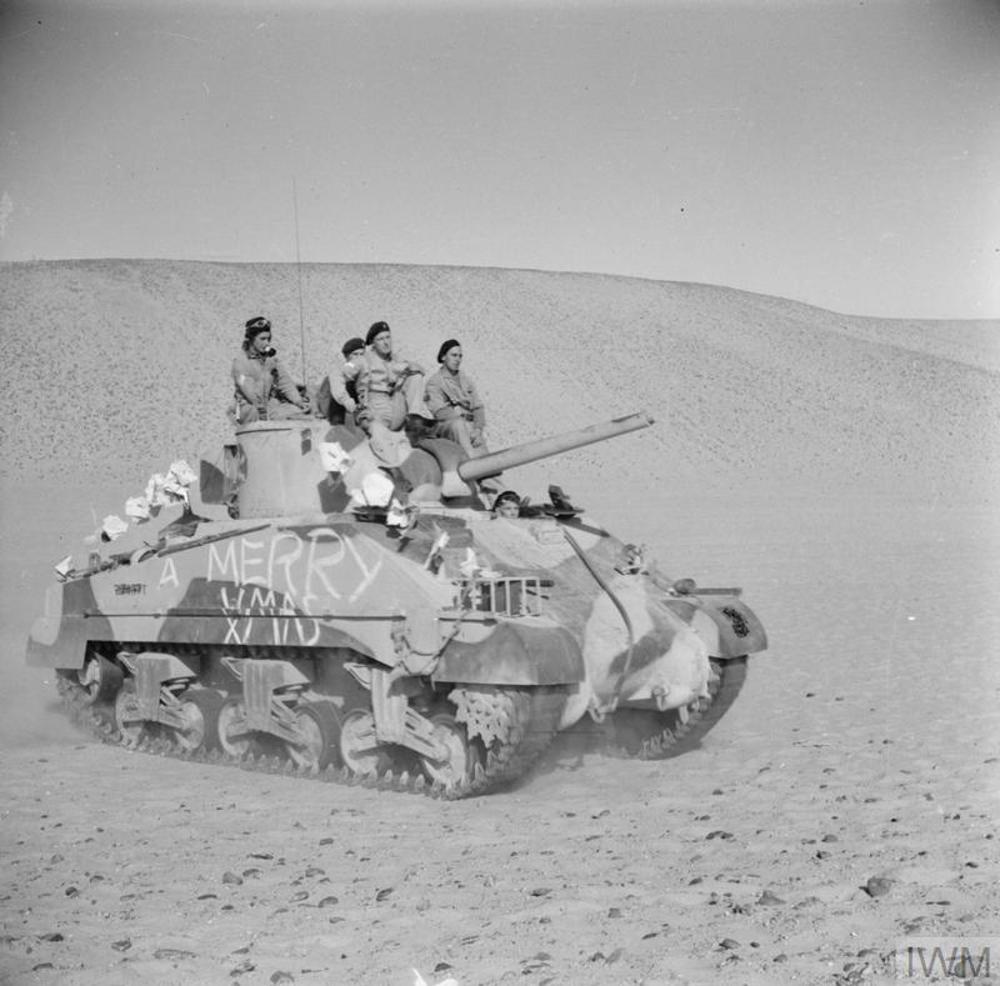
Image: A Sherman tank with a Christmas greeting painted on its hull, Benghazi, 26 December 1942 (IWM (Q 108312))
In a similar fashion to their First World War counterparts, those British and Commonwealth soldiers who celebrated Christmas did so in whichever ways they could during the Second World War.
Presents, Christmas cards and treats were sent to the frontline by their loved ones, while soldiers enjoyed special Christmas rations, including the ever-popular Christmas pudding, and troops came together to sing carols and songs.
Plays, pantomimes, and Christmas get-togethers were held in barracks, aboard ships and submarines, officers' messes, canteens, and other military sites all over the world. Even out at the front, if conditions allowed, rations would get through.
Otherwise, soldiers may have to try and see out the day at the front as best they could. But Christmas was a busy time for British and Commonwealth servicemen were engaged in important operations around the holiday season in practically every year of the war.
For instance, in North Africa in December 1942, British and Indian troops were engaged in combat for important high ground in Tunisia at the Battle of Longstop Hill. On Christmas Day itself, the 23rd Coldstream Guards were pushed from the hilltop by the 10th Panzer Division.
Likewise, the following year, Canadian troops were involved in the bloody battle for Ortona, losing over 800 men, including many on Christmas Day, in the attempt. The Battle of the Bulge raged through the Ardennes in 1944, while in Burma, African and Indian troops were heavily engaged against the Japanese.
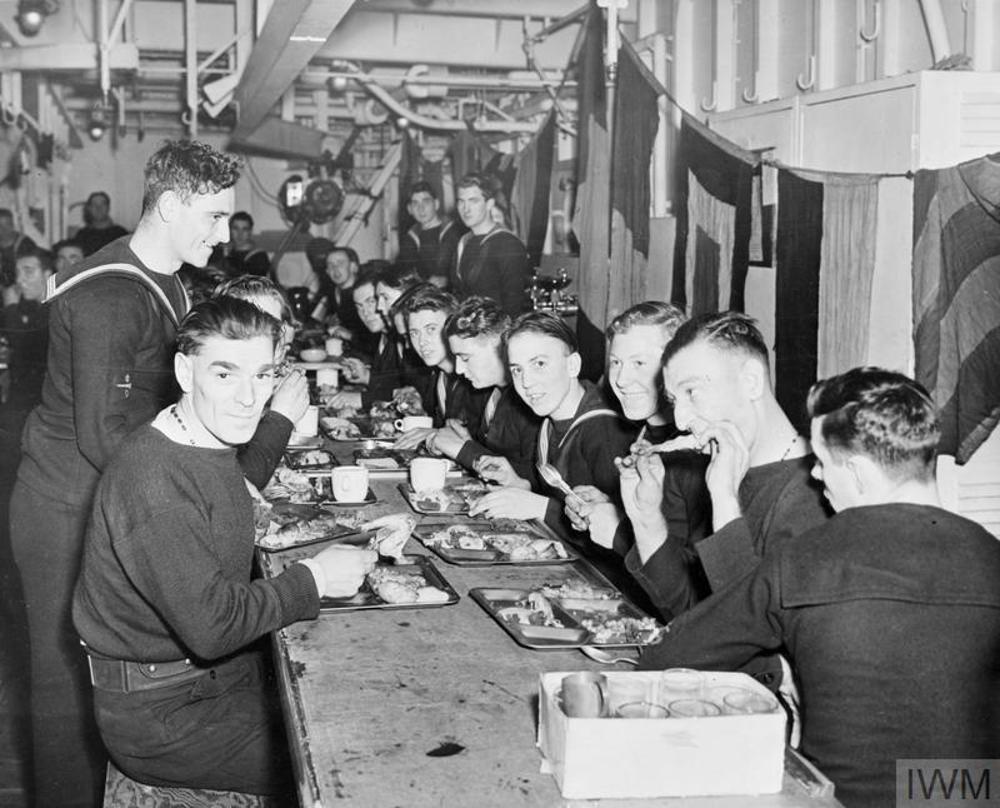
Image: British sailors aboard escort carrier HMS Trumpeter tuck into a special Christmas "Big-eat" (IWM (A 21225))
At sea, naval patrols continued above and below the waves, while merchantmen ferried vital cargo around the world. While crews would take the time to mark Christmas in their own ways, patrolling and sailing the high seas was still perilous, regardless of whether it was Christmas or not.
While there was no major truce like the miraculous one seen on the Western Front in 1914, some sectors did cool down for Christmas.
Canadian soldiers in the Netherlands, after having fought the tough Battle of the Scheldt, dug into positions across a wide front. Enduring bitter weather and heavy counterattacks, they settled in for the Christmas period in foxholes, dugouts and fortifications.
The war diary of the Calgary Highlanders reports that they heard Germans singing carols, playing accordions and horns, getting into the Christmas Spirit. According to their war diary, the Canadians responded with rifle, Sten gun, and mortar fire, not embracing the peace in the same manner as their opponents.
Matching their forebears from the Great War, Commonwealth soldiers celebrated Christmas in numerous ways, in a variety of countries, across the globe. While neither war was over by Christmas, they still tried to find more humanity amidst the carnage and chaos of the World Wars.
This Christmas Share Your Story on For Evermore
Christmas is traditionally a time when we get together and tell stories - and fewer stories are more interesting than those of the 1.7 million men and women in our care.
For Evermore: Stories of the Fallen is our online resource for sharing the memories of the Commonwealth’s war dead.
It’s open to the public to share their family histories and the tales of the service people commemorated by Commonwealth War Graves so that we may preserve their legacies beyond just a name on a headstone or a memorial
If you have a story to tell of a casualty we care, sjare it this Christmastime. Head to For Evermore to upload and share it for all the world to see.
Author acknowledgements
Alec Malloy is a CWGC Digital Content Executive. He has worked at the Commonwealth War Graves Commission since February 2022. During that time, he has written extensively about the World Wars, including major battles, casualty stories, and the Commission's work commemorating 1.7 million war dead worldwide.