

30 March 2026
Neuve-Chapelle: Indian architecture influences and why the memorial looks different
The Neuve-Chapelle Memorial is a war memorial dedicated to Indian servicemen who died on the Western Front. Over 4,700 names of Indian officers and enlisted men, sadly with no known war grave, adorn its magnificent name panels.
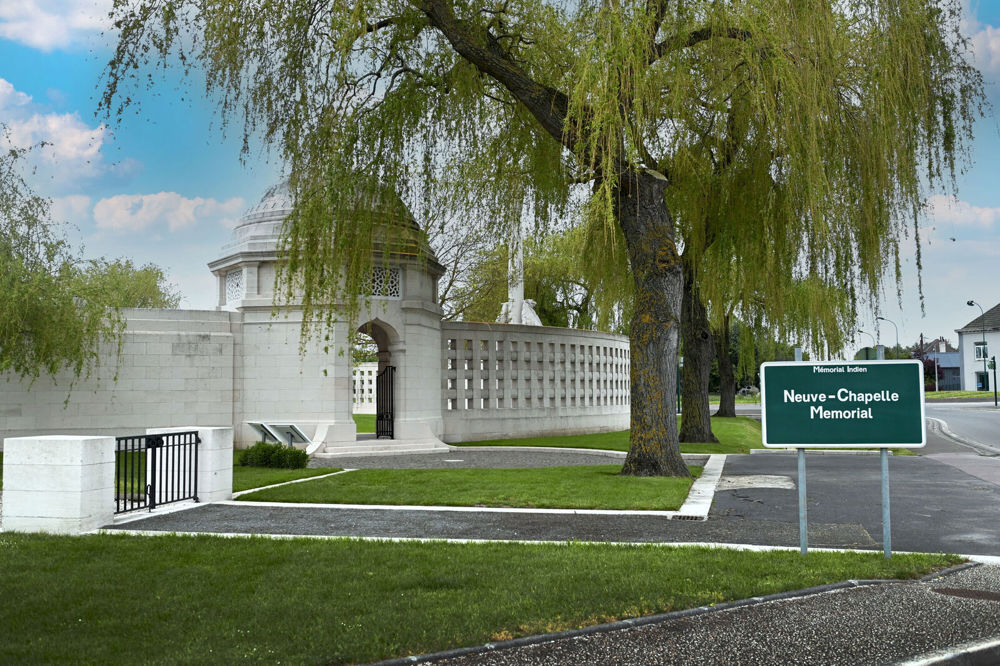
Image: The entrance to the Neuve-Chapelle Memorial
For the Indian Army, Neuve-Chapelle is a place rich in meaning and significance. It was here, in March 1915, that the Indian Corps went into action on the Western Front as a single unit for the first time.
Despite taking heavy casualties, it was able to capture an important part of the German frontline.
Over the course of the war, India sent over 140,000 men to the Western Front: 90,000 serving in the infantry and cavalry and as many as 50,000 non-combatant labourers.
They hailed from the length and breadth of British India: from the Punjab, Garwahl, the Frontiers, Bengal, Nepal, Madras, and Burma, and represented an extremely diverse range of religious, linguistic, and ethnic cultures.
Sadly, over 8,000 never made it home, and nearly half that number’s final resting places are unknown. Their names are listed in our war records; these souls are commemorated in our cemeteries and memorials in perpetuity.
Since it was unveiled in October 1927, the Neuve-Chapelle Memorial has become symbolic of Indian effort and loss in the Great War. But you may notice several architectural flourishes and designs that separate it from other CWGC battlefield memorials.
At a glance: What's on this page
This blog on the Neuve-Chapelle Indian Memorial covers:
- Why the Neuve-Chapelle Memorial looks different from many other CWGC memorials
- What Indian architectural influences visitors can notice on site
- How design choices help communicate commemoration and cultural recognition
- What visible features to look for when visiting
- Why this site matters within CWGC’s global commemorative landscape
- Where to go next to explore related memorials, records or stories
Why the Neuve-Chapelle Memorial looks different
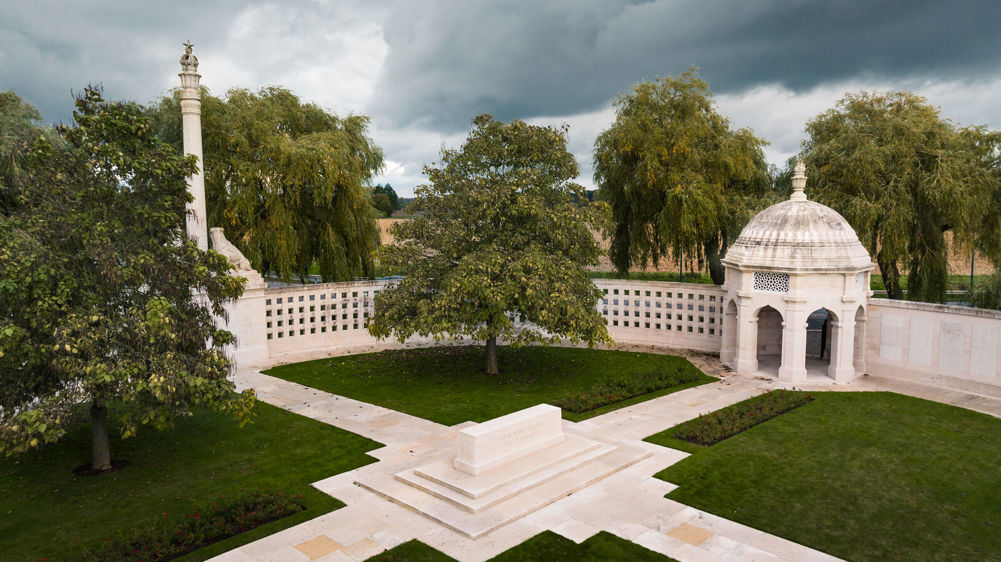
Image: The Neuve-Chapelle's Indian-inspired architecture separates it aesthetically from our other Western Front sites, but still looks and feels like a CWGC war memorial
The Neuve-Chapelle Memorial was designed by Sir Herbert Baker, one of the Commonwealth War Graves Commission’s Principal Architects, with sculpture by Charles Wheeler.
Baker, alongside Sir Edwin Lutyens and Sir Reginald Blomfield, pioneered the look and feel of our cemeteries and memorials in the Commission’s earliest days. Still, Neuve-Chapelle stands out from the rest with its own design language.
A distinctive first impression
As you approach the Neuve-Chapelle Memorial from the Route d’Estaires, you will immediately notice this is a memorial unlike any other CWGC memorial to the missing on the Western Front.
The circular wall, designed to recall the enclosing railings seen at early Indian shrines, and the tall central column give clues as to the servicemen commemorated here and their country of origin.
No single memorial design for every site
Neuve-Chapelle is unique, but then so are all CWGC war memorials or the national memorials we care for on behalf of their respective governments.
Each memorial’s architecture was carefully thought through by its respective designer, taking into consideration its location, its purpose, and the nationalities of those commemorated upon its name panels.
In this case, Neuve-Chapelle draws heavily on the architectural styles of the servicemen it commemorates’ homeland, resulting in the ideal memorial to the missing of the Indian Army.
Indian architecture influences at Neuve-Chapelle


Before his work with the Commission, Baker spent a lot of his career working on projects in British India. Some of his most notable works include the New Delhi Government buildings, the twin Secretariat buildings in British India’s colonial capital and Parliament House.
Baker’s work in Delhi and India as a whole blended classical Western architectural features with traditional Indian forms and aesthetics, no doubt inspired by the jihals and chhatris of the stunning pre-Colonial forts, civic buildings, step wells, and temples across India.
These influences are clearly visible on the Neuve-Chapelle Memorial. Here, Baker fused our established design principles with Indian architectural concepts to create a fitting memorial commemorating India’s missing war dead.
Forms and motifs
As we touched on earlier, much of the circular curtain wall encircling the memorial takes the form of stone railings, typically seen at some early Indian shrines and holy places, particularly the Buddha’s Shrine at Budh Guaya and those surrounding the great Sanchi topes, preserving sacred relics of the Buddha.
Standing proud in the Neuve-Chapelle Memorial wall is a towering stone column, rising high into the sky. Standing 15ft high, the column was inspired by the inscribed columns erected by the Emperor Ashoka throughout India in the 3rd Century BC.
The column is surmounted with a Lotus capital, the Imperial British Crown and the Star of India. Two tigers are carved on either side of the column guarding the temple of the dead.
On the lower part of the column, the words “God is One, He is the Victory” are inscribed in English, with similar texts in Arabic, Hindi, and Gurmukhi.
Entrances take the form of chhatri, traditional round-topped pavilions built into significant Indian holy complexes and monumental architecture, pierced with stone jihals or grills.
Even the horticulture is thematically linked to the Indian homeland. Wild irises and waterlilies decorate the site, offset with overhanging trees providing cooling shade, nestled alongside wide lawns.
Materials and layout
The memorial’s central volume is circular in nature, likely inspired by Yogini temples seen across India. These holy sites are typically large, round, open structures, featuring a central shrine. The central worship features have been replaced here with the CWGC Stone of Remembrance.
Constructed of hardy white stone, the Neuve-Chappelle Memorial is connected to the wider CWGC aesthetic via these materials, especially on the Western Front, where Portland stone is one of our most commonly used stones in our memorial architecture.

Want more stories like this delivered directly to your inbox? Sign up for our newsletter for regular updates on the work of Commonwealth War Graves, blogs, event news, and more.
Sign UpWhat the design tells visitors about commemoration
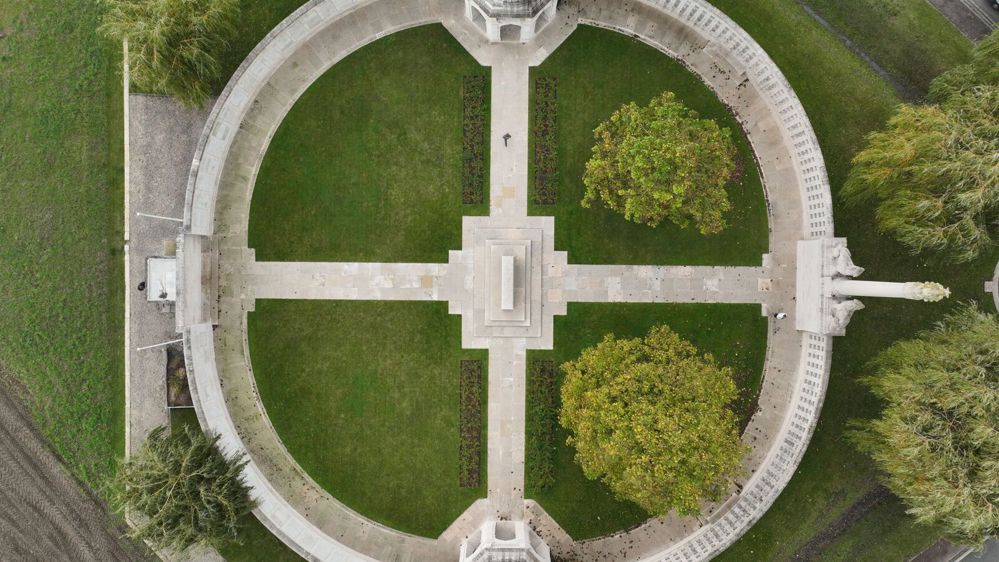
Image: A Bird's Eye view of the Neuve-Chapelle Indian Memorial
Baker’s design expresses an appreciation for the officers and men commemorated at Neuve-Chapelle.
Cultural Dignity
Here, several thousand miles from home, stands a piece of clearly Indian-inspired architecture, representing those who travelled miles from home, under the auspices of the British Empire, and lost their lives. Now, a small piece of their homeland stands at the site of one of the Indian Army’s most significant actions on the Western Front.
Cultural recognition in built form
The architecture also immediately informs visitors that this is a place dedicated not to European or Australian, Canadian, New Zealand, or South African soldiers. This is clearly a place dedicated to the commemoration and memory of India’s war dead.
Neuve-Chapelle within CWGC’s wider architectural story
A global design language
CWGC sites are recognisable by some common design themes. On the Western Front, Thiepval aside, our memorials tend to be built using the same Portland stone as our headstones, creating a connected visual identity.
You’ll also find some of our common cemetery and memorial elements at Neuve-Chapelle. The Stone of Remembrance sits proudly in the forecourt, a secular monument to the loss of life this memorial, and all our memorials, represent and commemorate.
Neuve-Chapelle falls into the wider CWGC architectural and aesthetic context neatly. While our architects established and followed clear design principles, they were allowed to express themselves and establish clear commemorative meaning within their work.
Although on the face of it, Neuve-Chapelle looks different to the monumental red brick and limestone pavilions and piers of Thiepval, or the barrel-vaulted triumphal arch-inspired Ypres (Menin Gate) Memorial, the architectural throughline that links our sites is clearly visible.
What visitors should look for on site
If you are visiting the Neuve-Chapelle Memorial for the first time, here are some hints and tips on what to expect and how to respectfully treat the site.
Approaching the site
The village of Neuve Chapelle is roughly five kilometres north of La Bassee and 20 kilometres west-south-west of Lille. The Memorial is 800 metres south-west of the village on the east side of the road from La Bassee to Estaires.
As you approach, note the high, curving boundary wall, the Indian-styled pavilions at each entrance, the Ashoka column rising high over the French countryside, and the lovingly cared-for trees and plants adoring the memorial.
Reading the space
Upon the curtain memorial wall are inscribed the names of over 4,700 officers and enlisted men of the Indian Army with no known war graves.
Our memorial name panels clearly list casualties by name, with each carved into the rock to the correct depth to ensure they are legible and readable.
While the arrangement of names on each memorial differs from location to location, Army casualties, such as those commemorated here, are generally ordered by:
If the memorial is dedicated to missing Army casualties, such as Thiepval, names are arranged by:
- Regiment by the Army’s standard of regimental precedence
- Rank in each regiment, moving down in seniority
- Alphabetically by surname for each rank
Before you arrive, you can also visit the memorial’s own page on our website. Here, you will find directions and location information, the memorial plan, and the ability to download the list of those commemorated here to help you find them.
What this memorial means today
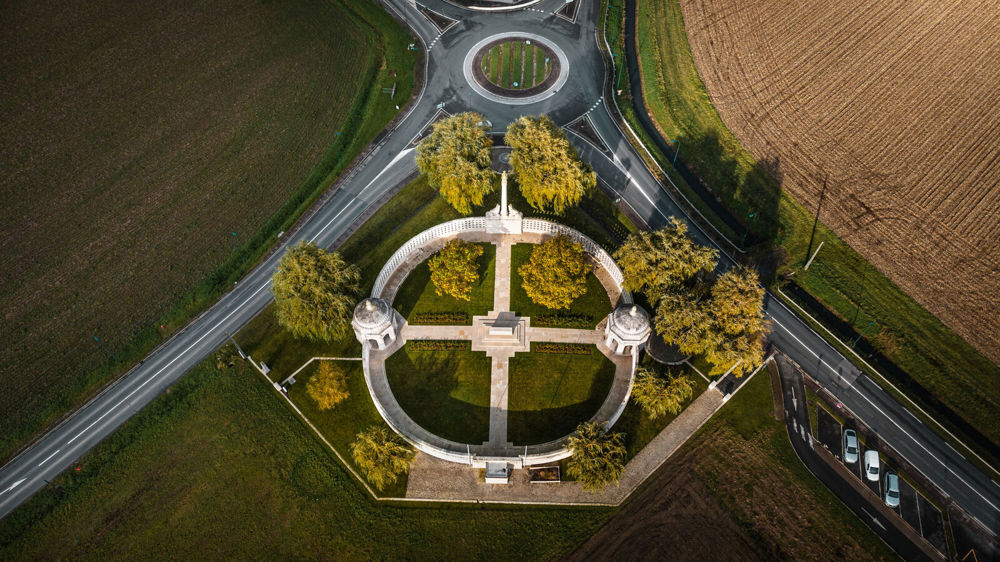
Image: The Neuve-Chapelle Memorial continues to be a place of memory and meaning not just for Indian casualties on the Western Front, but the Great War as a whole
Today, over a century after the Battle of Neuve-Chapelle and the Great War, and almost a hundred years after its unveiling, the Neuve-Chapelle Memorial stands, commemorating the Indian Army’s missing servicemen in perpetuity.
Why this design still matters
The design is important and still resonates as it demonstrates the major international effort that was the First World War. Millions of families across the Commonwealth and India were touched by the tragic loss of their sons, nephews, cousins, uncles, brothers, and fathers.
The Neuve-Chapelle Memorial reminds us of the enormous contribution made by the Indian Army, both frontline and support, in the First World War. India’s sons, so far from home, fought and fell alongside their comrades from Britain, Canada, Australia, New Zealand and South Africa on the World War One battlefields of the Western Front.
In 2015, marking a century since the battle this memorial marks, Indian Prime Minister Narendra Modi, left a message in the visitor’s book:
“I am honoured to pay homage to the Indian soldiers here at the Indian Memorial at Neuve Chapelle. Our soldiers who fought in foreign lands in the Great War, have won the admiration of the world for dedication, loyalty, courage and sacrifice. I salute them.”
From architecture to connection
The architecture of CWGC sites, such as Neuve-Chapelle, remains an important part of commemoration today. Many of our memorials have stood for over a century, and will stand for evermore, thanks to the incredible work of our maintenance and horticulture teams.
But commemoration today does not simply have to be visiting our site. It’s taking the time to reflect on the loss of so many from around the world, victims of the deadliest conflicts in human history; it’s remembering a relative or sharing their story; it’s caring for their final resting places and places of commemoration.
These built structures, cemeteries, and war memorials are all part of our shared history, linked by the World Wars and the people who fought them.
A global commemorative landscape
Today, the Commonwealth War Graves maintains war graves and memorials in more than 23,000 locations across over 150 countries and territories around the world.
We encourage you to visit these places of remembrance and reflection, including Neuve-Chapelle, to realise the huge global effort that was the World Wars, and the enormous cost in human life.
But you can also go beyond just names on war memorials or inscribed on headstones. For Evermore, our online stories archive, shares the stories of those in our care, helping you learn more about the Commonwealth servicemen we commemorate and the real people behind the names.
If you have a story of your own of someone commemorated by the Commonwealth War Graves Commission, please upload and share it on For Evermore today so it may be preserved and enjoyed by future generations.
Want to visit us? Use our Find Cemeteries and Memorials tool to find the nearest CWGC location to you.
Alternatively, use our apps to explore our sites from the comfort of your home.
Support our work and help honour the 1.7 million who never returned home
Author acknowledgements
Alec Malloy is a CWGC Digital Content Executive. He has worked at the Commonwealth War Graves Commission since February 2022. During that time, he has written extensively about the World Wars, including major battles, casualty stories, and the Commission's work commemorating 1.7 million war dead worldwide.