

24 November 2025
The final hour: The end of the First World War in East Africa
Few people realise that World War One in East Africa did not end on November 11, 1918. Discover how and why here.
On 11 November 1918, the guns fell silent on the Western Front – but did you know that in East Africa the fighting continued for a short while after the Armistice?
The history of East Africa during World War 1
The East African Campaign ww1
East Africa was the largest, busiest African theatre of the First World War. It is believed over a million men served, including many local labourers and servicemen. Such activity came at a terrible cost. Whilie frontline losses are estimated at between 3-10,000, the logistics and support troops suffered terribly.
As many as 88,000 African labourers died in the East African Campaign. All too often overlooked, we hope to shine a light on their experiences and losses here.
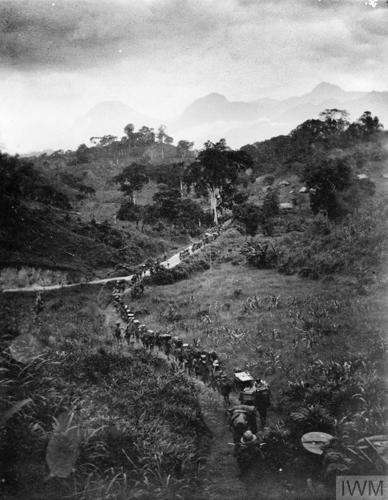
Eschewing the major set-piece battles of the Western and Eastern Fronts, the war in East Africa was one of movement, attempted sweeping envelopments, long marches into the African interior, and guerrilla ambush warfare.
Image: A column of transport troops on the march in German East Africa (present-day Tanzania) (© IWM Q 15412)
Compared with the confined trench warfare of the Western Front, the fighting in Africa could be ranged across vast areas, covering many different climates and terrains.
All told, the war in East Africa saw skirmishes and battles take place across much of modern-day Kenya, Mozambique, Malawi, Zambia, Rwanda, Burundi, and Tanzania.
Paul von Lettow-Vorbeck, the German commander of forces in German East Africa, launched his attacks in August 1914 on British positions around Mount Kilimanjaro and Lake Victoria.
A response force organised by Major-General Arthur Aitken landed in the port of Tanga on 3 November 1914.
The result was a defeat for the British and Indian forces arrayed to take Tanga, who suffered 850 casualties. German forces, by contrast, lost some 150 and were able to capture hundreds of weapons and thousands of rounds of ammunition.
For Lettow-Vorbeck, these resources would prove invaluable. Cut off from his main supply routes via British control of the sea, the German commander and his African troops fought a guerrilla war, targeting isolated forces, railways, roads, and other infrastructure using captured supplies and foodstuffs to sustain themselves.
Between 1914 and 1918, the British and their allies chased Lettow-Vorbeck’s small force through East Africa, struggling to pin the elusive German and his local forces down.
By 1916, the British Imperial forces under General Jan Smuts had captured Dar es Salaam, capital of German East Africa, and its important railway line, making troop and supply movement up the Indian Ocean seaboard easier, compelling Lettow-Vorbeck and his forces to retreat into the interior.
Carriers’ & labourers' vital role in military operations
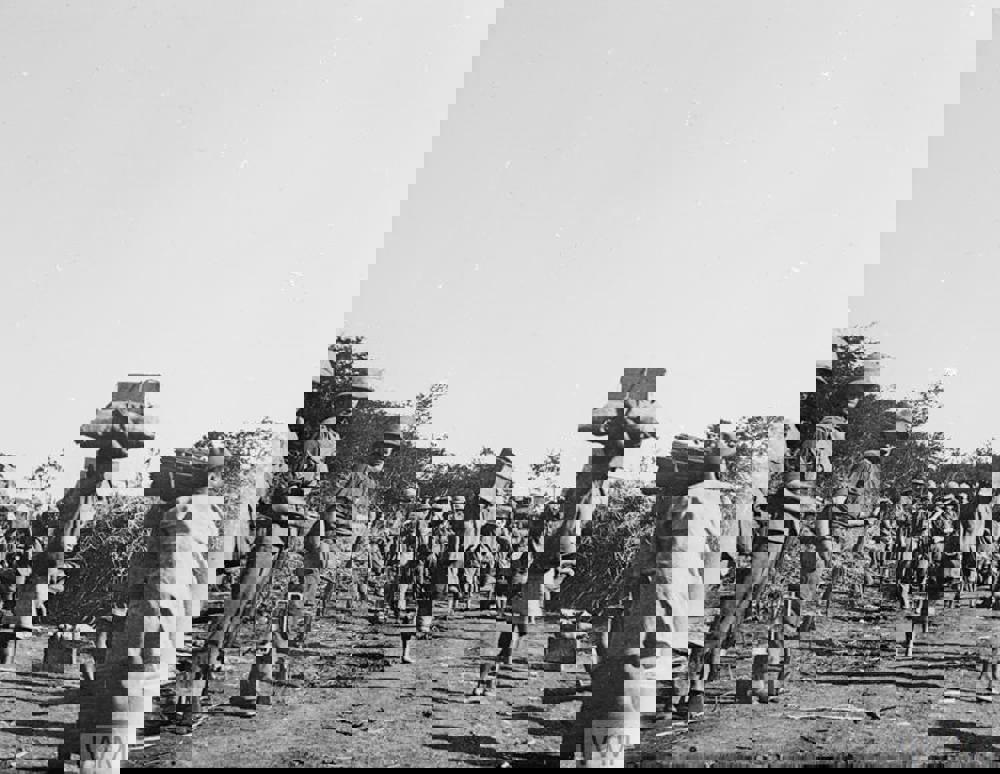
Image: Carriers and labourers were essential to military campaigning, especially in East Africa (© IWM Q 15528)
The campaigns of the militaries involved in the various African theatres on land were spread across huge areas, all with different geographical characteristics.
The sheer diversity of the landscape created numerous logistical challenges.
Mechanical transport of ammunition, food, water, and other essential supplies was limited, especially as the war in Africa during WW1 evolved into a guerrilla conflict. Forces would push deeper inland, where the already limited road and rail infrastructure became nonexistent.
This meant that much of what was needed by the combatant forces had to be carried on the backs of men.
It is believed some one million African men performed carrier and transportation duties in logistics units supporting the British Empire between 1914 and 1918 across Africa.
Carriers in East Africa
The most significant problem facing all combatants in East Africa was logistics and transport. With few all-weather roads and tropical diseases often making it impossible to keep pack animals alive, the only practical solution was the use of human porterage.
Given the vast distances covered, it has been estimated that around 6 carriers were required for every combat soldier Britain deployed in East Africa.
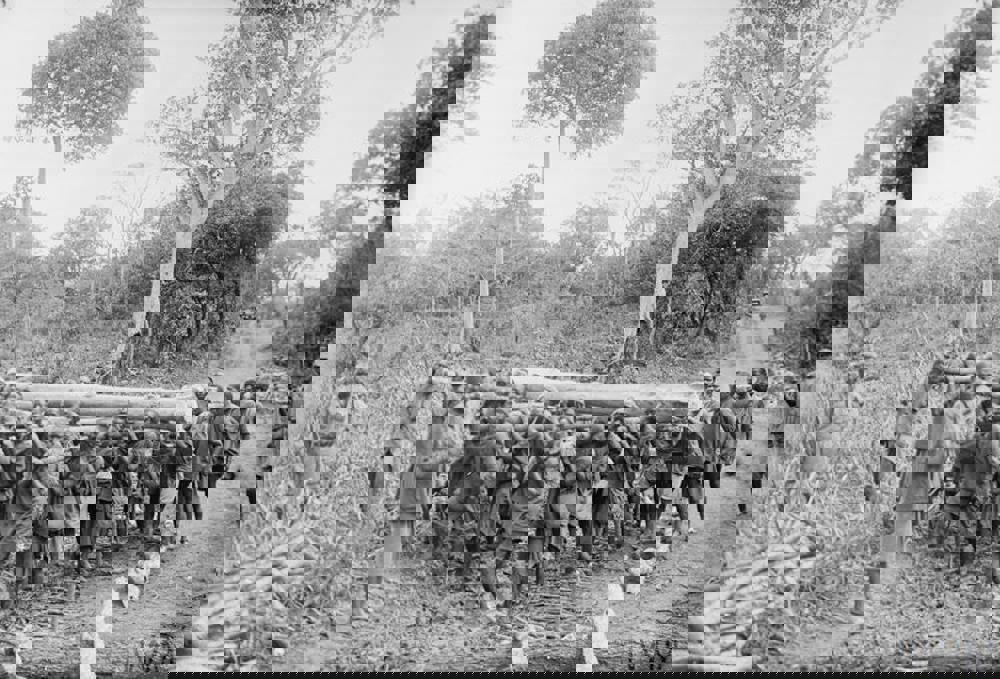
Image: Carriers and labourers also handled important tasks such as road clearing and maintenance (© IWM Q 15625)
These men were organised into units such as the Sierra Leone Carrier Corps, East African Military Labour Bureau, and the South Africa Native Labour Corps.
The work they did was arduous, difficult and could be extremely dangerous. Carriers were not soldiers, and so were unarmed.
However, despite not being expected to fight, they were still vulnerable to enemy gunfire during an ambush or if compelled to carry supplies up to the fighting line.
But sickness accounted for more deaths; dysentery, tuberculosis and especially malaria all took a hefty toll on the Carrier Corps, especially for those who were recruited in other parts of Africa and transported to unfamiliar climates.
Their contribution is all too often overlooked, but was vital to the war effort.
Surrender of German forces in East Africa
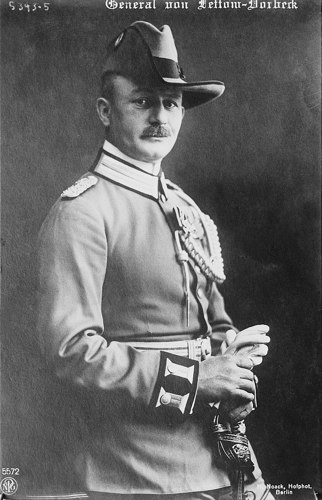
Image: General Paul von Lettow-Vorbeck, commander of the German forces in German East Africa (Wikimedia Commons)
Even though a knockout blow was never landed on the German forces in East Africa, by the end of 1916, they had been confined to southern German East Africa.
Early in 1917, the British high command and its French and Belgian allies made moves to push against Lettow-Vorbeck. Allied units stuck out from Kenya, Malawi, and parts of the Belgian Congo to track and trap Lettow-Vorbeck’s forces.
The Germans split their forces into three columns. Two managed to escape into Portuguese-held territory in Mozambique, but one group, numbering 5,000 men, was forced to surrender.
Lettow-Vorbeck continued to evade his pursuers. In April 1918, the Germans fought and won a battle against the Portuguese at Nhamacurra, allowing the raiders to replenish their stocks of weapons and ammunition.
Throughout the rest of 1918, the Germans would continue to harass and engage British columns and raid towns and villages.
The last battle was fought on 12 November 1918, notably after the Armistice was signed in France.
During an attack on a rubber factory in Kasama, Zambia, the German forces captured a British dispatch rider. The rider told his captors of the Armistice and the German surrender on the Western Front.
Even after receiving this message, Lettow-Vorbeck marched at the head of his men, some 1,500 remaining, at Abercorn (today Mbala), presenting his surrender to the British Forces.
The fighting in East Africa, and the wider First World War in Africa, was over.
Why did the fighting in East Africa continue after the Armistice was signed?
The conditions in East Africa were completely different to the Western Front and other First World War combat theatres.
Lines of communication were lengthened as units faced many of the same problems regarding the spread of information as they did regarding the distribution of supplies.
Then there was Paul von Lettow-Vorbeck himself. The Allies had spent several years chasing him around East Africa. Tracking him down to deliver the news that the German government had surrendered was difficult.
Telegrams from Europe to East Africa could take a couple of hours to several days to arrive. A message was sent to the British General Staff to East African commanders on November 10, asking for the quickest way the Germans could be reached.
Ultimately, Lettow-Vorbeck was apprised of the situation but only by semi-chance. Who knows how long he could have avoided surrender had he not attacked the rubber factory at Kasama?
Interestingly, Lettow-Vorbeck was never defeated in the field. He is said to have been shocked at the terms of unconditional surrender laid out in the Armistice.

Want more stories like this delivered directly to your inbox? Sign up for our newsletter for regular updates on the work of Commonwealth War Graves, blogs, event news, and more.
Sign UpStories from the East African Campaign
Regimental Sergeant Major George Williams DCM*
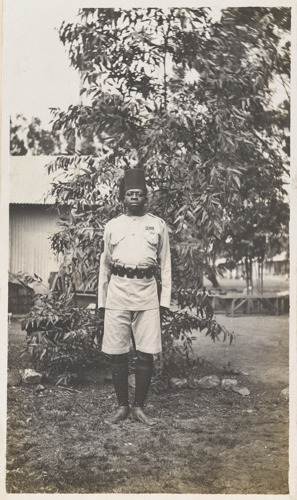 Image: Regimental Sergeant Major George Williams
Regimental Sergeant Major George Williams' military career matched incredible battlefield bravery with peacetime struggles.
Born in Mombasa, Kenya, in 1874, he enlisted in the King's African Rifles, aged 24, in 1898.
His record paints him as a mildly wayward but dedicated soldier. Throughout the years, he was written up on several charges, including a trial for desertion.
George was also frequently demoted for his indiscretions, which occurred mostly during peacetime soldiering. Despite this, he would rise in rank time and again, showing his competence as a soldier.
It was with the Ugandan Rifles that George first experienced action, serving in Uganda between July and October 1900, and again in 1905 and 1906. George's pre-First World War military service took him to Somaliland between 1908 and 1910, and East Africa, where he served in 1905 and 1913-14.
George was commended for gallantry on four occasions between 1913-1915; he was even nominated for consideration for a Victoria Cross, the highest award for gallantry in the British Army.
At Tsavo, in the south of Kenya, George was cited for gallantry on two occasions within the space of a month.
The first, on the night of 4/5 September 1914, resulted in George receiving the Distinguished Conduct Medal, and the second, on 1 October, saw George receive a promotion to Colour Sergeant.
As the citation for his DCM noted, George showed ‘great courage and enterprise… [as] This N.C.O. twice, at great personal risk, crept up to the German position and brought back information of the enemy’s disposition and strength’.
At Jasin, George went back under heavy fire to drag out the machine gun under his command, after the whole crew and porters had been killed.
After 1916, George’s service record becomes less detailed. His unit was actively involved in the advance into German East Africa (present-day Tanzania) in 1916 and then pursued German Commander Von Lettow’s forces into Portuguese East Africa (present-day Mozambique) until 1918.
George, by now, was in his mid-40s and one of the longest-serving soldiers in his regiment. Despite his experience and expertise, he would sadly not survive the war.
George was killed in action on 22 July 1918 at the Battle of Namirrue, in Portuguese East Africa. The battle, fought among hilly terrain dappled with ruined buildings, was devastating for George’s battalion, which was essentially wiped out as a fighting force.
George was one of five men and officers confirmed dead; 91 were reported missing, and a further 14 were wounded. Because of the damage sustained by the battalion, it was essentially retired from frontline service. There is some irony that George, among the battalion’s most experienced soldiers, died in his unit’s last engagement of the war.
Private Abdulla Fadlmulla
Abdulla was just sixteen when he enlisted in the King's African Rifles on 1 December 1913. A member of the Lugbara tribe, he hailed from the village of Jara in the Fort Portal district of Uganda. His attestation members show Adbulla was 5 foot 6 1/2 inches tall with a 32 1/2 chest and burn marks below his armpits.
Sadly, we know very little about Adbulla's wartime service. His attestation papers give us little details, save that he was fined for neglectfully losing his blanket in September 1914. His records come to an abrupt stop on 17 January 1915 at the Battle of Shirari Hill.
The Battle of Shirari Hill was a clash between German and British forces on the German East AFrican border. After learning that a German force, some 100 strong, had occupied and fortified Shirari Hill, the 4th King's African Rifles made for Shirari.
The KAR attacked uphill at dawn, covering broken, uneven ground, capturing the German baggage train. A German counterattack saw the King's African Rifles captured in return.
German losses were estimated at 18 men killed, while the KAR suffered 4 killed and 5 wounded.
Abdulla Fadlmulla was one of the few Riflemen killed in action that day. According to after-action reports, he died while attacking an enemy machine-gun emplacement. Given the age recorded at his enlistment, Abdulla would have been no more than 18 years old when he died.
Commemorating the Fallen in East AFrica
The Commonwealth War Graves memorials in Nairobi, Dar es Salaam, and Mombasa were built to honour the service and contribution of African servicemen who died with Commonwealth forces during the First World War.
The memorials are bronze statues, depicting soldiers and carriers of the African forces, and as, at the time, no complete record of names was believed to exist, no names appear on these WW1 memorials.
Since 2021, extensive work has been underway in an attempt to find the missing names of all those who served in this theatre of war, and to work with communities to commemorate their contribution more equally.
To find CWGC sites commemorating casualties of the First World War in Africa, please use our Find Cemeteries & War Memorials tool.
Dar Es Salaam War Cemetery
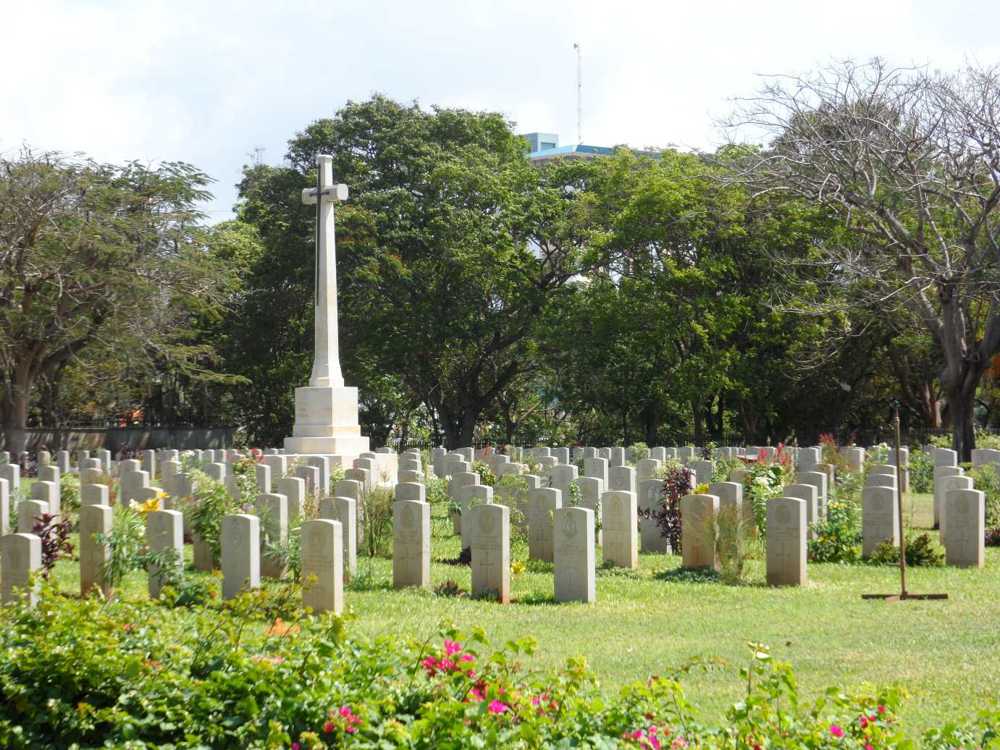
Image: Headstones and the Cross of Sacrifice at Dar Es Salaam War Cemetery
Dar es Salaam in Tanzania was the capital of German East Africa.
It saw one of the first recorded British actions of the First World War when on 8 August 1914, HMS Astraea shelled the German wireless station and boarded and disabled two merchant ships - the "Konig" and the "Feldmarschall". The port was captured in 1916 and the divisional headquarters was moved to Dar es Salaam. Later, No.3 East African Stationary Hospital was stationed there.
Dar Es Salaam War Cemetery was established in 1960 after the original Dar es Salaam (Ocean Road) Cemetery had to be moved due to the construction of a new road. It contains 1,766 Commonwealth burials of the First World War, 60 of them unidentified. Also buried were over 100 burials of German, Belgium, and Portuguese servicemen.
The cemetery also contains the Dar Es Salaam Hindu Cremation Memorial which commemorates 14 Indian servicemen whose remains were cremated in accordance with their faith.
The Dar Es Salaam British and Indian Memorial which stands within Dar es Salaam War Cemetery, commemorates by name more than 1,500 officers and men who died in East Africa during and after January 1917 (the advance to the Rufiji River) who have no known grave.
Zomba 1914-1918 (King's African Rifles Tower) Memorial
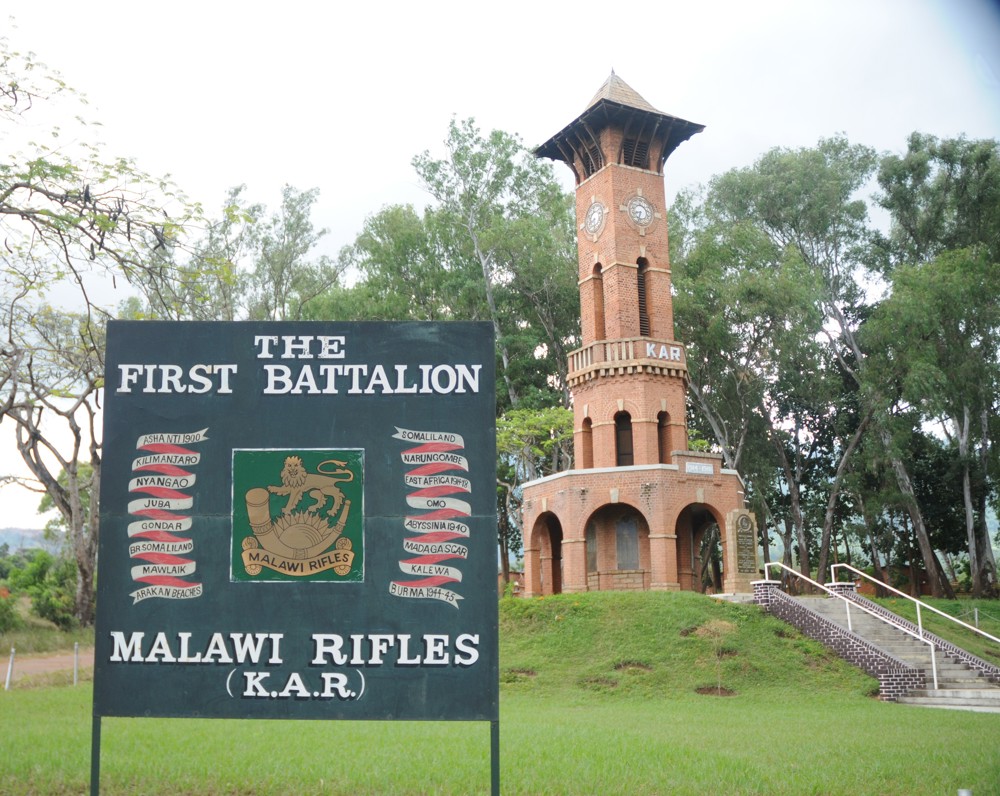
Image: The Zomba 1914-1918 (King's African Rifles Tower) Memorial
Unveiled in 1924, the King's African Rifles War Memorial Tower was erected by public subscription to commemorate the men of the 1st and 2nd KAR who lost their lives in service to the British Empire during the First World War.
This magnificent structure takes the form of a clock tower, making it one of, if not the only CWGC memorial to include this feature. At the tower's base is an octagaonal cloister, holding eight brass tablets. Each of the tablets is a roll of honour, naming the men who served with a specific battalion.
In October 2023 a partnership was established between the Commonwealth War Graves Commission, the Malawi Defence Force (MDF) and the government Department of Museums and Monuments.
The Commonwealth War Graves Commission has been designated the King’s African Rifles War Memorial Tower as the official point of commemoration for those named on the tablets but who have no known grave, or whose grave could not be maintained, and is known for this purpose by CWGC as the Zomba 1914-1918 (King’s African Rifles Tower) Memorial.
Mbala Memorial
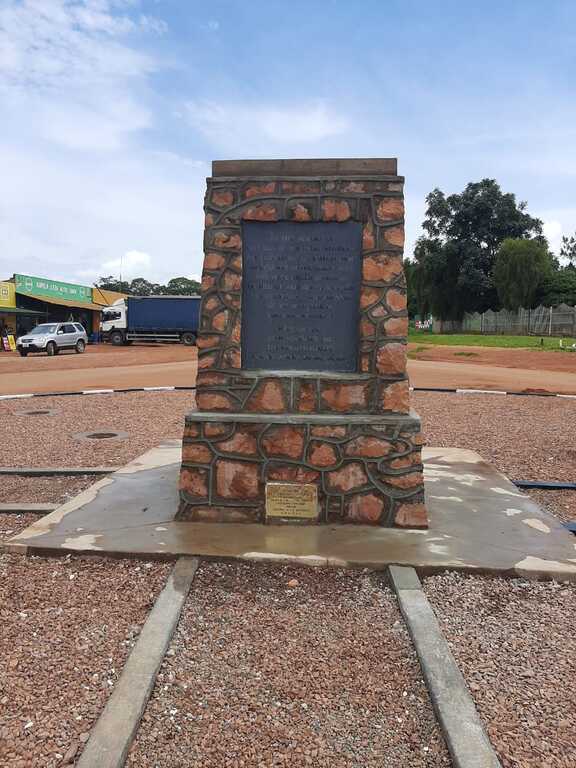
Image: The red brick Mbala Memorial
Just as you’re heading down the M1 Road through Mbala, the provincial capital of Zambia’s Northern Province, you will notice a truncated red brick column in the middle of a roundabout.
Taking a closer look reveals a large, proud bronze plaque inscribed with the following description:
To the memory of 1467 men of Northern Rhodesia
who served in the British Army as carriers in the Great War
and were killed in action
or died of wounds or sickness
and in especial remembrance
of 433 who fell in Northern Rhodesia
Here on the 25th November 1918 the German forces in East Africa surrendered
The Mbala War Memorial, also known as the Abercorn Memorial, stands at the spot where German General Paul Emil von Lettow-Voerbeck surrendered formally to British General William F.S. Edwards, putting the full stop on a Great War chapter that is all too often overlooked.
The Wider First World War in Africa
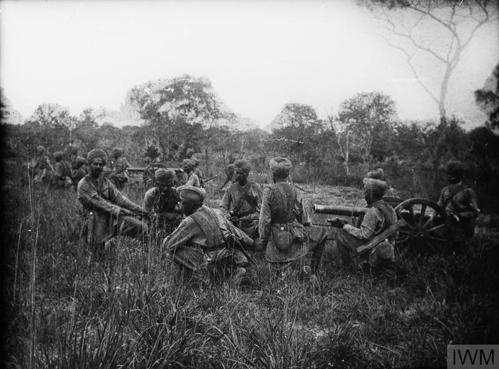 Image: Indian Army troops of the Kashmir Mountain Battery at Nyango Oct 1917 (© IWM Q 15458)
At the time of the First World War, many of Europe’s leading powers, and the Great War’s key belligerents, held colonial possessions across Africa.
The British Empire’s presence across the continent is well known, controlling vast swathes of territory. Its ally, France, also held massive tracts of African land, as did Belgium.
Germany also controlled numerous territories which bordered others under the control of the Entente Powers.
By 1914, Germany controlled territory in present-day Tanzania, Burundi, Rwanda, Namibia, Cameroon, Togo, and Ghana.
German authorities in their colonies had hoped to avoid war, but surrounded as they were by the larger colonies of France & Great Britain, once war broke out in Europe, war in Africa became inevitable.
What’s interesting is that the first shots fired by a soldier under British command of the war were fired in Togoland (part of present-day Togo) rather than France or Belgium, as is the common conception.
Troops from the Gold Coast Regiment from present-day Ghana were moving into Togoland on 7 August 1914. They encountered a German-led police patrol, which opened fire on the British Forces.
Lance Corporal Alhaji Grunshi shouldered his rifle, returned fire, and thus became the first soldier under British command to fire a shot in anger during World War One.
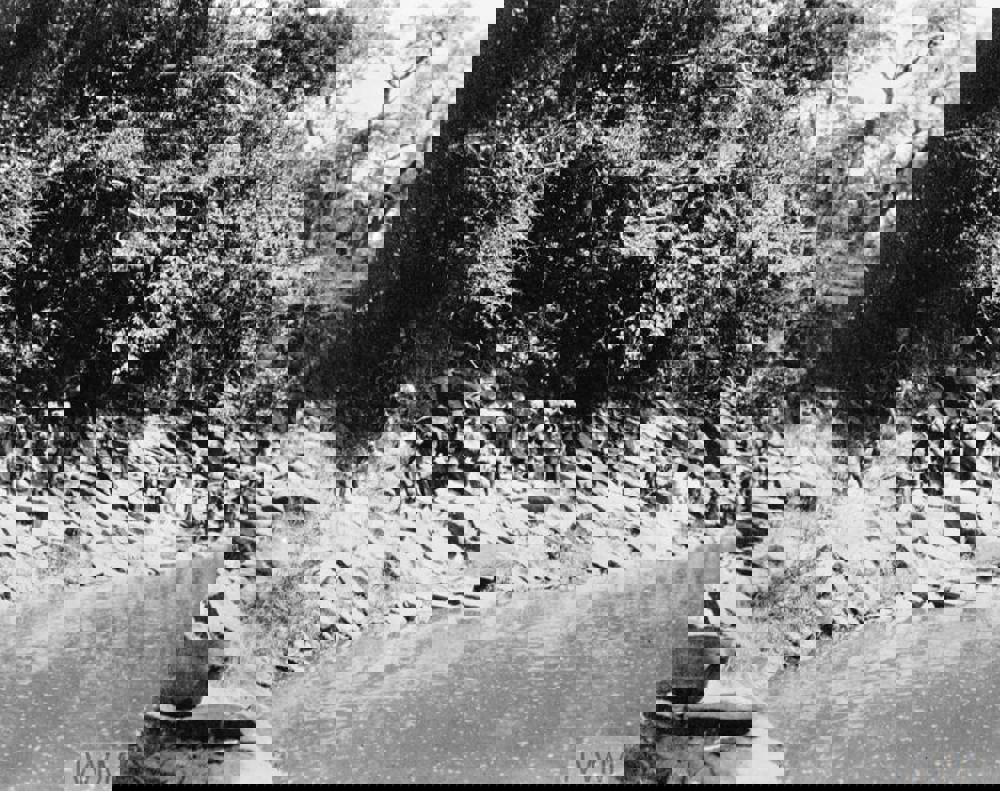
Image: Nigerian troops traverse the rocky banks of a swift-coursing river (© IWM Q 15426)
A mixture of units and nationalities fought the campaigns in East, Southwest, West, and North Africa. Under the British, assembled armies included UK soldiers, Indians, South Africans, Rhodesians, and even Australians and New Zealanders in some theatres.
However, hundreds of thousands of local African soldiers were also recruited, especially from 1916 onwards, in East Africa by British authorities.
Regiments such as the King’s African Rifles, raised from British East Africa (today Kenya), Nyasaland (Malawi), Uganda, and British Somaliland (part of present-day Somaliland), fought across the continent. By the end of the First World War, the King’s African Rifles was made up of over 35,000 men, 33,000 of whom were African-born.
Another multi-national unit assembled under British command was the West African Frontier Force (WAFF). The WAFF was made up of soldiers drawn from the Gold Coast (present-day Ghana), Nigeria, Sierra Leone, and Gambia.
Germany’s military presence was comparatively very small. Throughout the East Africa campaign, for example, the force under General Lettow-Voerbeck never amounted to more than 14,000 fighting men.
The core of Lettow-Vorbeck’s force was his locally raised troops, men who knew the terrain and conditions well.
Author acknowledgements
Alec Malloy is a CWGC Digital Content Executive. He has worked at the Commonwealth War Graves Commission since February 2022. During that time, he has written extensively about the World Wars, including major battles, casualty stories, and the Commission's work commemorating 1.7 million war dead worldwide.