

24 March 2026
Visitor Guide: How to Read a Memorial Name Panel and Find a Name
Commonwealth War Graves Commission war memorials commemorate the missing fallen of the World Wars. But do you understand how to read and interpret the memorial name panels?
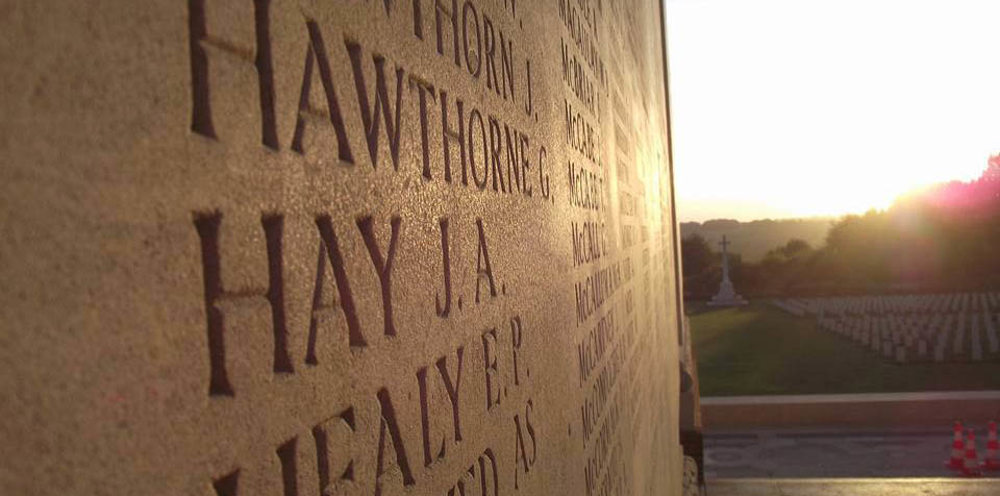
Image: A handful of the more than 70,000 names etched into Theipval's monumental memorial name panels
We commemorate 1.7 million Commonwealth war dead across 23,000 locations in more than 150 countries and territories worldwide. War memorials, commemorating those with no known war grave, form an important part of our work and worldwide commemoration.
From the massive Thiepval Memorial to the Missing of the Somme in northern France, to smaller war memorials like the Dar Es Salaam British and Indian War Memorial in Tanzania, to the Runnymede Air Forces Memorial in England and our British Naval Memorials, they all play a vital role in commemorating by name our war dead.
If you are unfamiliar with our war memorials, this guide explains how to read the name panels, the purpose of our memorials, and how to find names on our memorials.
At a glance: What this guide will tell you
This visitor guide to CWGC war memorials explains:
- Understand what a CWGC memorial panel is and why names appear there
- Learn how names are grouped and ordered on different memorials
- Know what to check before you visit
- Use memorial registers, plans and site information more confidently
- Find a name on site without feeling overwhelmed
- Understand what it means when someone has no known grave
- Know what to do if you cannot find a name straight away
What a memorial panel is – and why it matters
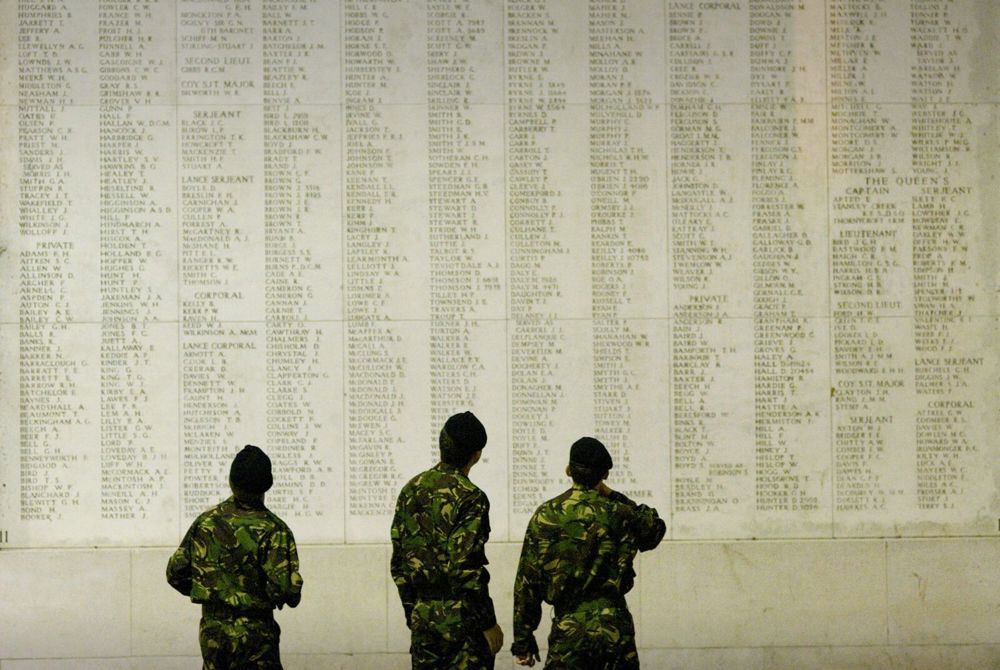
Image: Present-day service personnel inspect the name panels on the Ypres (Menin Gate) Memorial
Over half the war dead we commemorate at Commonwealth War Graves have no known grave. Memorial panels are name panels commemorating these missing service personnel by name.
When a name appears on a memorial rather than a headstone
A casualty will appear on a war memorial if their final resting place is unknown. In our case, these are the men and women who lost their lives in military service to the British Empire during the two World Wars.
Such traumatic, global events sadly saw the loss of millions of people around the world. The circumstances of their deaths, or battlefield conditions, often meant people’s bodies were not recoverable or were simply lost amid the chaos and carnage of World Wars.
While the majority of CWGC Memorials to the Missing name the individual servicemen and women they commemorate, not every CWGC memorial does.
For example, the 'Askari' memorials in Dar es Salaam, Nairobi and Mombasa, commemorating locally-raised soldiers and labourers, commemorate units as a whole, rather than naming individual people.
This is predominantly due to historical imbalances in commemoration, something CWGC's Non-Commemoration Programme has worked hard, and continues to work hard, to reverse.
Memorial panels as a form of commemoration
CWGC war memorial name panels are permanent points of commemoration for our missing war dead of the World Wars.
After the First World War, many families sadly did not know their loved ones’ final resting places. War memorials allowed us to create spaces where these families could grieve, and physical markers commemorated missing casualties by name.
This philosophy was summed by Field Marshal Hubert Plumer’s moving speech at the unveiling of the Ypres (Menin Gate) Memorial in July 1927:
“The hearts of the people throughout the Empire went out to them and it was resolved that here at Ypres, where so many of the missing are known to have fallen, there should be erected a Memorial worthy of them which should give expression to the Nation’s gratitude for their sacrifice and their sympathy with those who mourned them.
"A Memorial has been erected which, in its simple grandeur, fulfils this object, and now it can be said of each one in whose honour we are assembled here today:
“’He is not missing: he is here!’”
What “no known grave” means
No known grave means we have not been able to identify the final resting place of a given World War casualty.
There are many reasons why a casualty may have no known final resting place. Their remains may have never been recovered, or they were not able to be identified upon discovery, for example. They may have died in concentration camps or PoW camps, been shot down over enemy territory, or lost at sea.
Every effort was made at the time to locate the war graves of the fallen and to identify them. Even now, over 80 years after the end of the Second World War and a century after the Great War, our work continues.
We are informed of the discovery of 80 to 150 new sets of World War remains each year. Each set is diligently investigated and inspected by the Recovery and Commemorations Teams. If we can identify the casualty, they will be removed from their respective war memorial and reburied in an appropriate CWGC war cemetery, complete with a headstone.
What you might see on a memorial panel
Here’s what to expect when visiting a CWGC war memorial and reading a name panel.
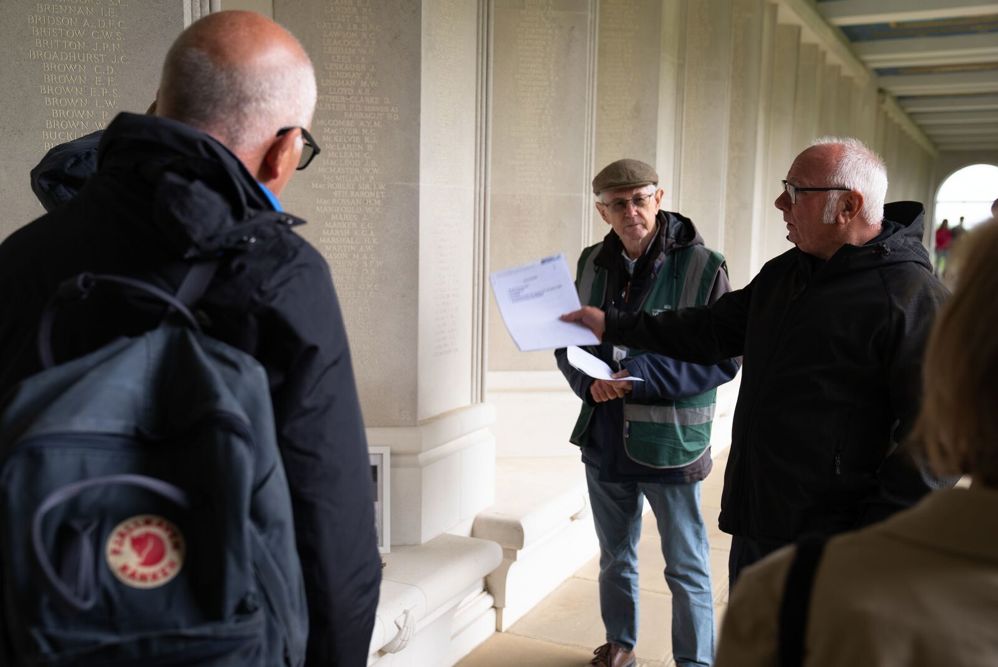
Image: A guide shows visitors around the alcoves of the Runnymede Air Forces Memorial, upon which the names of missing Commonwealth of the Second World War are commemorated
Names, rank, unit and other details
The majority of our war memorials commemorate Commonwealth officers and enlisted men by name. If casualties have the same name, then service numbers will be used to differentiate between each individual.
We also include their rank, unit, squadron, or ship, depending on which armed forces branch the memorial is dedicated to.
For example, the Ypres (Menin Gate) Memorial commemorates by name over 54,000 British, Australian, Canadian, Indian, and South African servicemen of the First World War.
Abbreviations and formatting
Names are typically displayed by surname then initials, largely due to space-saving requirements.
Some of our memorials commemorate upwards of 40,000 to 70,000 names, so you can imagine space is very much at a premium.
Likewise, regimental or branch names such as the Royal Air Force would be shortened to RAF, or His Majesty’s Ship, denoting Royal Navy vessels, would be abbreviated to HMS in standard nomenclature fashion.
Why do some entries appear different from others?
Generally, while the purpose of war memorials around the world remains the same, the way in which the information is arranged differs at each location.
Each memorial’s register details the arrangement at each site, so be sure to check these when visiting our sites!

Want more stories like this delivered directly to your inbox? Sign up for our newsletter for regular updates on the work of Commonwealth War Graves, blogs, event news, and more.
Sign UpBefore you visit – The Fastest Way to Prepare
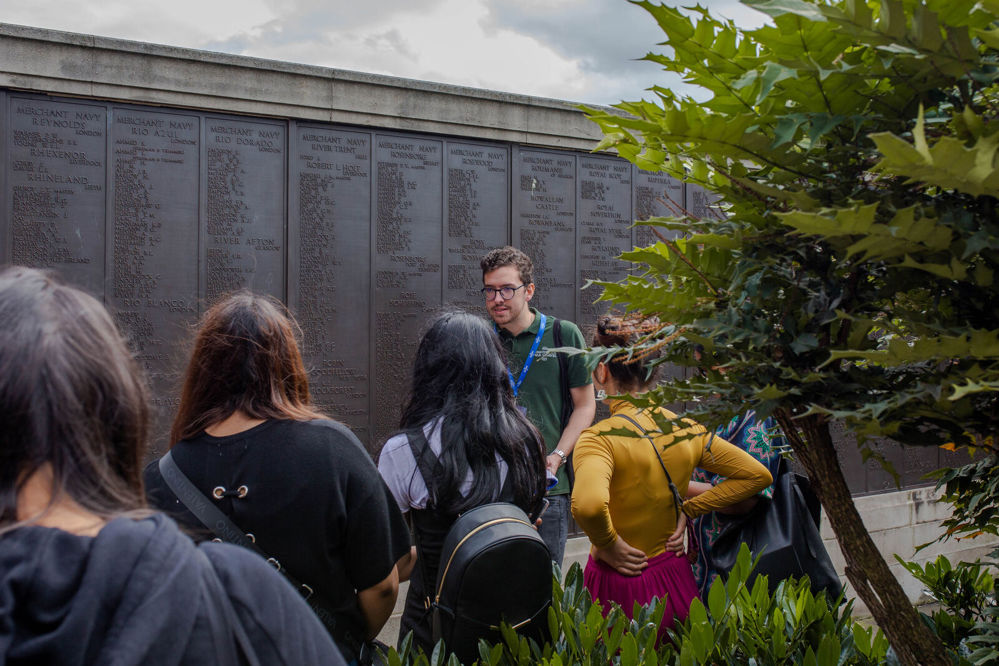
Image: The bronze memorial panels of the Tower Hill Memorial commemorate members of the Merchant Navy and fishing fleets of the Commonwealth who lost their lives in the World Wars
Not visited a CWGC war memorial before? Here are some hints and tips to help you prepare for your visit.
How names are organised on memorials
Those names etched into memorial panels are carefully arranged, so visitors looking for a particular person can find them with ease, but the method of arranging differs subtly from memorial to memorial. The Memorial register details how each memorial is arranged, but there are some typical examples to know.
If the memorial is dedicated to missing Army casualties, such as Thiepval, names are arranged by:
- Regiment by the repsective army’s standard of regimental precedence
- Rank in each regiment, moving down in seniority
- Alphabetically by surname for each rank
Naval memorials and the Tower Hill Memorial commemorating members of the Merchant Navy and fishing fleets are arranged:
- By ship or vessel, alphabetically
- Alphabetically by seniority
The Runnymede Air Forces memorial arranges commemoration by:
- National Air Force (RAF, Royal Canadian Air Force, Royal Australian Air Force, etc.)
- Rank by seniority
- Alphabetically by name
Each memorial panel is also numbered. The numbers will tell you on which section of a memorial a particular individual is commemorated.
Use the register, apps or site plan to find casualties
Each memorial has a register, listing all those commemorated here and their location on the memorial.
These are available in clearly labelled boxes or small cupboards at each site. We would recommend reading these to help locate the individual/s you are searching for.
On some memorial web pages, you will be able to find and download the memorial plan, usually with a button titled “cemetery plan”. This will give an overview of the memorial layout, including pier and panel numbers. Check these for the layout and cross-reference with the register on-site to help you improve your search.
You can likewise use the For Evermore app to take virtual or in-person tours of our memorials, listing casualties’ locations as well as sharing the stories of some of those commemorated.
If you cannot find a name straight away
If you cannot find the individual you are searching for, don’t panic! We realise that it can be intimidating or difficult if you are unfamiliar with our memorials. Here are some tips you can use to help locate individuals on CWGC war memorials.
Double-check the memorial and panel reference
It may seem obvious but double-check to ensure the casualty’s official point of commemoration is on the memorial in question or not.
You will be able to check this via the individual’s casualty page. Not only will this tell you which memorial the serviceman or woman is commemorated on, but also the pier and panel number you will find them on.
If you are on-site, you can use the memorial’s register to help locate individuals.
Try spelling and service variations
Ensure that you have spelt the casualty’s name correctly. We realise there are many variations in names, so be vigilant to ensure you’re looking for the correct person on the correct memorial!
If there are name clashes, i.e., two or more individuals serving in the same regiment with the same name, then we will use their service numbers to differentiate them. Service numbers were unique to each individual soldier. Knowing these should be able to help you pinpoint the person you are searching for. You can also search our casualty database by service number to aid your search.
Check with our team
On certain occasions, a member of our staff will be on hand, usually for major anniversaries or events, to help you find the individual’s memorial location.
The Commonwealth War Graves Foundation Guides are based at Thiepval Memorial to the Missing of the Somme and select other sites for the summer. Look out for them in their distinctive yellow polo shirts! They will be able to help point you in the right direction and give more information about the site and those commemorated there.
If you have further questions or queries, you can always contact us at enquiries@cwgc.org. Our friendly team will be able to help you.
From a name panel to a deeper story
As well as commemorating our missing war dead, CWGC memorials are places of inspiration.
A memorial name is a starting point, not the end
A name on a war memorial is not just a scant few lines etched into stone; they were a real, living, breathing person with their own hopes and aspirations.
These men and women and their actions and experiences shaped the world we live in today. It’s our responsibility to ensure their memories and stories are never forgotten. We are exploring more ways to tell their stories, and you can too.
Explore the record behind the name
Each casualty we commemorate has their own individual page.
This will tell you their name, rank, service branch, age at death, and place of commemoration. Where possible, we also include additional information, such as parents’ names, place of birth, and personal inscriptions (although the latter is not relevant for memorial casualties).
From here, you can begin or enhance your research journey into learning more about the people behind the names.
Share or discover stories through For Evermore
For Evermore: Stories of the Fallen is our digital stories archive. Here, we host and share stories submitted by the public, researchers, historians, and groups tied to the World Wars, of those we commemorate.
So far, we have over 10,000 First and Second World War stories in our archive – but with 1.7 million men and women commemorated by CWGC, we have some way to go until each and everyone’s story is preserved and shared.
Got a story of someone commemorated on a Commonwealth War Graves war memorial? Upload and share it today on For Evermore.
Support our work and help honour the 1.7 million who never returned home
Frequently Asked Questions: Memorial Panels and Finding a Name
Reading Memorial Panels & Finding Names
First, search for the casualty you wish to find on the CWGC Find War Dead tool. Each individual casualty page lists their place of commemoration, including war memorial piers and panels. When on site, you can use the Memorial register to locate individual casualties. Each register lists the location of all commemorated on our respective memorials. Each memorial panel is also numbered for ease of location.
Memorial Panels are permanent parts of our war memorials. They commemorate by name missing Commonwealth casualties of the World Wars, as well as further information, such as rank, regiment, squadron, ship, and so on.
No known grave means we have not been able to identify the final resting place of a given World War casualty. There are many reasons why a casualty may have no known final resting place.
Their remains may have never been recovered, or they were not able to be identified upon discovery, for example. They may have died in concentration camps or PoW camps, been shot down over enemy territory, or lost at sea.
If a casualty has not been identified or their final resting place is unknown, they will be commemorated on a CWGC War Memorial.
The method of arranging is different one memorial to another.
If the memorial is dedicated to missing Army casualties, such as Thiepval, names are arranged by:
- Regiment by the British Army’s standard of regimental precedence
- Rank in each regiment, moving down in seniority
- Alphabetically by surname for each rank
Naval memorials and the Tower Hill Memorial commemorating members of the Merchant Navy and fishing fleets are arranged:
- By ship or vessel, alphabetically
- Alphabetically by seniority
The Runnymede Air Forces memorial arranges commemoration by:
- National Air Force (RAF, Royal Canadian Air Force, Royal Australian Air Force, etc.)
- Rank by seniority
- Alphabetically by name
Each memorial panel is also numbered. The numbers will tell you on which section of a memorial a particular individual is commemorated.
If you cannot find a name on a memorial panel straight away, you can:
- Use the relevant casualty page to find the individual's location on the memorial
- Use the Memorial register to locate them
- Ask a member of staff or a CWGF Guide if they are on-site (our staff will not always be on-site)
- Check our apps
If the memorial commemorates casualties by name, it will have a memorial register. Not every CWGC memorial has a plan. In some cases, this is due to the layout of the memorial being a single-screen wall. Larger Memorials, such as Thiepval, Rangoon and the Menin Gate, will have plans detailing pier and panel locations.
Yes, each individual we commemorate has their own casualty page. On here, you will find details of their place of commemoration, including location on their respective war memorial.
Author acknowledgements
Alec Malloy is a CWGC Digital Content Executive. He has worked at the Commonwealth War Graves Commission since February 2022. During that time, he has written extensively about the World Wars, including major battles, casualty stories, and the Commission's work commemorating 1.7 million war dead worldwide.