04 February 2026
Who Were the Black Canadian Servicemen of the World Wars?
Did you know thousands of Black Canadians served in the armed forces during the World Wars? This Canadian Black History Month, learn more about their story with Commonwealth War Graves.
Canadian Black History Month
Each February, people across Canada participate in Black History Month events and celebrations that honour the legacy and contributions of Black people in Canada and their communities.
Here, we take the opportunity to celebrate the diverse nature of Canada’s armed forces in the world wars, including the experiences of those of non-European descent in wartime.
Black Canadian Servicemen in the First World War
At least 1,500 Black Canadians volunteered to serve in the Canadian Expeditionary Force (CEF) during the First World War.
Only a small handful of Black volunteers were accepted into Canadian battalions in the first two years of the war, but pressure was put on the Canadian government by Black communities at home, hoping for wider participation in the war effort.
Despite the obstacles they faced, Black Canadians still found ways to enlist for overseas and domestic military service.
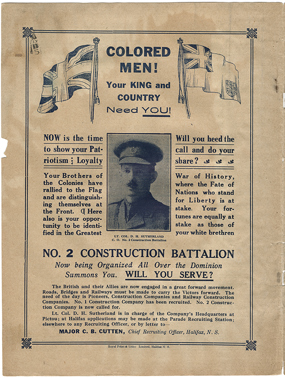
Image: A contemporary recruitment poster encouraging Black men to enlist in the No.2 Construction Battalion. Note, this poster reflects the language and attitudes of the time, including a picture of one of the unit's White officers (Wikimedia Commons)
By 1916, the first segregated Black Canadian unit of the First World War, the No.2 Construction Battalion, had been formed.
Further barriers to military service were dropped in August 1917, with the introduction of the Military Conscription Act.
The act required all men aged 20-45 to register for military service. This led to the creation of diverse support and frontline units.
While the majority of volunteers from Canada’s Black communities worked in labour and support roles, many did serve in regular frontline units, too, such as:
- 7th Battalion (1st British Columbia)
- 78th Battalion (Winnipeg Grenadiers)
- 106th Battalion (Nova Scotia Rifles)
The No.2 Construction Battalion/Company

Image: No.2 Construction Battalion in 1916. While the majority of enlisted men were Black, the unit's officers were still White Canadians (Wikimedia Commons)
The No.2 Construction Battalion was formed on 5 July 1916. This was a segregated unit led almost entirely by white officers, apart from Reverend William Andrew White, the unit’s chaplain.
The rest of the Battalion was made up of Black Canadians, as well as those who came from places like the United States, the British West Indies, and South Africa.
Numbering 800 men at its peak, the Battalion was reorganised into the No.2 Construction Company in May 1917, attached to the Canadian Forestry Corps (CFC). The company was sent to France the same year.
By the autumn, the unit was operating in the heavily forested Jura Mountains near the Franco-Swiss border.
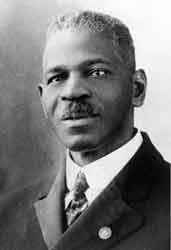 Image: Reverend William Andrew White, Chaplain of No.2 Construction Battalion (Wikimedia Commons)
The area was a major forestry centre, and CFC units were already working in sawmills and lumberyards before No.2 Construction Company’s arrival. While in Jura, the company’s duties included felling trees, transporting logs to mills, and milling the lumber into usable products for the war effort.
The frontline called for a constant supply of wood. It was used for duckboards, shoring timbers, crates, and other practical uses on the frontline.
In addition to its forestry duties, No.2 Construction Company was responsible for operating and maintaining utilities for CFC units. The men also cared for the horses used to pull log carts and transport lumber to distribution depots and railway yards.
The men of No.2 Construction Company laboured tirelessly in harsh conditions. The winter mountain weather and close nature of the work led to sickness spreading through the unit, with some men sadly perishing in the Jura mountains.
In 1918, the CFC provided support to the Royal Air Force on the Western Front, building, repairing, and moving airfields. No. 8 Company was formed, a primarily Black unit of 180 men, for this task, whereas other recruits were spread to other Companies within the CFC.
Commemorating the men of the No.2 Construction Company
26 Members of No 2. Construction Company died in military service during the First World War. The bulk of the unit’s losses came from accidents or illness.
Supt Churchyard, Jura
The small Commonwealth War Graves plot in Supt Churchyard, Jura, holds 8 members of the Canadian Forestry Corps. Four of the men buried here were members of the 2nd Construction Corps:
- Private Charles Henry Bryant – From Hamilton, Ontario, died of meningitis and was buried in July 1917
- Private William Boone – A native of Alabama, US, William succumbed to nephritis and was buried in December 1917
- Private J Mansfield – Private Mansfield’s cause of death is unknown
- Private Charlie Some - Originally from Natal, South Africa, Private Some was found dead, presumably murdered away from the Battalion's camp in Jura
Champagnole Communal Cemetery
A further six No.2 Construction Company members are buried in Champagnole Communal Cemetery, Jura, alongside 14 other Canadian burials of the First World War. These are:
- Private T M Williams – Died 28 January 1918
- Private George Sylvia – Died 28 March 1918
- Private A B Cromwell – Died 16 June 1918
- Private Belfield Elliott Hall – Born in Barbados, British West Indies, died of illness on 22 October 1918
- Private Michael Jackson – Died 3 November 1918
- Private Sydney David – Died 10 November 1918
Delsaux Farm Cemetery, Beugny
A further member of the No.2 Construction Company lies buried in Delsaux Farm Cemetery, Beugny.
- Private Victor Carvery - Died November 20 1918
Seaford Cemetery, Sussex, UK
One man of No.2 Construction Company lies amongst 19 Commonwealth war graves at Seaford in Sussex.
- Private Aubrey Mitchell - Died 17 April 1917
Real lives, lived and lost
Private Charlie Some
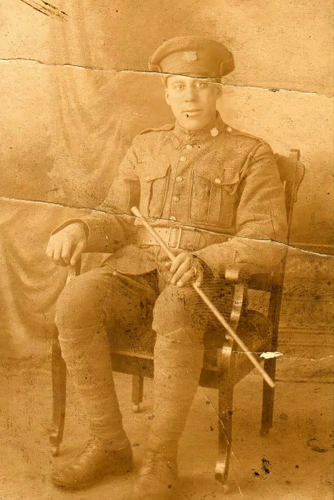 Image: Private Charlie Some (Encyclopedia Canada)
Charlie Some was born in Natal, South Africa, in 1886. He emigrated to Canada at some point in between 1911 and 1914,
At at time when mixed marriages were uncommon in Canada, he married his wife Gertrude, a White Canadian, with the pair settling in the predominantly Black community of Affricville in Halifax, Nova Scotia.
Charlie enlisted with No.2 Construction Battalion, sailing for England in March 1917. As the unit had been reduced in size, he remained in England for some time, participating in infantry training and using his pass to explore the local Brammshott area.
He shipped out to France in May 1918, joining the unit in Jura. He appears to have picked up some lax habits in England and was prone to wandering. At one point, he was found some 150 kilometres from Jura at Lyon Train Station.
Unfortunately, it appears this habit led to Charlie's death. His body was found away from camp on a small mountain road connecting Andelot and Salins after going AWOL on the night of September 22/23 1918.
A post-mortem examination by a member of the Canadian Army Medical Corps showed he had been attacked and killed with a cut from a sharp object.
The exact circumstances of Charlie's death have never been conconvered but French military authorities prosecuted a French soldier for the alleged murder. Charlie is buried with his comrades from No.2 Construction Battalion in Supt Churchyard.
Private Aubrey Mitchell
Private Aubrey Mitchell was a Black soldier born in Saint Vincent, British West Indies, who enlisted in the Canadian forces during the First World War.
He sailed with No. 2 Construction Battalion to England and was stationed at Seaford Camp in Sussex.
In April 1917, Mitchell contracted pneumonia, likely in the damp spring weather under canvas, and died on 17 April 1917. He was 20 years old. Private Mitchell is buried at Seaford Cemetery, Sussex, UK.
His grave is one of 19 Commonwealth war graves at Seaford belonging to West Indian and other Black servicemen who trained there during the war.
Private Victor Carvery
Private Victor Carvery from Africville, Nova Scotia, was killed on November 20, 1918, nine days after the Armistice ended fighting on the Western Front, by one of his own comrades.
Private Carvery had been transferred to No. 37 Company, CFC, in November 1917.
His assailant was identified as Private Arthur Johnson. Private Johnson was later sentenced to 15 years' penal servitude.
Black Canadians on the Frontlines of the First World War
Despite finding it difficult to enlist, Black Canadians fought in some of the Canadian Expeditionary Force’s earliest engagements on the Western Front.
The first few arrived with the initial wave of Canadian soldiers in Europe, with the earliest known Black Canadian frontline casualty being Private Charles Green, who succumbed to wounds he received at the Second Battle of Ypres on 26 April 1915.
According to the Canadian Encyclopaedia, at least 66 Canadian battalions that served at the front contained Black volunteers by 1917.
While their numbers were small, some of these volunteers were present at some of Canada’s most important battles of the First World War. At least 27 fought at the Battle of Vimy Ridge, for example, while a further 18 were spread across units fighting in the Hundred Days Offensive.
Only seven Black Canadians served as commissioned officers in the war. The majority served with the Canadian Army Medical Corps, but Reverend William Andrew White, the Chaplain of No.2 Construction Battalion/Company, was an honorary Captain.
Approximately 60 volunteers died in the First World War, at least 32 during frontline service. One of the latter was Lieutenant Lancelot Bertrand.
Lieutenant Lancelot Bertrand
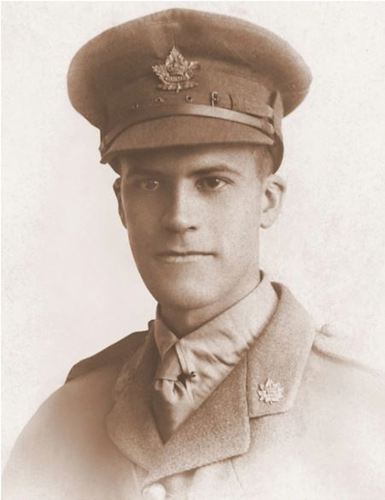 Image: Lancelot Bertand (Encyclopedia Canada)
Lancelot was born in Grenada, serving two years with the Grenada Volunteers before emigrating to Canada, where he worked as a clerk.
Lancelot enlisted for overseas military service at Valcartier in September 1914. He went to France with the 7th Battalion, CEF, before being wounded in the shoulder in May 1915 and sent to England to recuperate.
While in England, he was assigned to the Canadian Signal School at Shorncliffe. Because of his clerical background, he was made a Sergeant, responsible for the pay section.
It was here that Lancelot’s leadership abilities were noted, leading to his commission as Lieutenant on 21 August 1916, becoming the CEF’s first Black infantry officer. He returned to the 7th Battalion at the front in France the following month.
Lancelot’s first major operation on his return was the pivotal Battle of Vimy Ridge, launched on 9 April 1917.
Here, the four Canadian divisions fought together for the first time as a Corps. With support from a British division, the Canadians stormed the ridge after an intense three-day battle. It was one of Canada’s most notable victories and feats of the First World War.
At Vimy, the other officers in Lancelot’s company were killed or wounded, leaving Lieutenant Bertrand to take his men forward, successfully reaching their objectives They their objectives. For his actions at the Battle of Vimy Ridge, Lancelot was awarded the Military Cross.
Sadly, Lancelot was killed in the heavy fighting at Hill 70 in the Pas-de-Calais, northern France, on 15 August 1917.
His body was never recovered, so Lieutenant Bertrand is commemorated alongside over 11,000 other Canadians servicemen of the First World War on the Vimy Memorial, perched atop the very ridge he fought to take in April 1917.

Want more stories like this delivered directly to your inbox? Sign up for our newsletter for regular updates on the work of Commonwealth War Graves, blogs, event news, and more.
Sign UpBlack Canadian Servicemen in the Second World War
Several thousand Black Canadians served in the Canadian Armed Forces during the Second World War, as well as in the merchant navy. Some were First World War veterans serving on the home front in units such as the Veterans Guard of Canada.
Women also joined the war effort, working in the medical services as well as specific women's units such as the Canadian Women’s Army Corps (CWAC) and Air Force (WDs). As clerks, drivers, canteen workers, amongst other roles, these women also made hugely important contributions.
As Canadian military authorities did not record race during recruitment, it is difficult to get a precise figure on the number of Black Canadian personnel who served in the Second World War. Likewise, as the CWGC also never collected this information, it is also difficult to provide an accurate number for those who died in military service.
As the Canadian Army was not segregated in the Second World War, units were more diverse. The Royal Canadian Air Force (RCAF) and Royal Canadian Navy (RCN) initially restricted Black service in the war’s early stages. However, as the war progressed and manpower requirements rose, these barriers were lowered.
In 1943, Allan Bundy became one of only 2 known Black Canadian pilots to serve in combat in the Second World War, serving on coastal defence duties in England from 1944 until the end of the war with 404 Squadron, RCAF.
The other was Pilot Officer Junius Haukan, who earned his wings in 1941. Junius was later sent to England to serve with the RAF.
Black Canadian stories from the Second World War
Private Clarence Alvin Trimm
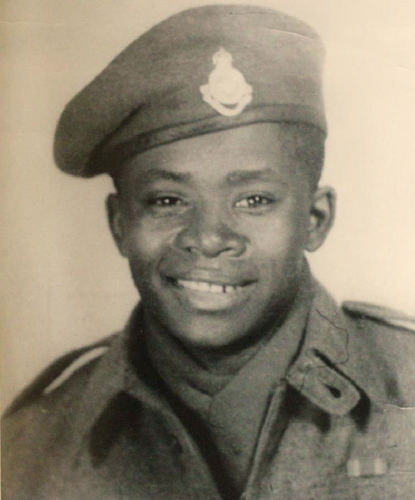
Clarence Trimm was born on 18 of January 1924, in Montreal, the son of James McDonald, a jeweller (died 1944), and Isabella Sheppard Trimm (died 1938), both of whom originated from British Guiana (Guyana). Clarence had a brother, Randolph, and a sister, Carmen.
When war broke out, Clarence was aged 15 and tried to enlist but was refused due to his age. He was, however, determined to do so and even grew a moustache to look older, but his further efforts went unrewarded until the 10th of May, 1943, when he was aged 19 and was able to enlist in Montreal.
Posted to the Lincoln and Welland Regiment, 10th Infantry Brigade, 4th Canadian Armoured Division, he went overseas in December and in July 1944 landed with his regiment in France.
The regiment advanced across northern Europe, taking part in the liberation of the Netherlands and then continued into Germany. It was here, on the 27th of April 1945, with the end of the war in Europe just two weeks away, that Clarence was mortally wounded in action near Bad Zwischenahn. He received multiple bullet wounds to his lower abdomen and spine, and despite being operated on, died the same day.
Private Trimm was originally buried with twelve other Canadian casualties in a battlefield Cemetery at Friesoythe. Today, he is buried at Holten Canadian War Cemetery, Netherlands, alongside nearly 1,400 Canadian servicemen of the Second World War.
Pilot Officer Junius Hokan
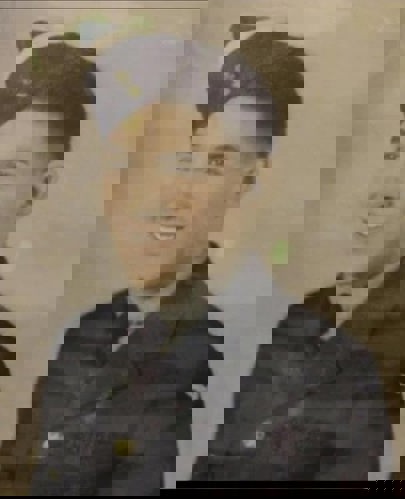 Image: Pilot Office Junius Hokan
Pilot Officer Junius Lyman Edward Hokan was born on March 4, 1922, in St. Catharines, Ontario.
His father, a First World War veteran, had served with the Canadian Field Artillery, inspiring Junius’s service. At 18, he enlisted in the Royal Canadian Air Force (RCAF) on November 11, 1940, in Niagara Falls, Ontario.
Hokan trained as a pilot, excelling in flight school and earning his wings on August 8, 1941.
Due to his high standing, he was commissioned as a pilot officer and sent to the United Kingdom, where he trained in air combat before joining No. 610 Squadron RAF in February 1942. He participated in numerous air battles, including escort missions and the Dieppe Raid on August 19, 1942, where he damaged a Focke-Wulf FW-190.
Besides flying, Hokan designed a navigation aid that gained the interest of the British Air Ministry. However, before he could develop it further, he was transferred to 401 Squadron RCAF on August 24, 1942.
On September 26, 1942, while escorting bombers back from a raid on Morlaix, France, his aircraft ran out of fuel over the English Channel. His last words were, “Out of petrol, bailing out. So long, boys. Will see you tomorrow.” He was never found and was declared killed in action at age 20.
With no known war grave, Pilot Officer Hokan is commemorated on the Runnymede Memorial.
Discover more stories of black servicemen on For Evermore
For Evermore: Stories of the Fallen is our online resource for sharing the memories of the Commonwealth’s war dead.
It’s open to the public to share their family histories and the tales of the service people commemorated by Commonwealth War Graves, so that we may preserve their legacies beyond just a name on a headstone or a memorial.
If you have a story to tell of a Black casualty we care for, we’d love to read it! Head to For Evermore to upload and share it for all the world to see.
Visit For Evermore and explore personal stories of service and sacrifice
Author acknowledgements
Alec Malloy is a CWGC Digital Content Executive. He has worked at the Commonwealth War Graves Commission since February 2022. During that time, he has written extensively about the World Wars, including major battles, casualty stories, and the Commission's work commemorating 1.7 million war dead worldwide.
This blog was written with the help of Dr George Hay and Dr John Burke.
Dr George Hay is the Official Historian at the Commonwealth War Graves Commission (CWGC), an Honorary Academic at the University of Kent and a Fellow of the Royal Historical Society. He writes widely on the social history of British and Commonwealth armies in peace and war, and works to generate greater understanding of the CWGC’s history, its sites and the casualties in its care. He co-authored the CWGC’s 2021 and 2025 reports on historical inequalities in commemoration and continues this work by leading the research strand of the organisation’s ongoing Non-Commemoration Programme.
Dr John Burke is a Senior Research Historian at the CWGC. He obtained his PhD from Newcastle University and has published widely on the remembrance and representation of conflict, and on the legacies of British colonialism. He co-authored the 2021 and 2025 reports on historical inequalities in commemoration.
Contributions have also been made to this article by Katrielle Ethier. Katrielle is Marketing Communications Executive for Canada, helping promote our work in commemorating thousands of Canadian servicemen of the World Wars buried or commemorated in their homeland.