

19 November 2025
Who was Bazruta Effendi Mursal and what story does this grave tell?
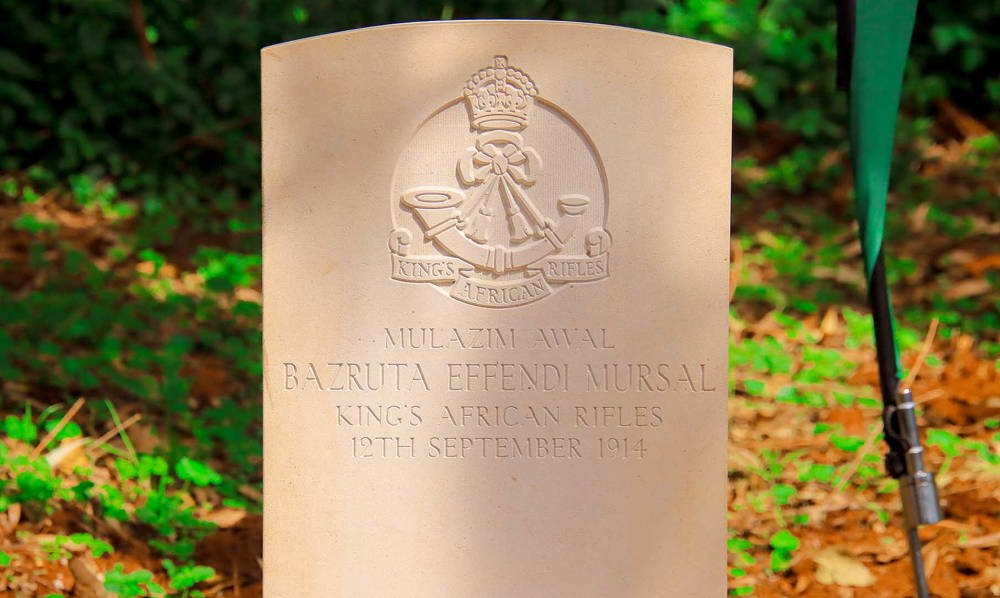
Bazruta Effendi Mursal’s name surfaced at an early stage of the research work undertaken by the Non-Commemoration Programme in a forgotten file— a single reference buried deep in the CWGC archive.
From there, his legacy echoed across four archive sets from the UK to Kisumu in Kenya, and from Nairobi to Syracuse University Archive – where a sketch map produced by Herbert Doyle in 1924— provided a key piece of evidence identifying Bazruta’s burial site at Kissi Boma Military Graves.
Bazruta served with the 4th (Uganda) King’s African Rifles— a regiment shaped by Sudanese recruits, who were called upon to join a war that was not their own – and to defend distant colonial borders. He rose to the rank of Mulazim Awal—Lieutenant—the highest rank an African officer could hold in the KAR. His sons, Sebi and Mohamed, followed in his footsteps… both serving in the Second World War. Sebi became a Company Sergeant Major. Mohamed, a Sergeant.
Kisii played a significant role as a battle ground between the British imperial forces and the Germans who had crossed over from Mwanza, in the then Tanganyika - German East Africa - to Kisii via Sori Bay on the shores of Lake Victoria, which was in the then British East Africa.
The Kissi people, also known as the Abagusii people, contributed hugely to the British imperial forces, many as carriers and labourers. By September 1914 fighting reached Kisii and Bazruta’s King’s African Rifles (KAR) unit joined the fight— and records document a fierce clash. Black powder betrayed the German lines, smoke revealing their positions. But the cost was high. Captain Thorneycroft who commanded the company of KAR was killed during the engagement, and his grave was marked. Bazruta and other Asakaris and Carriers also died and were buried – but their graves were not marked.
This grave site is poignant – not only because its previously unmarked status is a stark and visual telling of historical inequalities that the CWGC widely acknowledges, and seeks to redress, but also because it symbolically can be part of the honouring of all those from across the continent of Africa whose names were not recorded – meaning that there are many we cannot find, and likely never will.
In 1914, Bazruta was buried at the edge of what is today the Kisii Sports Clubs’ golf fairway and as a high-ranking officer, his individual grave was recorded by maps.
Over one hundred years later the combined field team and historian efforts for the Non-Commemoration Programme has achieved a proper commemoration. It was with the help of local elders and storytelling passed from generation to generation that the CWGC Nairobi team found his grave. In partnership with the Kisii Sports Club, CWGC has been able to place a new headstone at Kissi Boma Military Graves.
On Saturday 15 November our teams worked with the club to run a community sports and education event, to mark the important contribution made to inclusive and equal commemoration.