

25 August 2026
Brazilian lives of service remembered on Dia do Soldado
On 25 August, Brazil marks Dia do Soldado, the Day of the Soldier. Explore stories of Brazilian servicemen in our care.
The day marks the birthday of Marshal Luís Alves de Lima e Silva, a famous military officer, a key politician, and the patron of the Brazilian Army. It has since expanded to become a day of celebration and commemoration for Brazil’s armed forces.
To mark the occasion, we trace the lives of people who tied Brazil to Commonwealth service during the two World Wars: from a young cabin boy lost off the Irish coast to pioneering airmen, a wing commander, a rifleman from a titled Rio family, and the ordinary Brazilians whose fundraising helped arm entire RAF squadrons.
Brazil's Day of the Soldier
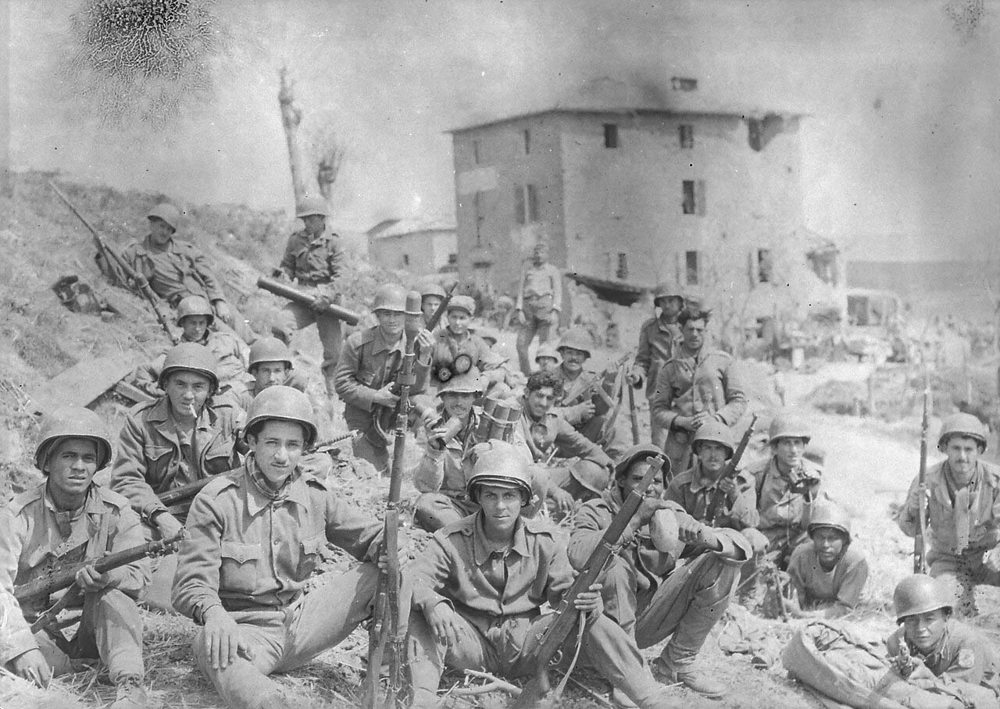
Image: Brazilian soldiers in Italy during the Second World War (Arquivo Nacional)
Every year on 25 August, Brazil marks Dia do Soldado. The date is the birthday, in 1803, of Luís Alves de Lima e Silva, the Duke of Caxias, patron of the Brazilian Army. Known as "the Peacemaker," Caxias is remembered as one of the most significant figures in Brazilian military history.
On 9 August 1943, the Força Expedicionária Brasileira, the Brazilian Expeditionary Force, or FEB, was formed under General João Baptista Mascarenhas de Moraes.
Brazil had entered the Second World War the year before, after German submarines began targeting and sinking Brazilian merchant shipping supporting the Allied war effort.
Over a few days in mid-August 1942, the submarine U-507 sank a string of Brazilian vessels off the coast of Bahia, killing more than 600 people, many of them civilians.
Public anger forced the government's hand: on 22 August 1942, Brazil formally declared war on Germany and Italy.
Brazil in the Second World War
The FEB eventually numbered more than 25,000 men. Before it existed, sceptics had a saying: it would be easier for a snake to smoke a pipe than for Brazil to enter the war.
When the force finally sailed, its soldiers made the joke their own, adopting a green, pipe-smoking snake as their emblem and going to war as the Cobras Fumantes, the "Smoking Snakes".
Known popularly as “pracinhas”, they fought alongside Allied troops through the Italian campaign, including the hard mountain fighting at Monte Castello, Montese and Fornovo.
The Army was only one part of the effort.
The Brazilian Navy escorted convoys across the Atlantic and helped carry the FEB to Europe. The Air Force patrolled the South Atlantic, while the 1st Brazilian Fighter Group flew P-47 Thunderbolts over northern Italy, completing 445 combat missions between November 1944 and the end of the war.
Brazil's connection to Commonwealth service was not limited to those who enlisted.
To the skies
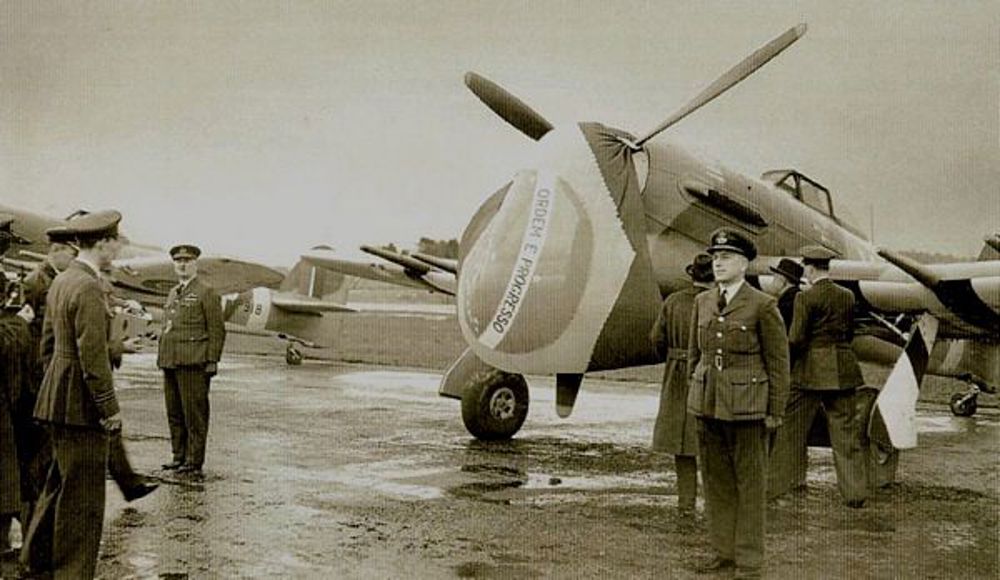
Image: Typhoon JP784, DP-X, commanded by Squadron Leader Petre, with the Brazilian flag (SP Modelismo)
British residents, Brazilian citizens and whole communities raised money to support the Allied war effort, nowhere more so than through the Fraternidade do Fole, the Fellowship of the Bellows in the Second World War.
The movement began among British expatriates in Buenos Aires in 1940, raising funds to buy aircraft for the RAF as it fought the Battle of Britain. It reached Brazil within months.
Tom Sloper, who ran Sloper's department store in Rio de Janeiro, widened an existing Spitfire appeal into a telephone campaign run with the Brazilian Telephone Company, and the idea caught on well beyond the British community. By 1942, the Fellowship had spread across ten Brazilian states, and Brazilians of every background had raised some £80,000 for the RAF.
The aircraft they paid for carried names drawn from home. A national campaign funded five Spitfires, Brazil No. 1 to Brazil No. 5; the fifth was formally named as Bellows Brazil No. V by the Brazilian Ambassador at Hendon in April 1943.
The São Paulo branch funded two more for No. 111 Squadron, O Bandeirante and O Guarany. O Bandeirante presented at Debden, Essex, where Ambassador José Joaquim Moniz de Aragão greeted the squadron on behalf of the people of São Paulo.
When the first aircraft was damaged, the name passed to a second Spitfire, flown as the personal aircraft of the squadron's commanding officer, Squadron Leader P. R. W. Wickham.
The Rio de Janeiro branch chose Botafogo, Bem-Te-Vi, Carioca and Fluminense, familiar names from home, painted onto aircraft serving thousands of miles away.
After Brazil entered the war, the giving ran both ways. Britain gave the Brazilian Air Force a Lockheed Hudson, Britannia No. 1, its tail marked Doado pela Inglaterra, “Donated by England."
On 16 October 1943, nine Typhoons bought by Brazilian subscribers were formally presented to No. 193 Squadron at RAF Harrowbeer, formed there the previous December.
Brazil's Ambassador in London attended; Lord Sherwood, Under-Secretary of State for Air, accepted the aircraft on behalf of the British Government.
At the same ceremony, No. 193 Squadron, whose motto "Aera et Terram Imperare" meant "To govern the air and the earth", took the title "The Fellowship of the Bellows of Brazil Squadron", which it carried in its records for the rest of the war.
It was more than the handover of nine aircraft. It was a public act of friendship between Brazil and Britain, marked in the presence of Brazil's own ambassador and formally recognised by the British Government.
No. 193 Squadron’s Typhoons went on to attack enemy shipping, ground positions and V-1 launch sites in support of the liberation of Europe.
But Brazil's wartime story across both world wars reaches further still, into the individual records kept by the Commonwealth War Graves Commission.
Brazilian Second World War stories
Wing Commander Cosme Lockwood Gomm
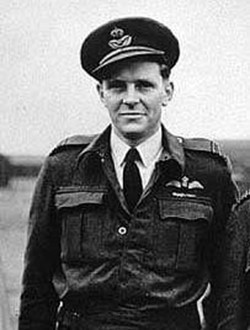 Image: Wing Commander Cosme Lockwood Gomm (Sussex Heritage)
Cosme Lockwood Gomm was born in Curitiba, Paraná, on 15 November 1913.
He moved to Britain and joined the RAF in 1933, serving in the Middle East, East Africa and Canada before the Second World War gave him harder flying to do.
The Anglo-Brazilian flew Whitley bombers on night operations with No. 77 Squadron, then transferred to night fighters with No. 604 Squadron, where he was credited with destroying several enemy aircraft and awarded the Distinguished Flying Cross in April 1941.
Promotion followed, command of RAF Colerne, conversion to four-engined aircraft, and a spell as a test pilot at RAF headquarters. At the end of 1942, Cosme became the first commanding officer of No. 467 Squadron, a newly formed, nominally Australian Royal Australian Air Force unit flying Lancasters from RAF Bottesford, crewed by airmen from across the Commonwealth.
By the accounts of those who served under him, Gomm was both a skilled pilot and a commander who felt every loss personally.
During a raid on the Zeppelin works at Friedrichshafen in June 1943, one of the earliest uses of the "Master Bomber" technique on a major operation, he took over direction of the attack after the original master bomber was forced to turn back, and the raid caused serious damage without a single Lancaster lost.
Two months earlier, Gomm had been given a harder task: nominating one of his own crews for a new, unnamed squadron forming at Scampton for a secret mission that was not expected to be especially dangerous.
He first asked Sergeant Frank Heavery's experienced crew, who narrowly voted to stay with 467 Squadron. He then asked the less experienced crew of Sergeant Vernon Byers, who transferred to the new 617 Squadron in March 1943.
Two months later, Byers and his crew became the first Dambusters lost on the Dams Raid, shot down off the Dutch coast on the night of 16 May 1943.
Gomm did not outlive them by long. On 15 August 1943, he led 467 Squadron towards Milan. His Lancaster, ED998, was shot down over France on the return flight. Gomm and all six of his crew were killed; the Commission's own record gives his age as 30.
His family in Brazil were told he was missing five days later; his death was confirmed only afterwards, through the International Red Cross.
He is buried at St Désir War Cemetery in Normandy; beneath a personal inscription his family chose:
The great adventure now begins; not dead but gone before. His name shall live evermore.
Curitiba has not forgotten him. A street in the Bigorrilho district, Rua Cosme Lockwood Gomm, carries his name, and the street beside it, Rua Isabel Withers Gomm, carries his mother's.
Vicenti Rodriques Silva
Vicenti was born in Brazil and went to sea as a cabin boy, one of the youngest and most junior roles aboard ship. Cabin boys' roles included serving meals, cleaning quarters, and carrying messages between officers and crew. He served aboard the British sailing barque Harold.
In July 1917, Harold left Liverpool with a cargo of coal, bound for the Brazilian port of Santos, a voyage that took her through waters patrolled by German submarines.
On 21 July, some 65 nautical miles off Tory Island, on Ireland's north-west coast, she was torpedoed by the German submarine U-66 and went down with 13 of her crew. Vicenti was only 20 years old.
His body was never recovered. He is commemorated on the Tower Hill Memorial in London, alongside his shipmates from that day, men born in Shetland, Chile, Norway, Wales and the United States among them, a reminder of how international a merchant crew could be on a single British vessel.
Vicenti is one of at least seven Brazilian-born seafarers named on the Tower Hill Memorial, each of them losing their lives while carrying the food, fuel and other supplies that kept the war effort moving.
Lieutenant Eugenio da Silva Possolo
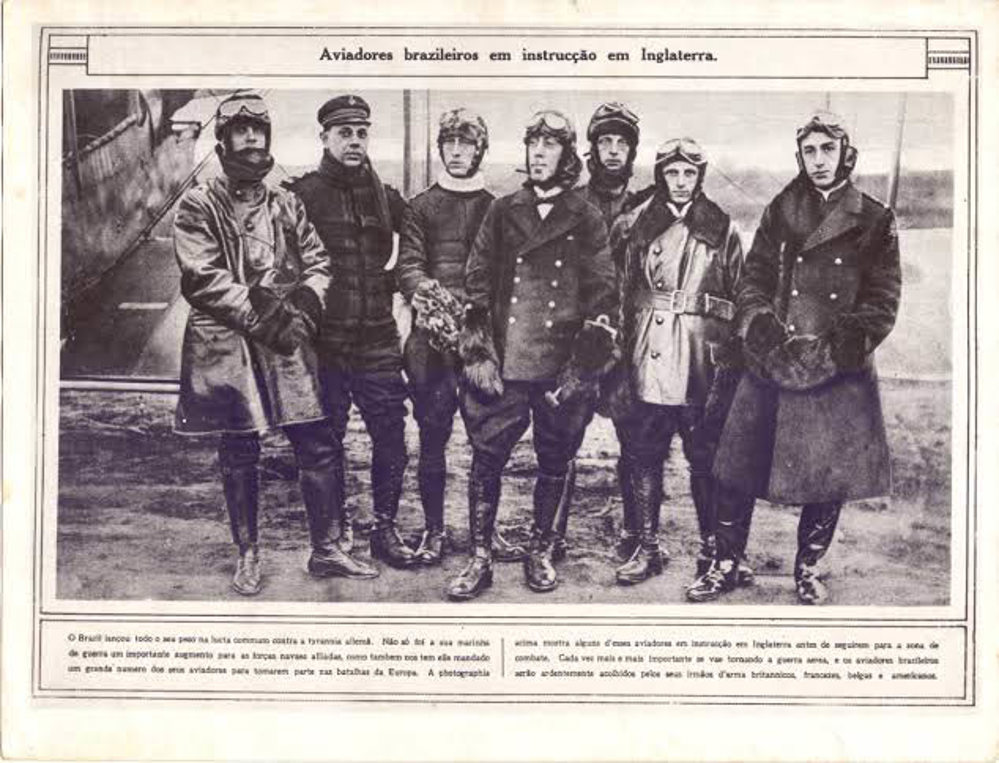
Image: Brazilian pilots with Eugenio central with the white collar (Sussex Heritage)
Eugenio da Silva Possolo was born in São Paulo on 10 August 1894.
He joined the Brazilian Navy as a teenager, when naval aviation was barely a decade old anywhere in the world, and in 1918 was chosen as one of thirteen Brazilian volunteers sent to Britain for flying training, twelve from the Navy, one from the Army.
Volunteers were required to be unmarried; flying training was considered too dangerous to risk leaving a widow behind. Possolo had married shortly before he left Brazil, without telling the Navy. Behind the story of the young officer sent overseas was, therefore, a wife waiting for his return.
He trained with No. 50 Training Depot Station of the Royal Air Force, based near Eastbourne, where he learned to fly the Sopwith Camel, fast and famously unforgiving, its engine, fuel and guns all crowded into a small space just ahead of the pilot.
On 5 September 1918, Possolo took off from Eastbourne aerodrome with two other Brazilian pilots and three British pilots for a formation-flying exercise.
The formation leader, Captain Frank Creasy, watched another Camel, flown by Lieutenant Reginald Sanders, climb to around 1,500 feet before diving back down and failing to see Possolo's aircraft in its path.
The two Camels collided and crashed near Friday Street Farmhouse. Both pilots, each 24 years old, were killed instantly.
A Sussex coroner recorded a verdict of accidental death.
Possolo was buried at Ocklynge Cemetery in Eastbourne, beneath a grey granite cross carved with a palm leaf. He is remembered as the first Brazilian airman to lose his life in service, a death that came within two months of the war's end, at the very beginning of Brazilian naval aviation.
In central Rio de Janeiro, a street is named ‘Rua Tenente Possolo’ in his honour.
Ernest Elmo de Vicq
Ernest Elmo de Vicq was 19 years old when he was killed in one of the largest battles of the First World War.
He served as Rifleman 202140 in the 1st/5th Battalion, The King's (Liverpool Regiment), part of the 55th (West Lancashire) Division, which had already fought at Festubert, Loos and the Somme.
His Commonwealth War Graves Commission record describes him as the son of Baron de Vicq and the late Baroness de Vicq, of Rio de Janeiro. This title very likely traces to the de Vicq de Cumptich family, hereditary Belgian barons whose descendants today live in Brazil in greater numbers than in Belgium itself.
At 5.40 am on 20 September 1917, Ernest’s battalion advanced during the Battle of the Menin Road Ridge, part of the wider Third Battle of Ypres, often known as the Battle of Passchendaele.
The plan was "bite and hold": take a limited objective, dig in, and break the expected German counter-attack, rather than force a breakthrough in a single move.
Ernest was killed in the fighting; no record survives of exactly where or how. His body was never identified.
Word reached Rio de Janeiro within weeks.
On 21 October 1917, the newspaper A Noite reported that Elmo de Vicq had been "killed in action" at Ypres. It announced a memorial service two days later at the Church of Nossa Senhora do Parto, on the corner of Rua São José and Rua Rodrigo Silva in central Rio.
Ernest has no known grave. His name is carved into the Tyne Cot Memorial in Belgium, among the tens of thousands of Commonwealth servicemen who died around Ypres and were never found in the same corner of Flanders that his father's family had left generations before.
Caring for Brazilian war dead
Today, the graves and memorials the CWGC cares for keep these connections visible. Through research, partnership and storytelling, the people behind the names can be remembered not only as casualties of war, but as individuals whose lives were part of a shared history between Brazil and the world.
Author acknowledgements
James Garbett is Area Marketing and Communications Lead at the Commonwealth War Graves Commission, leading on communications and engagement across Africa, Asia, the Americas, the Pacific, and the United Kingdom, to share the stories of those commemorated by the CWGC, helping connect new audiences with the Commission’s work around the world.
Jason Hsu is a Human Geography student at the University of Southampton with a strong interest in the global landscapes, histories and communities that shape the world, including the international footprint of the Commonwealth War Graves Commission.