

20 May 2026
Brookwood 1914-1918 Memorial: A New Chapter in Commemoration
In Brookwood Military Cemetery, a new memorial is taking shape. The new Brookwood 1914-1918 Memorial will be a fresh chapter in commemoration of missing casualties of the First World War.
Our war memorials commemorate missing servicemen, i.e., those with no known war grave or final resting place.
In the case, the Brookwood 1914-1918 Memorial is dedicated to missing Great War servicemen who died in the UK and Ireland during the Great War, but whose final resting places are unknown.
We have partnered with architectural practice Studio Wignall & Moore and internationally acclaimed garden designer Tom Stuart-Smith on this project.
The results will be a sustainably built memorial that will look entirely unlike any other CWGC memorial while still retaining the inspirational beauty and quiet dignity of our major sites.
Discover more about this exciting new chapter in Brookwood’s extensive history today.


At a glance: What's on This Page
This page covers the new Brookwood 1914-1918 Memorial, including:
- Why the Commonwealth War Graves Commission is building a new memorial
- Who the new Brookwood 1914-1918 Memorial commemorates
- Inspiration and rationale behind the memorial's design
- How sustainability and horticulture are interwoven into the Brookwood Memorial
- Ways to engage with Brookwood beyond the new memorial
- Frequently asked questions about the Brookwood 1914-1918 Memorial
Why is CWGC building a new memorial at Brookwood Military Cemetery?
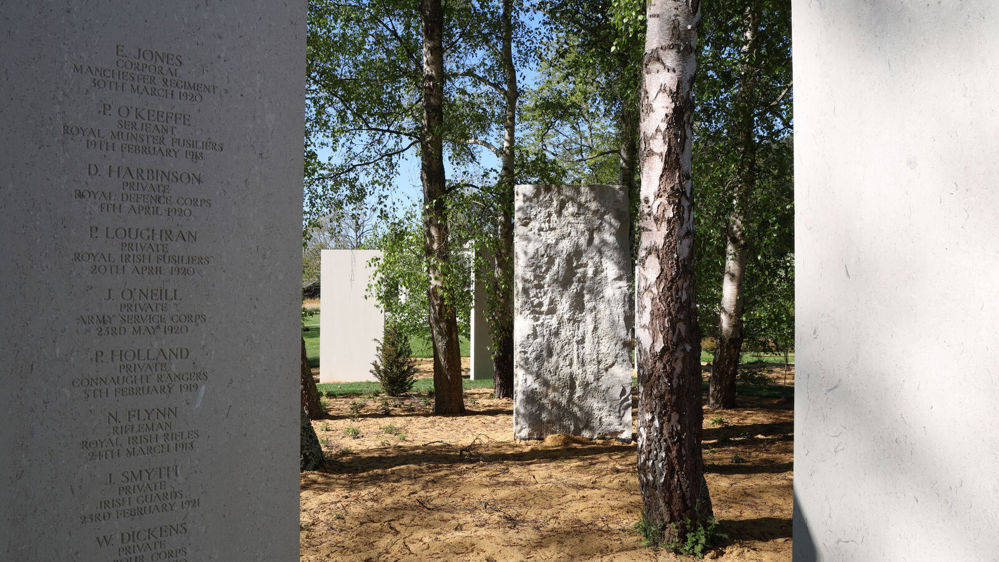
Image: The stone stelae of the new Brookwood 1914-1918 Memorial sit in an area of fresh woodland
The realisation of extensive research
The decision to build a new memorial at Brookwood Military Cemetery follows years of extensive research by our Commemorations Team, supported by volunteer researchers, including the In From the Cold Project.
Our work continues
In 2015, the original Brookwood 1914-1918 Memorial was unveiled, commemorating more than 200 servicemen who died in the UK with no known war grave.
Since then, the names of more missing servicemen have been discovered and identified, while the burial locations of previously missing Brookwood Memorial casualties have been discovered.
The new 1914-1918 Memorial is a response to this pioneering research and commemorative work. Since our founding in 1917, it has been our duty to ensure all those lost in service to the British Empire in the World Wars are commemorated by name.
A memorial that can grow
As our work never stops, and new servicemen and women’s names are discovered, the Brookwood 1914-1918 Memorial will have room to accommodate them.
Space and flexibility have been provided to add names as they are discovered and to remove them as and when new war graves are found and marked.
The 1914-1918 Memorial is a reminder that commemoration is not fixed: it’s an ongoing responsibility to remember, to research, and to honour each of the Commonwealth’s war dead.
Who does the new Brookwood memorial commemorate?
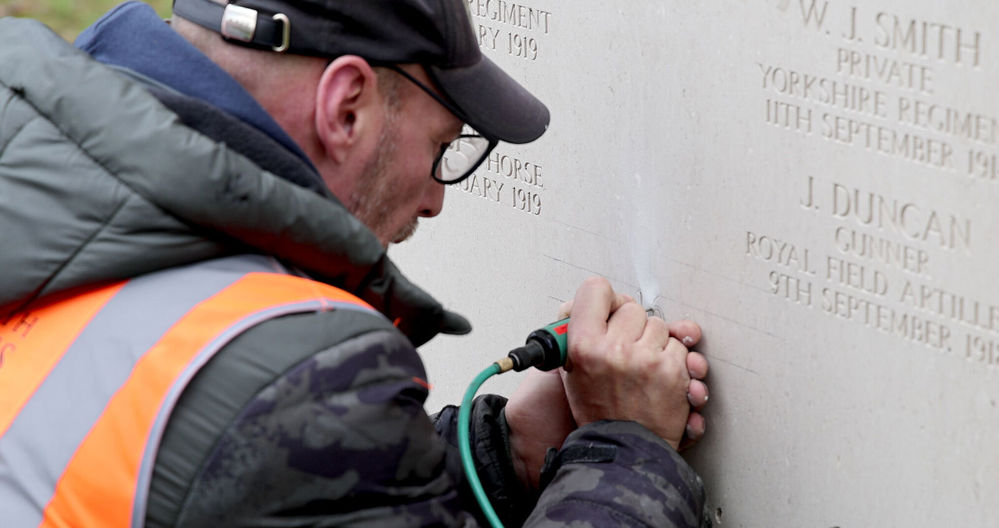
Image: Fresh names are carefully etched into stone
400 new names
Research submitted by the In From the Cold project and the ongoing work of our Commemorations Team has revealed 400 names for inclusion on the new Brookwood memorial.
Using local archives, death certificates, and military records, we can identify and properly commemorate these previously non-commemorated Great War service personnel.
The missing of the First World War
More than 1.1 million British and Commonwealth service personnel died during the First World War. Approximately half have no known war grave or final resting place.
These men and women are known as the missing, i.e., those killed in battle, lost at sea, or whose graves were destroyed or could not be identified.
Their names are commemorated, etched in stone and cast in bronze, on CWGC war memorials around the world. Through architecture, landscape and symbolism, these powerful points of commemoration express sacrifice, loss, and a commitment to remember.
Rectifying historic lapses in commemoration
In 1920, the Commonwealth War Graves Commission assumed responsibility for eligible war graves in the UK. While every effort was made to uncover local war graves, such as those buried in municipal cemeteries, churchyards and burial grounds, it became clear that some had been missed.
These were typically servicemen buried by their families locally, but in such a way that proper documentation and paper trails pointing to their final resting places were initially missed by CWGC surveyors in the 1920s.
Not only has the research of the Commemorations Team uncovered new names for inclusion on the memorial, but it has also revealed the burial locations and war graves of some casualties named on the memorial’s previous incarnation.
Together, these twin pillars of research have enabled us to properly commemorate these missing or newly discovered service personnel, either by carving their names onto memorial stelae or by placing CWGC headstones at their graves.
Landscape and Commemoration: How horticulture and landscape design shape Brookwood 1914-1918 Memorial
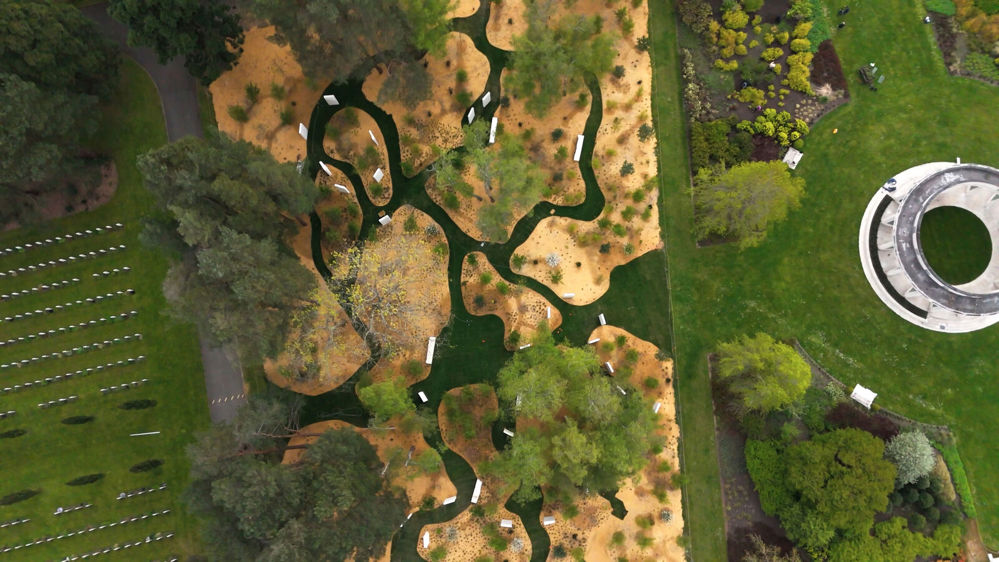
Image: A bird's eye view of the new memorial. In time, the sandy plots will be rich with hardy, lush plantlife and trees
In Stone, Sky and Landscape
A thoughtful, considered approach was taken to develop the new memorial with our partners Studio Wignall & Moore and Tom Stuart-Smith. Rather than a single, static memorial, the space is forward-thinking and will evolve as more names are uncovered and the horticulture blooms.
Adaptability is at the heart of the Brookwood 1914-1918 Memorial’s design.
To the stars
30 Portland stone stelae and a stelae acting as a dedication form the core of the memorial. These provide space for the existing names, as well as leaving areas for new ones to be added. With some stelae remaining uninscribed, we will be able to add newly identified casualties for commemoration as soon as they are discovered.
A subtle celestial theme has been woven into the memorial layout. The stelae are erected, mirroring the position of stars in the night sky as they were on 11 November 1918. Each stellate has been discretely named after a bright star visible at that moment, linking earthly loss with a permanent shared sky.
The inclusion of the celestial element in the Brookwood Memorial from the architect’s wider exploration of how commemoration can be connected to time and place. It was developed with aid from the Royal Astronomical Society to ensure the layout was accurate but also respectful and appropriate for a commemorative setting.
Legacies carved in stone
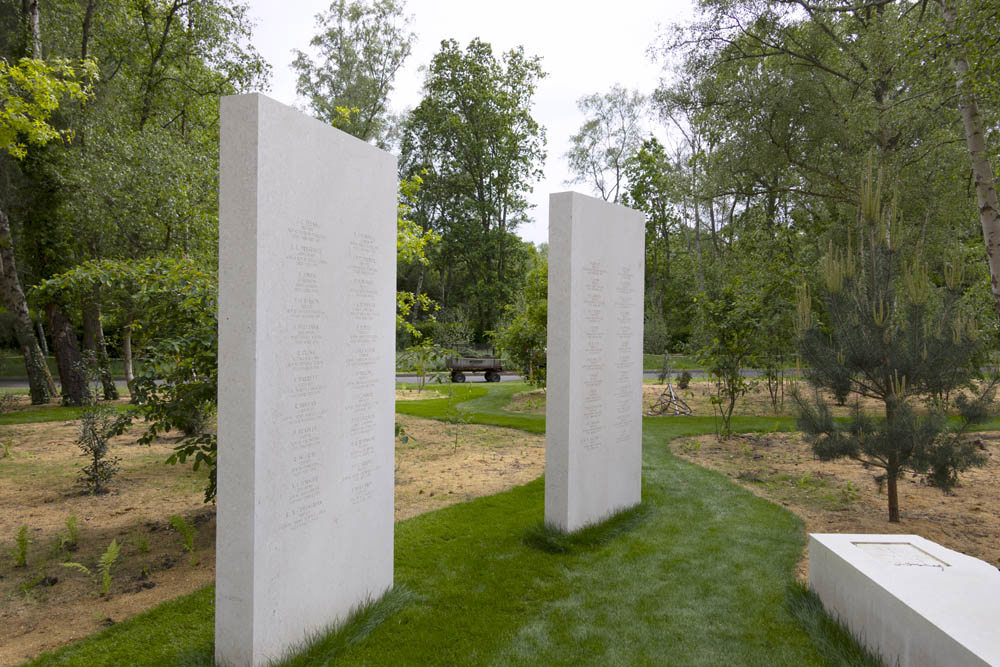
Image: Hundreds of names will be carved into the Portland stone stelae at Brookwood with room for more
Portland stone is one of our most iconic building materials, used in the construction of our headstones and major war memorials. But at Brookwood, the material takes on a new significance, expressing geological and human time.
Carved from the largest available blocks, with dimensions shaped by the limits of the Dorset quarry, eight stelae retain unfinished quarry faces. This allows visitors to encounter the stone in its raw state, speaking quietly of endurance, process, and the passage of time.
Visitors are also invited to pause and reflect on one of six monolithic Portland stone benches. These have been carefully arranged to align with the arc of the sun, where visitors can sit on lives lost but still remembered.
The stone elements of the memorial work in tandem with the horticulture to reflect our ongoing mission and tradition of commemoration for a new century, placed within an evolving landscape context.
Sustainability and horticulture at the Brookwood 1914-1918 Memorial
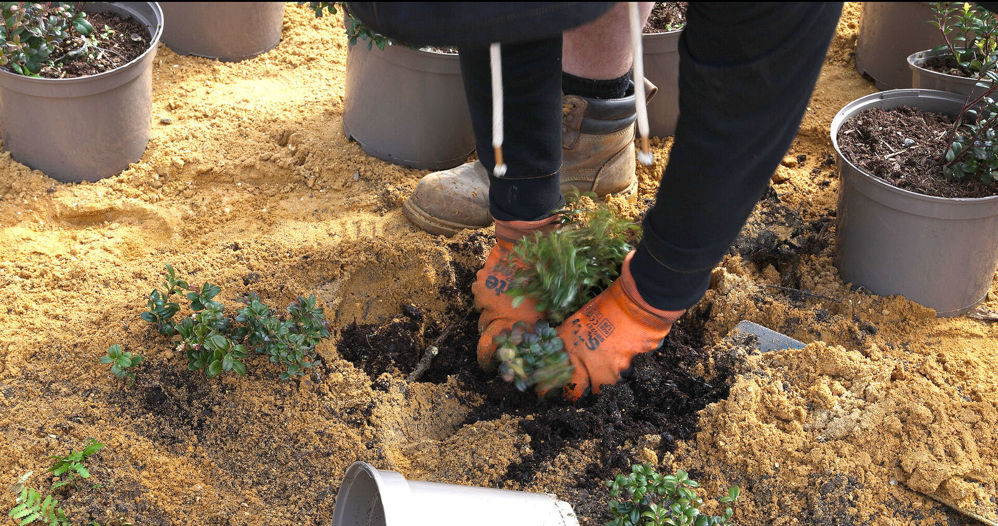
Image: Some of the first plantings are made at the new Brookwood Memorial
A growing memorial landscape
Conceived as a memorial that grows from its setting, rather than being imposed on it, the memorial design blends sky, stone, and plant life together. At the time of writing, the plants are bedding in, but in time will grow into a tranquil woodland environment and the perfect commemorative space.
At Brookwood, architecture and nature are inseparable, working together to create an ever-developing, evolving and growing memorial landscape.
A woodland setting
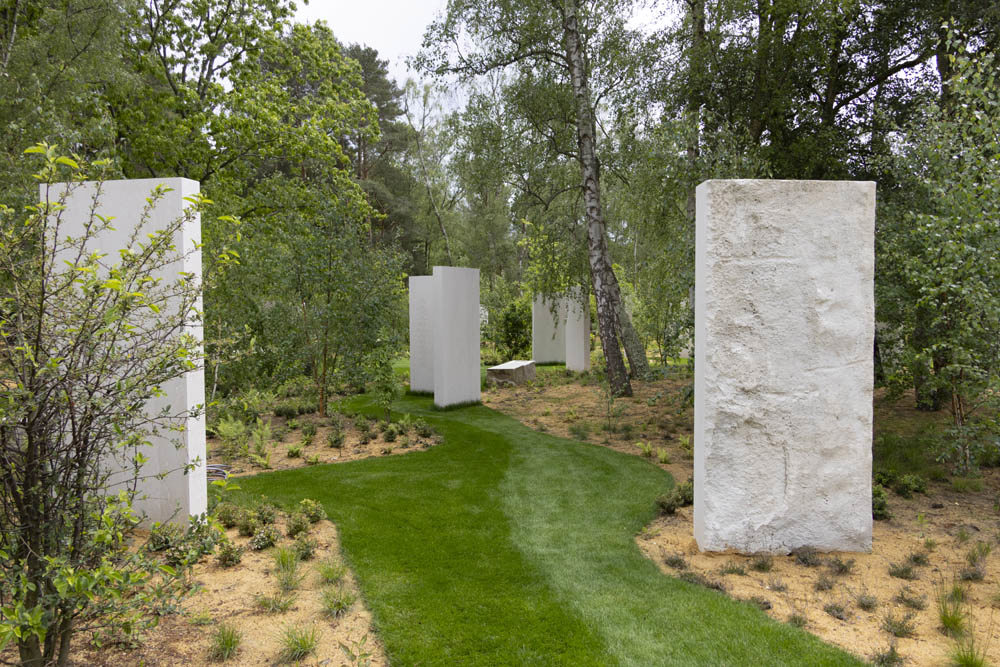
Image: Newly planted shrubs sit beneath trees next to the stone stelae. In time, the memorial will blossom into a tranquil woodland landscape
Guided by Tom Stuart-Smith and our own in-house horticultural experts, the Brookwood memorial vision will see it bloom into a stunning yet tranquil woodland. Broad sweeps of conifers and silver birch will be planted with as many as 600 new trees taking root around Brookwood.
Trees are an integral part of sustainable, biodiverse landscapes. Once mature, they will provide shelter and food for local wildlife and shading for visitors, while also aiding soil health across the memorial complex.
We also plan to include several species of wildflowers to add splashes of colour around the site, while attracting pollinators to again foster biodiversity.
Sustainable solutions for an evolving memorial
Sustainability is core to our ongoing operations at CWGC, and the Brookwood 191401918 Memorial was designed with this in mind.
Horticulture provides a big part of our sustainability plans for the new memorial. For example, low-nutrient sand has been carefully introduced to naturally foster resilience within our plant life. We have chosen plants that have adapted to lean conditions to help create a balanced ecosystem, one that helps us carefully monitor water usage but also encourages biodiversity.
Biodiversity is an essential addition to the memorial landscape. It helps us respond to environmental changes and, when coupled with our ongoing long-term care, should flourish into a beautiful space that inspires and delights.
We are not rewilding. We’re introducing a more sustainable and environmentally resilient planting that complements our places, spaces and formal landscapes. It is an evolution of our approach, one hundred years on, and not a replacement for what we know people love and value.
Other sustainability flourishes included using ground-up stone leftover from the demolition of the previous Brookwood 1914-1918 Memorial for use in this project and other CWGC initiatives around the world.
Why Brookwood is the perfect place for this new memorial
CWGC’s largest UK war cemetery
The Brookwood 1914-1918 Memorial lies within Brookwood Military Cemetery, the largest CWGC cemetery in the United Kingdom. Today, the cemetery is home to over 5,000 Commonwealth war graves and 800 war graves of other nationalities.
Those buried here represent all major service branches and all six CWGC member governments: Australia, Canada, India, New Zealand, South Africa, and the United Kingdom. Brookwood also contains burials of Belgian, Czechoslovakian, French, German, Italian, and Polish servicemen.
A memorial within the greater Brookwood site
Brookwood’s prominence makes it the ideal place to build this new memorial.
The 1914-1918 Memorial will slot seamlessly into the wider cemetery context, adding to Brookwood’s already extensive commemoration of our shared war dead.
Brookwood has represented our extensive past, but now it has come to emblemise our future as a forward-thinking, proactive organisation.
Exploring Brookwood beyond the memorial
The For Evermore App
The For Evermore App contains virtual and in-person tours and stories of those we commemorate at Brookwood.
We have curated a 60-minute, 17-stop walking tour of Brookwood Military Cemetery that will take you through Brookwood, explain its history, and share some of the captivating stories of servicemen commemorated here.
Download the For Evermore App for free today and enhance your Brookwood visit.
Browsing and sharing on For Evermore: Our online storytelling platform
For Evermore: Stories of the Fallen is our digital stories archive where we collect the stories of the war dead from both world wars commemorated by the Commonwealth War Graves Commission.
For Evermore: Stories of the Fallen is your opportunity to remember the stories that mean the most to you. Tell us about a relative, loved one or someone you have researched who today is commemorated at one of our cemeteries and memorials around the world.
We’ll collate your stories to create a single, searchable repository that honours the memory of the men and women across the Commonwealth who lost their lives during the world wars and ensure that these stories are available for the generations to come.
Head over to For Evermore to share your stories of those commemorated at Brookwood today.
Frequently Asked Questions
The memorial unveiled in 2015 honoured First World War casualties who died in the United Kingdom and Ireland and have no known grave. Since then, we have discovered more casualties for commemoration and furthermore, we have located the final resting places of some of those listed on the previous memorial, which is why a new memorial is now needed: to ensure every individual is remembered and commemorated.
400 service personnel will be commemorated on the new memorial. As research progresses, additional names will be added, with space available to record up to 1,200 names.
Many names were uncovered in the last decade by the In From The Cold Project, volunteers who combed military records, death certificates, and local archives.
In addition, the Commission has located the graves of approximately 250 servicemen and women who were previously commemorated on the memorial. These casualties will now be honoured at their original burial locations. This vital work – locating casualty graves and ensuring appropriate commemoration - restores their place of remembrance within the communities where they were originally laid to rest. Over 100 years later, our work continues.
Sustainability has been woven through every stage at this project.
Names will be engraved on sustainably sourced Portland stone, that uses all parts of the quarried stone, with normally wasted off cuts being used as seating. The stone from the previous memorial will be sent to local craft colleges.
The surrounding landscape uses wildflowers and pollinator friendly planting to support biodiversity and create a tranquil, living habitat. We will plant over 600 trees in the scheme.
No, only the area we are working in will be closed during construction, the majority of the site and all graves will remain open for visitors throughout the works.
This memorial has been designed by Studio Wignall & Moore, working closely with internationally acclaimed landscape Architect Tom Stuart-Smith.
The design honours the fallen while enhancing the natural environment. The memorial’s stone tablets are arranged to mirror the pattern of stars as they appeared on 11 November 1918: the night the Armistice came into effect on the Western Front. Set within carefully landscaped grounds, the design strikes a balance between solemn remembrance and a biodiverse, peaceful environment for reflection.
A stele (STEE-lee) is a stone slab, generally taller than it is wide, erected in the ancient world as a monument. The surface of the stele often has text, ornamentation, or both. These may be inscribed, carved in relief, or painted. Here at Brookwood we are using large stone Stele with the names of the missing engraved into the surface.
This new memorial marks the beginning of an important new chapter for Brookwood. We’ll be sharing regular updates on the construction process across our social media channels and here on our website, giving you a behind-the-scenes look at how a memorial of this significance is brought to life by our team of experts. Make sure you are signed up to our newsletter here.
Brookwood is more than a place of remembrance; it’s a living, breathing community dedicated to honouring history.
Here’s how you can be part of it:
Join our events
From moving commemorative services to uplifting concerts, Brookwood Military Cemetery hosts a vibrant calendar of events that bring people together in remembrance and celebration.
Volunteer with us
Lend your time, skills, and passion. Whether you have green fingers for gardening or a voice for storytelling, there’s a place for you in our volunteer family.
Support The Commonwealth War Graves Foundation
Join our charitable foundation or make a donation to help us inspire the next generation. Your support fuels our education and outreach work, ensuring the stories of those we commemorate are never forgotten.
Author acknowledgements
Alec Malloy is a CWGC Digital Content Executive. He has worked at the Commonwealth War Graves Commission since February 2022. During that time, he has written extensively about the World Wars, including major battles, casualty stories, and the Commission's work commemorating 1.7 million war dead worldwide.