

14 September 2026
Cairo Panels and Lesser-Known Memorials: CWGC Cares for More Than Cemeteries
You may not realise it, but the Commonwealth War Graves Commission cares for more than just war cemeteries and war graves.
Our remit is to care for the final resting places and points of commemoration for over 1.7 million Commonwealth men and women worldwide. Often, these places are not simple war cemeteries but wider spaces featuring other forms of commemoration.
Take Cairo War Memorial Cemetery. As well as rows of iconic CWGC headstones, this location features name panels and special memorials, showcasing other ways we commemorate the Commonwealth’s war dead.
Join us as we look at how the Cairo War Memorial Cemetery combines war graves, war memorial name panels, and special memorials for an almost holistic approach to commemoration.
At a glance: What's on this page
This page looks at Cairo War Cemetery and different forms of commemoration around the Commonwealth War Graves Commission, including:
How CWGC cares for more than just war cemeteries
What counts as a place of commemoration
Cairo War Memorial Cemetery and how it offers more than just war graves
Egyptian sites without war graves
How we care for lesser-known sites worldwide
Why some names are on war memorials
How to find names in CWGC records
Myth: CWGC only cares for cemeteries
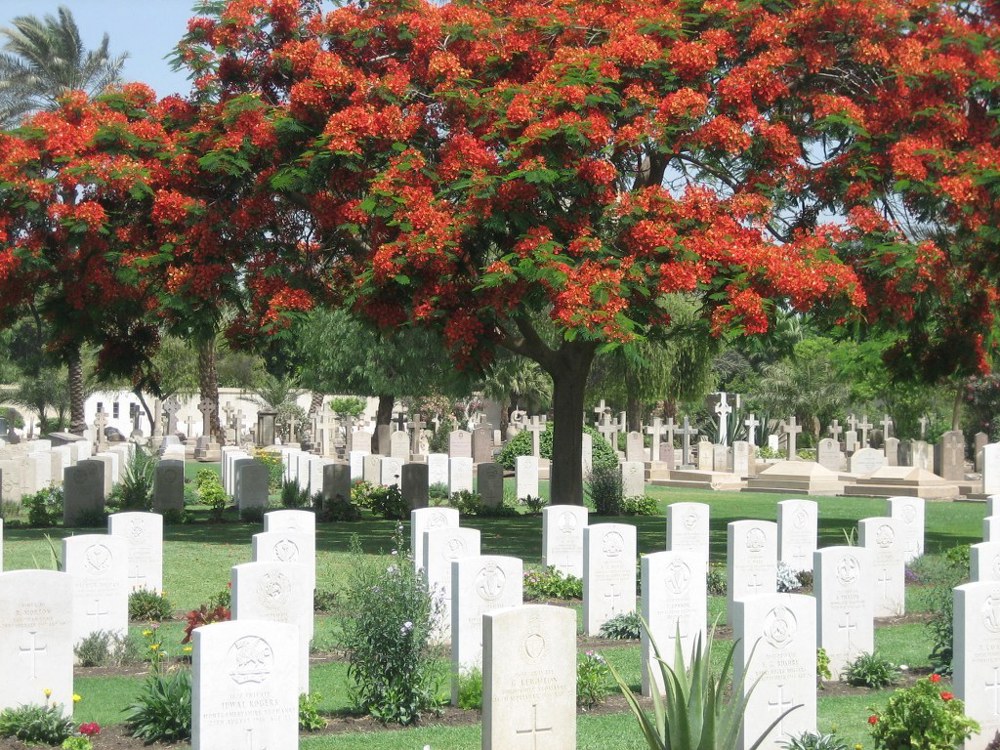
Image: Cairo War Memorial Cemetery is just one of many, many sites cared for by CWGC
If you thought the Commonwealth War Graves Commission cares for just war cemeteries, think again.
Cemeteries are central but not the whole story
Our war cemeteries are perhaps the most visible spaces, but they are not the only way we commemorate the Commonwealth’s dead of the World Wars.
Around 500,000 or so of the men and women in our care have no known war grave, thus aren’t necessarily buried in a CWGC cemetery. They may very well lie alongside their comrades in a war grave, but sadly not every casualty could be identified upon recovery or burial.
Our records state where and how the Commonwealth’s war dead are commemorated.
Care across many types of places
With sites in more than 23,000 locations in over 155 countries and territories, we can’t apply a one-size-fits-all approach to commemoration. Geography and history combined for some interesting results.
We have a global network of commemorative spaces, including individual war graves in local churchyards and burial grounds, monumental memorials to the missing, special memorials and more.
Wherever and whatever the layout and form of our sites, they are all diligently cared for by a global network of horticulturalists, gardeners and skilled craftspeople.
While our sites’ features make them easily recognisable, each layout is unique and may combine different forms of commemoration in one place, such as at Cairo War Memorial Cemetery.
What counts as a place of commemoration?
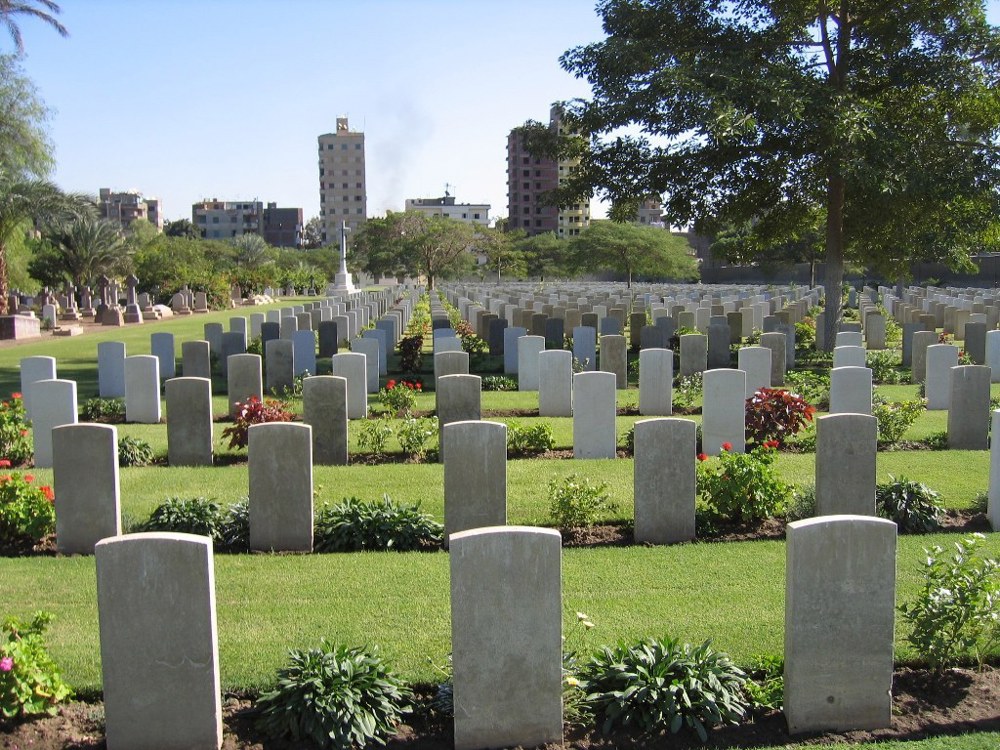
Image: Cairo War Memorial Cemetery contains several different points of commemoration, from headstones to special memorials
The Commonwealth War Graves Commission maintains various places of commemoration around the world.
Graves and cemeteries
The most commonly known CWGC location is our purpose-built war cemeteries complete with CWGC headstones.
Over 1.1 million burials worldwide have a CWGC war grave and headstone.
Our dedicated military cemeteries were constructed specifically to hold the remains of Commonwealth servicemen and women of the two world wars.
In the case of Cairo War Memorial Cemetery, it holds over 2,000 First World War and 340 Second World War burials.
You may also find CWGC plots in your local burial grounds or churchyards, due to:
Families opting to have their loved ones buried close to home instead of a military cemetery overseas.
Many casualties succumbed to wounds or sickness at local wartime hospitals, casualty clearing stations, or nearby airfields, and were buried in the closest available civilian cemetery.
May have died in an accident or on training and buried nearby
May have been shot down over enemy territory or their remains swept ashore and been recovered for local burial
Memorials to the missing
Sadly, not every serviceman or woman’s remains were able to be recovered or identified upon recovery.
As such, these individuals have no known war grave.
To commemorate these people by name, in accordance with our commemoration policies, war memorials were constructed around the world.
Our memorials to the missing are the points of commemoration for individuals who have no known war grave. This includes memorials dedicated to pilots and air service personnel whose remains were never recovered, and our naval memorials, commemorating those souls lost to the deep.
Special memorials
Special memorials are headstones or markers placed to commemorate service personnel whose exact burial place is lost, unknown, or unmaintainable.
Common inscriptions on our special memorials include:
"Buried elsewhere in this cemetery" - The person is in the graveyard, but the exact plot is lost.
"Believed to be buried in this cemetery" - There is strong evidence of the burial, but absolute confirmation is missing.
"Buried in [Name] Cemetery" - The original grave site was elsewhere and unmaintainable, so they are commemorated nearby.
Graves may have been lost when burials were brought in from smaller cemeteries and concentrated into one larger site, for example. Others for when their original burial ground proved too difficult to maintain.
Cairo War Memorial Cemetery holds a special memorial dedicated to a small number of casualties known to have been buried in other civil cemeteries in Cairo but are now lost.
Name panels
Typically, name panels are the central commemorative feature of CWGC war memorials.
However, there are some examples where the original memorial has been replaced or removed; thus, the name panels have been moved to a different location.
Moving the panels in this way ensures the service personnel they name remain properly commemorated as per our policies and philosophy.
Cairo War Memorial Cemetery: More Than Rows of Graves
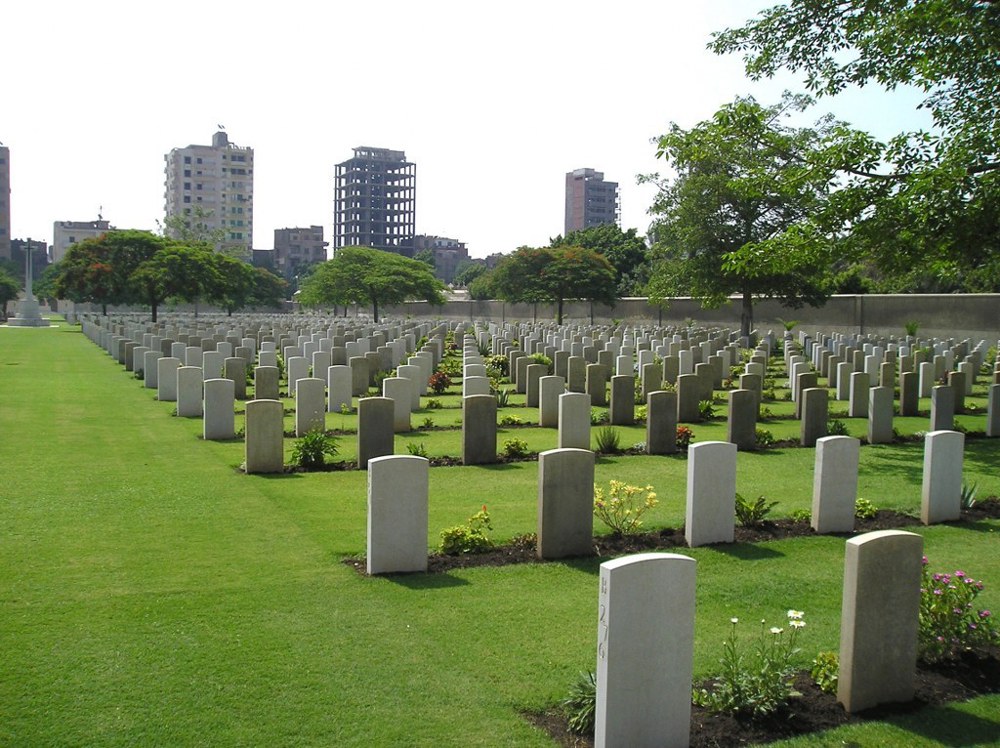
Image: Headstones are just one method of commemorating our war dead we use at Cairo War Memorial Cemetery
Cairo War Memorial Cemetery is a good example of a cemetery where different types of commemoration meet. In fact, Egypt is a good location to investigate, as commemoration takes various forms here, which we will explore later.
Buried and commemorated at the same site
As we touched on above, Cairo War Memorial Cemetery contains over 2,400 Commonwealth World War burials.
Designed by Sir Robert Lorimer, the site was formerly part of the New British Protestant Cemetery. Part of the older cemetery was given over to the Commission in 1920.
Egypt was a hub of military activity in the First World War. Control of the Suez Canal was vital for keeping the flow of men and materiel around the British Empire constant.
Alongside Alexandria, Cairo became a main hospital centre for the ill-fated Gallipoli Campaign in 1915. It later dealt with the sick and wounded from military operations in Egypt itself, particularly the defence of the Suez Canal from Ottoman attack, and campaigns in Palestine and the Middle East.
Come the Second World War, Cairo was the home of General Headquarters, Middle East Command. An RAF Sector Headquarters was established there in 1941, and Cairo continued as a significant medical centre.
Six of the major Commonwealth members are represented among the burials, where British, Australian, Indian, New Zealand, and South African servicemen lay side by side. Several Polish servicemen’s graves are maintained here too.
Special memorials for lost graves
Special memorials are erected in CWGC cemeteries to commemorate servicemen believed to be buried at a site but can’t be located or identified, or whose original place of burial was unmaintainable and so are commemorated nearby.
A special memorial at Cairo War Memorial Cemetery is dedicated to those who were buried in other Cairo civil cemeteries, but whose graves are now lost, including:
Cairo (Basatin) Jewish Cemetery
Old Cairo Jewish Cemetery
Cairo Maronite Cemetery
Cairo Civil International Cemetery
Old Cairo New Latin Cemetery

Want more stories like this delivered directly to your inbox? Sign up for our newsletter for regular updates on the work of Commonwealth War Graves, blogs, event news, and more.
Sign UpCairo Panels and Memorials Without Familiar Grave Rows
Egypt features a few CWGC locations that differ from the norm.
Giza Memorial and panels without names
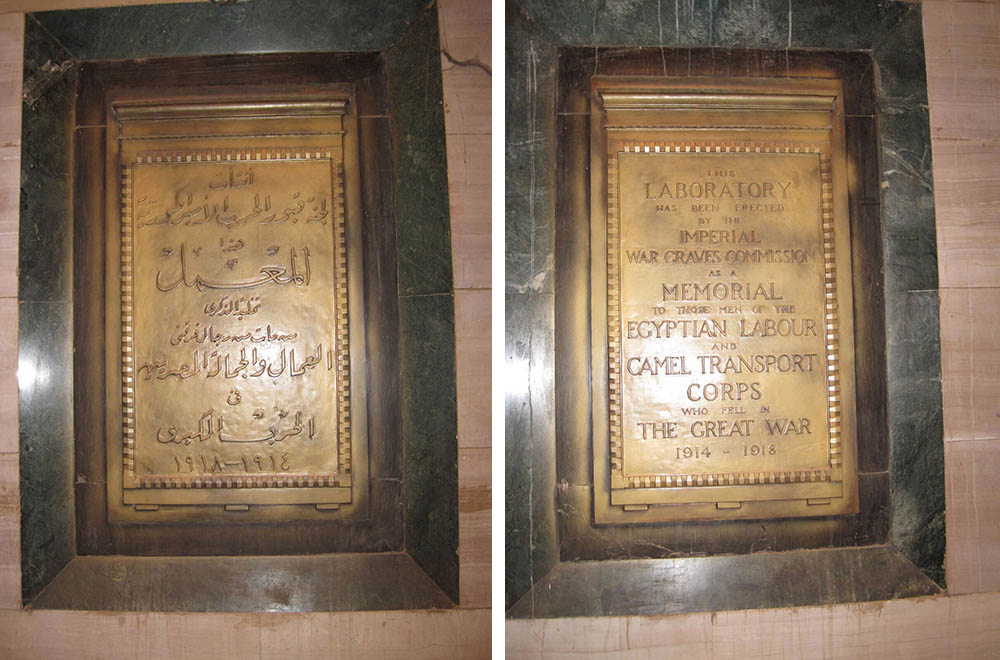
Image: Some of the bronze panels that make up the Cairo Memorial
The Giza Memorial is perhaps the most unique CWGC memorial of them all.
When it came time to commemorate the service and loss of those Egyptians who had supported the British Empire Forces in the Egyptian Labour Corps (ELC) and Camel Transport Corps (CTC), the Commission and local authorities were met with a major challenge.
Approximately 125,000 Egyptian Men served in the ELC and CTC, but it’s estimated that between 10,000 and 50,000 lost their lives during the First World War.
Contemporary record-keeping failed to document the names of these men, making their commemoration by name impossible without extensive research.
Debate continued for some time between the Commission and the Egyptian authorities over the most appropriate way to honour and commemorate these men. Originally, a memorial mosque was planned but, Cairo being replete with mosques of all shapes and sizes, a more practical option was sought.
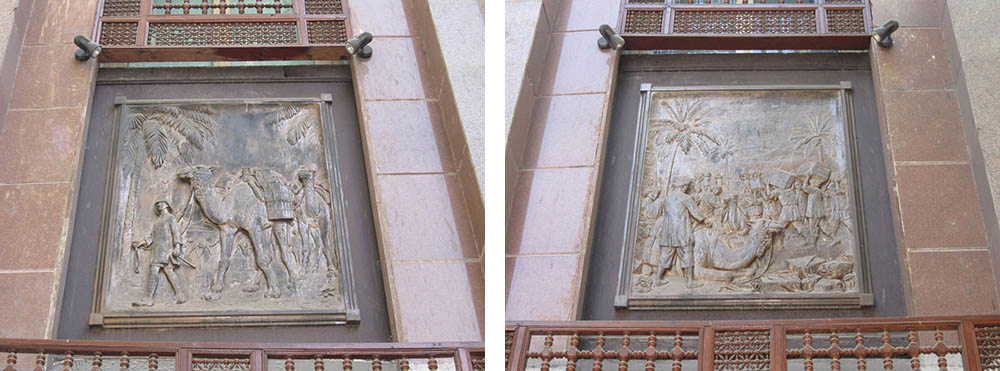
Image: Scenes of logistical troops captured in bronze in tribute to Egyptian servicemen
Finally, after lengthy consultations, the erection of a separate ‘memorial laboratory’ at the new ophthalmic hospital being built at Giza, Cairo, was decided.
The laboratory would be used for postgraduate training of Egyptian doctors in ophthalmic work. The memorial building was designed by Noel Dawson and includes two bronze panels depicting the work of the Egyptian Labour Corps and Camel Transport Corps.
The laboratory, which is still in operation today as part of the Egyptian Research Institute of Ophthalmology, has continued to be used to train doctors and treat eye diseases for nearly 100 years.
Heliopolis and relocated memorial panels
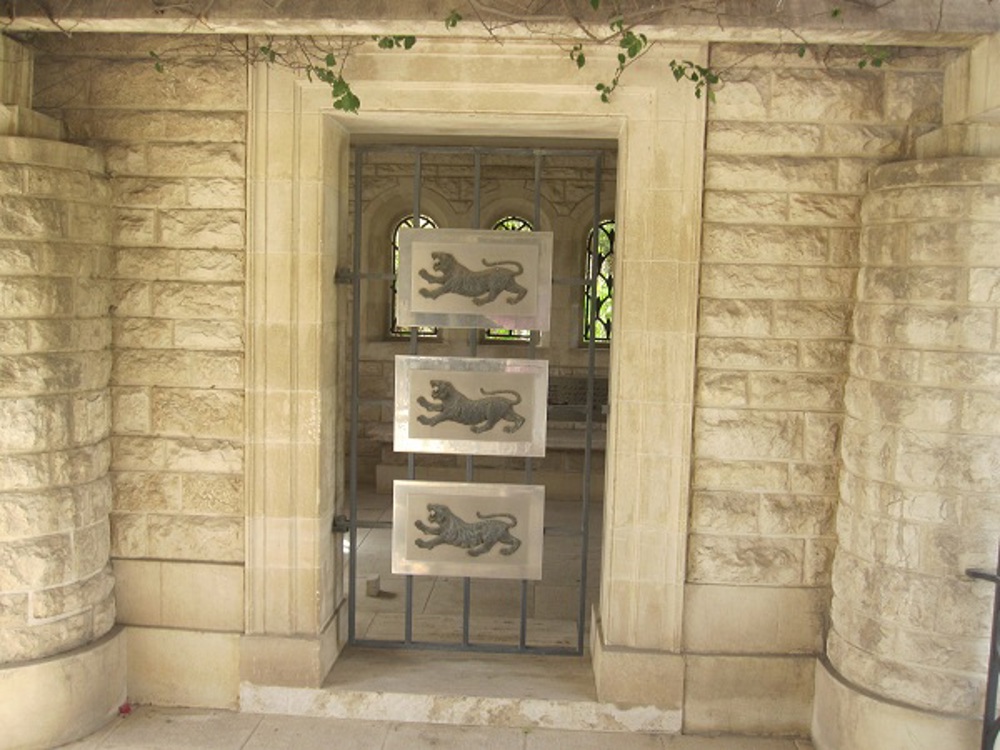 Image: The relocated bronze lions of Port Tewfik, roaring to this day
More than 5,000 Indian Army personnel of the First World War are buried or commemorated in Egypt. Over 3,000 are commemorated at a single site: the Heliopolis (Port Tewfik) Memorial.
For more than half a century, the memorial’s twin crouching tiger guardians stood fiercely over the mouth of the mighty Imperial artery of the Suez Canal, coiled, ready to strike, calling on passers-by to remember the more than 3,000 Indian soldiers of the Great War who died in Egypt and Palestine.
Sadly, the original memorial was damaged beyond repair during the 1967 Arab-Israeli War. Its tigers were no longer so fierce.
In the 1970s, after attempts to repair the memorial proved fruitless, the decision was made to rebuild the Heliopolis (Port Tewfik) Memorial within the grounds of Heliopolis War Cemetery in Cairo, 75 miles away from its original location.
The Commission also took the time to restore a historic inequality in commemoration when rebuilding the memorial.
When originally unveiled in 1926, the memorial commemorated no service personnel by name. Only units and regiments were mentioned, as Colonial and Army records were unsatisfactory to the Commission's requirements.
With the correct records found and names added to the registry, the Commission was able to properly commemorate each of the 3,700 officers and enlisted men by name.
Three bronze tiger plaques were added to the memorial once reconstructed, still snarling, still defiant, still in commemoration of the men of the Indian Army who never left Egypt and Palestine in the Great War.
Kantara and panels for those commemorated elsewhere
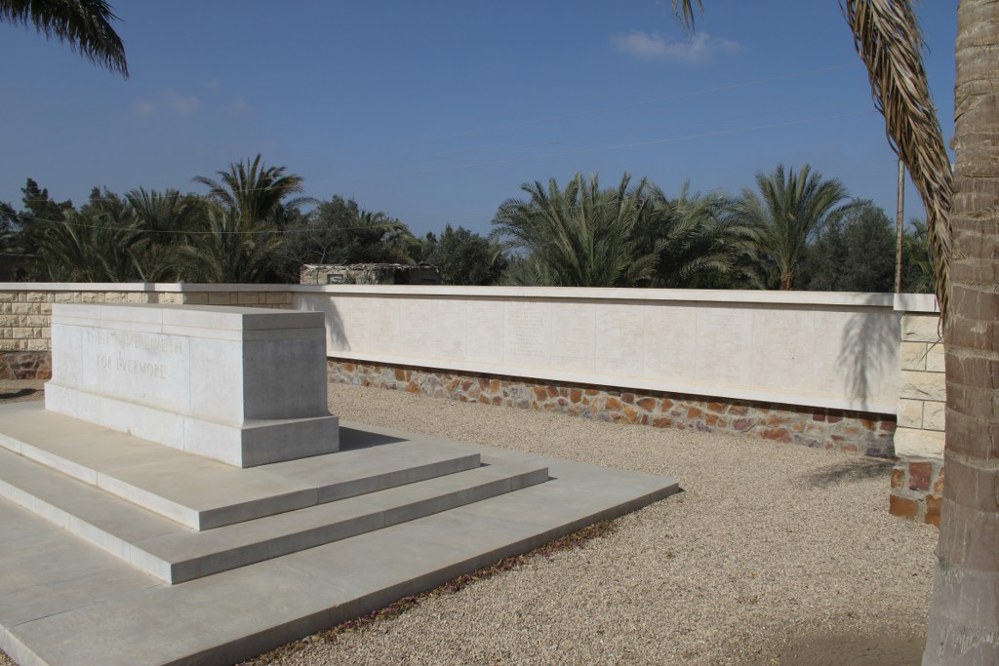
Image: Kantara Indian Cemetery Memorial behind the Stone of Remembrance
Special memorials typically take the form of a standard CWGC headstone, inscribed with the names of several service personnel.
But at Kantara War Memorial Cemetery, the memorial takes on a different form: several large name panels installed on the rear cemetery wall as the Kantara Indian Army Memorial.
Kantara War Cemetery lies on the eastern side of the Suez Canal, some 160 kilometres northeast of Cairo, in the city of El-Qantara.
During the First World War, Kantara was an important defensive point for repelling Ottoman attacks on the Suez Canal. It developed into a major base and medical hub and remained active until the late 1920s.
The Second World War again saw Kantara as a hospital centre. No 1 General Hospital was there from July 1941 to December 1945, and two others, Nos 41 and 92, were there in turn for varying periods. One of the major Allied medical units in the area, No 8 Polish General Hospital, adjoined the war cemetery.
An Indian Army cemetery was established in the First World War, but over time, sadly became inaccessible and unmaintainable.
In 1961, it was decided that the 260 or so at Kantara Indian War Cemetery would be commemorated at Kantara War Memorial Cemetery.
Originally, the memorial had a general inscription with the names recorded in a register.
In 2000, the decision was made to give these Indian servicemen a permanent point of commemoration. Multiple name panels, commemorating each man by name carved in stone, were installed in the cemetery’s rear wall.
At the cemetery entrance, you will also notice a smaller memorial panel, bearing the white fern of Aotearoa New Zealand.
This is the Kantara Memorial. It bears the names of 16 New Zealand servicemen of the First World War who died in actions at Rumani and Rafa, and who have no known grave.
Why Some Names Are On Memorials, Not War Graves
Over 750,000 Commonwealth servicemen and women are commemorated by name on our war memorials and special memorials. These are individuals with no known war grave.
No Known War Grave
Individuals may have no known war grave for several reasons:
Unable to be identified upon recovery
Were lost at sea or shot down over enemy territory
Died in concentration or prison camps and their remains were not recoverable
Their remains were never recovered initially
Their war graves have become lost, inaccessible, or unmaintainable
Individuals with no known war grave may be buried in a CWGC war grave. Typically, their headstone will read along the lines of “A Soldier of the Great War Known unto God”.
They are commemorated by name on special memorials and war memorials around the world.
For example, naval casualties lost to the deep are commemorated on our naval memorials. Likewise, air force personnel lost on operations over Northwest Europe are commemorated by name on the Runnymede memorial.
When a grave is lost or cannot be maintained
Every effort is made to protect the final resting places of the men and women commemorated by the Commonwealth War Graves Commission.
If a grave is lost or cannot be maintained, we will find alternative methods of commemoration. Typically, this will take the form of an inscription on a special memorial or memorial panel.
Otherwise, circumstances may dictate a larger, permanent solution, such as the Kantara Indian Army Memorial detailed above.
How records connect names to places
The name of each Commonwealth individual who died in military service in the World Wars is kept in our records. You can use these to cross-reference their place of burial.
If an individual is buried in a war cemetery, burial ground, or local churchyard, they will have a CWGC war grave and headstone or grave marker. If an individual is recorded as commemorated on a war memorial, then they will have no known war grave, or their grave has been lost or could not be maintained.
How CWGC Cares for Memorial Panels and Lesser-Known Places
The same high standards of care are applied to all of our locations, from the most famous like Thiepval to the lesser-known sites mentioned in this article.
Caring for names and inscriptions
Legibility of names is very important for us. If a name on a headstone or memorial name panel becomes illegible, it will be altered and restored so the text can be clearly read.
Often, this involves reengraving on-site. Only in the most extreme circumstances will we fully replace a headstone or memorial panel.
Caring for memorial fabric
Our stonemasons, metalworkers, carpenters and skilled craftspeople are experts in the maintenance and care of the memorial fabric and materials we employ.
We pursue a policy of conservation for all our sites. That means we try to recycle and reuse as much of the original material as possible before any wholesale replacements are made.
Records as part of care
CWGC records contain the commemoration information for the more than 1.7 million men and women commemorated by us.
Our records are diligently updated to give the most accurate information possible. If war graves are lost, or new names are identified, or the point of commemoration has changed, our records will be updated to reflect this.
This is part of our ongoing mission to ensure that each Commonwealth serviceman who died in the service of the British Empire in the World Wars can be commemorated by name where possible.
How to Find a War Grave, Memorial, or Name Panel
Here is a quick guide to finding war graves and memorials.
Start with a name
If you know the name of an individual we commemorate, you can use our Find War Dead tool to search for them.
Use the first name, last name, or initials fields to refine your search.
Once you click Search, this will reveal all individuals with the exact name or similar names and initials. You can also refine your search further by using fields such as country of service, conflict, Armed Forces branch, etc.
From here, you can find their place of commemoration, including a cemetery or war memorial.
Search by cemetery or memorial
Use our Find War Cemeteries and Memorials tool to search through all our locations worldwide. You can refine by country and locality, conflict, and so on.
Clicking on a cemetery or memorial page will give you visitor information, such as maps, location, and directions, as well as historical context.
You will also have the option to see the names of all individuals commemorated at a specific site.
Check whether a record says a grave or memorial
Our records note the final resting places and points of commemoration for each individual in our care. Start there to see if a casualty is buried in a war cemetery or commemorated on a memorial name panel.
Some memorials sit within war cemeteries, so you can use this information to plan your visit too. We hope to see you at one of our sites soon.
Headstones
Military casualties buried in a grave are commemorated with a CWGC headstone or pedestal marker. If they have been identified, their military details are engraved in a standard layout. Some may also have a religious emblem and personal inscription chosen by their family.
Those with no known grave are commemorated on one of the Memorials to the Missing, according to where and when they died.
Individuals who died away from the battlefield, or after they were discharged may have been buried by their family in a churchyard or civil cemetery and their grave marked by a private memorial which is a headstone not erected by us and not of the design used by the CWGC.
Commonwealth civilian casualties from the Second World War are commemorated in specially bound volumes of the Roll of Honour held at Westminster Abbey in London.
We look after a vast global estate, with around 1.1 million headstones under our care. More information on how we care for our sites can be found at the following link - Gravestone Maintenance, Cemetery Restoration & Care.
Climate change is affecting the way we maintain our sites. For more information on the challenges we are facing, please see this page on our website - Tackling staining on our headstones – an update
The CWGC has no responsibility for the war memorials that were erected by local communities, churches and work places after both world wars.
Those who established these memorials could decide who they wished to include, so the names on a local memorial may be different to the individuals who are official war casualties commemorated by the CWGC.
To learn more about UK memorials and their care, visit War Memorials Register | Imperial War Museums
We do not provide this service. The Royal British Legion provide a service of overseas wreath-laying for European countries and cemeteries where they have a volunteer presence.
Visitors are welcome to place fresh flowers, wreaths, and poppy crosses as a tribute. These will be removed once the flowers have faded or the items are no longer in good condition, to help keep the cemetery looking cared for.
We kindly ask that personal items are not left on graves, as this makes it difficult for us to maintain the graves and headstone borders. It can also affect the overall appearance of the cemetery. For these reasons, any items left will be removed. We also ask that visitors do not attach anything to the surface of a headstone or memorial or plant flowers.
CWGC are responsible for the commemoration of personnel who died between
4 August 1914 and 31 August 1921 and
3 September 1939 and 31 December 1947
whilst serving in a Commonwealth military force or specified auxiliary organisation.
Personnel who died between
4 August 1914 and 31 August 1921 and
3 September 1939 and 31 December 1947
after they were discharged from a Commonwealth military force, if their death was caused by their wartime service.
Commonwealth civilians who died between
3 September 1939 and 31 December 1947
as a consequence of enemy action, Allied weapons of war or whilst in an enemy prison camp.
Find out more by reading our eligibility policies.
Author acknowledgements
Alec Malloy is a CWGC Digital Content Executive. He has worked at the Commonwealth War Graves Commission since February 2022. During that time, he has written extensively about the World Wars, including major battles, casualty stories, and the Commission's work commemorating 1.7 million war dead worldwide.