

02 June 2026
Our work continues: New names added to the Doiran Memorial
The ongoing work of the Non-Commemoration Team takes us to Greece where 148 new names of previously non-commemorated First World war servicemen have been added to the Doiran Memorial.
Members of the Macedonian Mule Corps are now commemorated by name on a newly amended section of the pre-existing Doiran Memorial.
The work of the Non-Commemoration Team has always been global in scope. This new addition reflects our ongoing efforts to discover new names for commemoration, ensuring that each of the Commonwealth’s 1.7 million war dead is commemorated equally by name.
Adding new names to the Doiran memorial
Dr John Burke guides us through the context of the predominantly Cypriot Macedonian Mule Corps, Cyprus’s role in the First World War, and the search for new names.
Cyprus in the First World War
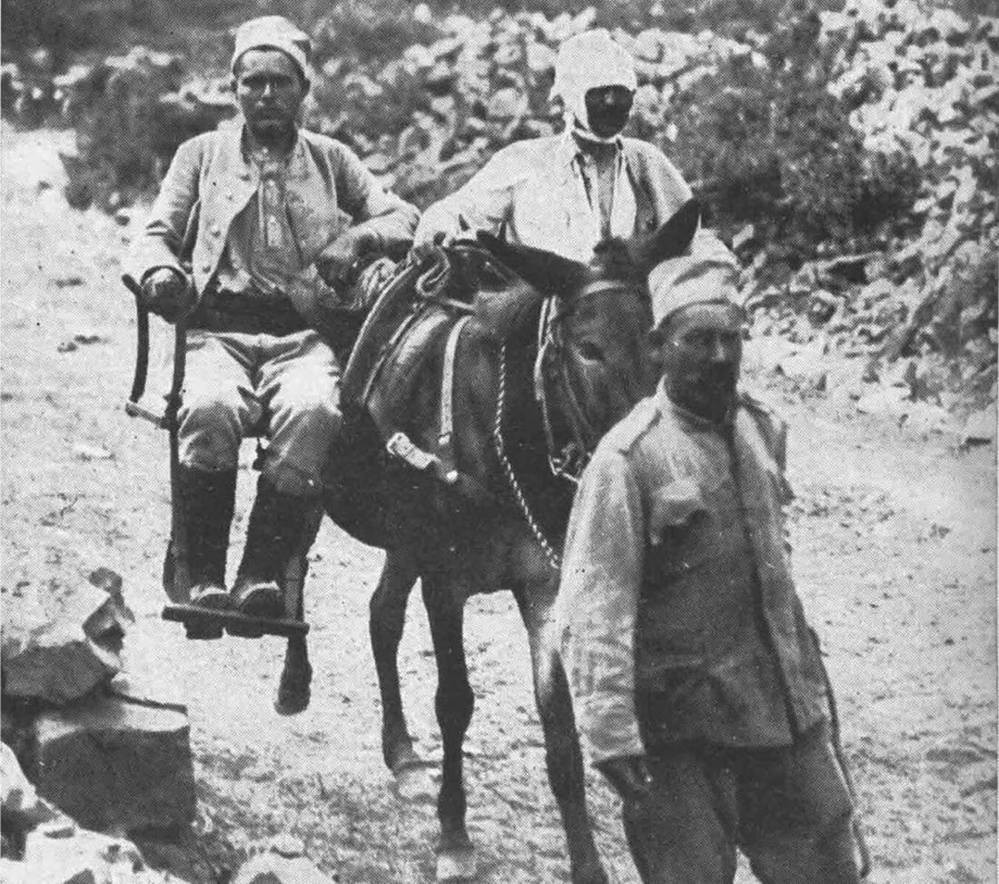
Image: Cypriot members of the Macedonian Mule Corps (Cyprus Mail)
Prior to the outbreak of the First World War, under the terms of the Cyprus Convention of 1878, Britain leased the island of Cyprus from the Ottoman Empire.
Under the provisions of this agreement, Cyprus was occupied and administered by the British, but it was still technically under Ottoman sovereignty. However, with the Ottoman entry into the war on 5 November 1914, this Convention was unilaterally annulled by an Order in Council, and the British formally annexed Cyprus.
Over the course of the war, thousands of tonnes of fuel, timber and foodstuffs were exported from Cyprus to the Expeditionary Forces operating in Egypt and Salonika. Moreover, a total of 3,543 mules, 3,249 donkeys and 140 horses were shipped to Egypt and Salonika for transport purposes.
Of most importance, however, were the thousands of men raised for service as part of the Macedonian Mule Corps.
The Macedonian Mule Corps
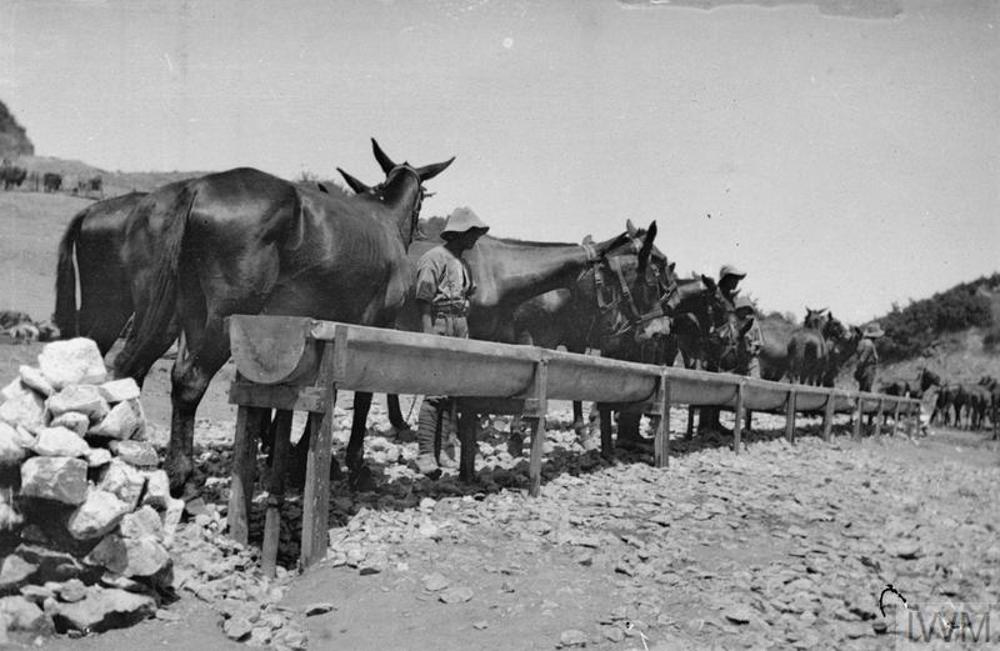
Image: Mules and their handlers stop for a drink in the mountains of Macedonia (IWM (Q 64388))
Despite its name, the Macedonian Mule Corps was predominantly, but not exclusively, a Cypriot regiment. Its principal remit was to provide logistical support to the armies operating as part of the Salonika/Macedonian campaign – transporting food and ammunition to the front and returning with the sick and wounded.
Given the mountainous terrain, as well as the scarcity and poor quality of the roads across the Macedonian front, the British army had to rely heavily on pack transport to maintain its supply lines. At this time, Cyprus was renowned for its strong and hardy mules, and given its proximity to the front, it became a significant supplier of pack animals for the army.
Furthermore, in May 1916, Army HQ Salonika requested the raising of a corps of Muleteers in Cyprus, as the army needed these men and their mules to help maintain its supply lines. In total, over 12,000 men volunteered to serve, largely operating on one-year contracts.
From the work undertaken by Professor Andrekos Varnava, it has been estimated that this accounted for around 20-25% of the able-bodied eligible adult male population of Cyprus.
Before the work of the Non-Commemoration Programme, the CWGC commemorated 49 Macedonian Mule Corps casualties across Greece, Bulgaria, Georgia and Turkey. The largest concentration of burials is in the Mikra British Cemetery in Kalamaria, Greece.
The overall total of 49 casualties, however, did not tell the full story of the losses suffered by the Macedonian Mule Corps.
New names for the Doiran Memorial
During the course of the Non-Commemoration Programme, the search for the names of those missing from the Commission’s records has always been global.
Through the excellent work of Professor Andrekos Varnava, who has written extensively on the history of the Macedonian Mule Corps, we were able to identify 148 casualties not previously commemorated by the Commission.
Although these names were not provided to the Commission by the relevant military authorities when it was undertaking its commemorative work in the 1920s, through the work of the Non-Commemoration Programme, they are now inscribed onto an addenda panel on the Doiran Memorial.
From the available archival evidence, we can learn a great deal about those who served and died as part of the Macedonian Mule Corps.
For example, of the 148 names now added to the Doiran Memorial, we know that 136 were drawn from the following regions of Cyprus: 43 Nicosia, 34 Limassol, 19 Kyrenia, 18 Famagusta, 17 Paphos, and 5 Larnaca.
Muleteer Nicolas Christou
Amongst those now commemorated on Doiran is Muleteer Nicolas Christou from Agios Epiktitos, Kyrenia.
Nicolas served with the Macedonian Mule Corps for a year before dying on 15 May 1919 in No.28 General Hospital, Salonika. Nicolas had been ill for a few days before being admitted to hospital on 9 May, and sadly, his condition continued to worsen.
His final death certificate noted that he died from heart failure owing to chronic pneumonia and malaria.
Nicolas was only 22 years old when he died, and he left behind his mother in Cyprus, whose name was recorded as Efrosini Mina.
Another is Muleteer Demetris Constandi, who died on 7 May 1919 after being kicked in the stomach by his mule. He was only 20 years of age.

Want more stories like this delivered directly to your inbox? Sign up for our newsletter for regular updates on the work of Commonwealth War Graves, blogs, event news, and more.
Sign UpAdding new Doiran Memorial Names: the process


The memorialisation process began with visits to quarries in both South and North Greece.
Eleni Kakkava, Regional Manager, and Chris McLean, Senior Works Manager, assessed multiple stone sources to find the closest match to the original memorial material. Suppliers were then asked to provide samples, which were transported to the Doiran Memorial for on-site testing.
Once the ideal stone was selected, technical specifications were drafted, and the Regional Office in Greece arranged the purchase.
"In April 2025, Eleni and I visited the memorial as well as visiting suppliers of Greek Marble I visited at the Stone Show in Verona, Italy, in September 2024," Chris said.
"We visited the Memorial to decide if we could add the casualties to a new memorial on site or incorporate into the existing memorial, but ensuring it was identifiable as a separate commemoration. We chose the proposed location, on the rear of one of the existing separate screen walls that was readily accessible.”
"We took measurements onsite and brought these back to the Drawing Office to prepare the new panel layouts, in conjunction with the Commemorations Team, to finalise the names and dedicatory text.
"The font was copied from the existing panels on the memorial."
Before shipment, Eleni and Nikos Chantzis inspected the finished panels at the supplier’s yard. Eirini Stampolidou coordinated customs clearance, packing lists, and logistics to ensure smooth transport to France. The Headstone Production Unit engraved the panels and returned them to Greece for installation.
The installation was carried out by the Works Team: Nikos Chantzis, George Yfantidis, and Polikarpos Myridis. Their tasks included removing the existing coping stones, carving precise recesses for the new panels, installing all ten pieces, repointing the joints, and reinstating the coping stones.
The workmanship was exceptional, supported by the Mobile Team North Greece, with special thanks to Apostolos Vlachos, who provided crucial assistance during lifting and setting operations.
The Doiran Memorial
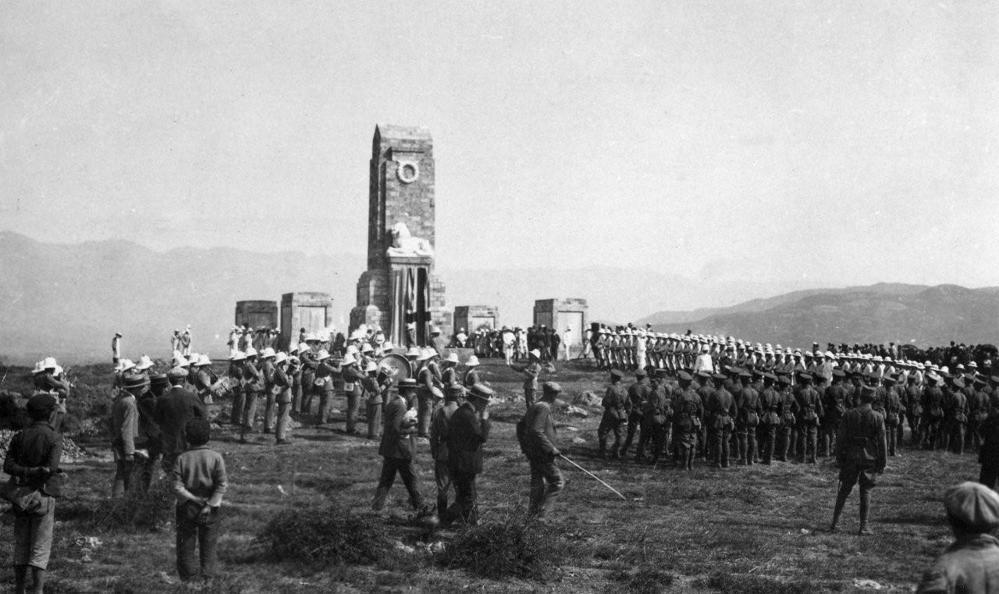
Image: The unveiling of the Doiran Memorial in 1926
The Doiran Memorial stands roughly in the centre of the line occupied for two years by the Allies in Macedonia, but close to the western end, which was held by Commonwealth forces. It marks the scene of the fierce fighting of 1917-1918, which caused the majority of the Commonwealth battle casualties.
From October 1915 to the end of November 1918, the British Salonika Force suffered some 2,800 deaths in action, 1,400 from wounds and 4,200 from sickness.
The campaign afforded few successes for the Allies, and none of any importance until the last two months. The action of the Commonwealth force was hampered throughout by widespread and unavoidable sickness and by continual diplomatic and personal differences with neutrals or Allies. On one front, there was a wide malarial river valley, and on the other, difficult mountain ranges, and many of the roads and railways required had to be specially constructed.
The memorial serves the dual purpose of Battle Memorial of the British Salonika Force (for which a large sum of money was subscribed by the officers and men of that force), and place of commemoration for more than 2,000 Commonwealth servicemen who died in Macedonia and whose graves are not known.
The Non-Commemorations Programme
The CWGC Non-Commemoration Programme had a clear mandate: to ensure all those who died in the world wars, no matter where they were, where they died or how they died, are remembered equally.
Whilst our initial five-year programme to address historical inequalities in commemoration after the World Wars reaches its formal endpoint in 2026, the work will continue. This ongoing global effort will ensure all individuals who we have found not to have been commemorated equally will receive the proper recognition they deserve.
Author acknowledgements
Alec Malloy is a CWGC Digital Content Executive. He has worked at the Commonwealth War Graves Commission since February 2022. During that time, he has written extensively about the World Wars, including major battles, casualty stories, and the Commission's work commemorating 1.7 million war dead worldwide.
This blog was written with the help of CWGC Senior Research Historian Dr John Burke, CWGC Senior Works Manager Chris McLean and CWGC Regional Manager for Greece Eleni Kakkava.