

24 August 2026
Recovery Unit Explained: What Happens When Remains Are Commingled
At the Commonwealth War Graves Commission (CWGC), we regularly respond to discoveries of military remains across former battlefields and conflict landscapes.
While some casualties are recovered as complete individuals, others are found as commingled remains, where the remains of two or more people have become mixed together.
Recovering and identifying these casualties requires a combination of forensic archaeology, anthropology, historical research, and meticulous documentation.
Our goal is always to recover the fallen with dignity, preserve all available evidence, and, where possible, restore a name to those who made the ultimate sacrifice.
Here, Head of the Commonwealth War Graves Commission Recovery Unit Stephan Naji explains the process of recovering and dealing with the intermingled remains of World War servicemen.
At a glance: What's on this page
This page examines what happens when commingled remains are discovered, including:
- What comingled remains are
- Why commingling can happen
- How the Recovery Unit records remains
- What happens when commingled remains are found
- How evidence supports investigation
- Commemoration without a name
What Are Commingled Remains?
Commingled remains are the skeletal remains of two or more individuals that have become mixed together.
This can range from a small number of bones found together to complex recoveries involving multiple casualties whose remains have become heavily intermingled.
For the Recovery Unit, these cases require a particularly careful and methodical approach.
Before we can begin investigating who an individual might be, we must first determine how many people are present and which remains belong to each casualty.
Why Commingling Can Happen
The battlefields of the First and Second World Wars were often chaotic and destructive environments.
Casualties were sometimes buried under difficult circumstances, often while fighting continued nearby.
Later disturbances and land use
Commingling can occur when explosions disturb existing burials, when multiple casualties are buried together, or when burial sites are later affected by agricultural activity, construction work, erosion, or natural processes.
The effect of time and environment
Over the course of more than a century, these disturbances can significantly alter the original burial context.
As a result, the remains we recover today may not always be found in the same position or condition in which they were originally buried.
What Happens First When Remains Are Found?
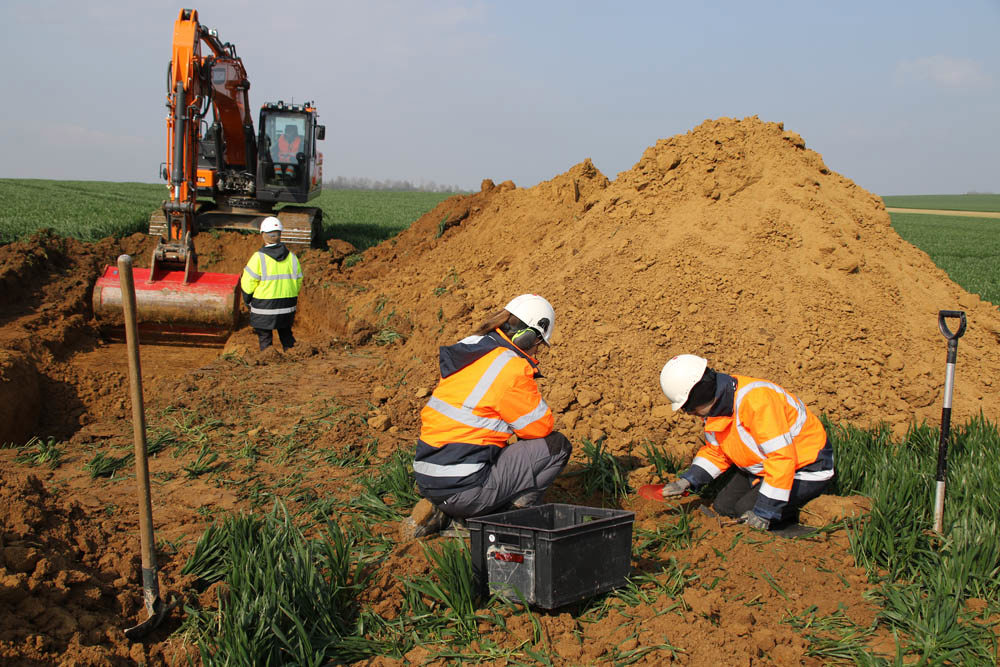
When human remains are discovered, our first priority is ensuring that the site is safe and that all appropriate authorities have been informed.
Working with local authorities
We work closely with local authorities, police services, landowners, and explosive ordnance disposal specialists, particularly in areas where unexploded munitions may still be present.
Protecting evidence
Once responsibility for the recovery has been established, we begin a formal assessment of the site. At this stage, preserving evidence is critical.
Any information lost during the initial response can have a direct impact on our ability to understand the circumstances of burial or identify the casualty later.
How the Recovery Unit Records and Recovers Remains
Over recent years, the Recovery Unit has increasingly adopted forensic archaeological methods to document and recover human remains.
Recording the site
Rather than simply excavating and removing remains, we treat each site as a potential source of evidence. Our objective is to preserve not only the remains themselves, but also the relationships between bones, artefacts, military equipment, and the burial environment.
Before excavation begins, we record the site using a combination of traditional archaeological methods and modern digital technologies.
This includes detailed photography, drone footage, geospatial recording, and increasingly, 3D photogrammetric documentation.
These techniques allow us to create accurate digital records of the recovery and preserve observations that can be re-examined long after the excavation has been completed.
This forensic approach strengthens the chain of custody for all recovered material and maximises the evidentiary value of the site.
It ensures that observations made during excavation can be reviewed, verified, and integrated into later anthropological, historical, and identification investigations.
Throughout the recovery process, every item is carefully recorded, labelled, and tracked to maintain a complete record from discovery through to analysis.
What Happens When Remains Are Commingled?
When we encounter commingled remains, documentation becomes even more important.
Recovery and records
Every bone and artefact is recorded in situ before removal, with particular attention paid to spatial relationships and patterns within the deposit.
The detailed 2D and 3D records we create allow us to revisit the recovery virtually, helping us interpret the original context even after excavation has been completed.
Assessing results
Following recovery, the remains undergo specialist anthropological examination.
We assess skeletal elements to determine how many individuals are represented and to identify the most probable associations between bones. This process combines archaeological observations from the recovery with osteological analysis carried out in the laboratory.
In some cases, separating individuals can be relatively straightforward. In others, particularly where severe fragmentation or disturbance has occurred, the process can be considerably more complex.

Want more stories like this delivered directly to your inbox? Sign up for our newsletter for regular updates on the work of Commonwealth War Graves, blogs, event news, and more.
Sign UpHow Evidence Supports Identification
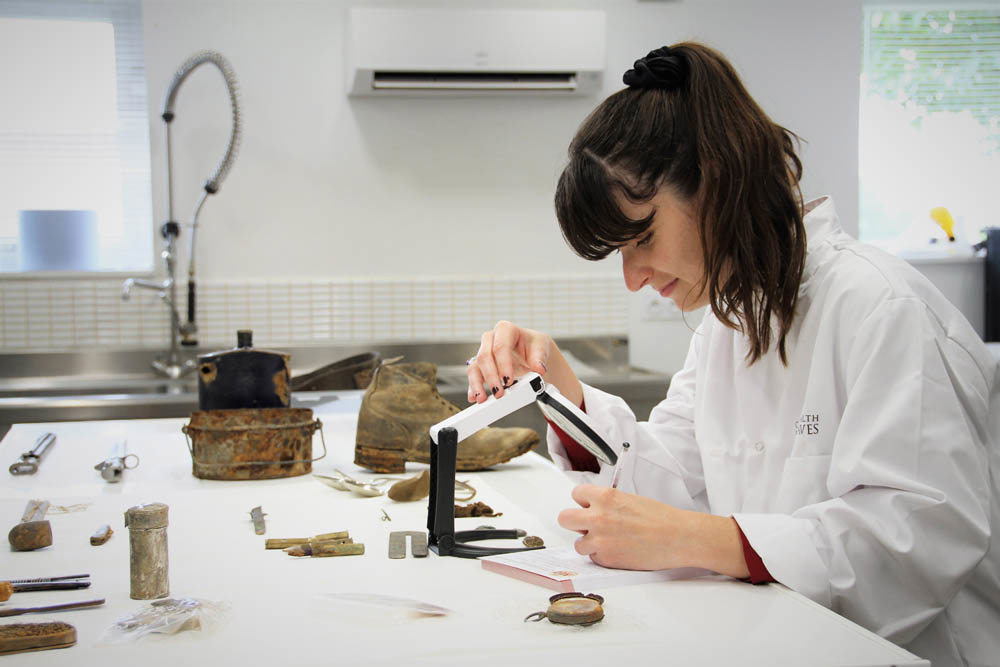
We rarely identify a casualty through a single piece of evidence. Instead, we build a case using multiple complementary sources of information.
Creating context
The location of the discovery, the archaeological context, associated military equipment, uniform fragments, cap badges, personal effects, and contemporary military records all contribute to our investigation.
Historical research allows us to understand which units operated in the area and which soldiers remain unaccounted for.
Anthropological research
Anthropological analysis may provide information about age at death or biological characteristics.
The strength of an identification often comes from the convergence of these independent lines of evidence.
The forensic archaeological record created during recovery is an important part of this process, helping us understand how evidence relates to both the individual and the site where they were found.
What Role Does DNA Play?
DNA analysis has become an increasingly valuable tool in casualty identification.
In some cases, DNA can help distinguish between individuals whose remains have become commingled and can provide evidence to support a proposed identification.
Where possible, DNA profiles recovered from remains may be compared with samples voluntarily provided by living relatives.
DNA evidence in context
However, DNA is only one element of the investigation.
Environmental conditions, preservation, and the availability of suitable family reference samples can all influence the outcome.
For this reason, DNA is always considered alongside archaeological, anthropological, historical, and contextual evidence.
Our thanks go to the Recovery Unit, including:
- Stephan NAJI – Head of the Recovery Unit
- Lorelei MARGELY-LARDEYRET – anthropologist
- Isaure DUCOUSSO – anthropologist
- Michiel VANMARCKE – Ceremony coordinator
What If Identification Is Not Possible?
Despite advances in forensic science and historical research, it is not always possible to establish an individual's identity with sufficient confidence.
When that happens, our responsibility remains unchanged. Every casualty recovered by the Recovery Unit is treated with dignity, respect, and professional care throughout the investigation process.
Commemoration without a name
Where identification cannot be achieved, the Commonwealth War Graves Commission works with its partners to ensure that the individual is appropriately buried and commemorated.
They will often be buried in a war grave with a headstone bearing inscriptions such as:
- “A Canadian Officer of the First World War”
- “A British soldier of the Second World War”
Although a name may be lost, their service and sacrifice are not.
Every recovery helps us preserve the evidence of the past, contributes to our understanding of conflict history, and fulfils our commitment to ensuring that those who served are never forgotten.
Recovery of Commingled Remains FAQ
Commingled remains are the skeletal remains of two or more individuals that have become mixed together.
This can range from a small number of bones found together to complex recoveries involving multiple casualties whose remains have become heavily intermingled.
Commingling can occur when explosions disturb existing burials, when multiple casualties are buried together, or when burial sites are later affected by agricultural activity, construction work, erosion, or natural processes.
Before excavation begins, we record the site using a combination of traditional archaeological methods and modern digital technologies.
This includes detailed photography, drone footage, geospatial recording, and increasingly, 3D photogrammetric documentation.
Every bone and artefact is recorded in situ before removal, with particular attention paid to spatial relationships and patterns within the deposit.
The detailed 2D and 3D records we create allow us to revisit the recovery virtually, helping us interpret the original context even after excavation has been completed.
We assess skeletal elements to determine how many individuals are represented and to identify the most probable associations between bones.
This process combines archaeological observations from the recovery with osteological analysis carried out in the laboratory.
The location of the discovery, the archaeological context, associated military equipment, uniform fragments, cap badges, personal effects, and contemporary military records all contribute to our investigation and identfication.
DNA analysis has become an increasingly valuable tool in casualty identification.
In some cases, DNA can help distinguish between individuals whose remains have become commingled and can provide evidence to support a proposed identification.
Where possible, DNA profiles recovered from remains may be compared with samples voluntarily provided by living relatives.
Despite advances in forensic science and historical research, it is not always possible to establish an individual's identity with sufficient confidence.
When that happens, our responsibility remains unchanged. Every casualty recovered by the Recovery Unit is treated with dignity, respect, and professional care throughout the investigation process.
If identified, the individual will be buried with a CWGC headstone inscribed with their name and further details, such as regiment and country of service.
If identification is not possible, they will often be buried in a war grave with a headstone bearing inscriptions such as:
- “A Canadian Officer of the First World War”
- “A British soldier of the Second World War”
Unidentified casualties will be commemorated by name on CWGC Memorials to the Missing, but it may not be possible for us to link the name to the memorial, and thus they will be interred using the process mentioned above.
Author acknowledgements
This blog was written by Stephen Naji, CWGC Head of Recovery Unit.
Trained as an archaeological anthropologist, Stephan's international experience has enabled him to work in numerous institutions in France and the United States.
Now Head of the CWGC Research Unit, Stephan coordinates field operations following the chance discovery of human remains from wartime, and assists Commonwealth member countries in identifying and reburying their soldiers.