

22 May 2026
Remembering the Battle of Crete
2026 marks the 85th anniversary of the Battle of Crete. A sad defeat for the forces of the British Empire, over 3,500 Commonwealth servicemen were killed in action during the island’s failed defence.
Fought between May 20 and June 1, 1941, the Battle of Crete was one of the earliest and largest airborne operations of the war, but it was the British forces that were on the defensive.
A major force of German Fallschirmjäger paratroopers landed on Crete. Despite the British knowing of the forthcoming assault and inflicting heavy casualties on the German airborne troops, Commonwealth troops were ultimately forced to evacuate the island.
As well as defeat on land, Crete would be the Royal Navy’s single costliest engagement of the war, losing three cruisers and 6 destroyers, with 21 other vessels significantly damaged. 1,800 Commonwealth sailors lost their lives in the Battle of Crete.
The fallen of Crete are buried at Suda Bay War Cemetery or commemorated on the war and naval memorials to the missing in Greece and the UK.
Discover the story of the Battle of Crete and how the casualties are commemorated here.
The Battle of Crete
Background: The situation in Greece
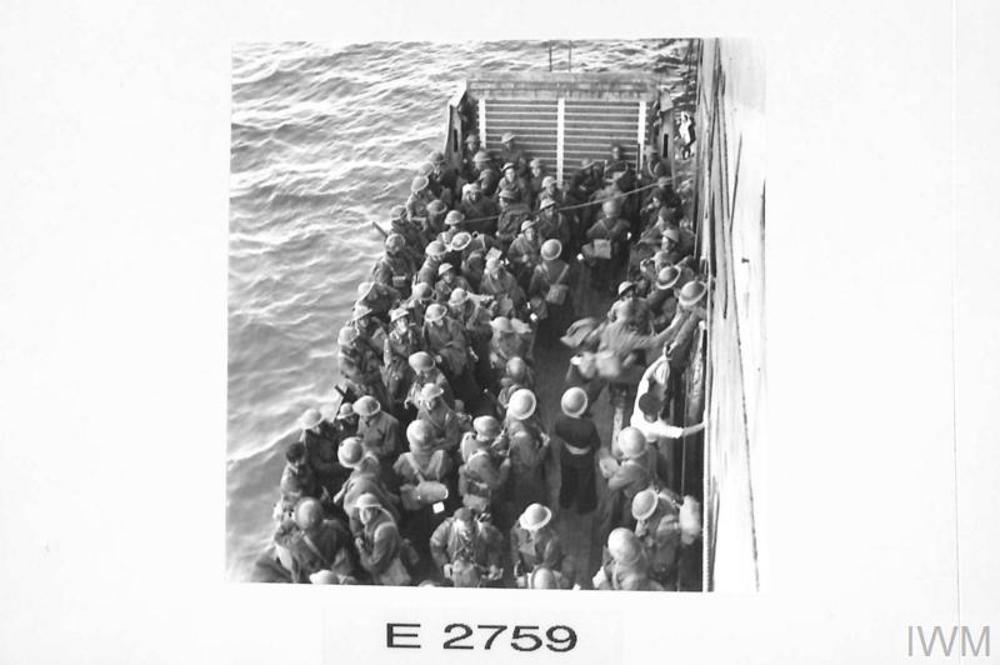
Image: British soldiers packed onto a small craft during the Evacuation of Greece (IWM (E 2759)
In October 1940, following a rebuffed ultimatum to surrender, the forces of Fascist Italy invaded Greece from occupied Albania.
Expecting slight resistance, the Italians were surprised by the determined Greek defence. Supported by a small contingent from the Royal Air Force, Greek resistance stalled the Italian advance and drove the Axis forces back into Albania.
In March 1941, a Commonwealth force, comprised of British, Australian, New Zealand, Cypriot, and British Palestine troops, was sent to Greece to aid the Greek counteroffensive.
This proved ill-timed as the battle in the Western Desert against Axis forces, including the Afrika Korps under German General Erwin Rommel, was intensifying. Short on manpower, Commonwealth forces were driven back, and the strategically important port of Tobruk was besieged.
For German high command, Italian success in Greece took on new importance. Germany was preparing for Operation Barbarossa, its invasion of the Soviet Union. Securing its southern flank ahead of the invasion was a top priority.
In April, German forces invaded Greece from Axis Bulgaria. Outnumbered and outgunned, Allied forces were quickly driven back.
Athens fell to the German onslaught on 27 April. By the end of the Month, German forces reached mainland Greece’s southern shore.
Some 50,000 Allied troops were evacuated from the mainland by the combined efforts of British, Greek, and Dutch navies. They pulled back to British bases on the Island of Crete with some transported further afield to British-controlled Egypt.
During the evacuation from Greece, the German Luftwaffe attacked Allied shipping. 28 vessels were sunk.
The fighting and retreat on the mainland had claimed the lives of around 1,600 Commonwealth service personnel. A further 7,000 were taken as prisoners of war.
May 20, 1941: The Fallschirmjäger attack

Image: German Fallschirmjäger paratroopers landing on Crete in the early stages of the invasion (Wikimedia Commons)
On the morning of 20 May, shortly after 8 am, British and Greek soldiers noticed the first gliders moving through the air. Soon, the air was thick with the droning of engines as Lufwaffe aircraft filled the skies.
Hundreds of German planes dropped thousands of Fallschirmjäger paratroopers onto Crete. Landings took place around Maleme and the township of Canea. Later, further landings occurred at Retimo and Heraklion, on or close to the all-important airfields.
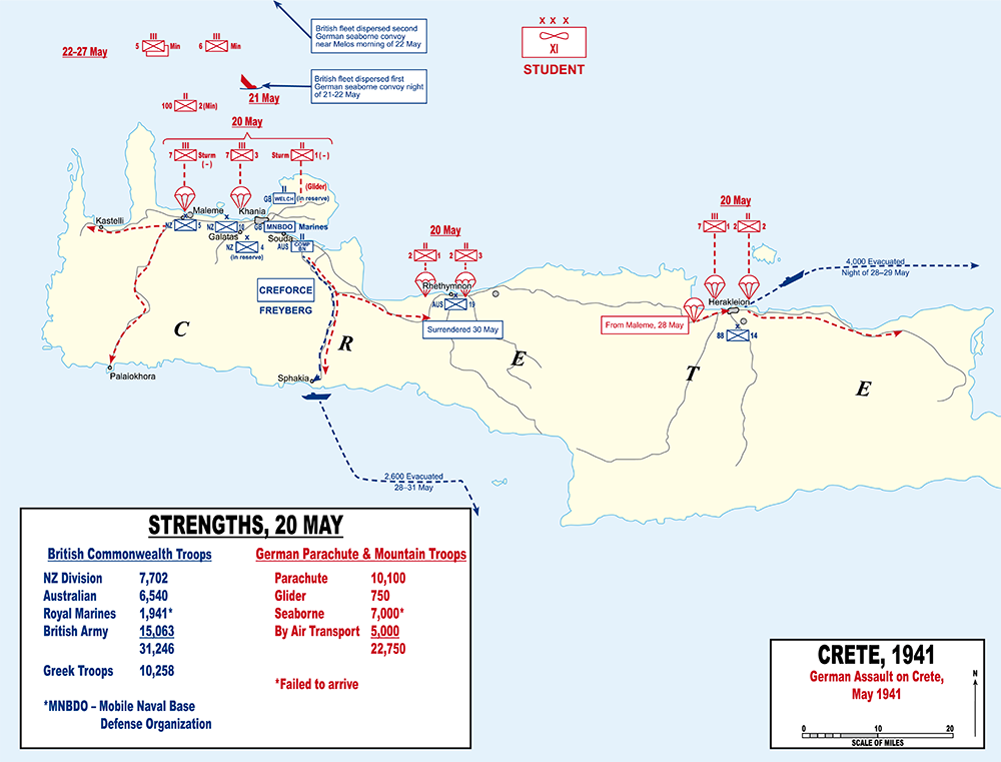
Image: Map showing the force dispositions and German landing zones at the Battle of Crete
At first, Commonwealth resistance was fierce. German casualties were heavy, with many being cut down before they could reach the ground. Others were mown down as they struggled to release their parachutes after landing or extract themselves from gliders.
In the face of heavy losses, the German paratroopers gained footholds west of Maleme and to the southwest of Canea.
By the end of 20 May, German forces around Maleme, Retimo, and Heraklion had failed to secure their objectives. Apart from a foothold at Maleme, they were facing the prospect of a major defeat. German commanders decided to throw everything into an attack at Maleme the next day. Securing the airfield was the key to unlocking the Allied defence of the island.
Despite continued resistance from the 22nd New Zealand Infantry Battalion, they were pushed back from the perimeter of the airfield. The German ability to land men and supplies at Maleme from 21 May changed the prospects of the whole campaign.
Despite this loss, the Royal Navy was able to score some successes at sea. On the night of the 21st, Royal Navy ships intercepted a limited Axis seaborne landing force, causing severe losses. This halted the amphibious element of the German invasion. It could do little to assist the fight on land, however, and its surface ships were dangerously vulnerable in daylight thanks to German air superiority.
Defeat and evacuation
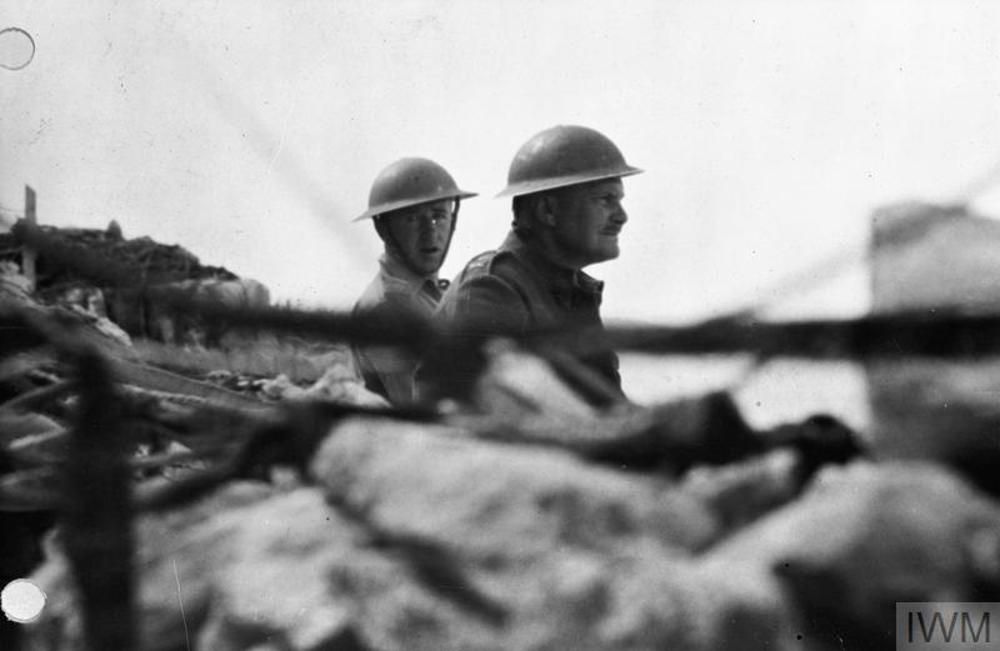
Image: Lieutenant General Bernard Freyberg VC, commanding officer of the British forces on Crete, with his Aide-de-camp, Captain Jack Griffiths watch the attack on Maleme airfield from outside the wall at CREFORCE headquarters in the quarry above Canea, 20 May 1941 (IWM (E 3020E))
The capture of Maleme airfield essentially spelt disaster for the Allied troops on Crete. The Germans were able to land reinforcements and supplies. With the RAF busy elsewhere, there were few, if any, Allied aircraft to intercept and disrupt the German air plan.
Between 22 and 23 May, the Royal Navy took heavy losses from repeated Luftwaffe air attacks. The fleet was later ordered to withdraw from the waters around Crete.
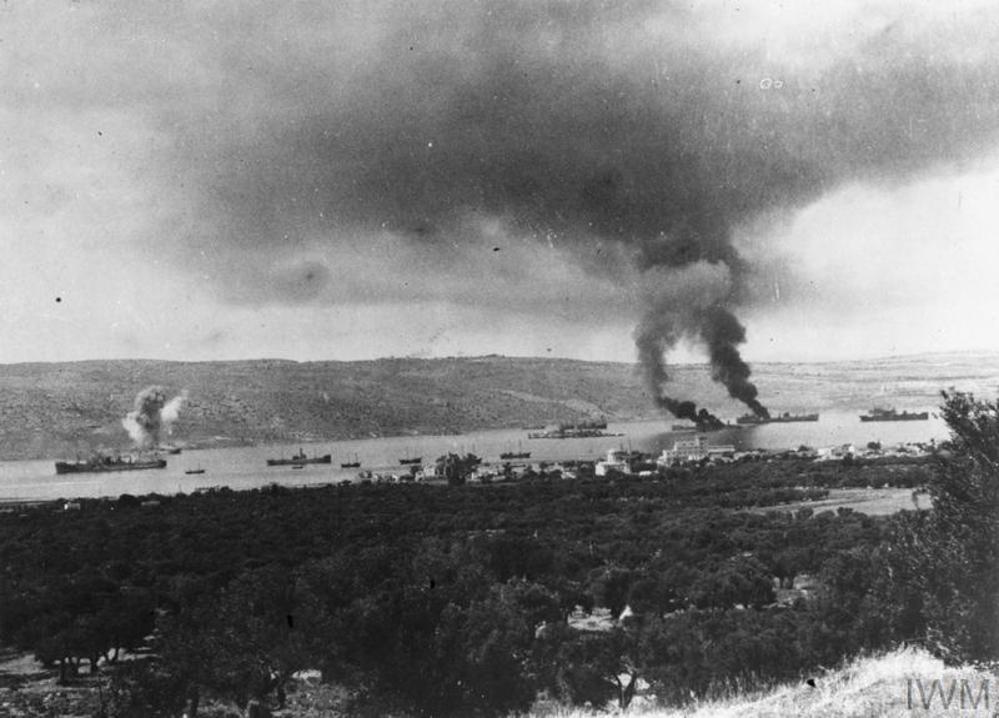
Image: Burning ships lie in Suda Bay, victims of German air supremacy, during the Battle of Crete (IWM (E 3138E))
On land, Allied troops fought for several days alongside Cretan civilians to resist the invaders, but Commonwealth commanders were eventually forced to order the evacuation of Crete on 27 May.
The evacuation began on 28 May. During this time, German air and sea attacks continued to inflict heavy losses. During the operation, the Royal Navy lost three cruisers and six destroyers. A further 21 vessels were badly damaged.
By June 1, the Battle for Crete was over. The Allies had been defeated.
18,000 Commonwealth servicemen were evacuated to Egypt. 12,000 were taken as prisoners of war.

Want more stories like this delivered directly to your inbox? Sign up for our newsletter for regular updates on the work of Commonwealth War Graves, blogs, event news, and more.
Sign UpCasualties of the Battle of Crete
Over 3,500 Commonwealth servicemen were killed in the Battle of Crete. Of these, 1,800 were Royal Navy and Commonwealth seamen.
Despite their now total control of the strategically important island, German losses on Crete were heavy. The invasion force took some 6,500 casualties, including 4,500 killed or missing.
The victory was a pyrrhic one. Nazi Germany would never again undertake a large-scale airborne assault.
Stories from the Battle of Crete
Captain John Devitt Stringfellow Pendlebury
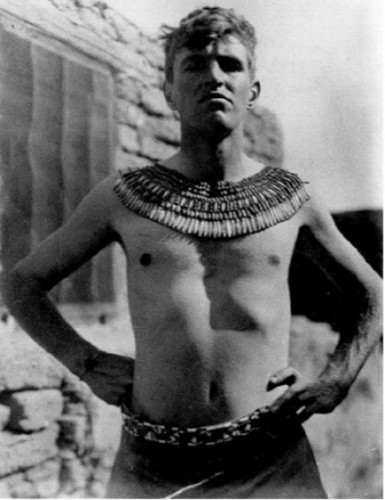 Image: Captain John Pendlebury in his pre-war archaeology days
Born in London in October 1904, John lost an eye when he was two years old. He showed an interest in archaeology from an early age and, after attending Winchester College, went up to Cambridge.
After university, he travelled to Athens and studied at the British School there. In 1928, he married Miss Milda White, a fellow student. They were involved in excavations in Egypt and Crete, and John became the Curator of Knossos, Crete, in 1929 and the director of the site at Tell-el-Amarna in Egypt in 1930
John was a keen hiker and got to know the island of Crete and its people well, speaking the language fluently.
When war came, he travelled to England to enlist and was commissioned as a captain in military intelligence in 1940. He was sent back to Crete as the British Vice-Consul in Heraklion, where he worked to set up a Cretan resistance network in preparation for a possible invasion.
In October, following Italy's attempted invasion of Greece, John was assigned as liaison officer for the newly arrived British Commonwealth troops and the Greek forces on Crete.
During the invasion, John was involved with local Cretan forces in the fighting around Heraklion, and on 21 May, he was wounded while engaging German troops south-west of the town.
Uncertainty surrounds the circumstances of John's death.
Most sources suggest that he was taken to a nearby cottage to be cared for by local women while German troops overran the area.
He was given treatment by a German doctor and allowed to remain at rest in the cottage. The next day, new German troops arrived, and finding John out of uniform with no military identity discs, he was executed as a spy.
He was buried nearby, then reburied by the Germans, before being moved by an Australian War Graves unit to Suda Bay Cemetery in September 1945.
He is buried in Plot 10. Row E. Grave 13. The personal inscription on John's headstone is a line from Percy Bysshe Shelley's poem Adonaïs: An Elegy on the Death of John Keats:
“HE HAS OUTSOARED THE SHADOW OF OUR NIGHT"
HMS Valiant & Force A1

Image: A camouflage-painted HMS Valiant (Wikimedia Commons)
In 1941, the battleship HMS Valiant was stationed at Alexandria, operating as part of Force A.
In early March, she helped cover the landing of Commonwealth troops in Greece. On 27–29 March 1941, she was involved in the Battle of Cape Matapan, fought in the waters to the east and south of Crete.
Italian signals traffic had been decoded, and an Italian formation, including 1 battleship, 6 heavy cruisers, 2 light cruisers, and 13 destroyers, was intercepted by 1 aircraft carrier, 3 battleships (including Valiant), 7 light cruisers, and 17 destroyers of the Royal Navy and the Royal Austrian Navy.
The Italians lost 3 heavy cruisers and 2 destroyers for just one British aircraft and 3 killed. For his part in the Battle, the late Prince Philip was mentioned in dispatches for his command of the ship’s searchlight control.
In April, Valiant took part in the naval bombardment of Tripoli, and in early to mid-May, she was engaged in convoy escort to and from Malta. She also participated in the bombardment of Axis forces at Benghazi.
On 18 May, Valiant was sent to operate west of Crete as part of Force A1 to deter Italian naval interference. On 20 May, the German attack on the island began. For the next two days, Force A1 was repeatedly attacked from the air.
On 22 May, Valiant was struck by two bombs but was not seriously damaged, although Royal Marine Thomas James Knox was killed (commemorated on Plymouth Naval Memorial).
That same day, two cruisers and one destroyer were sunk, and two battleships, two cruisers and several destroyers were damaged.
On 23 May, C-in-C Mediterranean Fleet ordered Force A1 to withdraw to Alexandria, but several ships were still caught and sunk by German air attacks.
Staff Serjeant Dudley Churchill Perkins
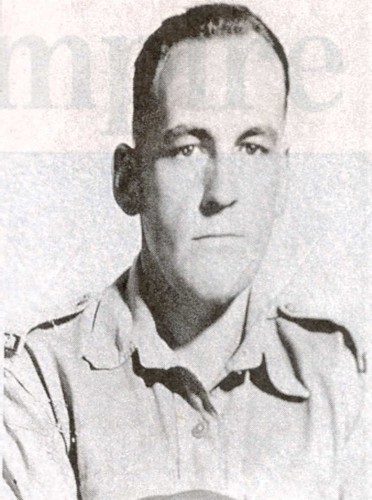 Image: Staff Serjeant Dudley Churchill Perkins
Son of the Reverend John Perkins and of Adelaide Agnes Perkins (nee Perry) of Christchurch, New Zealand, Dudley was born on 23 February 1915. Dudley joined the New Zealand Army shortly after the outbreak of war in September 1939.
After initial training in New Zealand, in February 1940, Dudley went to Alexandria in Egypt before being sent with the rest of the New Zealand Division, along with Australian and British troops, to Greece following the Italian invasion of October 1940.
Following the German invasion, Dudley and many others were evacuated to Crete and formed part of the garrison stationed in the area of Chania called Galatas.
After German forces overran Crete, Dudley became a prisoner of war. However, Dudley and several of his comrades managed to escape from the German PoW camp and hide out in the hills.
Aided by local Cretans, Dudley and several others managed to remain at large on the island until June 1942, when they left the island by submarine with a Special Boat Service raiding party.
In April 1943, he was transferred to Force 133 of the Special Operations Executive (SOE) and returned to Crete to aid the partisans. He took part in several raids and partisan activities, disrupting the German and Italian occupation of Crete.
In late February 1944, Dudley was leading a group of partisans when they encountered a German patrol, and he was hit in the ensuing firefight and killed. The exact date of the incident remains disputed, but 25 February was accepted for official purposes by the Army.
Dudley was originally buried in the village of Lakkoi but was reburied in Suda Bay War Cemetery in September 1945 by an Australian War Graves unit. He is buried in Plot 15. Row C. Grave 12.
5th Destroyer Flotilla and HMS Kelly

Image: HMS Kelly (Wikimedia Commons)
The destroyer HMS Kelly was commanded by Lord Louis Mountbatten, commander of the 5th Destroyer Flotilla.
The Flotilla arrived at Malta in late April 1941 for operations against Axis shipping off North Africa. On 8 May, the flotilla left Malta as part of a convoy (Operation Tiger) carrying tanks and essential stores to Egypt and Greece.
On the return leg, on 10 May, she led the destroyers to bombard Benghazi before returning to Malta. On 21 May, she was dispatched to Crete along with HMS Kashmir and HMS Kipling and began patrols north of the island the following day.
On the morning of 23 May, during the evacuation of Crete, Kelly and Kashmir came under attack by the Luftwaffe. Despite shooting down three enemy aircraft, Kelly was hit and is reported to have sunk within two minutes with the loss of half her crew (130 killed, most commemorated on Chatham Naval Memorial). The Kashmir was also sunk with the loss of 80 lives (all commemorated on Portsmouth Naval Memorial).
The destroyer HMS Kipling was able to rescue 279 officers and men, including Lord Louis Mountbatten. The next morning, while still fifty miles out from Alexandria, Kipling ran out of fuel and had to be towed into harbour.
The survivors from Kelly were deeply affected by the loss of their ship and comrades. On trying to console the ship's company, Mountbatten is reported to have said: "We didn't leave the Kelly – the Kelly left us!"
Commemorating the Fallen of the Battle of Crete
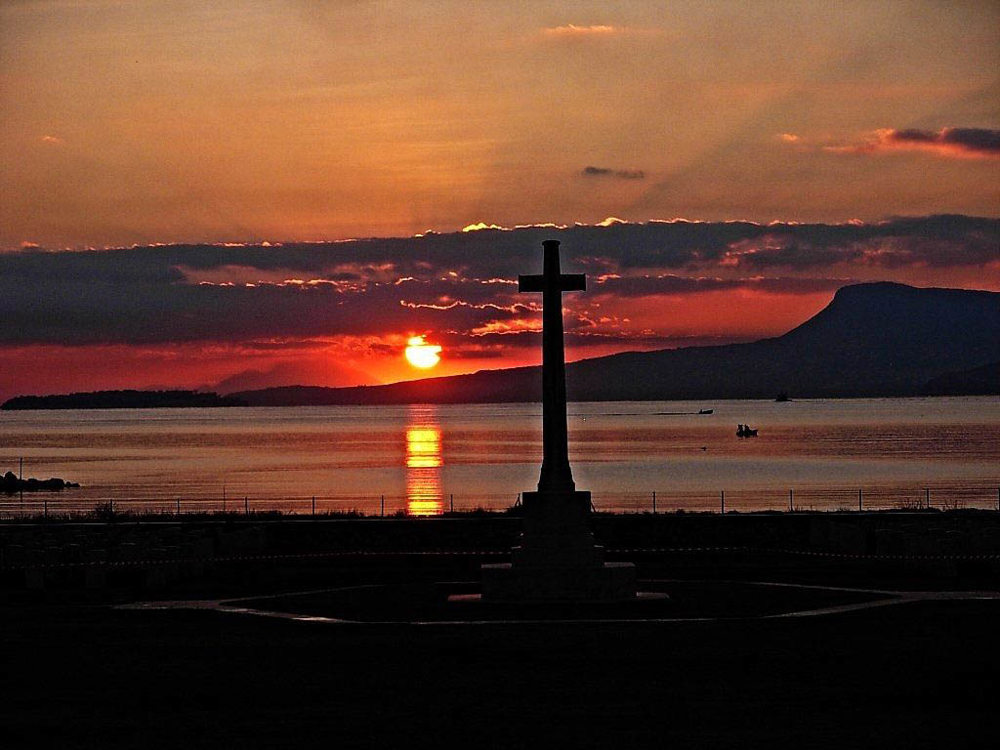
Image: The sun sets over Crete and Suda Bay War Cemetery
The CWGC commemorates over 3,700 Commonwealth service personnel who died in Greece between 1940-41 (a further 1,600 are commemorated from later fighting on the Greek islands and mainland).
Of those who died in 1940-41, 2,400 have no known grave and are commemorated by the Athens Memorial, which stands in Phaleron War Cemetery in Athens.
The sailors and marines of the Royal Navy who were lost at sea with their ships are commemorated on the three Naval Memorials at Plymouth, Portsmouth and Chatham in the UK – the three ‘manning ports’ of the service during the two world wars.
Most of those lost with HMS Kelly are commemorated at Chatham, while those from Kashmir are commemorated at Portsmouth.
Suda Bay War Cemetery
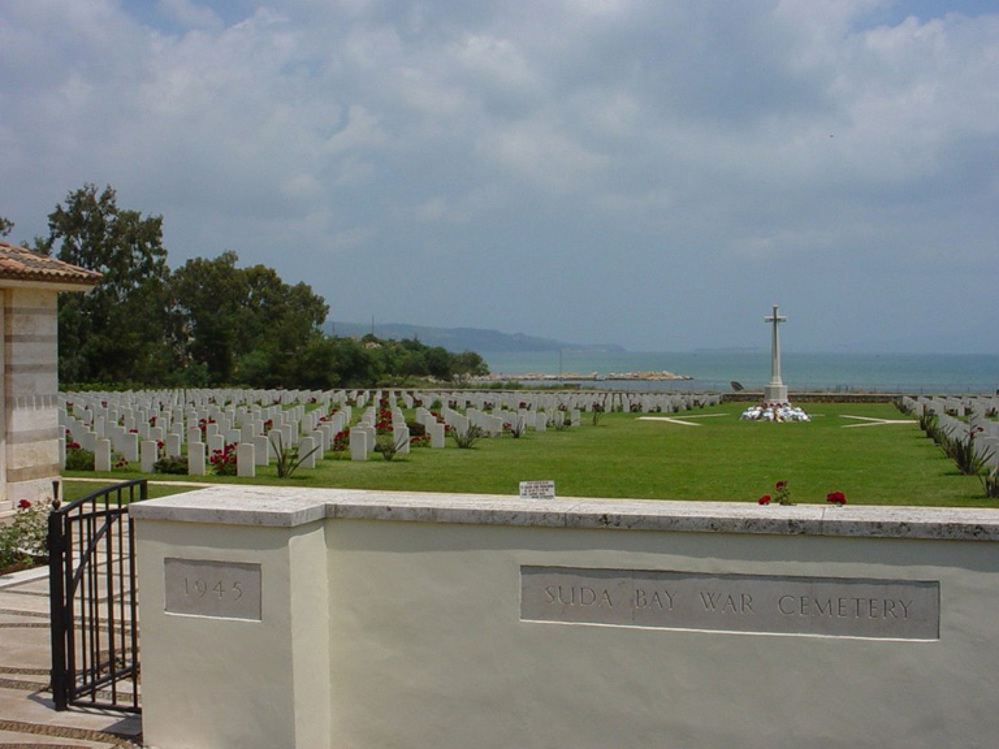
Image: Suda Bay Way Cemetery
The only CWGC site on Crete, Suda Bay War Cemetery, contains the graves of over 1,500 Commonwealth servicemen of the Second World War, of whom 776 remain unidentified. The cemetery also contains 19 First World War burials brought in from Suda Bay Consular Cemetery. In addition, there are 7 burials of other nationalities and 37 non-war burials.
The Suda Bay site was chosen after the war, with graves moved there from the four burial grounds that had been established by the German occupying forces at Canea, Heraklion, Retimo and Galata[GH1.1], and from isolated sites and civilian cemeteries. This work was completed by the 21st and 22nd Australian War Graves Units.
The cemetery was designed by the architect Louis de Soissons, who had a deep and personal connection to the campaign in Greece.
His 17-year-old son, Philip, was killed on 23 May 1941, when German aircraft attacked and sunk the light cruiser HMS Fiji off the coast of Crete, with the loss of 241 of the ship's crew. Philip has no known grave and is commemorated on the Portsmouth Naval Memorial.
Author acknowledgements
Alec Malloy is a CWGC Digital Content Executive. He has worked at the Commonwealth War Graves Commission since February 2022. During that time, he has written extensively about the World Wars, including major battles, casualty stories, and the Commission's work commemorating 1.7 million war dead worldwide.
This blog was written with the help of Dr George Hay.
Dr George Hay is the Official Historian at the Commonwealth War Graves Commission (CWGC), an Honorary Academic at the University of Kent and a Fellow of the Royal Historical Society. He writes widely on the social history of British and Commonwealth armies in peace and war, and works to generate greater understanding of the CWGC’s history, its sites and the casualties in its care. He co-authored the CWGC’s 2021 and 2025 reports on historical inequalities in commemoration and continues this work by leading the research strand of the organisation’s Non-Commemoration work.