

29 May 2026
The Battle of Jutland told in six stories
On 31 May 1916, the largest naval Battle of the First World War, the Battle of Jutland, took place off the coast of Jutland, Denmark.
Over 6,000 British sailors perished as the British Grand Fleet and Imperial German High Seas Fleet clashed in the North Sea.
All too often, we think of the First World War as a land war, fought primarily on the battlefields of the Western Front. The Battle of Jutland indicates otherwise. While the naval war was not as large as the Second World War, sea power was still a crucial element of warfare in World War I.
Here, we shine a spotlight on six sailors who lost their lives in this pivotal naval battle, taken from our online storytelling platform For Evermore: Stories of the Fallen.
They provide a human link to what could be an abstract clash between battleships and cruisers, helping us better understand the people behind the Battle of Jutland.
If you have a story about a casualty from Jutland, we encourage you to upload and share it on For Evermore so we can preserve it for future generations to discover, learn, and remember.
Why Jutland stories matter
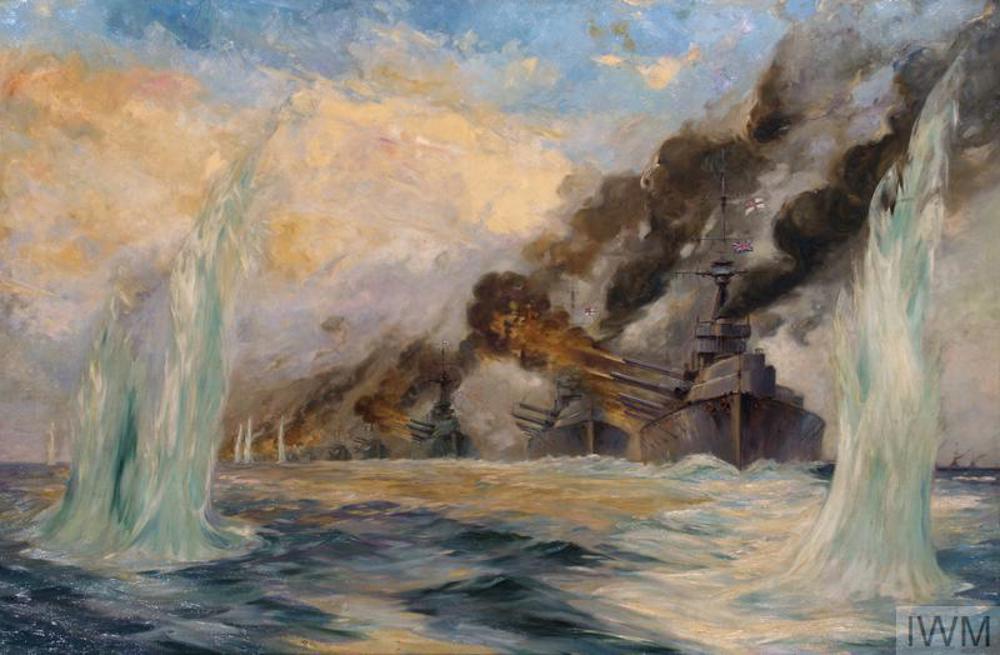
Image: Battleships in Action at Jutland, Robert Henry Smith, 1919 (IWM (Art.IWM ART1248))
The Battle of Jutland was the largest naval battle of the First World War. Historians continue to debate whether it was a British or German victory, with some suggesting a German tactical victory and a British strategic victory.
While the German High Seas Fleet sank 14 British ships, resulting in the loss of 6,097 Royal Navy sailors, to the 11 ships and 2,551 sailors lost, the High Seas fleet retreated and never left port again for the remainder of the war. After Jutland, Britain had total surface control of the vital Atlantic shipping lanes.
But the importance of Jutland stories is twofold:
- Understanding the wider war – The First World War was not just fought on land on the Western Front. It was a truly global war where naval power played an important role. Securing the sea lanes for shipping was important to keep fronts around the world supplied with men and materiel was vitally important. Although submarines emerged as a threat later in the war, Jutland helped keep the Atlantic free of German surface ships, keeping the flow of supplies to Britain and Europe open.
- Understanding the real people behind the Battle of Jutland – As the First World War and battles like Jutland have fallen out of living memory, we often forget that real people fought these engagements. Each of the 6,000 or so sailors lost at Jutland was an individual in their own right; a son, a brother, a father, a loved one. Reading, sharing, and preserving their stories keep this human connection to the past alive and help us better understand the real people behind these battles.
Why naval losses can be harder to picture
Because of the nature of naval warfare, fought at distances over the world’s oceans, many of the casualties are simply lost to the deep, and their bodies were never recovered. While some Jutland casualties’ bodies were found washed ashore and buried in churchyards and municipal cemeteries, many sadly have no known grave but the sea.
This can make naval losses hard to picture. The Commonwealth War Graves Commission realised this early on and endeavoured to build naval memorials to provide commemoration spaces for these missing sailors.
Why Naval commemoration is Different


No known grave but the sea
As explained above, CWGC naval commemoration differs from the commemoration of land-based forces insofar as the majority of naval casualties have no known war grave.
If a ship was sunk, and survivors could not be rescued, sailors typically went down with their ship. While remains could be washed ashore and recovered, as you will read below in the Jutland crewmen’s stories, most were sadly committed to the deep alongside their vessels.
Recovery in these instances was usually impossible.
Why memorials matter for naval casualties
Memorials are important as they offer permanent places of commemoration for missing servicemen.
For Royal Navy casualties, and indeed sailors from the Merchant Fleet and other Commonwealth navies, they are doubly important.
The majority of lost naval personnel have no known war graves or places of burial. Often, ships and vessels were lost in remote spots upon the world’s oceans, making recovery of bodies and remains a sad impossibility.
Commonwealth War Graves Commission naval memorials are points of commemoration for naval casualties. Rather than being placed on or near to the places where these servicemen were lost, which would be physically impossible, they provide a place to commemorate sailors, regardless of when and where they were lost.
Portsmouth, Plymouth and Chatham
The three major naval memorials at Portsmouth, Plymouth and Chatham are physical places of commemoration for the Royal Navy’s war dead of the First World War.
These locations were chosen as each Royal Navy sailor was assigned a manning port for administrative purposes, either Portsmouth, Plymouth or Chatham. Each city also had a strong naval tradition throughout the Royal Navy’s history, making it an appropriate place for the construction of naval memorials.
Here, the dead of Jutland are commemorated alongside other Royal Navy losses of the Great War, their names etched in stone for permanent remembrance.
Such spaces remind us of the losses of Jutland and the wider role played by the Royal Navy in the First World War.
Six Stories from the Battle of Jutland
Below are six stories from the Battle of Jutland that help us better understand who the Royal Navy crews were at Jutland, their roles, and the circumstances of their loss.
Boy 1st Class John Gilbert Eyres
 Image: Boy 1st Class John Gilbert Eyers
John Gilbert Eyres was born in Runcorn, Cheshire, the fourth son of Alfred Eyres and Ruth nee Ellis.
He was educated at Warrington Road School and attended St Ambrose Church and Sunday School. Aged 16, he went to work in the Cooper’s shop at the Vine works and afterwards went to Messrs Southwoods for two years as a shop assistant.
According to the 16 June Edition of Weekly News, which published John’s obituary, he joined the Royal Navy in 1915, aged 16, training for six months on HMS Powerful in Devonport before being assigned to HMS Black Prince. He was serving aboard Black Prince at the time of Jutland.
By Jutland, John had reached the rank of Boy 1st Class. Boys were typically aged between 14-17, with 1st Class Boys aged between 16-17. They had a variety of roles, including cleaning the mess deck and pots and pans, being buglers and messengers, and working as signalmen if they had the proper academic aptitude.
Boys 1st Class were also involved in gunnery, working as ammunition loaders or “powder monkeys”. John may have worked with gunnery crews, as, according to the Weekly News, he “loved the sea, and his ambition was to become a Gunner”.
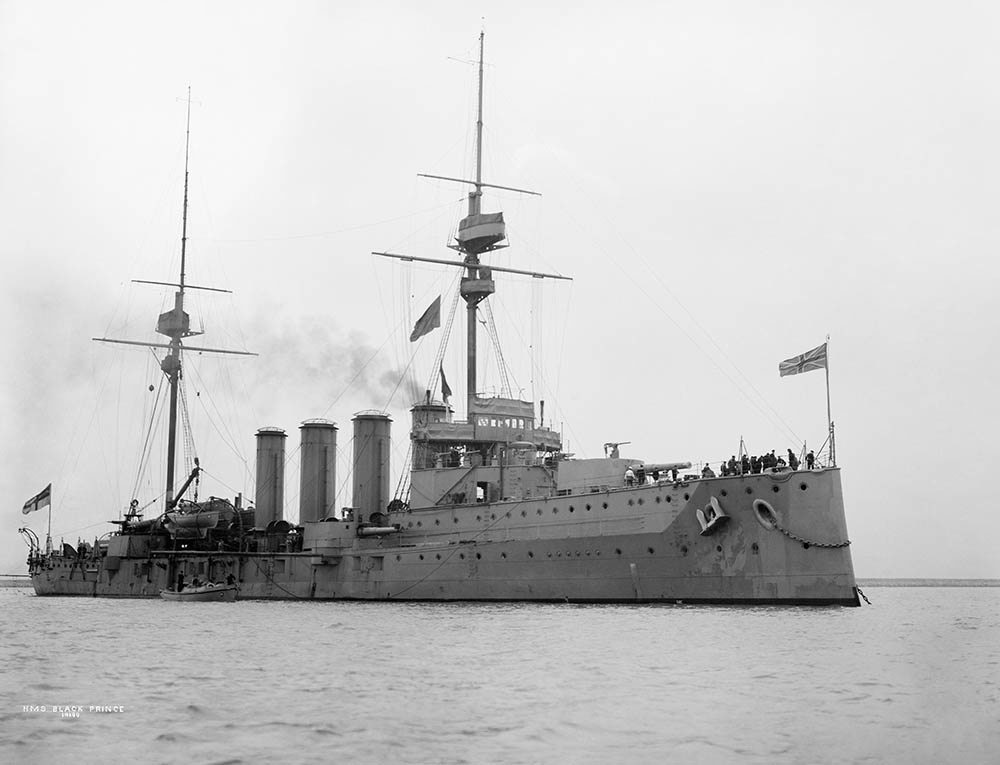
Image: HMS Black Prince (Wikimedia Commons)
HMS Black Prince was a Duke of Edinburgh-Class Cruiser launched in 1904. At Jutland, she was part of the Cruiser screening force sent ahead of the main fleet as part of 1st Cruiser Squadron.
At 17.42 on the 31st of May, the cruisers came into contact with the German fleet and Black Prince lost contact with the rest of the squadron. No positive sightings were made after that, although a signal was received from her at 20.45 reporting a submarine sighting, and a destroyer did report seeing a large ship on fire, which was later thought to have been the Black Prince.
Black Prince was sunk by enemy action. Reports conflict, but the general account is that the cruiser came across enemy vessels just after midnight, approaching them in the belief they were fellow Royal Navy ships.
Unfortunately, it appears Black Prince sailed right in the path of the German fleet. Fixed with spotlights, she was blasted at point-blank range by some five German battleships. Helplessly outnumbered and outgunned, Black Prince was hit by at least twelve heavy shells and several smaller calibre ones, sinking in under fifteen minutes.
There were no survivors of Black Prince’s 857-strong crew. Among them was the 17-year-old John Gilber Eyers.
John has no known grave and is commemorated on the Plymouth Naval Memorial.
Compounding the tragedy of John’s loss was the fact that he was just two weeks away from celebrating his 18th birthday.
John’s parents lost two further sons in the Great War: Sappers William and Alfred Eyres. Both contracted disease in the Gallipoli Campaign and appear to have returned home to Britain before succumbing to illness. William is buried in Caernarfon, while Alfred is buried in Widnes.
Our thanks to Phillip Baldock for sharing John’s story on For Evermore.
Stoker 1st Class William Adolphus Tucker
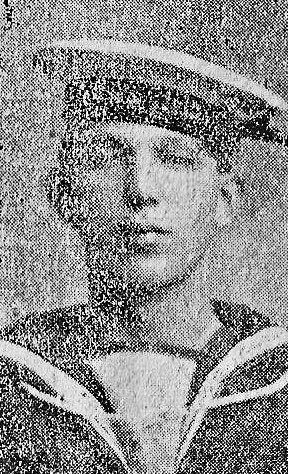 Image: Stoker 1st Class William Adolphus Tucker
The complex engines of the Royal Navy’s vessels at the time of Jutland were powered either by coal or oil. Fuelling and maintaining these was tough, backbreaking work, done in intense heat, with Stokers working in stifling temperatures in up to 24-hour rotating shifts.
Stokers were required to shovel coal or feed oil into the engines, maintain boiler pressure, clear clinker and keep machinery oiled and operational. They did so in the bowels of their ships, usually below the waterline, meaning they rarely survived when disaster struck.
Among the Stokers lost at Jutland was Stoker 1st Class William Adolphus Tucker of Perranwall, Cornwall.
William was born on 26 July 1894, the sixth of nine known children to Melchesidic Tucker, a farm labourer, and Susan Tucker.
His pre-war naval career began in April 1913 as a Stoker 2nd class. He was aged 18 and described as being: "5' 7" tall; with brown hair; blue eyes; a fresh complexion; and a chest measurement of 36".
He signed on for a 12-year engagement and went to HMS Vivid II, the shore base at Devonport, where he carried out his training.
On completion of his training, he was posted to his first, and what was to be his only ship, on 2 September 1913, when he went aboard HMS Defence, a Minotaur-class armoured cruiser, serving with the 1st Cruiser Squadron in the Mediterranean. He was advanced to Stoker 1st class on 14 June 1914.
HMS Defence sailed in the Dardanelles, the Southern Atlantic and the South and West African coast before Jutland. She was refitted in 1915 and 1915 with additional smaller guns and, with HMS Black Prince, served in the 1st Cruiser Squadron at Jutland.
For Jutland, Defence served as the flagship of the squadron’s commanding officer, Rear-Admiral Sir Robert Arbuthnot.
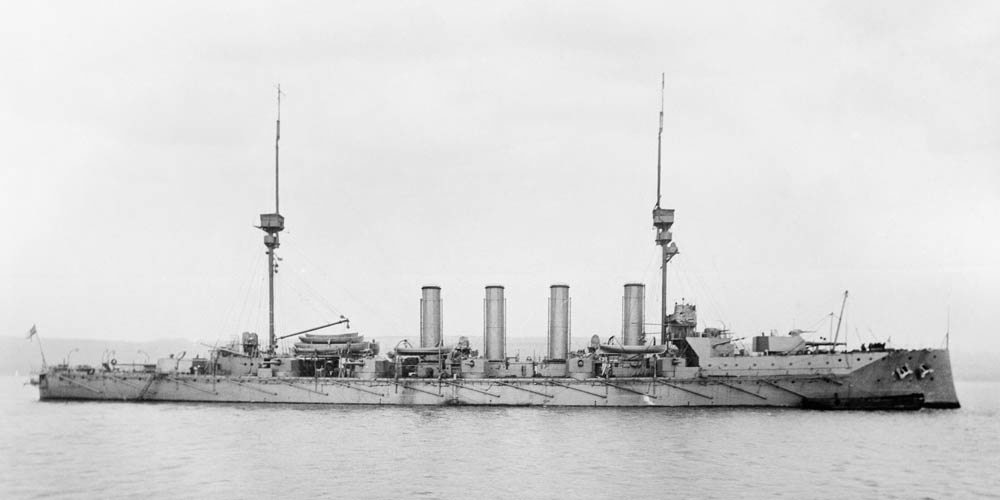
Image: HMS Defence (Wikimedia Commons)
At 17.47 pm, Defence and HMS Warrior, the leading two ships of the squadron, spotted the German II Scouting Group and opened fire, their shells falling short. The two ships set off in pursuit of the German vessels.
Shortly afterwards, they spotted the disabled German light cruiser SMS Wiesbaden and closed to engage when they were spotted by the German battlecruiser SMS Derfflinger and four battleships, which were less than 8,000 yards away.
The fire from the German ships was heavy. Defence was hit by two salvoes from the German ships that caused the aft magazine to explode.
The magazine is a ship’s ammunition and gunpowder storage, and is usually located below the waterline. An explosion in a magazine can prove fatal for a ship.
The resulting fire spread via the ammunition passages to the adjacent 7.5-inch magazines, which detonated in turn.
The ship exploded at 6.20 pm with the loss of all hands. 904 men were killed, including Stoker 1st Class William Adolphus Tucker, who was aged 21. As his body was never recovered, William is commemorated by CWGC on the Plymouth Naval Memorial.
With thanks to Nicholas Tucker for sharing William’s story.
Commander Loftus William Jones VC
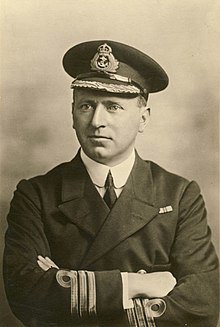 Image: Commander Loftus William Jones VC
Four Victoria Crosses, the highest military decoration for valour in the British Armed Forces, were awarded at Jutland, three of which were awarded posthumously.
Among those posthumously decorated sailors was Commander Loftus William Jones of HMS Shark.
Loftus William Jones was born on 13 November 1879 in Southsea, Portsmouth, the son of Admiral Loftus Francis Jones and his wife Gertrude. Seemingly destined for a naval career, he was educated at Eastman’s Royal Naval Academy.
He was appointed as a Sub-Lieutenant to HMS Spiteful in 1901, promoted to Lieutenant on 1st April 1902, and was appointed later that year to HMS Tamar, the naval base at Hong Kong, for service on destroyers in reserve at the China Station.
Loftus rose to become a Commander aboard HMS Shark during the First World War and was aged 36 at the Battle of Jutland.
Ranking below Captain and above Lieutenant-Commander, a Commander typically commanded smaller vessels, such as sloops, submarines, and destroyers. They also acted as Second-in-Command on major battleships.
Loftus’ vessel, HMS Shark, was an Acasta-class Destroyer. She had only been afloat for roughly 3 and a half years before she was lost at Jutland, struck by a torpedo at 19.00 on May 31 1916.
Loftus was posthumously decorated for his personal bravery during the loss of Shark. His Victoria Cross citation, gazetted on 6 March 1917, gives the following details:
“The London Gazette, 6 March 1917 “On the afternoon of the 31st May, 1916, during the action, Commander Jones in H.M.S. ‘Shark’, Torpedo Boat Destroyer, led a division of Destroyers to attack the enemy Battle Cruiser Squadron.
“In the course of this attack, a shell hit the ‘Shark's’ bridge, putting the steering gear out of order, and very shortly afterwards another shell disabled the main engines, leaving the vessel helpless. The Commanding Officer of another Destroyer, seeing the "Shark's" plight, came between her and the enemy and offered assistance, but was warned by Commander Jones not to run the risk of being almost certainly sunk in trying to help him.
“Commander Jones, though wounded in the leg, went aft to help connect and man the after wheel. Meanwhile, the forecastle gun with its crew had been blown away, and the same fate soon afterwards befell the after gun and crew. Commander Jones then went to the midship and the only remaining gun, and personally assisted in keeping it in action.
“All this time the ‘Shark' was subjected to very heavy fire from enemy light cruisers and destroyers at short range. The gun's crew of the midship gun was reduced to three, of whom an Able Seaman was soon badly wounded in the leg.
“A few minutes later, Commander Jones was hit by a shell, which took off his leg above the knee, but he continued to give orders to his gun's crew, while a Chief Stoker improvised a tourniquet round his thigh. Noticing that the Ensign was not properly hoisted, he gave orders for another to be hoisted.
“Soon afterwards, seeing that the ship could not survive much longer, and as a German Destroyer was closing, he gave orders for the surviving members of the crew to put on lifebelts. Almost immediately after this order had been given, the ‘Shark’ was struck by a torpedo and sank.
“Commander Jones was unfortunately not amongst the few survivors from the ‘Shark’ who were picked up by a neutral vessel in the night.”
In contrast to many of the victims of Jutland, Commander Jones' body was washed ashore in Western Sweden some days after the battle. He was originally buried at Fiskebäckskil, Västra Götaland, Sweden, and later transferred to the CWGC plot in Kviberg Cemetery, Gothenburg.
With thanks to Malcolm Peel for sharing Commander Jones’ story with us.

Want more stories like this delivered directly to your inbox? Sign up for our newsletter for regular updates on the work of Commonwealth War Graves, blogs, event news, and more.
Sign UpOrdinary Seaman Edward Arda
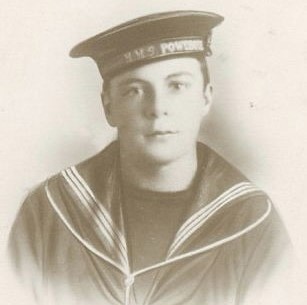 Image: Ordinary Seaman Edward Arda
Ordinary Seamen were the lowest ratings (ranks) of the Seamen Branch of the Royal Navy. They were essentially entry-level sailors, young in age, doing “on-the-job” training, learning to become Able Seamen.
An Ordinary Seaman’s training revolved around intense physical labour, such as cleaning, hauling lines, and assisting with weapon operations.
There would have been thousands of Ordinary Seamen present at Jutland, with Ordinary Seaman Edward Arda among them.
Edward, who was serving aboard the Dreadnought-class HMS Malaya during the Battle of Jutland, was born in Bedminster, Somerset, but lived with his family in their native Manchester.
He enlisted in the Royal Navy on 10 May 1915 at the age of 17. An article in the Ashton-under-Lyne Reporter (10 June 1916) states that he “always had a hankering after the Navy”.
After completing training at HMS Powerful, Edward was first assigned to HMS Victory before transferring to the newly-launched battleship Malaya.
Ahead of Jutland, Edward had progressed from Boy 2nd Class to Boy 1st Class and had reached his Ordinary Seaman rating in March 1916, a few scant months before losing his life.
During the battle, Malaya was part of the 5th Battle Squadron commanded by Rear Admiral Hugh Evan-Thomas. She targeted several German battlecruisers, including the SMS Seydlitz, scoring numerous hits.
As the German fleet intercepted the 5th Battle Squadron, Malaya was hit by seven 12-inch shells. As she turned to join the rest of the Grand Fleet, she was struck a further eight times.
Malaya survived but took major damage, resulting in injuries or death to 65 sailors. Many suffered severe burns, including Ordinary Seaman Edward Arda.
Arda survived long enough to be transferred to HMS Victory for treatment but later succumbed to his wounds. He died on 3 June 1916, aged 18.
Edward is buried at Rosskeen Parish Church Extension, Invergordon, ,Scotland. His family chose the inscription 'As we loved him so we miss him ever in our thoughts'.
Our thanks to Hazel Arda for sharing the story of her relative Edward.
Captain Thomas Parry Bonham
Thomas Parry Bonham was the son of Admiral C. W. Bonham, R.N., and was born on 31 March 1873; he entered the Royal Navy in January 1886.
He was Commander of Vernon Torpedo School between 1906 and 1910, where he was likely training Russian naval officers, hence his award of the Order of St Stanislas in August 1909.
From February 1914, he was made Inspecting Captain of Mine Sweeping Vessels, which position he held until January 1916, when he was given command of Black Prince, which, as we know, was sunk at Jutland.
Jutland by Captain Donald MacIntyre (1957) describes what happened to Black Prince at Jutland as follows:
"The cruiser Black Prince, which, at the first meeting of the two main fleets, had followed her flagship, Defence, into action and been roughly handled at the time that Defence had been blown up and Warrior disabled, had been left behind by the Grand Fleet's turn to the southward after deployment.
“For some reason, which will never be known, she was still at this time far astern of and out of touch with the British fleet; but when a line of battleships was dimly seen ahead, it was no doubt thought that they were the British squadrons. Course was altered to close them. At a bare half-mile range, the German recognition signal flashed out.
“The horrified Captain Bonham, swung his ship away in a desperate effort to escape, but it was too late.
“In the battleship Thuringen, the same deadly efficient night action procedure that had been displayed at the head of the line went into play. Brilliantly lit by half a dozen searchlights, the Black Prince was raked from stern to stem by a tornado of shells and lay a helpless wreck before she could even fire a shot in reply.
“As she drifted down the German line, ship after ship opened up on her, Thuringen, Ostfriesland, Nassau and, finally, as the fleet flagship Friedrich der Grosse, added her quota. The Black Prince met the same end as the Defence, blowing up with a tremendous explosion, vanishing with all hands...”
CWGC thanks Noonans Mayfair Ltd for this story.
Major Francis John William Harvey VC
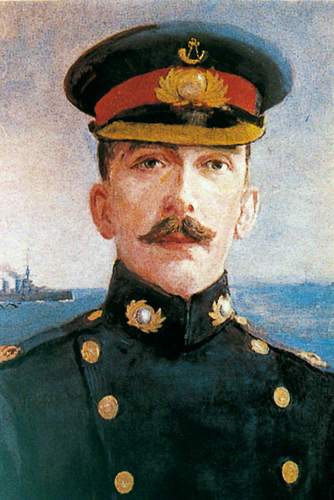 Image: Major Francis John William Harvey VC
The Royal Marines were present in force during the Battle of Jutland, providing several important naval battle roles.
The Marines manned primary and secondary armaments, such as the massive gun batteries on the Royal Navy battleships, with many also serving as gunlayers and sightsetters.
The highest-ranking Royal Marine officer aboard the Grand Fleet’s flagship HMS Lion was Major Francis John William Harvey.
Francis had been born into a family with a strong naval tradition. His family had a strong naval background going back to his great-great-grandfather, John, who was killed in the Fourth Battle of Ushant in 1794 during the French Revolutionary Wars.
Francis had a long career at sea after graduating from the Royal Naval College, Greenwich, in 1892. As well as serving aboard ships on the oceans, Francis also taught gunnery at Chatham Dockyard and was promoted to major in 1911.
A report highlighted Francis’ gunnery skills: "The degree of efficiency in the Gunnery Establishment at Chatham is very high, both as regards general training and attention to detail. Great credit is due to all concerned, but particularly to Major F.J.W. Harvey”.
On the strength of this report, he was selected as HMS Lion’s senior Royal Marine Officer, serving under Commander of the Grand Fleet Rear Admiral David Beatty.
HMS Lion had eight 13.5-inch guns. Francis was stationed in Q turret, directing their operation and fire.
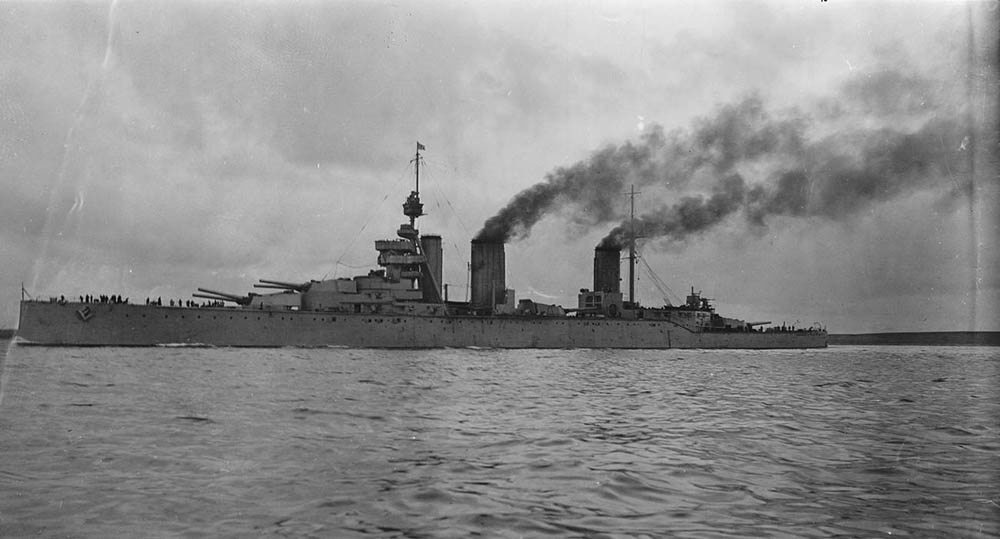
Image: HMS Lion (Wikimedia Commons)
After action in the Battle of Heligoland Bight, HMS Lion was badly damaged during the Battle of Dogger Bank and returned to Rosyth for repairs, where Francis remained for the whole of 1915 and the first five months of 1916, continuing his gunnery training and preparing for major fleet action.
Francis wrote to a fellow officer who was serving on HMS Orion describing his experiences: “As to the fighting in a turret, one doesn't suffer any discomfort, and my chief feeling has been of 'curiosity' mixed with the idea that whoever else is coming to grief, oneself will be all right. I am under no delusion, though, that if a projectile does hit one's turret, it will, in all probability, come right in and send one to glory.”
Given what was to follow, his words were prescient in the extreme.
At Jutland, HMS Lion was hit by nine shells from the German battlecruiser, Lutzow. One shell struck Q turret, where Francis was at Action Stations, and punched a piece of the 9-inch face plate into the turret before detonating, blowing off the armoured roof of the turret and starting a fire.
The initial explosion killed or wounded everyone stationed in the gun house itself, but Francis, despite severe wounds and burns, gave orders down the voice pipe for the magazine doors to be closed and the magazine compartments to be flooded, an action which would normally prevent the cordite in the magazines from detonating.
The magazine was consequently flooded and locked up within minutes of the hit. However, there were still ready charges in the gun room and gun barrels. Many crewmen remained in the shell room and magazine below, and the fire, which was thought to have been extinguished, gained strength and ignited the remaining cordite charges, setting off a large explosion that killed all the men in the vicinity, the flame of the explosion reaching as high as the top of the ship's masts.
His bravery in the face of certain death did not go unnoticed, as he was mentioned by name in Admiral Jellicoe's post-battle dispatch, and he was posthumously awarded the Victoria Cross.
Francis' body was never recovered. He is commemorated on the Chatham Naval Memorial.
Thanks again to Malcolm Peel for sharing Francis’ story.
How to share your Jutland stories
This is only a very small selection of Jutland stories. More than 6,000 remain to be told.
Use CWGC records to find Jutland sailors
Each of the 6,000 Royal Navy souls lost at the Battle of Jutland are commemorated by us at the Commonwealth War Graves Commission.
Our database lists each sailor by name and includes their place of commemoration, including the respective naval memorial or the churchyard or cemetery where they are buried if their body was recovered.
Our Find War Dead tool allows you to search by Armed Forces Branch and by ship, allowing you to pinpoint the crewmen of the sunken vessels of Jutland.
You can use this as a starting point for your research. You may also wish to check our “How to Search” guides for more information and tips.
Combine our casualty database with wider documents, such as service records held by the National Archives, census information, and local newspaper archives, to help you uncover more information about those we commemorate.
Sharing your stories on For Evermore
For Evermore is our online stories platform. Here, we collate and share stories of those we commemorate, including Royal Navy casualties from the Battle of Jutland.
This platform is open to you to submit your stories. They could be a relative of yours, or just a casualty whose story you find inspirational, moving, or tragic and wish to share.
Uploading stories is easy. Head over to For Evermore today to discover stories of servicemen and women in our care and to upload yours today.