20 July 2026
The Commonwealth Games: Sporting lives, shared stories, and Commonwealth commemoration
The Commonwealth Games brings together athletes and audiences from across the Commonwealth, united by a love of sport.
A sporting moment with a wider story
Those who come to watch and compete are connected by the Commonwealth’s shared heritage and history, much like the people commemorated by the Commonwealth War Graves Commission.
Among those we commemorate are stellar athletes of their day: from league-winning footballers to stars of the rugby pitch, to Olympic gold medallists, we care for the final resting places of some of the most noted sportspeople of the 20th Century who died in the World Wars.
Competitors from the British Empire Games, the precursor to the Commonwealth Games, are amongst those commemorated by Commonwealth War Graves.
Here, we’ll examine how sport and the World Wars are linked, the connections forged by sporting endeavours across the Commonwealth, and how the Commonwealth Games can be a gateway to commemoration.
At a glance: What's on this page
This page looks at the connection between the Commonwealth Games and the Commonwealth War Graves Commission and the link between sport and our shared history, including:
- How the Commonwealth Games link to CWGC and Commonwealth history
- Sport and identity
- How Sport can be used as an entry point to learn more about World War servicemen
- How to use CWGC records to research and write sporting stories
- Where to read and share Commonwealth sporting stories
Why is the Commonwealth Games relevant to the Commonwealth War Graves Commission?
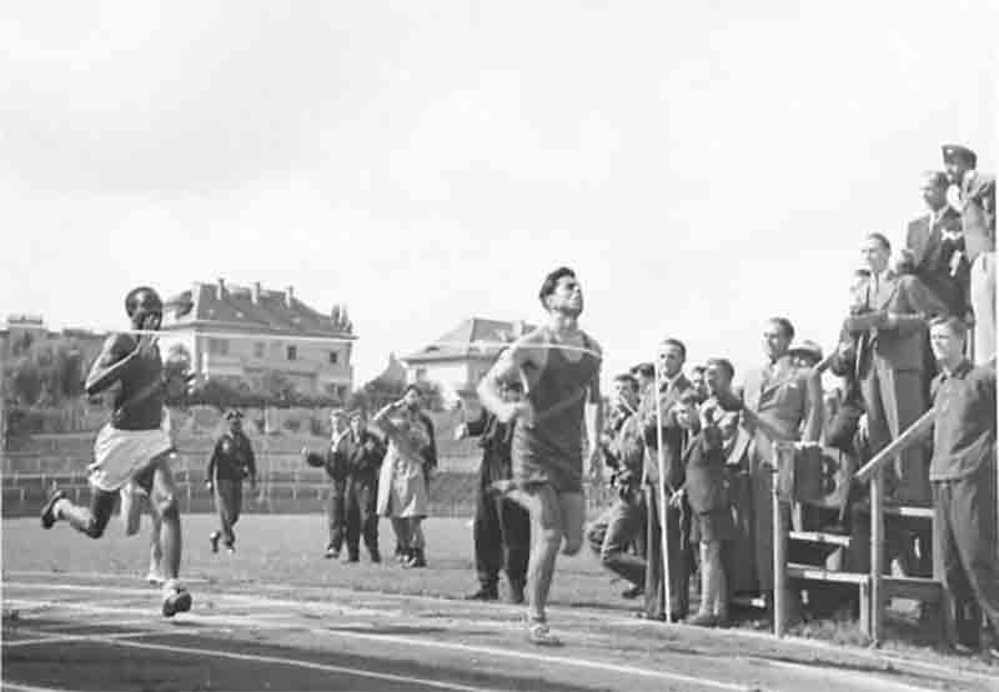
Image: Sport and the Commonwealth's military and shared history are more closely linked than you may think (IWM)
The Commonwealth Games began life in 1930 as the British Empire Games, mirroring our 1917 origin as the Imperial War Graves Commission.
Over time, as attitudes shifted, the British Empire Games changed into the Commonwealth Games. In the same way, we changed our name in the 1960s to reflect this shift and have been the CWGC ever since.
But names aside, the Commonwealth Games and Commonwealth War Graves Commission have more in common than you might think.
Global moments; Shared Commonwealth History
Major sporting events like the Commonwealth Games allow fans and competitors alike to come together from around the world and experience exciting, shared moments.
Our collective sporting endeavours and triumphs root us in a shared Commonwealth story, as does our ongoing work at the Commonwealth War Graves Commission.
Sport as an entry point into people’s lives
We know that the Commonwealth Games and our work at Commonwealth War Graves are two ways our shared history connects nations. But what about the people behind the events and our war graves?
Sport makes an ideal entry point into understanding people’s lives, especially the sportsmen and women among the 1.7 million people we commemorate.
When looking at someone’s sporting achievements, we can learn more about their background.
Clearly, they must have been dedicated and committed, as well as mentally and physically tough and capable. We might learn more about their pride in representing their country, and we can find out more about their pre- and post-sport lives. We might get a better picture of them as a person.
When it comes to commemoration, knowing more about the individual enhances the power of remembrance. Names etched into headstones and carved into memorial panels can be little impersonal and abstract. Sport can help with this.
Sport, identity, and the people behind the names
Diving into the exploits and achievements of the Commonwealth Games competitors commemorated in our cemeteries and war memorials helps bring the real person behind the names to life.
More than a record
Each was their own person, with their own hopes, dreams, sporting successes, failures, and hopes and disappointments.
By using sport as a gateway, we can learn much about the Commonwealth soldiers and sportsmen we commemorate.
Clubs, communities and everyday life
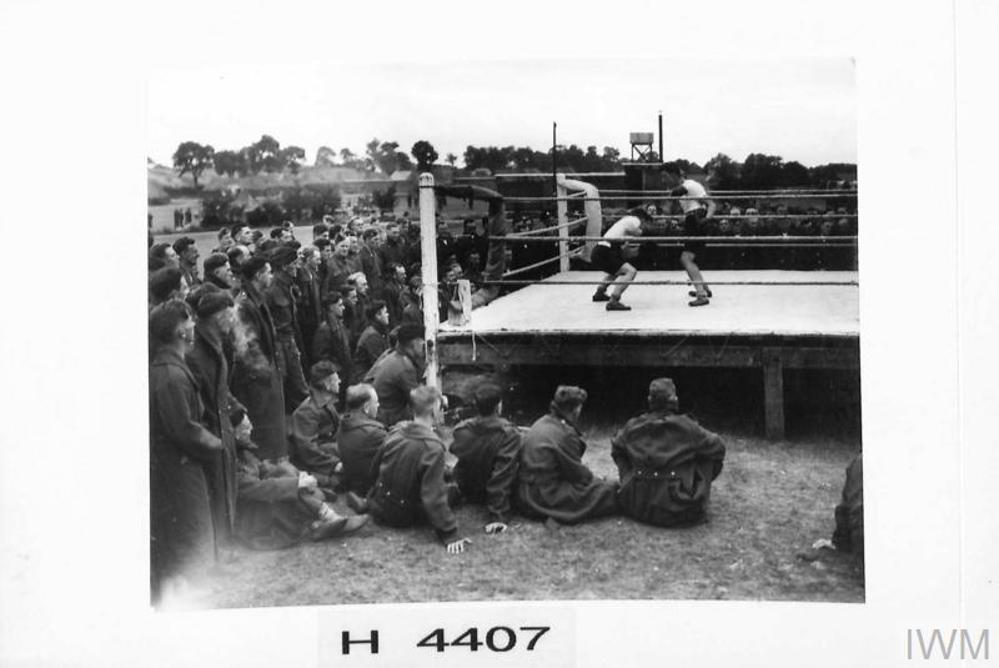
Image: Soldiers watch on as an inter-regimental boxing match unfolds (IWM (H 4407))
Sports clubs were, and still are, pillars of communities up and down the UK and across the Commonwealth.
Historically, team sports and clubs give people the space to enjoy competitive sport, boost their physical and mental health, and meet friends and family socially in a friendly setting.
As rules were codified across various games in mid-Victorian England, more and more sports clubs, gymnasiums and grounds and venues popped up across the UK and Empire, providing more people with access to sports facilities and teams than ever before.
There were tens of thousands of sports clubs, amateur and professional, at the time of the World Wars. Universities proved fertile ground for sport, especially Cambridge and Oxford, producing many Olympic and Commonwealth competitors and medal winners.
Football, cricket, and rugby were especially popular in the British Empire, but field hockey, rowing, and track and field athletics were also extremely popular.
Entire sports teams even joined up to serve, notably the Leyton Orient and Hearts of Midlothian football squads in the Great War.
Sport carried over into the Armed Forces.
As a tool for relaxation, morale, and physical exercise, sport helped forge closer bonds between comrades, from individual soldiers taking part for fun, to inter-divisional, inter-service rivalries and championships, knitting tight links between units and organisations.
Why sporting details can matter
Sport can reveal character, routine, friendship, local identity and hopes for the future. Any biographical details of those we commemorate really help flesh them out as a formerly living, breathing person.
But we should stress, although this article covers the Commonwealth Games, sporting skill and interest are by no means restricted to the absolute elite. Sport was ingrained in British and Commonwealth life, from school competitions to local cricket clubs, and everything in between.
Sporting details, regardless of a person’s abilities, help us understand that they were human, that they were excited and interested in competition, and that they were ultimately more than just a name on a headstone or war memorial.

Want more stories like this delivered directly to your inbox? Sign up for our newsletter for regular updates on the work of Commonwealth War Graves, blogs, event news, and more.
Sign UpCommonwealth athletes' stories to explore
Wing Commander Arthur Wellington Sweeney
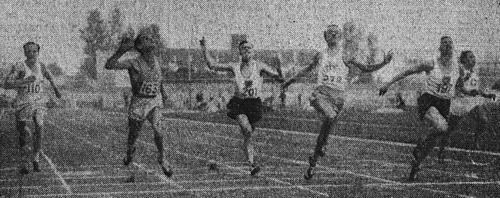 Image: A grainy photo showing the finals of the 100 metre sprint at the 1938 European Championships in Paris, with Arthur Sweeney seen far left (Wikimedia Commons)
Arthur Sweeney was one of Britain's leading sprinters of the 1930s. Arthur was crowned British 100 yards champion in 1934, after finishing as the top home athlete at the AA Championships.
Arthur won multiple championships during his career, including the 1935 and 1939 AAA 100-yard and the 1936 and 1937 220-yard titles.
Perhaps Arthur’s best display came at the 1934 British Empire Games in London. Arthur dominated in the English capital, taking home gold in the 100 and 220 yards, and the 4x110 yard relay.
Despite his domestic and Commonwealth dominance, Arthur was unable to translate this into Olympic medal success. Representing Great Britain at the 1936 Berlin Olympics, Arthur reached the semi-finals of the 100 metres and competed in the 200 metres sprint, failing to qualify for the finals.
Alongside his athletics career, Arthur served as an officer in the Royal Air Force. By 1940, he had reached the rank of Wing Commander.
Arthur was killed in a flying accident, aged 3, on 27 December 1940, half a mile offshore of Takoradi, Gold Coast (present-day Ghana).
He was taking off in a Mohawk IV aircraft, climbing steadily, before suddenly dropping into the Atlantic Ocean. The general opinion was that Sweeney had forgotten he was using a French reverse-operating throttle; the usual push forward for more power would instead cut out the motor.
Arthur’s body was recovered, and today he is buried at Takoradi European Public Cemetery.
Sergeant Gerald Ian Dacres Backhouse
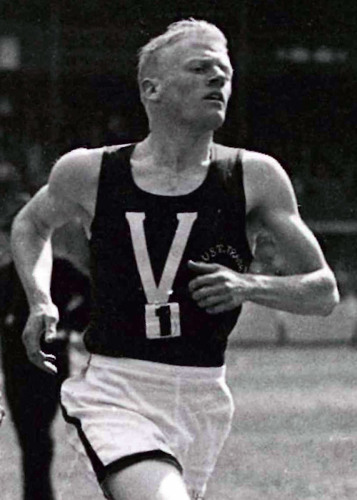 Image: Gerald Backhouse mid-race
If Arthur Sweeney was one of the leading British sprinters of his day, then Gerald Backhouse was one of Australia’s top middle-distance runners of the era.
“It was only by accident that I became interested in foot-running,” said Backhouse in 1940. “When the school’s first choice for the mile run at the public schools’ sports became ill one month before the day of the race, the sports master suggested I should train for the race.
“When the race started, I jogged along at the back of the field, but the roar of the crowd created within me a mental condition which I cannot explain.”
That spark ignited into a glittering running career. By 1935, Gerald had become Australia’s leading middle-distance runner, having broken the national 880-yard record with a time of 1:55.1.
In 1936, Gerald represented Australia at the Berlin Olympics, competing in the 1,500 metre heats and finishing 8th in the 800-metre final.
The 1938 British Empire Games were held in Sydney. Gerald, continuing to break domestic records, was keen to display his prowess. Racing on his home turf, he won silver in the 1-mile event and 7th in the 880 yards.
With these results, Gerald confirmed his place as one of Australia’s leading runners of his era.
Come the Second World War, Gerald served with the Royal Australian Air Force, attached to the RAF. He sailed for Britain in June 1941. Just six months later, he would be dead, killed in an accident during a practice bombing raid in Cumberland, northern England.
Gerald is buried in Causewayhead Cemetery, Silloth, Cumbria.
Captain Desmond Glover Kingsford
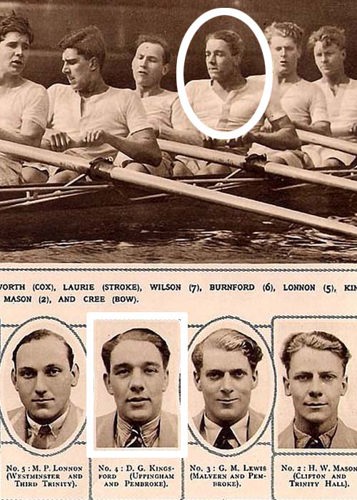 Image: Desmond Glover, circled, with his crewmates
Born in Dublin, Desmond Glover went on to study at Cambridge University, becoming a skilled oarsman alongside his brother Annesley.
The brothers were part of a successful Cambridge crew that won consecutive Boat Race victories in 1936 and 1937. Such was Desmond’s prowess that he was selected for Team Great Britain at the 1936 Berlin Olympics, finishing fourth in the men’s eight.
Representing London Rowing Club, he finished 2nd in the Silver Goblets at the 1937 Henley Regatta.
Desmond’s greatest rowing triumph came in 1938 at the Sydney British Empire Games. As part of the men’s eight, Desmond and his team surged to victory, claiming a gold medal.
Following the outbreak of the Second World War, Desmond was commissioned as an officer in the Irish Guards in February 1940.
Desmond took part in the Normandy Invasion and was awarded a Military Cross for his actions on 3 August 1944 at a crossroads near the commune of Saint-Charles-de-Percy.
After coming under a hail of machine-gun and anti-tank fire, the men under Desmond’s command were able to take their objective on the third attempt.
According to his medal citation, Desmond “Handled his group with great skill and daring. Had Captain Kingsford not persisted in his efforts to overcome this opposition, great delay would have been imposed in the execution of the Divisional plan.”
Unfortunately, Desmond would not live to see the end of the war. He was killed in action at Tilly-sur-Seulles on 10 August 1944. He is buried at Tilly-sur-Seulles War Cemetery.
From Commonwealth Games to Commonwealth Commemoration
Much like the Commonwealth Games draws in competitors and visitors from around the world, the work of the Commonwealth War Graves Commission is truly global.
A global community of names
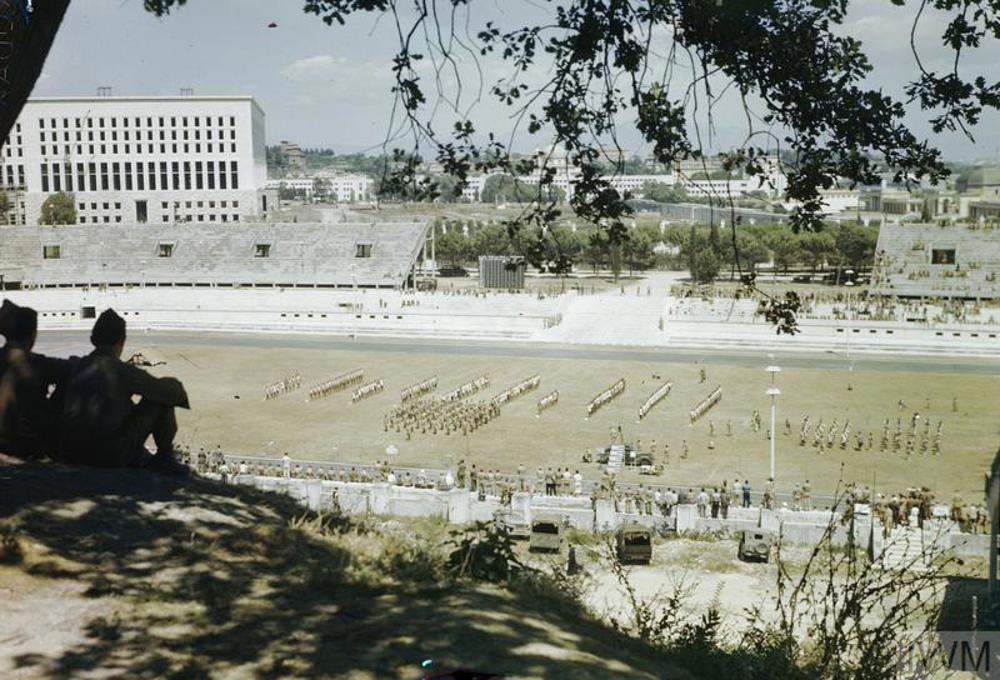
Image: British troops watch an Allied atheltics meet taking shape in Rome, circa 1944 (IWM (TR 2102))
Across over 23,000 sites in more than 155 countries and territories worldwide, you will find Commonwealth War Graves.
Our sites range from individual war graves in local churchyards, to our major purpose-built war cemeteries to our memorials to the missing, commemorating thousands of service personnel with no known war graves.
You will find the names of 1.7 million men and women of the Commonwealth we commemorate in our records and in our sites. Names from not just the UK, but the Caribbean, East, North, West, and South Africa; India, Australia, North and South America, across Europe, and beyond, are all represented among our shared war dead.
Commonwealth Stories across countries and territories
The stories written on the track and field, swimming pools, boxing rings, cycling tracks, rowing lakes, and sports grounds of the Commonwealth Games are drawn from across countries and territories.
So are the stories we share and remember at the Commonwealth War Graves Commission.
Since its inception, the Commonwealth Games have been held in cities around the world, from Hamilton, Ontario, Canada, in 1930 to Glasgow, Scotland, in 2026, on nearly every continent.
Likewise, you can find our cemeteries and memorials worldwide, highlighting just how global the World Wars were.
Many of the headstones and name panels within are inscribed with the names of famous sportsmen, such as Gerald Backhouse, Albert Walker, and Arthur Sweeney, revealing stories of the Commonwealth’s shared sporting and military history.
How to find sporting stories in CWGC records
CWGC records are your entry point for uncovering Commonwealth athletes' war graves, final resting places, and ultimately, their stories.
Start with a name
What’s in a name? In the case of researching our records, it’s everything.
Start with a name to help you search our records. You can also search by name, regiment, country of service, date of death or place of commemoration to help narrow your search and find the service person you are looking for.
Search by country, service or place
Further search fields are available to help refine your search.
Search by country to discover war dead commemorated within a specific country or territory. You can refine geographical searches further by using our Find War Cemeteries and Memorials tool.
You can also refine by service branch, including the Army, Air Force, and Navy. This will reveal all servicemen and women from one of the Armed Forces services for you to browse through. Use names, regiments, etc., to further refine your search.
Adding sporting context through stories
It should be stressed that CWGC records are not military service records or biographies. They instead detail the final resting places of each man or woman who died in military service to the British Empire in the two World Wars.
If you’re looking to combine our records with further details to create a sporting story, you will need to look further afield.
The Commonwealth Games and Olympic Games websites and archives hold details of each event and competitor. Sports clubs and universities also hold records and mementoes of their past members' sporting accomplishments.
Likewise, sporting exploits will have been reported in the newspapers of the time, especially large-scale events like the British Empire Games.
You may need to combine CWGC records with family records, club archives, local newspapers, and For Evermore stories to create the full picture.
Don’t forget to use our research guides as a starting point to help you along your storytelling journey.
Share a sporting or family story through For Evermore
Got a story of a Commonwealth Games athlete we commemorate and want to share it with the world? You can, using our online storytelling platform For Evermore: Stories of the Future.
Sharing your family World War sporting stories
For Evermore is our digital stories archive, containing thousands of stories of men and women commemorated by Commonwealth War Graves.
Most stories showcased For Evermore are submitted by the public: either families telling their ancestors' moving and inspirational stories, researchers sharing what they’ve uncovered, history associations, or more groups interested in sharing and preserving tales from The Commonwealth’s joint history.
Among the sections in For Evermore you can browse is Pre-War Sportsmen/women. As the name suggests, this section is devoted to athletes and sporting stories of those commemorated by the Commonwealth War Graves Commission.
Got a story to share? Upload it today on For Evermore.
Help others understand the person behind the name
For Evermore was launched to help us better know the people behind the names on our headstones and war memorials.
The stories, exploits, achievements, hopes, gains, and losses of each individual we commemorate remind us that they were real, living, breathing people before their wartime deaths.
We can better understand the mindsets, thoughts, feelings, emotions, and get a flavour of society through the lens of World War stories.
Sporting stories are celebrated and shared to this day, but For Evermore World War sportsman stories help us remember, understand, and celebrate Commonwealth athletes who may have otherwise been forgotten.
Browse and share sporting stories on For Evermore today.
Your support keeps these stories alive - donate to Commonwealth War Graves Foundation
CWGC & Commonwealth Games FAQs
The Commonwealth Games are shared moments in our collective history, just like the World Wars (albeit with much smaller stakes!). Both the Games and the work of the Commonwealth War Graves Commission represent our global connection and shared history. It continues to connect countries and cultures across the Commonwealth.
Yes, our records contain the names and details of any Commonwealth athelete who died in military service during the First and Second World Wars.
Yes, you can read stories about sportspeople commemorated by the Commonwealth War Graves Commission on our digital storytelling platform For Evermore: Stories of the Fallen
CWGC records are not military records. They are focused on commemoration. However, you can still use these to help research a sporting story of a casualty who died in the World Wars. Start with their name, regiment, and country of service by searching in our records. You may need to supplement your research with club records, newspaper reports, and military service records to create a complete story.
Author acknowledgements
Alec Malloy is a CWGC Digital Content Executive. He has worked at the Commonwealth War Graves Commission since February 2022. During that time, he has written extensively about the World Wars, including major battles, casualty stories, and the Commission's work commemorating 1.7 million war dead worldwide.