

16 November 2026
The Final Stages of the Somme Offensive and the aftermath of the First World War’s most notorious campaign
The Battle of the Somme and its first day are notorious for the bloodshed, but what about the rest of the battle?
The Somme extends far beyond 1 July 1916. The Somme Campaign stretched from July to November 1916, drawing in millions of troops from both sides.
While the First Day of the Somme is rightly remembered as the darkest day in British military history, it doesn't necessarily tell the whole story of the wider Somme Offensive. By the end of the campaign, the British and their Commonwealth allies had made ground but had paid an appalling cost in human life.
Here, we look at the final stages of the Somme Campaign, the people who fought it, and why the battle still matters to this day.
The Final Stages of the Battle of the Somme at a glance
The final stages of the Battle of the Somme include actions and offensives such as:
Battle of the Ancre Heights
Capture of Regina Trench by Canadian forces
Capture of the Stuff and Schwaben Redoubts
The Battle of Ancre
Lessons from the Somme helped turn the BEF into a more effective fighting force
The Somme’s later stages were tactical victories for the Allies, but the offensive ultimately failed to achieve what commanders hoped
Between October and November 1916, it’s estimated the British Forces took somewhere between 88,000 to 90,000 men, killed, captured, missing, or wounded
The situation on the Somme in late 1916
 Image: The Somme Front from July to November 1916 (Wikimedia Commons)
By the later stages of the Somme campaign, between October and November 1916, the Allies had endured four months of intense fighting.
The Somme battlefield covered a 20-square-mile area. In this small strip of the Picardy countryside, hundreds of thousands of servicemen, Commonwealth, French, and German alike, had lost their lives.
The Allies had continued to make small territorial gains as they ground down the German defences, but at a terrific cost.
To finally break the deadlock, the Allied armies launched a series of determined attacks around the River Ancre. These culminated in the Battles of the Ancre Heights, fought between 1 October and 11 November 1916, and the Ancre, fought between 13 and 18 November.
Commonwealth forces on the Somme
 Image: Canadian soldiers testing a machine-gun on the Somme frontline (IWM (CO 771))
Commonwealth troops supported their British counterparts from the Somme’s earliest engagements, such as the Newfoundland Regiment at Beaumont-Hamel, Indian cavalry at High Wood, and the South African Brigade at Delville Wood.
As the battle progressed and manpower dwindled, Commonwealth troops were sent to the front. The Canadians in particular soon found themselves at the forefront of the final phase of one of the war’s largest campaigns to date.
Why the Ancre Heights were important
Control of high ground is always important in any battle. In fact, during the Race to the Sea and the German retreat following the 1914 invasion, the Imperial German Army had captured almost all the high ground in front of the Allied positions.
Indeed, part of the reason why attacking casualties were so high among the Allies in the First World War was the fact they often had to attack uphill directly into well-prepared defences.
Strategic Somme high ground
The Ancre Heights formed a strategically important ridge north of the main Somme battlefield.
Allied forces mustering and advancing in front of the Ancre Heights were easily spotted by German observers.
Capturing the Ancre Heights would deny the Germans this crucial advantage. This would also give the British commanding views over German positions in the region, including Beaumont-Hamel, Serre, and Beaucourt.
The Battle of the Ancre Heights
The Battle of the Ancre Heights began with initial attacks on October 1, 1916.
 Image: British troops improvise a way across the Ancre using a fallen log as a bridge (IWM (Q 4568))
Opening attacks – 1-7 October
General Hubert Gough’s Reserve Army, fresh from successes at Thiepval Ridge, struck German positions along the ridge, located in the central Somme sector, from Courcelette to Thiepval.
Three German strongpoints were targeted:
Regina Trench – A 4-kilometre-long network of trenches, barbed wire and defensive strongpoints overlooking British forces at Courcelette, Grandcourt, and Thiepval.
Stuff Redoubt – A German strongpoint boasting barbed wire, machine-gun nests, fortified bunkers, and communication trenches. Parts of the Stuff Redoubt had already been captured in the battle for Thiepval Ridge.
Schwaben Redoubt – Yet another Imperial German fortification. This sprawling complex covered about 500 to 600 yards and boasted a network of caverns, underground concrete dugouts, and a multi-level trench system.
Intense resistance and poor weather made the early going tough for the British and Canadians.
Capture of the Stuff Redoubt – 8-9 October
With the Canadians Corps engaged in heavy fighting to capture Regina Trench, British attacks on Stuff Redoubt began on 9 October.
At 12:35 pm, a battalion of the 25th Division attacked the Stuff Redoubt, supported by an intense artillery barrage.
Perhaps drastically weakened by the previous month’s attacks on Thiepval Ridge, Stuff Redoubt had fallen into British hands at 12:42 pm.
High ground north of the redoubt remained uncaptured, however. Soon, the 25th Division was holding the line against determined German counterattacks.
On 14 October, the 7th Brigade advanced north, capturing an area of defensive high ground north of the Stuff Redoubt known as “The Mounds”. With their capture, the British had effectively silenced the Stuff Redoubt and defence structures north into the Thiepval Ridge.
Capture of the Schwaben Redoubt - 9-14 October
 Image: German positions on the Thiepval Ridge with the Schwaben Redoubt top right (
Next up was the formidable Schwaben Redoubt. The 36th (Ulster) Division managed to famously temporarily capture the notorious German fortifications on 1 July but were hurled back at great cost by intense German counterattacks.
British attacks intensified around the Redoubt. A series of attacks was held from 9 October, chipping away at the German defences.
The decisive blow came on 14 October when the 39th Division, including the 4/5th Black Watch and 1st Cambridgeshire Regiment, stormed the Schwaben Redoubt. Bit by bit, the preceding attacks had worn away the German defences, and the British capitalised on this.
German counterattacks were fierce but, by October 21, the Schwaben Redoubt was firmly in British hands.
Field Marshal Haig later described the Schwaben Redoubt’s capture as one of the British Army’s finest actions on the Western Front.
The Canadians at Regina Trench – 15-21 October
Meanwhile, the Canadian Corps was busy battling through the mud to capture the immense German fortifications at Regina Trench.
The Canadians had been attacking since October 1, with assaults on October 8 by the 1st and 3rd Canadian Divisions taking heavy casualties.
The tide began to turn by the 15th and by the end of the week, a determined Canadian and British attack, spearheaded by the 4th Canadian Division, captured major portions of Regina Trench.
Consolidation – 22 October to 9 November
By now, autumn rain turned the Ancre battlefields into a churning bog, making large-scale advances increasingly difficult.
This period saw the Allies consolidate their position. Canadian and British troops either dug in or committed smaller, localised attacks to improve their position and to drive off remaining German defenders.
As the pressure mounted, German forces suffered shortages of reserves. Increasing casualties from the continuous fighting were making their position untenable.
Final Actions – 10-11 November
On the night of 10/11 November, the Canadians launched a lightning raid that finally captured the western sections of Regina Trench. Estimates suggest the Canadians alone suffered more than 14,000 losses in this period, killed, missing, captured or wounded.
By now, the British and Canadian forces had completed the capture of the Ancre Heights. This gave the Allied forces in this sector commanding views of the German positions in Beaumont-Hamel and Serre.

Want more stories like this delivered directly to your inbox? Sign up for our newsletter for regular updates on the work of Commonwealth War Graves, blogs, event news, and more.
Sign UpThe Battle of the Ancre
 Image: British Soldiers inspect captured German machine-guns at Beaucourt (IWM (Q 4522))
The stage was now set for the final British offensive of the Somme: The Battle of the Ancre.
Running from 13-18 November 1916, the battle’s objective was to capture German positions that had resisted on 1 July, and exploit gains made by the capture of the Ancre Heights.
Prelude
After securing the heights, the British conducted a heavy bombardment of German positions, said to rival 1 July in its intensity.
Even after their hard-fought gains to capture the high ground, the British were still facing some major challenges, most notably the weather.
Heavy rain and freezing temperatures hampered preparations for the Ancre battle. Mud, especially, complicated movements of men, machinery, and materiel. Despite these obstacles, British commanders decided to proceed.
The attack begins – 13 November
Under the cover of fog and a creeping artillery barrage, British forces advanced behind a wall of shellfire towards German positions at Beaumont-Hamel.
Beaumont-Hamel had been the site of the Newfoundland Regiment’s darkest day, when the unit was all but destroyed on the First Day of the Somme.
The village was now in the sights of the 51st (Highland) Division. Despite advancing across difficult ground, outflanking German positions, the predominantly Scottish division captured its objectives along with hundreds of prisoners.
Advance into the Ancre Valley – 13-14 November
With the capture of Beaumont-Hamel, the advance continued up the Ancre into the river valley.
The village of St. Pierre Divion was a key objective. British attacks essentially rolled up the network of German trenches surrounding the village, leading to close-quarters combat.
The German defenders were becoming increasingly isolated as position after position fell. With the capture of Beaumont-Hamel, the Germans were coming under attack after attack from different directions, making it hard for them to maintain communications with headquarters.
Damaged roads, constant shelling, and the horrible weather restricted German counterattacks.
With St. Pierre Divion captured, the British now had control of the western Ancre Valley.
A bloody struggle at Beaucourt – 14-16 November
Beaucourt occupied important ground overlooking Ancre River crossings. If the Germans were allowed to hold it, they would maintain a defensive strongpoint north of the river. Beaucourt’s capture was essential.
Progress was slow and difficult for the attacking British. The weather was forming a most formidable obstacle. Men struggled through the shell-hole-marked landscape, trying to avoid the sucking, cloying mud.
What’s more, well-sighted German machine-gun nests took a heavy toll on the advancing British. Communications broke down too as telephone lines were cut or damaged in the fighting.
Inch by inch, the Brits fought through successive trench lines, finally seizing Beaucourt and its surrounding high ground on November 16.
Pressure on Serre and the German Withdrawal – 16-18 November
By now, snow and sleet were sweeping across the Somme battlefields. Soon, attacks would be essentially impossible.
After their losses at Beaumont-Hamel and Beaucourt, pressure was mounting on the German commanders. Were their positions at Serre defendable?
Once more, the British advanced northwards. Artillery bombardments continued to reign down on German frontline, communications, and assembly areas, causing some units to begin withdrawing to avoid isolation and encirclement.
Despite the pressure being mounted on the Imperial Germans at Serre, with a breakthrough near, the weather halted proceedings.
By now, conditions were too poor for further advances, with supplies struggling to reach the fighting men at the spear tip.
End of the Battle of the Somme – November 18
November 18 is officially marked as the end of the Battle of the Somme.
It was at this point that the British halted their advances on Serre and called an end to the campaign.
Had it all been worth it?
Were the Battle of the Ancre Heights and Ancre victories?
 Image: German prisoners of war captured after the Battle of Ancre
Yes, the Battles of the Ancre Heights and Ancre River are considered British military victories.
This goes against the traditional narrative of the Somme, which is, in the public imagination at least, widely considered a major military disaster.
The truth is much more subtle.
The British and their Commonwealth allies had advanced 7 miles across a 20-mile front during the Somme Offensive.
Battles like those in the Ancre Valley proved the British were learning their lessons and becoming an effective fighting force, one able to overcome the problems of modern warfare.
As ever, this came at a cost.
Casualties of the Battles at Ancre
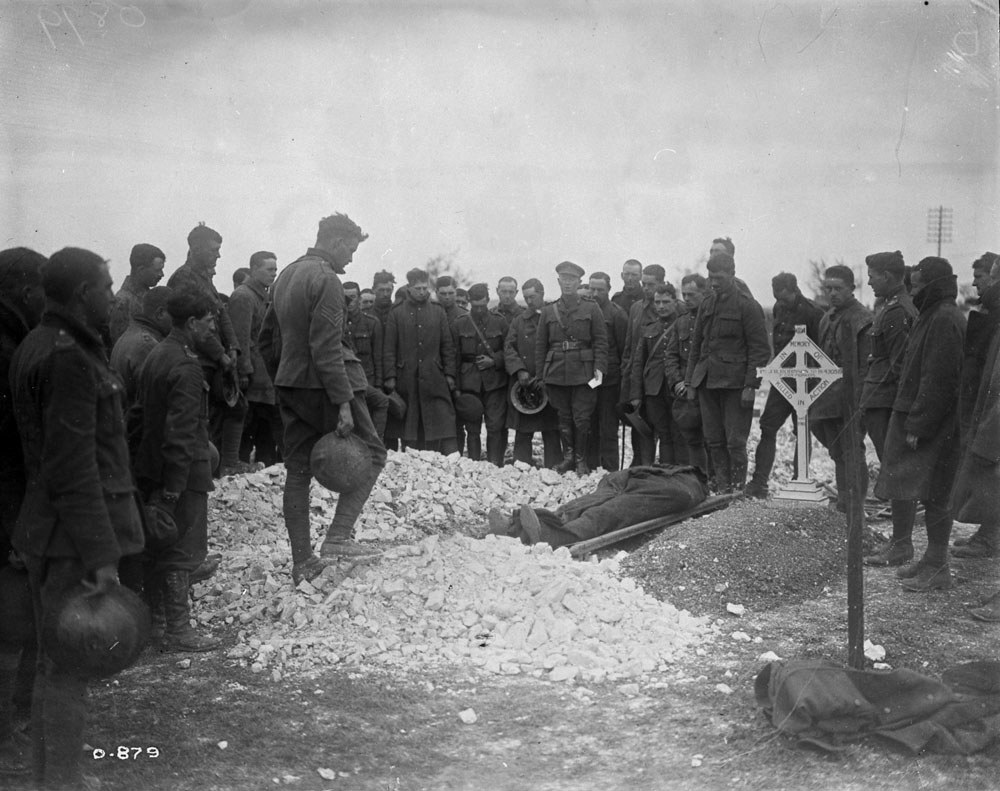 Image: "A Burial Service at the Front" Funeral of Major E.L. Knight, Eaton Motor Machine Gun Battery. October, 1916 (Libraries & Archives of Canada)
Between October and November 1916, it’s estimated the British Forces took somewhere between 88,000 to 90,000 men, killed, captured, missing, or wounded.
Of those, Canadian forces sustained 14,000 in the attacks on Regina Trench and related operations, a hefty chunk of the nation’s total 24,000 losses of the total Somme campaign.
Lessons from the Somme
The Somme’s successes, of which the Battles of the Ancre prove existed, must be viewed with subtler analysis than casualty figures would first suggest.
Of course, the huge loss of life for limited gains has coloured the perception of the Battle of the Somme. Over 150,000 British Empire servicemen had been killed or were missing by 18 November 1916.
However, the battle was an important crucible for the British Army from which it emerged a much more effective fighting force.
Advances in artillery spotting, planning, and doctrine meant barrages and bombardments became much more effective as the Somme rolled on.
Alongside the artillery, the infantry was whipped into shape. The previously untested Pals Battalions and members of Kitchener’s New Army were now combat veterans. NCOs and Junior Officers were given more freedom to improvise as their men gained experience, helping advance small unit tactics.
There is no overlooking the enormous losses of the Somme, but the battle’s wider impact goes beyond just casualty figures. The lessons learned on the Somme may have ultimately helped Britain and her Allies win the First World War.
Stories from the Final Stages of the Battle of the Somme
Discover servicemen’s stories from the closing Somme battles.
Don’t forget you can read thousands of servicemen and women’s stories from the World Wars on For Evermore: Stories of the Fallen, our digital stories archive.
Lieutenant The Hon. Vere Sidney Tudor Harmsworth
 Image: Lieutenant Vere Sidney Tudor Harmsworth (De Laszlo Archive Trust)
The second of three sons born to Harold Harmsworth, 1st Viscount Rothermere, Vere Sidney Tudor Harmsworth was born into one of the most influential publishing families in Britain.
His father founded Associated Newspapers Ltd in 1905, pioneering mass-circulation of newspapers and tabloid journalism.
Vere was educated at the Royal Naval College, Osborne, on the Isle of Wight, and Dartmouth Naval College.
After serving aboard HMS Cumberland and Defence, Vere’s military career was cut short. Prolonged exposure to gunfire left him partially deaf, leading to his discharge in January 1914.
Vere was studying at Cambridge University when the First World War broke out in August 1914. He volunteered for the Royal Naval Volunteer Reserve and was appointed to the Royal Naval Division’s Hawke Battalion.
The Royal Naval Division was an onshore military unit that fought alongside regular Army units during the Great War.
With the RND, Vere served at first in the ill-fated Gallipoli Campaign, where Hawke Battalion remained until the evacuation.
The RND was moved to France in May 1916, two months before the Somme Offensive began, before moving into positions ahead of the Ancre Heights in November.
Hawke Battalion and Vere participated in the Battle of the Ancre, with Beaucourt their ultimate objective.
Sadly, Vere was killed in action, but his commanding officer wrote home, speaking of Vere’s gallantry and leadership in the bloody fighting at Beaucourt:
“The men of his battalion who survived the action are thrilled with pride in his name. He led his company in the attack on the first German trenches. He saw that these were cleared of the Germans, and advanced with several men on the second line. In or near this line he was again wounded, this time on the right shoulder.
“Almost immediately he got up and collected such men as were near him, and led the attack on the third line. Just before reaching it he was hit by a shell, and instantly killed. During the greater part of this time he was commanding the attacking line, and by his endurance and courage got the men forward at a critical juncture.”
Hawke Battalion was devastated by the attack, the war diary recording “the Hawke Battalion after the first few minutes of the attack no longer existed”.
Many of the men, including Vere, were buried in a makeshift Royal Naval Division Cemetery before later being moved to Ancre British Cemetery. Vere is buried here to this day.
Private Charles Henry Gibson
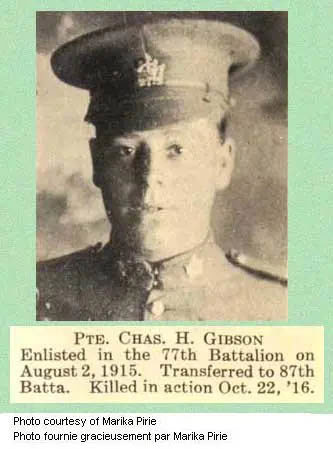 Image: Private Gibson from a newspaper clipping (Marike Pirie)
Charles Gibson was born in London but emigrated with his parents to Canada at some point before the outbreak of the First World War, possibly when Charles was a child or adolescent.
The Gibsons settled in Ottawa, and before his enlistment, Charles was working here as a general labourer. He was unmarried.
Upon his enlistment, Charles joined the 77th Overseas Battalion. After a short period of training, he arrived in England, where he was reassigned to the 87th Battalion (Canadian Grenadier Guards).
The 87th Battalion was somewhat unusual. It was one of only three units to recruit across the whole of Canada, rather than regionally, during the war. Within its ranks were many Indigenous, Black, and Asian servicemen, as well as those of White European descent.
Henry was part of the massive Canadian attacks on Regina Trench. Charles and the 87th were part of the force that captured extensive sections of the German fortifications on 21 October 1916.
Charles was reported initially as “missing, believed killed” on the 21st. He was confirmed killed the same day.
After his remains were identified and recovered by Grave Registration Units, Charles’ body was interred in ADANAC Cemetery, where he rests alongside 36 other members of the 87th Battalion.
Private Charles Thomas Clack
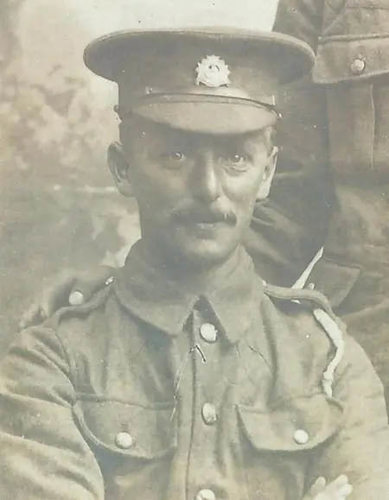 Image: Private Charles Clack
Charles Clack was born in Warboys, Huntingdonshire, around 1887, the son of a bricklayer and a grocer.
The eldest of four children, Charles was working as a farm labourer by age 14 but went on to find work as a postman, according to the 2011 Census.
Like millions of other young men, Charles enlisted in the Armed Forces, joining the 4th Battalion, Bedfordshire Regiment, based in the neighbouring county.
The 4th Bedfordshires was originally a training unit but was converted for frontline service as manpower shortages arose. It arrived in France for active duty on 25 July 1916.
Charles and his unit took part in the Battle of the Ancre, caught up in the horrific battlefield conditions that began to sweep the Somme in November. Poor weather and difficult ground hampered the British progress.
The 4th Bedfordshires' war diary states that they attacked between Beaumont-Hamel and the right bank of the Ancre at 6:45 am. It was likely that Charles was killed during this attack.
After the war, Charles’ remains were moved from Y Ravine Cemetery, Beaumont-Hamel, to Ancre British Cemetery.
CWGC sites to visit on the Somme
There are hundreds of CWGC cemeteries and war memorials dotted around the former Somme battleground, showing the devastation wrought over such a small area.
If you’re planning a visit to the Somme, here are some CWGC sites worth visiting, including those linked to the Somme Offensive’s final days.
Ancre British Military Cemetery
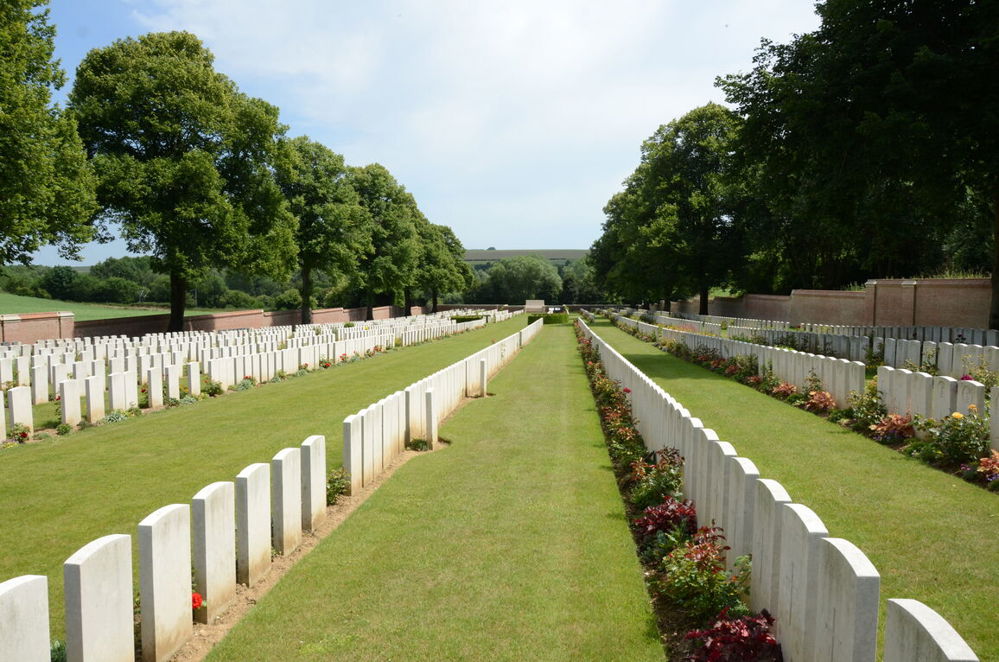 Image: Ancre British Cemetery
Some 2,540 Commonwealth casualties of the First World War are buried or commemorated in Ancre British Military Cemetery.
This cemetery represents the Somme from start, middle, to end, with war graves predominantly dating from 1 July, 3 September, or 13 November 1916.
Ancre is what’s known as a concentration cemetery where graves from other smaller sites nearby were brought in. Among the units represented here are the 51st (Highland), the 63rd (Royal Naval) and the 19th and 39th (Western) Divisions.
Regina Trench Cemetery
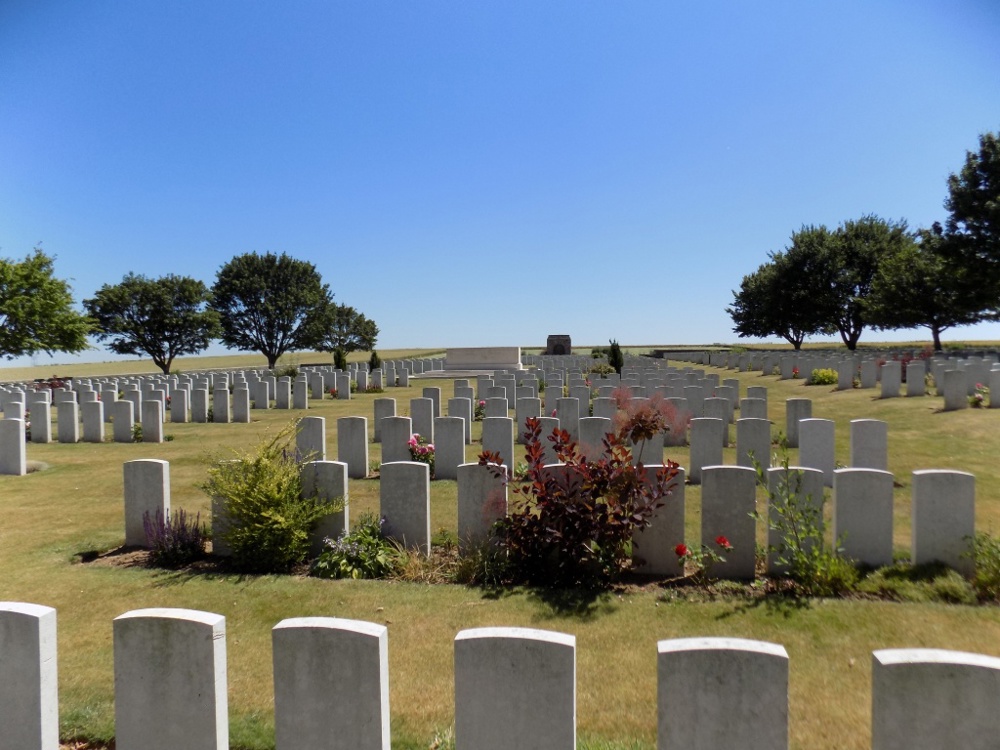 Image: Regina Trench Cemetery
The original part of the cemetery (now Plot II, Rows A to D) was made in the winter of 1916-1917. The cemetery was completed after the Armistice when graves were brought in from the battlefields of Courcelette, Grandcourt and Miraumont; most date from October 1916 to February 1917.
Two considerable groups of scattered graves, classed as cemeteries, were concentrated into Regina Trench Cemetery from Courcelette Road and Miraumont British Cemeteries.
Regina Trench now contains 2,279 burials and commemorations of the First World War. 1,077 of the burials are unidentified, but there are special memorials to 14 casualties believed to be buried among them. One American airman is also buried in the cemetery.
Thiepval Memorial to the Missing
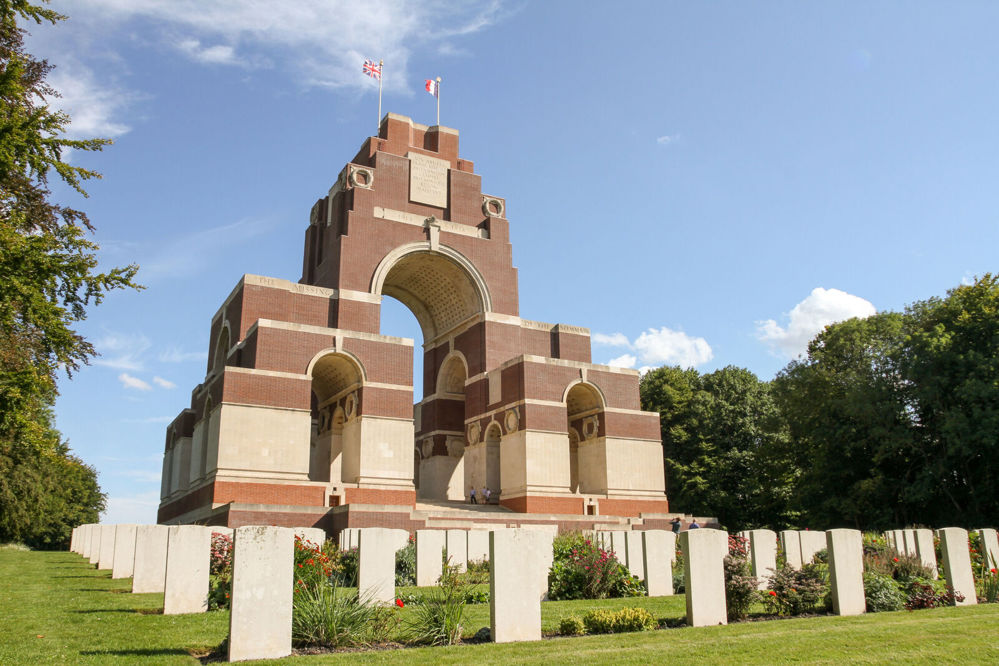
The ultimate symbol and point of commemoration on the Somme, the Thiepval Memorial to the Missing of the Somme is our largest memorial in the world.
Over 72,000 names of British and South African servicemen adorn its memorial name panels. Sadly, each person commemorated by the Thiepval Memorial has no known war grave.
Some 13,000 Thiepval casualties date from the campaign’s final stages.
Author acknowledgements
Alec Malloy is a CWGC Digital Content Executive. He has worked at the Commonwealth War Graves Commission since February 2022. During that time, he has written extensively about the World Wars, including major battles, casualty stories, and the Commission's work commemorating 1.7 million war dead worldwide.