

28 October 2026
The Freetown Memorial: Everything you need to know
The Commonwealth War Graves Commission is making new additions to the Freetown Memorial after new names have been uncovered for commemoration.
The Freetown Memorial stands in Freetown, the country’s capital and main port, commemorating men of the Sierra Leone Carrier Corps (SLCC).
Historically, the names of many of these men were sadly lost. However, due to ongoing work by the CWGC Non-Commemorations Programme team and external partners, we have been able to identify new names for commemoration.
A new extension to the Freetown Memorial, designed by Lagos-based Oshinówò Studio, commemorates by name over 940 men of the Sierra Leone Carrier Corps, the culmination of years of extensive research uncovering the names of the ignored and the missing.
Discover the story behind the Freetown Memorial and its transformation.
The Freetown Memorial
The Sierra Leone Carrier Corps
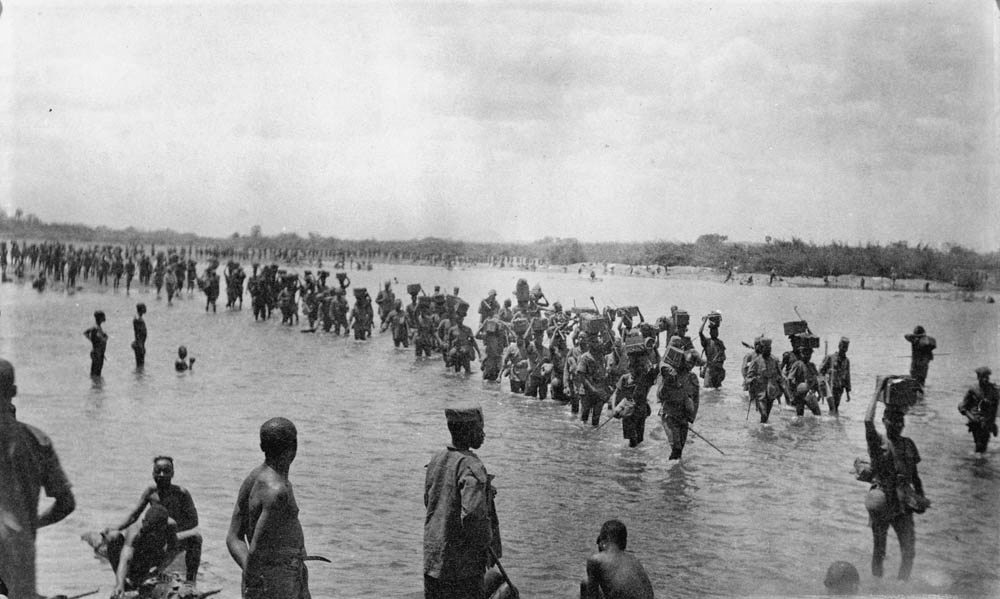 Image: A column of carriers transporting ammunition for the 2nd/4th Battalion King's African Rifles, Lurio River, Mozambique (© IWM, Q67823)
The Freetown Memorial commemorates the men of the Sierra Leone Carrier Corps (SLCC).
During the First World War, the British Empire drew on its colonies for manpower in both frontline and support roles.
The SLCC was one of the largest West African labour units raised by the British Empire in the First World War.
The importance of logistics
Raised nationwide, its members provided vital logistical and portering services for the fighting men at the front. They transported huge quantities of food, ammunition, water, medical supplies and military equipment, over long distances and challenging terrain.
The African theatres of the Great War, such as the East Africa Campaign, covered a wide variety of terrains and conditions. In areas lacking railways, metalled all-weather roads and plagued with insects that made the use of animal transport impossible, these men were essential to military operations, forming the logistical backbone of the British Imperial Forces in Africa.
How many men served in the SLCC?
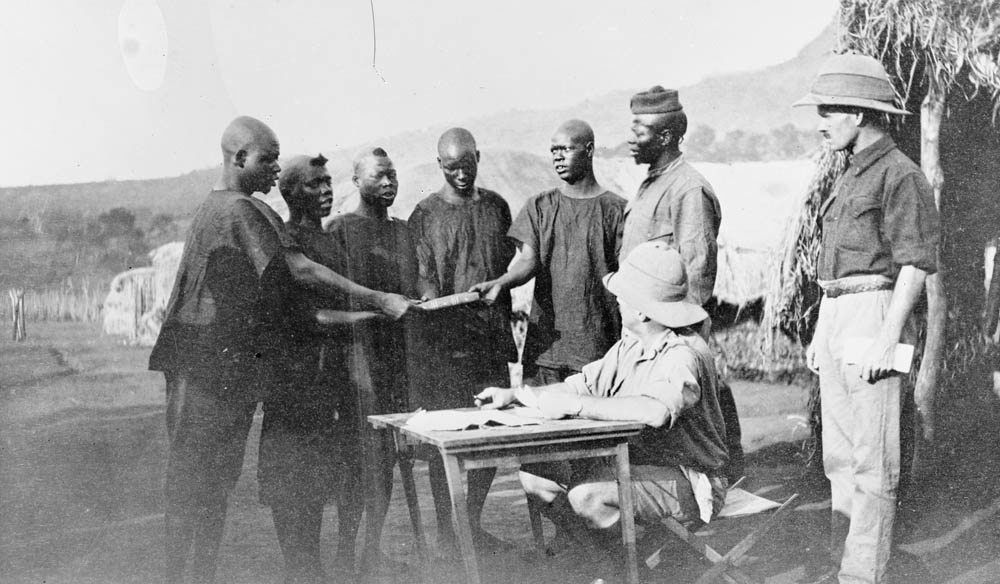 Image: Attesting Gun carriers swearing on the Koran, Tanzania (© IWM Q57990)
Over 10,000 men were recruited to support the British war effort in Africa during the First World War, seeing active service in modern-day Cameroon and East Africa (Kenya, Tanzania, etc.) between 1914 and 1918.
Organised into companies, including a Gambian Company attached to the SLCC, these men operated far from home in arduous conditions.
They marched with their heavy loads through dense forest, thick swamps, and mountainous country. Their efforts and hardships ensured frontline troops were kept supplied with vital equipment, ammunition and supplies.
The SLCC also helped transport wounded men from the front to medical facilities.
Those who never made it home
The demands placed upon them were immense, and they faced threats not only from their proximity to military operations but also from the endemic diseases that spread rapidly in wartime conditions.
Over 900 men of the Sierra Leone Carrier Corps did not return home, with the vast majority dying from disease during the East Africa campaign.
The original Freetown Memorial

Image: Unveiling of the original Freetown Memorial, Sierra Leone by Captain C E Cookson on 11 March 1931
The original Freetown Memorial was unveiled in 1931, representing the culmination of almost a decade of discussions between the Imperial War Graves Commission, as we were then known, local military authorities and the colonial government of Sierra Leone.
A memorial to the SLCC
The Freetown Memorial, unveiled in 1931, was the culmination of almost a decade of discussions between the Imperial War Graves Commission (IWGC), the colonial government of Sierra Leone and local military authorities.
Conceived as a memorial to those from Sierra Leone whose graves were unknown, unidentifiable or considered unmaintainable, it ultimately commemorated more than 1,000 First World War dead.
Designed by Sir Edwin Lutyens, one of the IWGC’s principal architects, the memorial was purposely placed in a prominent public location to serve as a visible focal point for remembrance.
Historical inequalities in Commemoration
However, the memorial’s history also reveals the inequalities embedded within imperial commemoration.
While the original panels recorded the names of African soldiers from the West African Regiment, the Sierra Leone Battalion of the West African Frontier Force and the Royal Engineers Inland Water Transport, members of the Sierra Leone Carrier Corps were commemorated only as a number.
Not only were their contributions downplayed, but it was decided that there was not enough room to name them individually.
Following the Second World War, alterations to accommodate additional casualties from that conflict further marginalised these men.
With the First World War dead condensed onto a single panel, all reference to the Sierra Leone Carrier Corps disappeared from the memorial. As a result, the names were only included in the memorial register.
This approach, shaped by imperial attitudes and structural inequalities, denied the dead of the Sierra Leone Carrier Corps the individual recognition afforded to their comrades.
The memorial therefore stood for almost a century as both a symbol of remembrance and a reminder of how imperial hierarchies shaped the commemoration of African wartime service.
The Freetown Memorial – Design and Meaning
The reimagined Freetown Memorial is both an extension of the existing memorial and an act of commemorative redress.
Designed by Oshinówò Studio, it transforms the Lutyens monument in Freetown with a contemporary glass structure dedicated to the men of the Sierra Leone Carrier Corps whose identities the original monument omitted.
Meet the Architect: Tosin Oshinówò
We were delighted to collaborate with Tosin Oshinówò on this remarkable project.
“It's a very emotional project; I'm very honoured to have been selected for it,” Tosin said. “It's very significant, not just as a Nigerian but as an African, to be involved in this very important work. It's very important that we do remember. So many, there are many generations of Africans who have very little knowledge or interest in this subject matter.
“I’m really happy that my practice has produced this because it's also about the plurality of the response. I grew up in Africa. I have a good understanding of the diversity of cultures and adding voices from the continent to contribute in a design capacity to create visual narratives that are unifying across many different people.
Rather than replacing the original memorial, the design extends it vertically, symbolically elevating those previously denied individual recognition.
Names etched in glass
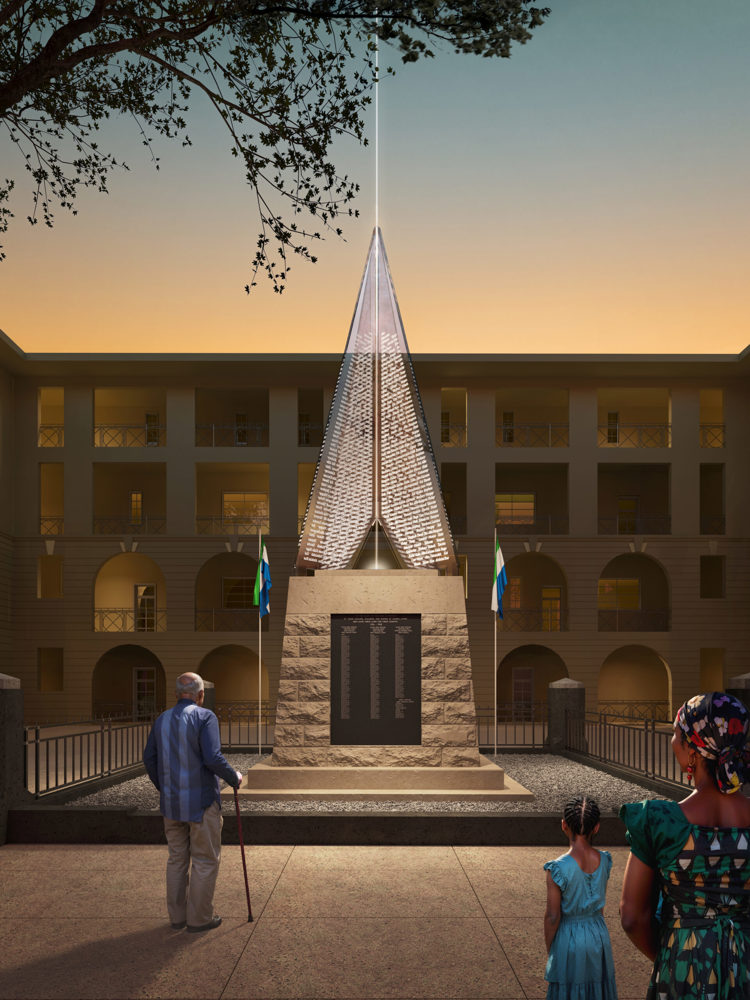
Image: Architect's rendering of the new Freetown Memorial (© Hayes Davidson, Oshinówò Studio)
Engraved glass panels rise above the stone structure, bearing the names of the casualties recovered through CWGC research and making them visible as individuals where they had once only been commemorated by number.
Tosin Oshinowo said: “It was also very important to use a material that would complement, not take away from, the existing architecture, and so glass, in its ephemeral, transparent appearance, can create this idea of volume tapering from the existing angle of the existing monument, and it gives us really a beautiful, elegant height.
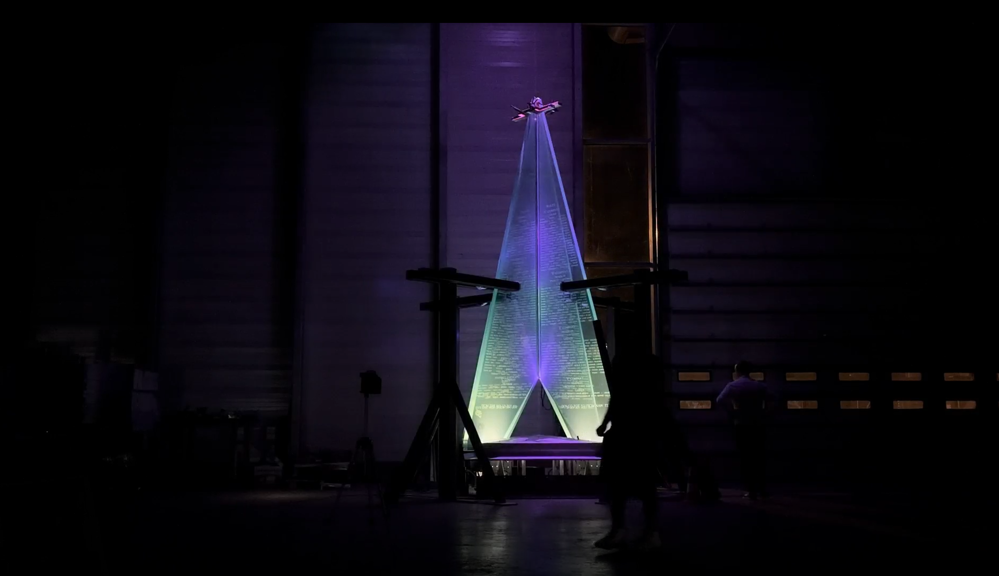 Image: The new glass intervention at the Freetown Memorial under construction
“Glass as a material is also very unifying. It was also important in the symbolism of the architecture to create something that would create a unifying factor for the many different, diverse groups that exist in Sierra Leone. I was very mindful. Africa as a continent has over a thousand languages.
“You know, there is so much diversity. How do you represent a group of people without necessarily making another group feel insignificant? So, it was very important to approach it from the idea of materiality, something that would be unifying for all people, and glass seemed to be quite natural in being able to create that.
“It was also very important to use a material that would complement, not take away from, the existing architecture, and so glass, in its ephemeral, transparent appearance, can create this idea of volume tapering from the existing angle of the existing monument, and it gives us really a beautiful, elegant height.
“It also adds to the idea that these are names of the missing, the idea of the hidden,, you know. So being able to create this idea of transparency but presence at the same time with etching into glass, it all seemed to very poetically come together and visually is a very striking structure and again, staying respectful to Lutyens but creating an architecture that very much is of the present day, acknowledging these people in a contemporary fashion.”
Memory through material
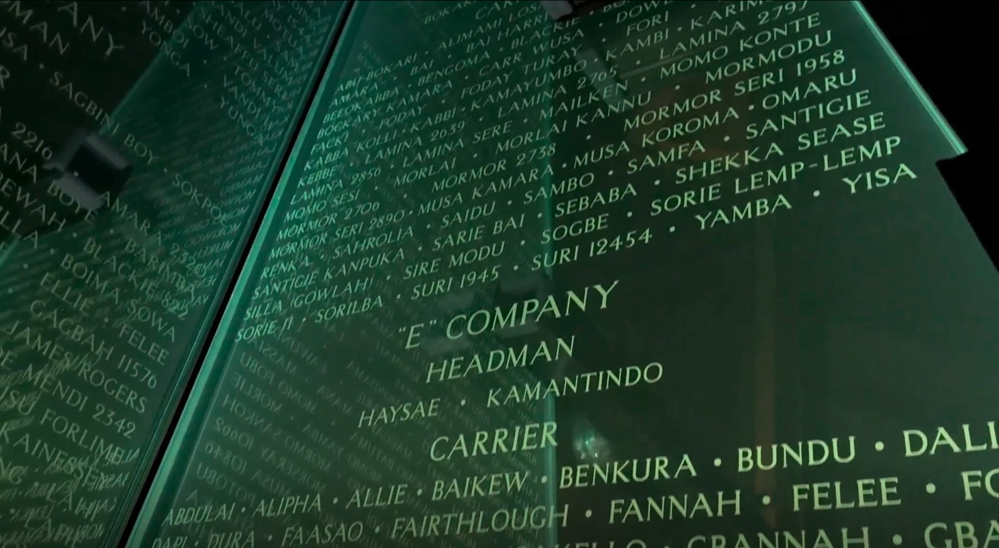 Image: Glass and stone were purposefully combined to reinforce the Freetown Memorial's message
The memorial’s materials reinforce this message.
The original stone represents permanence and continuity, while glass introduces transparency and fragility, reflecting how the memory of the Sierra Leone Carrier Corps was overlooked.
Together they create a dialogue between past and present, acknowledging both the original monument and efforts to address its omissions.
Light is a defining feature of the design. Edge lighting and a laser beacon will project a beam above Freetown on significant commemorative dates, extending remembrance beyond the memorial site and into daily life.
“The beam of light is a really beautiful addition to the project,” Tosin said. “Light lends itself really well to the idea of using glass. But it really came about because the monument, which was built in the 1930s, is now within the car park of the Ministry of Finance. And this is an area of Freetown that is not easily accessible to the general public.
“The monument is for the public, and we started to think about this idea of how do we ensure that the message of memory ripples far beyond the immediate service location, because it's not the easiest location; it's not the easiest place to access and possibly will only be accessible during public events
“And so, in tying with the existing structure and this tapering that we get with this glass piece, we started thinking about this idea of having a beam that could be projected from the base of the original monument all the way up and then started to look at the possibilities.
“The idea is that even though they physically can't see this monument, though they've seen pictures, whenever they see this beam of light, they know that it's associated with this location and this monument that is towards the Carrier Corps, who have now been honoured, who had previously not been acknowledged. It will also be used on other public events and days.
Accompanying the names is a commemorative poem by Nii Ayikwei Parkes and Julianknxx, including the phrase: ‘from today, you will be carried. you are borne, now and ever’.
"Together, the names, light and poetry transform the memorial into a public affirmation that those once forgotten are finally recognised and remembered."
The Non-Commemoration Programme
The Commonwealth War Graves Commission’s (CWGC) Non-Commemoration Programme was established in response to the findings of the 2021 Special Committee report on historical inequalities in commemoration. The Committee concluded that more than 100,000 soldiers and labourers, particularly in Africa, Asia and the Middle East, had not been commemorated equally following the First World War.
Discovering lost names
In response, the CWGC launched a five-year global programme of research and operational activity examining the Commission’s commemorative practices during the two world wars.
Combining historical research, public engagement, education and operations on the ground, the programme delivered new headstones for previously unmarked casualties, protected neglected burial sites, created new memorials and reinterpreted existing monuments.
Projects in Kenya, Sierra Leone, Nigeria, South Africa and elsewhere sought both to recover missing names and to explain the historical reasons behind their exclusion.
By the programme’s conclusion in March 2026, more than 20,000 names had been identified and added to the CWGC casualty database.
The programme’s wider significance lay in its commitment to transparency, historical accountability and equality of remembrance. Initiatives such as the renewed commemoration of the Sierra Leone Carrier Corps are aimed not only at restoring lost identities but also at addressing a century of unequal recognition.
Although the formal Non-Commemoration Programme has now concluded, its work continues as part of the day-to-day activities of the CWGC.