

06 July 2026
The Punjab Registers: Recovering the names of India's fallen servicemen
The Punjab Registers comparison project has been a truly collaborative endeavour, bringing together the UK Punjab Heritage Association, the University of Greenwich, the CWGC, and a global network of dedicated volunteers in a shared mission - one that culminated in the addition of 9,909 names to the CWGC casualty database.
This represents the largest single addition of names to the CWGC casualty database since the Second World War, and, crucially, it has helped correct a long-standing historical injustice.
What follows is an overview of how these names were recovered from a complex and challenging set of historical records.
The Punjab Registers at a Glance: What's on this Page
This article covers the Punjab Registers project to add new names to CWGC records, including:
- India and the Punjab's role in the First World War
- Investigating the Punjab Registers
- Punjab Registers methodology and execution
- Why Punjab Registers matter to Punjab Heritage
- Why adding 9,909 names to CWGC records is important
- How to search for Punjab names in CWGC records
- Punjab Registers FAQs
The Punjab Registers
India and the First World War
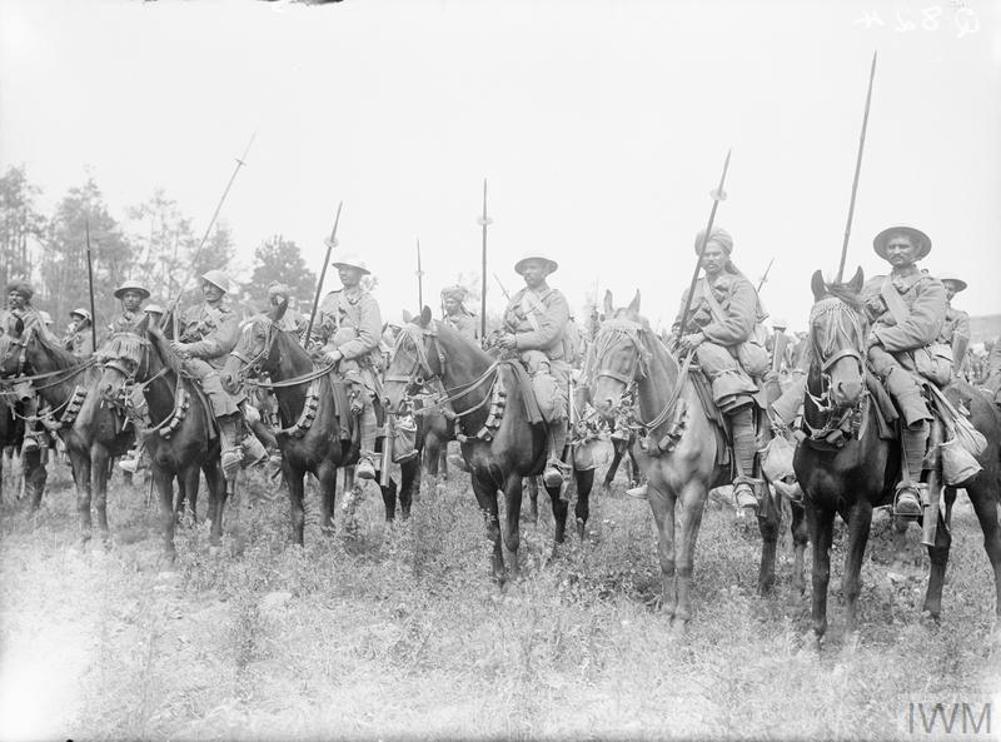
Image: Indian horseman during the Battle of the Somme (IWM (Q 824))
During the First World War, the Indian army was a major force, contributing over 1.4 million men and serving across every major theatre of the conflict.
The main recruiting ground for this force was the Punjab, with more than a third of all recruits coming from across this region.
These forces suffered a significant number of casualties, with over 70,000 previously commemorated by the CWGC. This figure, though, did not fully reflect the true scale of loss.
Two key issues help explain this discrepancy.
First, the Indian army faced a significant issue in the administration of its records, as wartime record-keeping struggled to keep pace with the sheer number of casualties.
When the IWGC commenced their work in the aftermath of the war, they found the records provided by the British Indian administration to be so incomplete and error-ridden that they were deemed effectively unusable.
To address this, Commission officials compiled a composite list of the dead by combining regimental rolls, theatre casualty lists and the official government list. However, this was always acknowledged to be imperfect.
Second, a more serious issue arose from policy: the British Indian authorities did not grant full war graves status to those who died in non-operational zones within India. This decision, now overturned, likely excluded thousands from named commemoration.
Together, these factors underscore the importance of the Punjab Registers in recovering these lost names.
Investigating the Punjab Registers
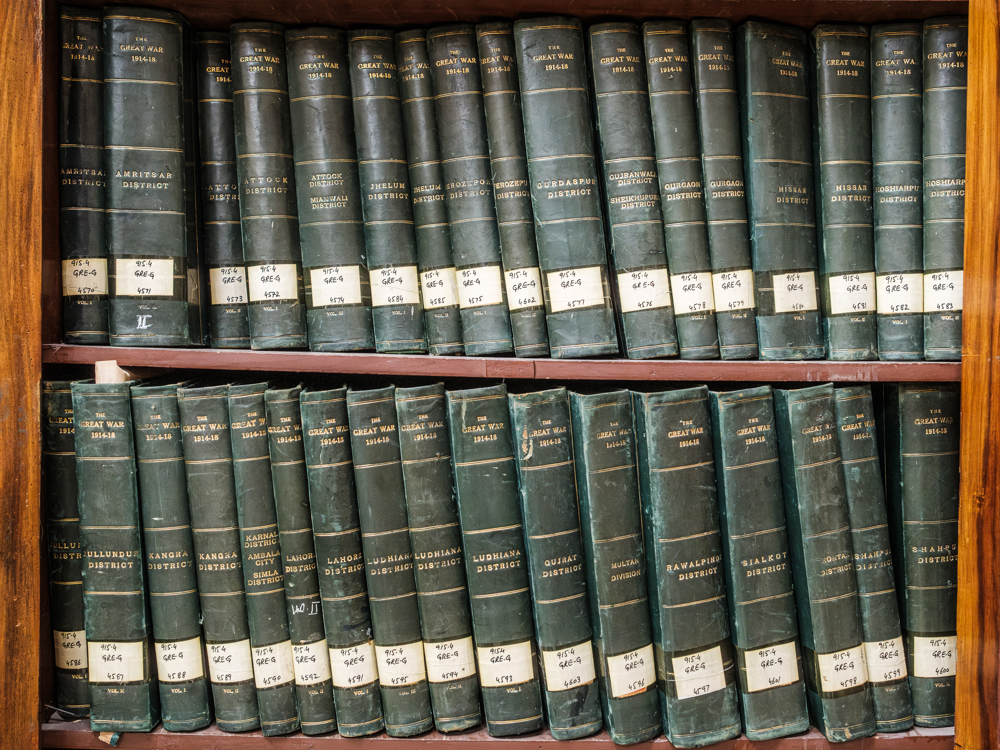
Image: Volumes of the Punjab Registers, waiting for investigation
The Punjab Registers consist of 34 bound volumes covering the 28 districts of British Punjab. Compiled in the immediate aftermath of the war, and organised by district and village, they provide a uniquely localised record of the men who served.
Now housed in the Lahore Museum, these 26,000 pages contain the names of over 320,000 individuals, including 15,935 who were recorded as having died in service.
Their value to the CWGC was first highlighted in 2020 by Amandeep Madra, of the UK Punjab Heritage Association (UKPHA), during initial research for the Non-Commemoration Programme.
In working with Professor Gavin Rand at the University of Greenwich, the registers were digitised and transcribed, making them accessible for systematic analysis.
Recognising their significance, the CWGC funded a PhD project at the University of Greenwich to explore the origins of the registers. By early 2025, the fully transcribed dataset was ready for comparison.
Cross-checking the names
Given the number of names involved, the core challenge was substantial from the very outset: comparing 15,935 recorded deaths in the Punjab Registers with the 74,000 Indian casualties listed in the CWGC casualty database.
To tackle this, PhD researcher George Williams developed a scoring system that compared nine data points between the two datasets.
This approach helped compensate for incomplete or inconsistent records, such as missing personal details in the CWGC database and limited regimental information in the Punjab Registers.
A global call for volunteers followed, and 19 individuals dedicated six months to analysing the data. Each name was reviewed at least twice in a double-blind process to ensure accuracy.
In this, particular recognition is due to Nick Ezra, who personally checked all 15,935 names. A truly remarkable achievement that rightly earned him Volunteer of the Year at the Museum and Heritage Awards.
Once the volunteer analysis was complete, the results were then validated through two independent computer models – one developed by the CWGC and one by UKPHA, which was then followed by further review by UKPHA volunteers.
By early 2026, the findings were consolidated, and the CWGC historians undertook a final phase of analysis. Out of this analysis, there were 1,637 ambiguous cases – i.e. matched to a CWGC ID by one volunteer/model but not another – that required detailed review.
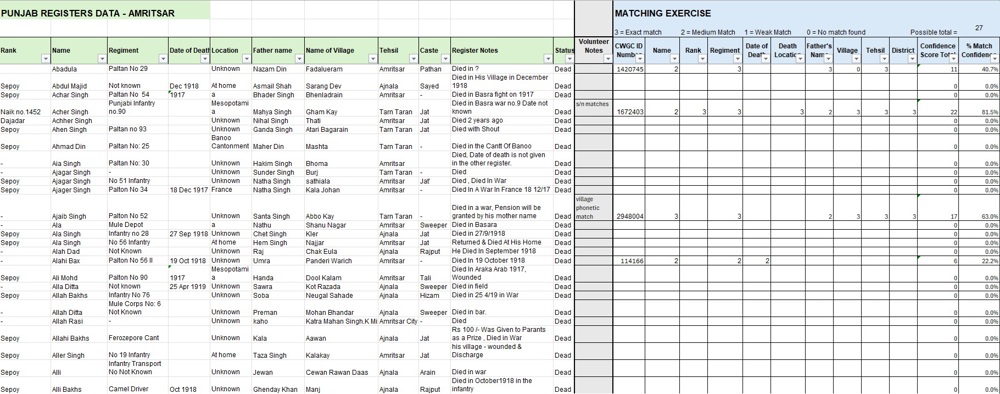
Image: An extract from the Amritsar spreadsheet, which housed 1,047 names
In doing this, the CWGC historians drew on an agreed framework devised in collaboration with our colleagues at UKPHA and the University of Greenwich. This stipulated that:
- For those casualties that had no additional information on the CWGC casualty database, 3 points needed to align – name, regiment and date of death – to prove a match.
- If a casualty’s name, father’s name and village name matched an existing casualty on the CWGC database, but not the regiment, it would be deemed a match.
- If a casualty’s name, father’s name and regiment matched a casualty on the CWGC database, but not the village, it would be deemed a match if there was only 1 candidate.
- A casualty should be treated as a non-commemoration case if the casualty’s name or father’s name was different to that on the CWGC casualty database, and this could not be explained away by spelling or construction of a nickname.
From this process, 1,101 names were matched to existing records, while 547 were identified as non-commemoration cases. In total, following all these checks and crosschecks, 9,909 names from the Punjab Registers were confirmed as non-commemoration cases.
As a final safeguard, and to provide another layer of verification, the project methodology was reviewed by an independent panel of Indian Army experts, who endorsed the approach. Following this validation, all 9,909 names were formally added to the CWGC casualty database in March 2026, ensuring their continued recognition and remembrance.
Cleaning and standardising the data
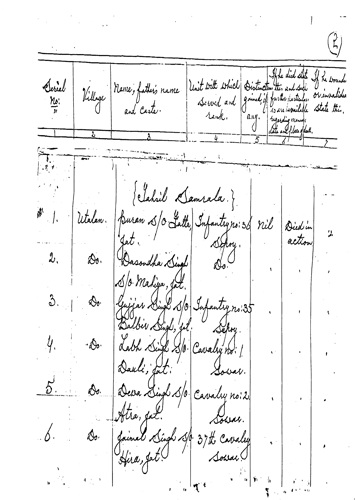 Image: A handwritten extract from the Ludihana Listing
One of the most complex aspects of the project was aligning the data from the Punjab Registers with the CWGC database.
For example, the CWGC database contains 309 unique Indian ranks, compared to 409 in the Punjab Registers. In many cases, the total in the Punjab Registers was the result of variations in spelling – e.g. colly, cooli, coolie, coollie, cooly or Kooli – which all required standardisation.
Regimental data was even more fragmented, with 345 regiments on the CWGC database and 4,908 entries in the Punjab Registers. In the majority of cases, regimental particulars were limited – i.e. 3rd or 12th – which could have a variety of potential options, both infantry and cavalry.
As a result, each regiment needed to be independently checked and standardised against the information on the CWGC database. As a result, 2,706 cases were given the regimental affiliation of the Indian Army, as there was not enough data in the registers to be more specific.
Added to this, many of the names listed in the Punjab Registers lacked a specific date of death – often given as 1917 or ‘during the war’. As a result, 7,587 names added to the casualty database have a date of death range, as no specific date of death was recorded.
Despite these challenges, the outcome is clear and significant. Through careful research, collaboration, and verification, 9,909 previously unrecognised individuals are now commemorated by name. This work not only enhances the historical record but also ensures that those who were once overlooked are now properly remembered.
Their inclusion in the CWGC database stands as a lasting act of recognition and an important step towards addressing the injustices of the past.
Why the Punjab Registers Matter to Punjab Heritage
Amandeep Madra, British historian, author and chair of the UK Punjab Heritage Association, dedicated to preserving Sikh and Punjabi heritage, said: “Britain and Punjab share a long history, notably during the two world wars, and for over a hundred years, part of it was missing.
"These men were never commemorated - not because they didn't serve, but because a decision made a century ago excluded their sacrifice from the record. Putting that right means giving families around the world their history back, and properly and equally commemorating the men who died."
Who worked on the Punjab Registers Project?
The Punjab Registers Project was an international collaborative project with key stakeholders listed below:
- UK Punjab Heritage Association - Identified the value of the collection, supported the research, and helped develop and validate the project methodology.
- University of Greenwich - Supported digitisation, transcription, and academic research, including the PhD project.
- Commonwealth War Graves Commission - Compared data with casualty records, reviewed cases, and added confirmed names to our database.
- Volunteers and experts - Checked potential matches and provided additional scrutiny.
What the Recovery of 9,909 Names Means
The inclusion of these 9,909 names in our records makes them the largest new addition of names into CWGC records since the Second World War.
Beyond this, it helps us right an historical wrong by incorporating these individuals who died in military service to the British Empire into our records.
According to CWGC Official Historian Dr George Hay, the Punjab Registers represent an extraordinary archival resource.
They not only preserve the names of hundreds of thousands of men but offer vital insight into how the Indian Army was recruited, administered and remembered at a local level.
Restoring these names is about more than record-keeping; it is about completing the historical narrative of the First World War and ensuring that commemoration reflects the full global reality of that conflict.
Gavin Rand, Professor of History at the University of Greenwich, said: “This project has not only helped to redress an historical injustice, but it has also enabled families and communities in Britain and across the world to connect with and better understand their shared history and heritage. The Punjab Registers project shows why research matters.”
Family connections
This research has helped create and strengthen further family connections among relevant communities within the UK, such as Dr Inder Singh Palahey, a Leicester-based dentist, and Manjinder Nagra, the first Sikh to represent England in Rugby.
“From just hearsay to now discovering the facts about my great-grandfather's ultimate military sacrifice, in particular the regiment he served in, has been incredibly poignant, Dr Palahey said. "Upon his death, he left a widow and two young children in poverty.
"So, the fact that he will now be remembered in perpetuity within global history ensures the whole family's sacrifice is recognised, which simply means everything to us.”
Mrs Nagra said: “When I attended the annual Chattri Memorial Service in Brighton, held in honour of the soldiers from Undivided India who gave their lives during the First World War, I never expected to receive such momentous news.
“Learning from the UK Punjab Heritage Association that my maternal great-grandfather will now be officially recognised on the CWGC casualty database was incredibly moving and overwhelming.
“To know that his service and sacrifice are finally being properly acknowledged means so much to our family over 100 years on. In the present difficult times, this recognition feels especially significant. After all these years, he is finally being given the honour, dignity and remembrance he always deserved.”
The Non-Commemorations Programme
The CWGC Non-Commemoration Programme had a clear mandate: to ensure all those who died in the world wars, no matter where they were, where they died or how they died, are remembered equally.
Whilst our initial five-year programme to address historical inequalities in commemoration after the World Wars reaches its formal endpoint in 2026, the work will continue. This ongoing global effort will ensure all individuals who we have found not to have been commemorated equally will receive the proper recognition they deserve.
How to search the Punjab Registers Names in CWGC Records
Each of the 9,909 Indian Army servicemen added to our database can be found by searching our records.
Find War Dead
The Find War Dead tool lets you search all 1.7 million men and women listed by name in our database.
The tool provides numerous search fields and functionalities to help you refine your search, including:
- First Name, Last Name and Initials
- Country of Service
- Regiment, ship, or squadron
- Place of Burial
- Date of Death
- Armed Service Branch
Additional fields can further refine your search. A short search process might look something like this:
- Begin with the person’s name
- Add a regiment, unit or service number where known
- Filter records to the First World War
- Try alternative spellings and name formats
- Check village, district or family information
- Search more broadly if a precise date of death is not known
Please note: CWGC Indian Army records are not military service records. They are based on commemoration and mostly track name, regiment, date of death, and final resting place or place of commemoration.
You will need to look for national service records, unit war diaries, regimental war diaries, and official histories as a starting point for further research into Punjab military history.
Punjab Registers FAQs
The Punjab Registers consist of 34 bound volumes covering the 28 districts of British Punjab. They contain the names and service information of 320,000 Punjab recruits of the First World War.
The Punjab Registers are currently held in Lahore Museum, Pakistan.
The Punjab Registers contain the names and service details of 320,000 First World War-era Punjab Recruits, including their places of birth, residence and more biographical details.
The Punjab Registers are important because they preserve the names and service histories of roughly 320,000 British Indian Army recruits from the First World War. By cross-checking these names against CWGC records, we have added 9,909 new names to our database, we have been able to rectify historic wrongs by commemorating previously overlooked servicemen.
The Punjab Registers were digitised by CWGC working in tandem with Professor Gavin Rand and the University of Greenwich.
A major verification process was undertaken. A CWGC-funded PhD student at the University of Greenwich, George Williams, and nineteen volunteers from around the world, many with personal ties to the Registers, examined 15,935 deaths and compared them with 74,000 existing CWGC Indian Army records.
Their enormous effort was supported by computer-assisted analysis, and each stage was reviewed by the CWGC and Indian Army specialists. The process revealed 9,909 casualties were missing from the records.
Yes, you can search Punjab Registers names in our database using our Find War Dead tool.
These records and documents were written by hand roughly a century ago. Over time, some details have been lost or become impossible to decipher.
Author acknowledgements
Dr John Burke is a Senior Research Historian at the CWGC. He obtained his PhD from Newcastle University and has published widely on the remembrance and representation of conflict, and on the legacies of British colonialism. He co-authored the 2021 and 2025 reports on historical inequalities in commemoration.