

04 May 2026
The Thiepval Memorial: 72, 311 Names and the largest CWGC Memorial in the World
The Thiepval Memorial to the Missing of the Somme is the largest Commonwealth War Graves Memorial in the world.
It bears the names of 72,311 servicemen of the First World War who have no known war grave, making it also the largest British war memorial in the world. But of the total number of men commemorated here, some 640 or so South African officers and enlisted men, showing the international effort and loss of the First World War.
Today, the Thiepval Memorial stands in tribute to the scale of loss endured by Britain and the Commonwealth during the Battle of the Somme.
More than 150,000 Commonwealth servicemen were lost on the Somme between July and November 1916. Nearly half have no known war grave and so are commemorated upon Thiepval’s name panels until such time as they can be recovered or identified.
Get to know about CWGC’s largest memorial, its purpose, meaning and history in this article.
At a glance: What’s on this page
- What the Thiepval Memorial is and why it matters
- Why the memorial commemorates 72,311 First World War servicemen
- Stories of servicemen commemorated on the Thiepval Memorial
- The Architecture of the Thiepval Memorial
- What the Thiepval Memorial tells us about the Missing of the Somme
- A short visitor’s guide to Thiepval
- Thiepval FAQs
What the Thiepval Memorial is and why it matters
Thiepval Memorial to the Missing commemorates over 72,000 First World War British and South African officers and enlisted men with no known war grave who died in the Somme Sector during the First World War.
Over 90% of those commemorated here died between July and November 1916, at the Battle of the Somme.
A memorial to the missing
Commonwealth War Graves defines “missing” casualties as those who have no known war grave or final resting place.
There are some key reasons why service personnel could be considered missing. They may have been unable to be identified upon recovery, for example, or they died in circumstances that may have made recovery or identification impossible.
Those with no known war grave are commemorated upon memorials such as Thiepval. This includes unidentified casualties buried within CWGC cemeteries in war graves marked with headstones bearing the inscription “Known Unto God”.
While their physical remains may have been buried, their point of commemoration will be a CWGC war memorial, such as Thiepval.
Why Thiepval Was Created
Thiepval and other CWGC memorials to the missing were built to be the physical places of commemoration for these missing servicemen.
More than 526,000 First World War casualties, from soldiers to merchant seamen to navy sailors to airmen, have no known war grave.
For relatives of the dead, these sites offered a place where they could visit their loved ones, even if they were missing. “He is not missing, he is here” was the guiding philosophy behind our war memorials.
Thousands of families made pilgrimages to our sites across the Somme and Western Front after the war, visiting CWGC war memorials like Thiepval to help them grieve and reflect on the great human loss of the Great War.
Why the memorial still matters today
As the world wars slide from living memory, memorials like Thiepval are important as physical reminders of the scale of loss.
The Battle of the Somme drew in millions of soldiers and servicemen on both sides, with total casualties of Commonwealth, French, and German troops standing at around 1.2 million, including wounded, dead, and missing.
The Somme was the site of military action during the war’s early, middle, and closing stages. The Second Battle of the Somme took place during the Hundred Days Offensive when Allied troops pushed back and broke German resistance on the Western Front, ending in victory.
The Thiepval Memorial, with its monumental structure and huge name panels, connects real names with this loss. Each of the people commemorated here had their own lives, families, hopes, and ambitions. Each British and South African serviceman was cruelly cut down in the chaos and carnage of the Somme.
Today, Thiepval is the focal point of commemoration on the Somme. Hundreds of thousands of visitors come and experience its power and grandeur every year. It also plays host to important events and ceremonies of remembrance for the Commonwealth’s war dead and the First World War in France in general.
Why 72,311 Names are on the Thiepval Memorial
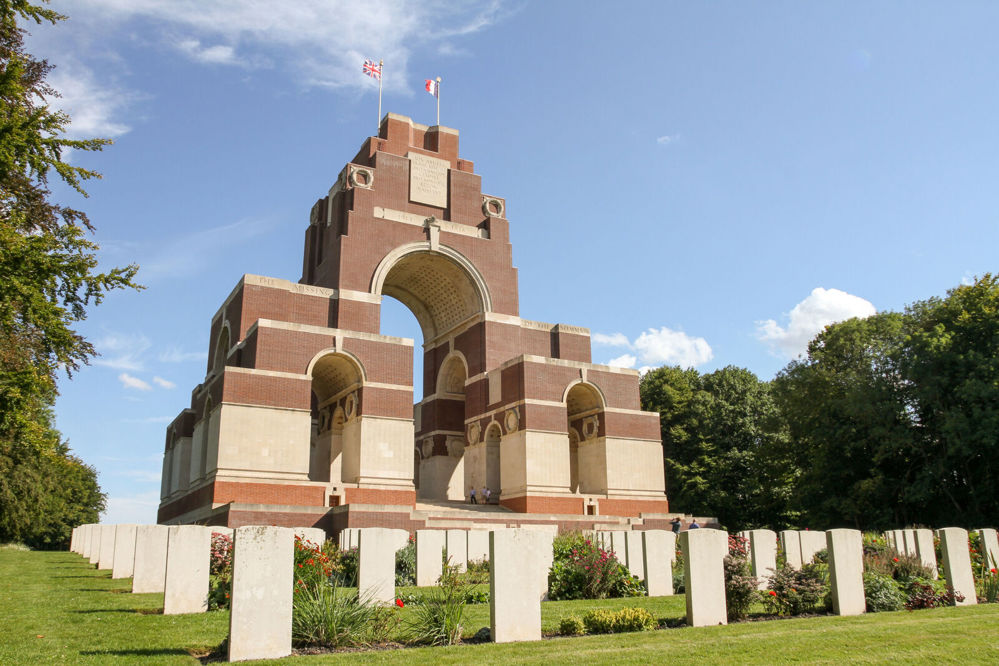
Image: The Thiepval Memorial as seen from the British section of Thiepval Anglo-French Cemetery
As explained above, the memorial offers a physical point of commemoration for more than 72,000 missing First World War soldiers with no known war grave.
What the numbers represent
The number of those commemorated at Thiepval itself can be quite abstract, but it’s a number that speaks to the destructiveness of the Great War and combat on the Western Front.
The number is almost immaterial. It’s the names that matter. Each of Thiepval’s memorial panels lists hundreds of names of individual servicemen, each one representing a soldier who died on the World War One battlefields of the Somme but is now sadly lost.
Each serviceman had their own achievements, ambitions, families, and stories. Upon its name panels are commemorated sportsmen, artists, writers, poets, and a host of other professions.
Those commemorated here have a huge number of honours and awards; there are more than 760 Military Medals, more than 100 Military Crosses, countless Mentions in Dispatches and even 7 Victoria Crosses, represented on the Thiepval Memorial.
Why names matter on a memorial like this
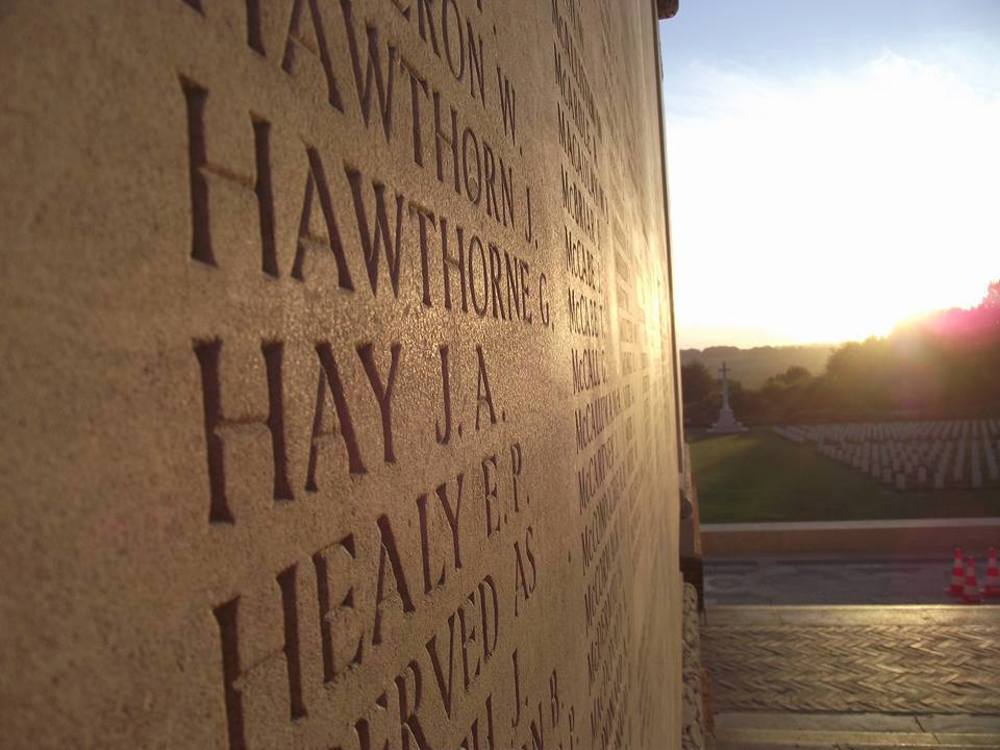
Image: The names carved into this panel are just a tiny fraction of the more than 72,000 Thiepval commemorates
The names help us remember that the war was fought by real people with real lives and stories.
Memorials to the Missing help connect us with our shared world war history, in this case linking the British and South African experiences on the Somme.
Thiepval is a physical reminder of the destructiveness of the Somme. The battle is infamous as one of the darkest episodes of the war, and 1 July 1916 remains the blackest day in British military history, with over 18,500 men killed.
Seemingly every community in the UK was touched by the slaughter on the Somme. The “Pals Battalions”, locally raised units drawn from cities, towns, and villages across the UK, went into battle for the first time on the Somme, resulting in entire streets losing their young men.
Today, Thiepval is a reminder of the sheer cost of war.

Want more stories like this delivered directly to your inbox? Sign up for our newsletter for regular updates on the work of Commonwealth War Graves, blogs, event news, and more.
Sign UpStories from Thiepval
Here is a small handful of the stories of the men commemorated on the Thiepval Memorial. You can read hundreds more on For Evermore, our online storytelling platform and archive.
Private George A.T. Brown
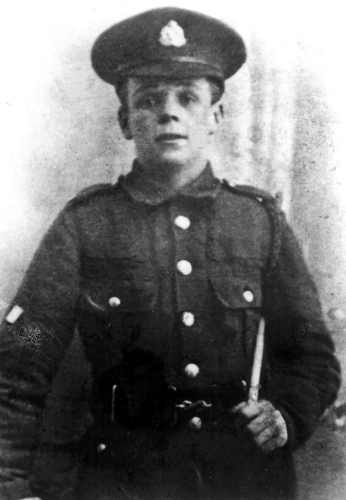 Image: Private George Brown
George was born in Barnes, Surrey, on 2nd November 1898, the eldest child of Alfred (a carpenter) and Emma Julia Gaskin Brown of 40 Railway Side, Barnes.
He was employed as a stoker when he enlisted at Putney on 18th September 1915. Although still almost two months short of his seventeenth birthday, he declared his age as 19 years.
Initially, he was Private 21507, 12th Battalion, Suffolk Regiment, but later transferred to the Lancashire Fusiliers.
George died on 30th July 1916, aged 17, in the Trônes Wood area where the battalion had been involved in heavy fighting. He is one of the youngest casualties commemorated at Thiepval.
Located between Montauban and Guillemont, this pear-shaped wood was a vital tactical objective because it dominated the southern approach to the German second position.
George is commemorated on Pier and Face 3D of the Thiepval memorial to The Missing on The Somme in France.
With thanks to the Thiepval Memorial Project for sharing George’s story.
Captain Eric Norman Frankland Bell VC
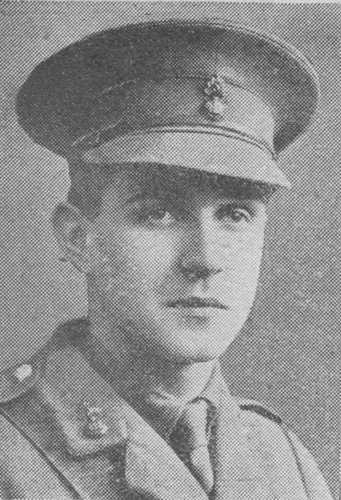 Image: Captain Eric Bell VC
Eric was born on 28th August 1895, one of five children of Captain Edward Henry and Dora Algeo Bell of Enniskillen, Co Fermanagh. He was educated at Warrington, St Margaret’s School, Liverpool and Bedford Road School, Bootle.
Later, he studied architecture at Liverpool University, where he proved to be a student of exceptional attainment, and several of his large drawings appeared in one of the leading architectural journals. He was an accomplished painter, black-and-white artist, and musician; as well as being fluent in both French and German.
On the outbreak of the First World War, he was an assistant to a professor in the School of Architecture at Liverpool University. He was one of the first to volunteer for active service from the university. He went to France in October 1915 with the 9th Royal Inniskilling Fusiliers.
The London Gazette, dated 26th September 1916, records the following:
"For most conspicuous bravery. He was in command of a Trench Mortar Battery, and advanced with the Infantry in the attack. When our front line was hung up by enfilading machine gun fire, Captain Bell crept forward and shot the machine gunner. Later, on no less than three occasions, when our bombing parties, which were clearing the enemy's trenches, were unable to advance, he went forward alone and threw Trench Mortar bombs among the enemy.
“When he had no more bombs available, he stood on the parapet, under intense fire, and used a rifle with great coolness and effect on the enemy advancing to counter-attack. Finally, he was killed rallying and reorganising infantry parties which had lost their officers. All this was outside the scope of his normal duties with his battery. He gave his life in his supreme devotion to duty."
For his actions that day, he was posthumously awarded the Victoria Cross. He was 20 years old.
The medal was presented to his father by HM King George V at Buckingham Palace on 29th November 1916.
Our thanks to Max Dutton for sharing Captain Bell’s story.
Lieutenant Alfred Frederick Maynard
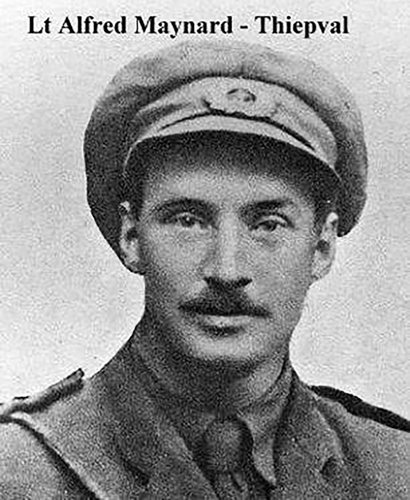 Image: Lieutenant Alfred Frederick Maynard
Alfred Maynard was born in Penge, Surrey, on 23 March 1894. His father's profession led the family to move to Durham, where Alfred was educated at Sussex House School, Seaford and then Durham School. There he discovered rugby and became captain of the team. He also played cricket, gymnastics, and soccer.
In 1912, he went on to study at Emmanuel College, Cambridge, where he gained blues, as well as the famous Varsity match against Oxford. He also played with the Harlequins, Durham City and Durham County. An all-round athlete, he also played cricket for Durham County, the Borderers and Durham City in competition, and field hockey, at which he captained the College team.
His career peaked when he was capped as hooker for England on 17 January 1914, to face Wales in the Five Nations Tournament. The Rose team won the match 10-9 and the 1914 Grand Slam. In total, he was capped 3 times for England.
He was in his final year at university when the First World War broke out. His rugby career was brought to an abrupt end, and he joined the Royal Naval Volunteer Reserve. He was assigned to the Royal Naval Division and found himself directly involved in the fighting for the defence of Antwerp in 1914.
He was appointed Second Lieutenant on 18 October 1914 and joined the Mediterranean Expeditionary Force for operations in the Dardanelles. He took part in the first raid on the Suez Canal, where he was wounded in the left leg on 19 May 1915.
After recovering from his wounds, he was promoted to Lieutenant in 1916 and left to join the Howe Battalion in France. Maynard took part in the Battle of the Ancre Heights, the final phase of the Somme campaign in 1916. He fell at Beaumont Hamel, where he was leading "A" Company on 13 November 1916. At the age of 22, he was one of the youngest British internationals to die in the war.
He has no known grave and is commemorated on the Thiepval Memorial, Pier and Face 1A.
The Design of the Thiepval Memorial: Scale, structure, and meaning
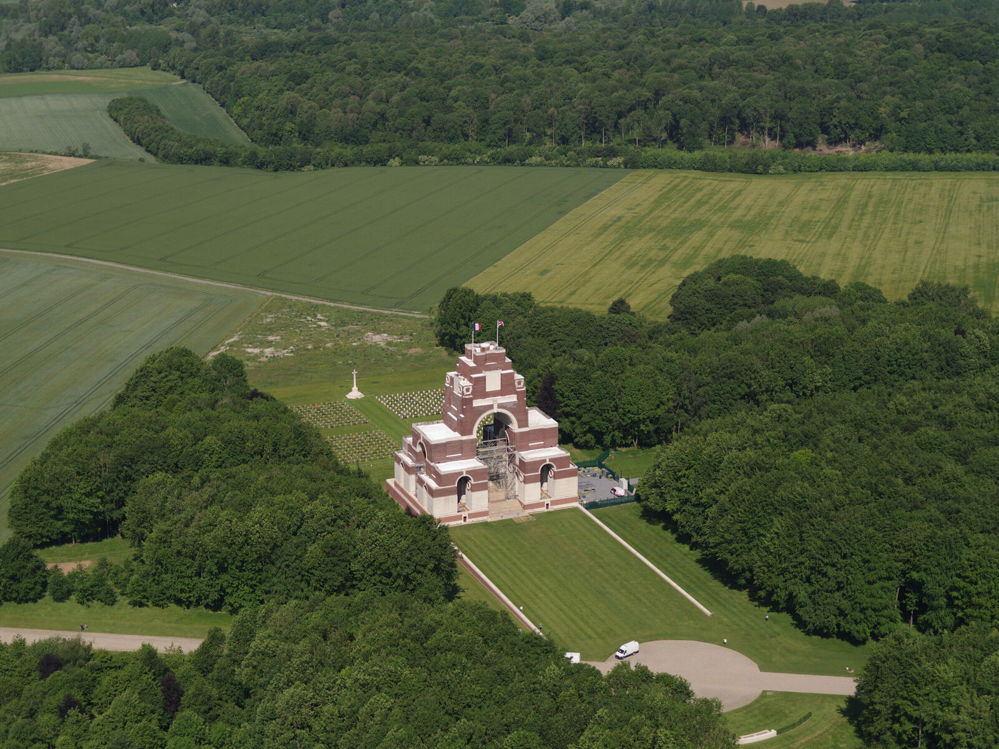
Image: This overhead shot of the memorial shows the scale of the Thiepval Memorial
No two CWGC war memorials are the same. The Thiepval Memorial’s architecture is unique, as befitting our largest memorial to the missing in the world.
Designed by Sir Edwin Lutyens and built between 1928 and 1932, the memorial has stood sentinel over the former Somme battlegrounds for nearly a century.
The BBC’s Dan Cruikshank describes the memorial: “The power of Lutyens’ work comes not just from the names, of which there are over 72,000, but from the monument itself. Power comes from the elemental abstract forms. The arches pirouette, they crest to north, south, east, and west, symbolising a loss of direction, and uncertainty.”
A monument built around names
The great multi-tiered, multi-arched red brick structure of Thiepval is offset by the Portland stone name panels which bear the more than 72,000 names of missing servicemen commemorated here.
While drawing on the forms of Roman triumphal arches, the name panels provide a sombre counterpoint to the immensity of the structure, but also highlight the scale of the loss of the Somme.
Scale with purpose
The number of names necessitated Lutyens to think big. This contrasts with his other memorial work, such as the Cenotaph in central London, which may feature several thousand names, but none approach the volume of Thiepval.
Just the sheer size of the Thiepval Memorial highlights the immense human cost of the Somme.
The structure sits within a sculpted landscape, rising high in a central tree-lined clearing, a place of peaceful serenity that contrasts starkly with the war-torn landscape of the prior century.
Because of its size, Thiepval is a focal point of memorial architecture on the Somme.
What visitors can notice at Thiepval
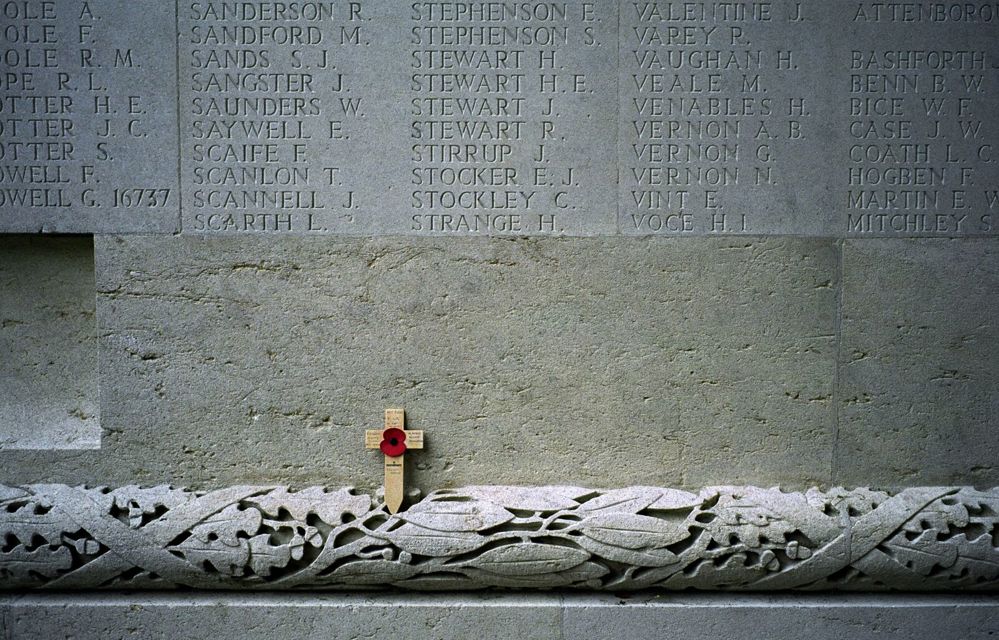
Image: A small section of Thiepval's intricate stonework
Approaching the Memorial, visitors walk up a gravel path that opens into a wide clearing, flanked by tall trees. A well-kept lawn leads up to the central structure, which sits astride the former German frontlines at the time of the Somme.
As you begin walking towards the memorial, the names will begin to appear, emerging from the Portland stone panels. Visitors can walk up the central arched nave and find the Stone of Remembrance sat in the centre of the structure.
The Stone of Remembrance is only placed at sites with over 1,000 casualties. It’s one of our most distinguishing architectural features, but in this case is overshadowed by the immensity of Thiepval’s name panels.
Cast your eyes up, and you’ll notice stone wreaths affixed at key points around the memorial. These wreaths bear the names of major actions of the Somme between 1914 and 1918.
The wreaths are formed of oak and laurel leaves, rich in symbolism. The former signifies remembrance, while the latter symbolises victory. The balance of triumph and commemoration is one that architects like Lutyens had to strike when designing war memorials; how to match victory with loss?
Continuing through the central arch leads visitors to Thiepval Anglo-French Cemetery. Here, 300 French and 300 British soldiers lie side by side, representing the alliance and shared loss of the French and British Empires during the First World War.
The CWGC Cross of Sacrifice stands at the end of the cemetery, before a patch of rough grass. The rough grass marks the German frontline location on 1 July 1916, where British soldiers were cut down in droves on the British Army’s blackest day.
What the Thiepval Memorial tells us about the Missing of the Somme
The number of missing servicemen from the Battle of the Somme speaks to the destructiveness of the Battle of the Somme and how conditions made it hard for servicemen to be recovered during and after the Great War.
The Missing of the First World War
Today, tens of thousands of British and Commonwealth soldiers still lie beneath the former battlefields of the Western Front.
Amidst the mud, blood, and wire of the Somme and other major First World War campaigns, servicemen were lost. They could have been struck by shells and artillery, leaving no earthly remains; they may have fallen at parts of the frontline that moved and changed, leaving their bodies behind on the shifting battlefields; they may have been buried in burial grounds and makeshift cemeteries that were damaged or simply lost.
Many unidentified casualties lie buried in CWGC war graves. Every effort was made to identify these servicemen at the time of their burial, but the conditions of the former battlefields or their remains may have made this impossible.
These missing soldiers, such as the 72,000 plus commemorated at Thiepval, are commemorated by name on our war memorials across the globe. Each memorial stands as a physical reminder of the loss and also provides a place of commemoration for these missing men.
From absence to named commemoration
Even today, we are informed of the discovery of between 80 and 150 sets of human remains in Northern France and Belgium. The Recovery and Commemorations teams work tirelessly with families and military authorities to identify these missing servicemen.
If a casualty can be recovered and identified, their name will be removed from their respective memorial name panel and given a CWGC war grave, complete with a headstone bearing their name.
Even over a century after the Battle of the Somme and the end of the war on the Western Front, our work continues.
How to Visit the Thiepval Memorial
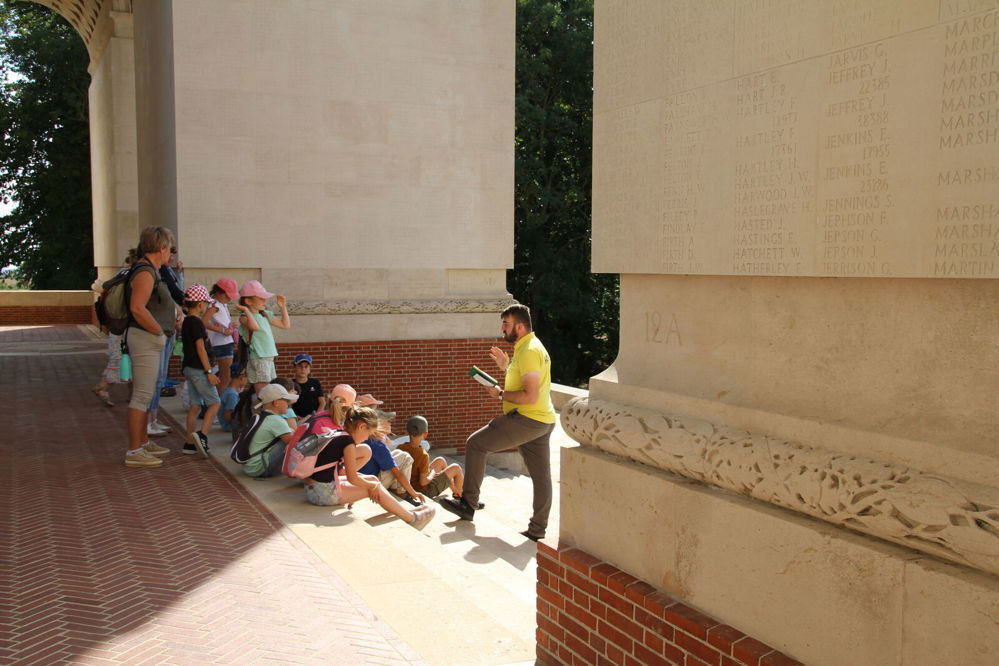
Image: A CWGF Guide chats to schoolchildren at Thiepval. If you're visiting in the summer, keep an eye out for the on-site guides!
Visiting Thiepval for the first time or planning a trip to the former Somme battlefields. Here’s a quick Thiepval Memorial visitors' guide on what to expect when travelling to our largest war memorial in the world.
What to expect when you arrive
The best way to reach the Thiepval Memorial is by car or coach, as it stands in a fairly isolated stretch of land amidst the open fields and farmland of the Somme at Hauts-de-France. The two closest towns are Amiens and Arras, but there is limited public transport that travels to Thiepval.
Directions are available on the memorial page.
Before you head up to the memorial, you may wish to visit the Visitors Centre at the base of the site. Here, you can learn more about the battle and pick up some books and First World War-themed merchandise in the gift shop. A paid exhibit details the Battle of the Somme from various perspectives.
Please note CWGC does not operate the Thiepval Visitors Centre. The CWGC Visitor Centre is located in Beaurains, near Arras, in the heart of key First World War sites.
Walking your way up the hill towards the memorial, you will pass the Cottage Geneviève et Auguste, a small café where you can get some light refreshment on your visit.
Depending on the time of year, as you continue up towards the memorial, you will find a gazebo manned by Commonwealth War Graves Foundation guides. These Guides, funded by our charity arm, are there to answer any of your questions, help you find names on the memorial, and even offer guided tours. Look out for them in their distinctive yellow shirts!
Turn right at the top of the hill leading up to Thiepval, and you will see the memorial in all its grandeur.
Memorial registration boxes can be found built into the memorial. Look out for the small metal doors near the Stone of Remembrance. Inside, you’ll find the memorial registers. These list the names of everyone commemorated here and their location on the memorial.
Continue past the Stone to find Thiepval Anglo-French Cemetery towards the rear of the memorial. Take a moment to step back and take in the Memorial from the cemetery and see its scale and size. It’s hard not to be moved.
How to read and find names
All of the casualties commemorated by the Thiepval Memorial are searchable on our website. You can download the list from the link on the memorial web page (some download limits and restrictions apply. Please contact us to learn more).
You can also use the on-site memorial registers to find and locate servicemen on the Thiepval Memorial. During the summer, CWGF Guides will also be on-site to help you with your search.
You can also use our apps to find more names and stories of Thiepval. We offer self-guided and virtual tours of the site via our For Evermore app, so download it today to discover more about the men commemorated by the Thiepval Memorial.
Alternatively, why not visit For Evermore, our online stories platform, which boasts more than 1,200 stories of Thiepval servicemen.
Visiting Thiepval Respectfully
Here are some tips on how to visit war memorials respectfully:
- Quiet reflection - These are spaces of quiet contemplation, so we would ask to please be mindful. The CWGF Guides on site during the summer months are aware that they may potentially disturb others while giving talks and tours around the site, but will do their best to ensure your visit is not interrupted or affected
- Respect graves and memorials - Our headstones are neatly arranged in plots and rows. We ask you to please not sit, stand or climb on headstones or memorials. Normally, our cemeteries will have seating. Likewise, please do not walk on graves or plant borders. This applies to Thiepval Anglo-French Cemetery, but we ask you to please give the same level of respect to the memorial itself.
- Tributes - Small tributes are acceptable, such as fresh flowers, poppy crosses, although we will remove these after a while. Please do not leave permanent items, such as glass vases, ceramic plates, or plastic tokens. Please do not attach anything directly to our headstones or name panels.
- Litter - Please take any litter you have with you when you leave
- Photography - Photography is encouraged and we love seeing your photos of your sites. We ask you to please be mindful of others when taking your photographs
Thiepval Memorial - Frequently Asked Questions
The Thiepval Memorial to the Missing of the Somme is a large Commonwealth War Graves Commission war memorial, commemorating British and South African casualties of the Battle of the Somme and casualties from the Somme sector across the First World War.
These soldiers are missing casualties of the Battle of the Somme, i.e., those who have no known war grave. The number indicates the huge loss of life experienced by Commonwealth militaries during the Battle of the Somme.
The Thiepval Memorial commemorates the largest number of British servicemen on one memorial. It is not just the largest war memorial commemorating British troops, but also CWGC’s largest memorial in the world.
The Thiepval Memorial commemorates British and South African enlisted men of the First World War who died on the battlefields of the Somme but who have no known war grave.
Missing refers to casualties who have no known war grave or final resting place.
Yes, you can search for names via our Find War Dead tool, via the cemetery page, with our apps, or with the on-site Memorial Registers.
Yes, the Thiepval Memorial is open to the public. Visiting information and directions can be found on our website.
Please keep in mind this is a place of quiet reflection and contemplation. Be mindful of others when visiting and remember each of the names commemorated here represents a real person who was sadly lost during the First World War.
Author acknowledgements
Alec Malloy is a CWGC Digital Content Executive. He has worked at the Commonwealth War Graves Commission since February 2022. During that time, he has written extensively about the World Wars, including major battles, casualty stories, and the Commission's work commemorating 1.7 million war dead worldwide.