

24 July 2026
Walking in the Footsteps of History: the CWGC Historians join the army’s Op REFLECT tour of France and Flanders
Few places in Europe evoke the memory of the First World War as powerfully as the battlefields of Flanders and northern France. Scarred by conflict yet transformed into landscapes of remembrance, they continue to tell the stories of the millions who served, suffered and sacrificed.
It was through these historic landscapes that the British army’s Op REFLECT Tour travelled, deliberately exploring the less familiar narratives of the Great War and the often-overlooked contributions of people from across the Commonwealth.
Over three days, our diverse group of more than 100 veterans, serving personnel, cadets and community representatives travelled through some of the most significant battlefields of the Great War, focussing on the contributions of all those who came from far and wide to serve, and in many cases, die in a foreign field far from home.
For our part, the CWGC Historians – George, John and Nick – put all our stops in context by providing a narrative of the history of the landscape, the Commission and its sites, and those who travelled to Europe to serve.
Operation Reflect Global Chapter (ORGC)
Operation Reflect Global Chapter (ORGC) is a British Army engagement programme focused on recognising and celebrating the shared heritage of people from across the Commonwealth and wider global communities who have served alongside Britain throughout history.
It aims to connect communities with this legacy, build trust and understanding, and inspire future generations through stories of service, leadership and sacrifice.
The tour was designed to highlight the contributions of personnel drawn from across the world who served with the armies of the British Empire during the First World War – contributions that have too often been overlooked in mainstream accounts of the conflict.
Each stop was designed to highlight the service of a different group – the Chinese Labour Corps, the Indian Army, West Indian forces, and labourers from South Africa.
By bringing together civic leaders, community groups, veterans, serving soldiers and young people, ORGC seeks to ensure that the actions of these previous generations in shaping Britain's military history are better understood and appreciated.
In the words of the main driving force behind this initiative, Brigadier Karl Harris CBE, "Through Op Reflect, the Army is using commemoration as an opportunity to pause, reflect and engage with communities across British society and beyond. It's about building stronger relationships, mutual trust and a better understanding of one another".
Lijssenthoek Military Cemetery and the Chinese Labour Corps
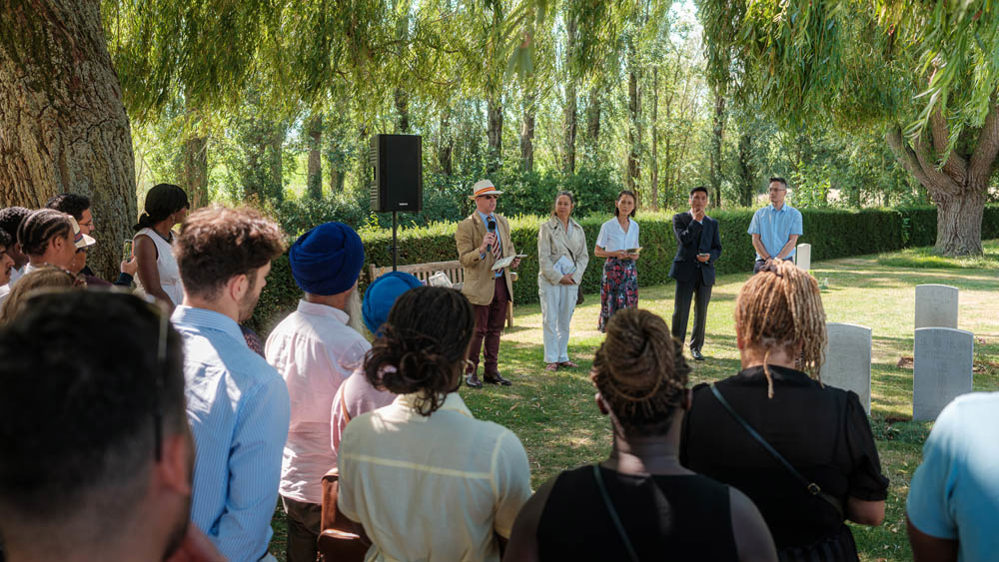
Photo courtesy of George Hay
Departing Invicta Barracks, Maidstone, on a sunny Friday morning, our two coaches made for the coast and the ferry to Calais. Conversations flowed throughout the journey, reflecting the group's shared interest in the work of the Commonwealth War Graves Commission and the stories it preserves.
Once on the continent, we made our way to our first stop at Lijssenthoek Military Cemetery – the CWGC’s second largest cemetery in Belgium. During the drive, the CWGC Historians gave the first of many briefings to prepare the group ahead of their arrival.
During the First World War, the village of Lijssenthoek was situated on the main rail and road communication line between the Allied military bases in the rear and the Ypres battlefields.
Close to the Front, but out of the extreme range of most German field artillery, it became a natural place to establish casualty clearing stations.
The cemetery, designed by Sir Reginald Blomfeld, houses over 10,000 burials, and it reflects the truly international nature of the Allied war effort by reminding visitors that the war extended far beyond the trenches themselves.
Our particular focus here was on the history of the Chinese Labour Corps (CLC), of whom, 35 are buried in Lijssenthoek. Around 140,000 Chinese labourers served behind Allied lines, undertaking essential work such as repairing roads, unloading supplies and clearing battlefields.
As the group gathered around their headstones, we were told about the service and sacrifice of the CLC in a series of moving talks.
The Menin Gate: remembering the missing
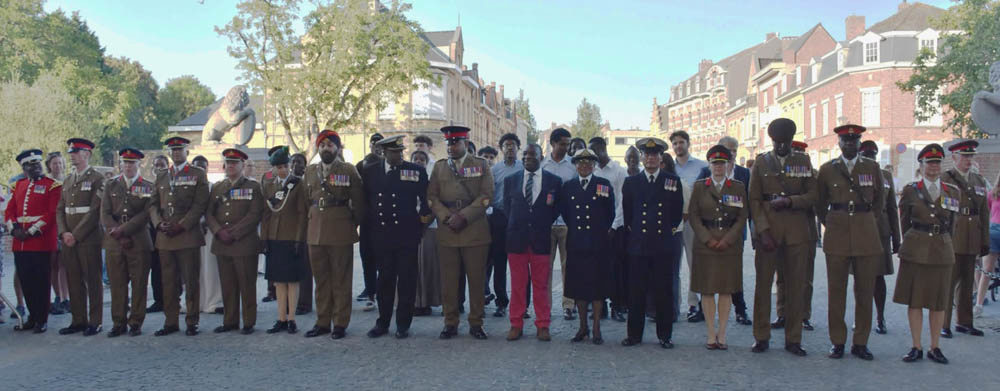
Photo courtesy of Manpreet Kaur Maycock
On leaving Lijssenthoek, our party moved to the city of Ypres (Ieper), which over a century ago sat at the heart of one of the most fiercely contested spaces of the war.
From October 1914 to October 1918, five major battles occurred at Ypres, with the city and its surrounds defended by the armies of the British Empire throughout. This, however, came at a great cost, as not only was the medieval city effectively destroyed, but hundreds of thousands died in its defence, with over half having no known grave.
As hundreds of thousands of Commonwealth troops had known the city during their time on the surrounding battlefields, it was decided that Ypres was where the missing should be commemorated.
Designed by Sir Reginald Blomfeld, the Ypres (Menin Gate) Memorial bears the names of more than 54,000 men of the forces of Australia, Canada, India, South Africa and the United Kingdom who died in the Ypres Salient and who have no known grave.
The New Zealand government decided that the names of its missing should be commemorated in cemeteries near to where they died.
Unveiled by Field Marshal Lord Plumer on 24 July 1927, the massed multitude of names on this memorial emphasises the scale of sacrifice made by those who served with the armies of the British Empire in Belgium in the First World War.
The sheer scale of the memorial left a profound impression on the group, as did the daily service that takes place beneath it. As the notes of the Last Post echoed around the structure, participants paused in quiet reflection, contemplating the immense human cost of the fighting here.
The Neuve-Chapelle Memorial – honouring the Indian dead
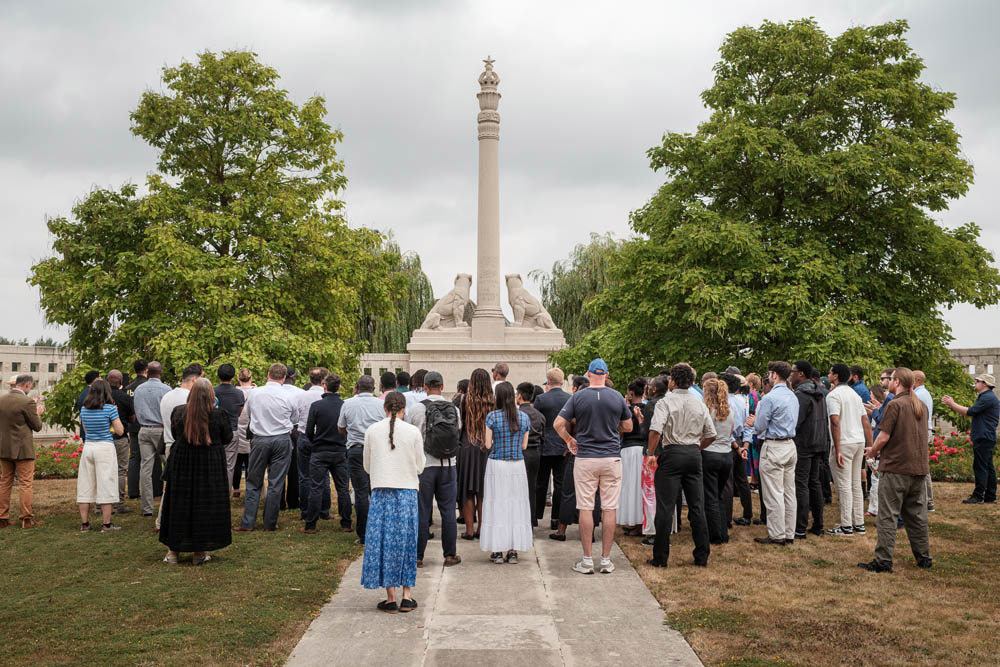
Photo courtesy of George Hay
Saturday morning began with a visit to the Neuve-Chapelle Memorial, which commemorates more than 4,700 Indian soldiers and labourers who died on the Western Front and have no known grave. Its location was deliberately chosen: it was here, in March 1915, that the Indian Corps fought its first major action as a unified formation.
In the opening months of the war, troops from India were rushed to France and Belgium to reinforce the overstretched British Expeditionary Force.
They fought in some of the hardest battles of 1914 and 1915, enduring unfamiliar weather, harsh trench conditions and the shock of industrial warfare. By the war's end, more than 1.4 million Indians had served across multiple theatres of conflict, with over 80,000 losing their lives.
As the historians explained to the group, the memorial was designed by Sir Herbert Baker and draws heavily on Indian architectural traditions.
At its heart stands a column inspired by the pillars of the Emperor Ashoka, crowned with a lotus capital, the Imperial Crown and the Star of India. Flanked by carved tigers and bearing inscriptions in several languages, it serves as a striking tribute to the diversity and sacrifice of India's wartime service.
Unveiled in October 1927 in the presence of Indian veterans, dignitaries and military leaders, the memorial remains one of the most significant sites of Indian remembrance on the Western Front.
Against this backdrop, delegates reflected on the often-overlooked contribution of the Indian Army, paying tribute not only to those who served and died, but also to the families and communities whose lives were forever changed by the conflict.
Canada Farm Cemetery and Caribbean Service
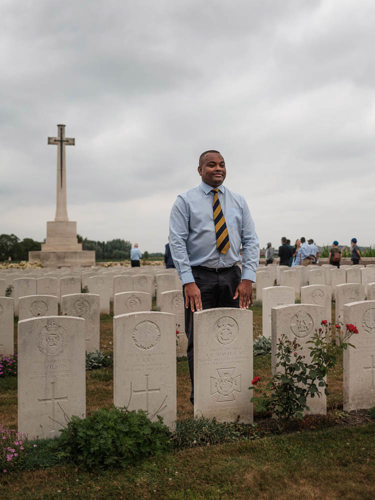 Photo courtesy of George Hay
Our next stop was Canada Farm Cemetery, where attention turned to the contribution of the British West Indies Regiment (BWIR) and other Caribbean personnel to the war effort.
Thousands of men volunteered from across the Caribbean, travelling vast distances to serve the Empire.
Employed in labour, transport and support roles – and in theatres outside of Europe, as front-line soldiers – they served with distinction, despite the discrimination and unequal treatment many faced.
Their stories are increasingly recognised as an essential part of the First World War's global history.
Named after a nearby farm used as a dressing station during the Third Battle of Ypres, Canada Farm Cemetery was designed by Sir Reginald Blomfield and contains many of those who died during the fighting in 1917. Among them are 19 members of the BWIR.
Seventeen of these men served with the 7th Battalion, BWIR, which arrived from Jamaica in 1917 and was deployed to nearby Elverdinghe on supply, transport and ammunition duties.
The battalion suffered its first loss on 11 September, whilst on the following day, an enemy bombing raid on the camp killed five more men and wounded 38 others.
The battalion's courage under fire was recognised in contemporary reports, with the Officer Commanding the Ammunition Column praising the conduct of the men in the face of danger. All 19 BWIR casualties buried at Canada Farm died between September and December 1917.
A particularly poignant moment occurred here when Warrant Officer Class 1 Johnson Beharry VC stood in quiet reflection in front of the grave of a fellow VC winner, Corporal James Lewellyn Davies VC, who died on 31 July 1917. Two soldiers united in their shared valour.
St George's Memorial Church: a living memorial
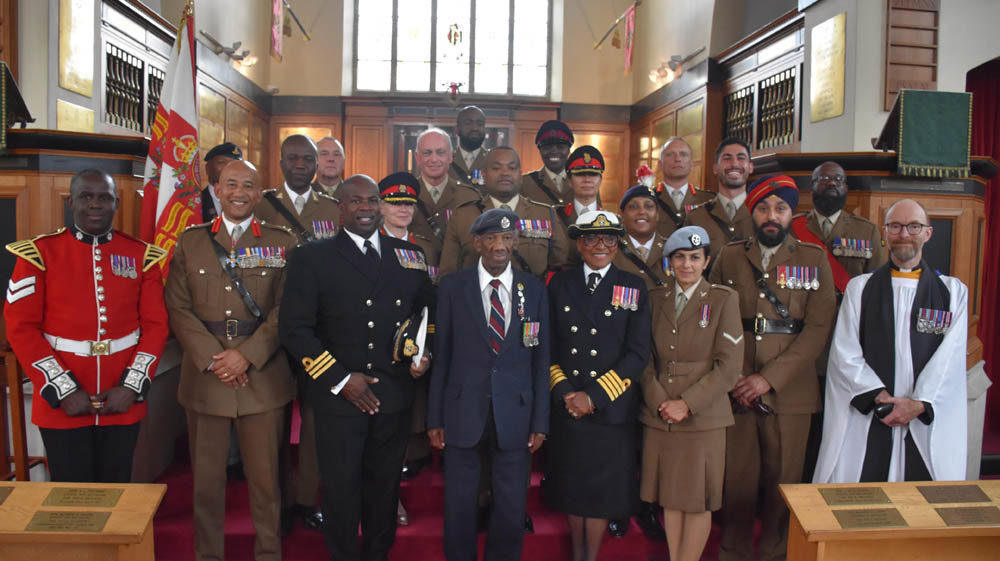
Photo courtesy of Manpreet Kaur Maycock
Travelling back to Ypres, the group then gathered at St George's Memorial Church for a commemorative service.
The church was constructed in the aftermath of the war as a memorial to British and Commonwealth soldiers who fought in the Ypres Salient.
Inside, visitors find regimental memorials, stained glass windows and commemorative plaques that tell countless individual stories of service and loss.
Unlike a museum or cemetery, St George's remains a functioning place of worship. As a result, it offers a unique connection between remembrance, faith and community, linking past generations with those who continue to visit the city today.
An unforgettable highlight of the service was the Last Post played on steel drum by a Corporal of the Coldstream Guards.
Longuenesse (St. Omer) Souvenir Cemetery and the role of South African labourers
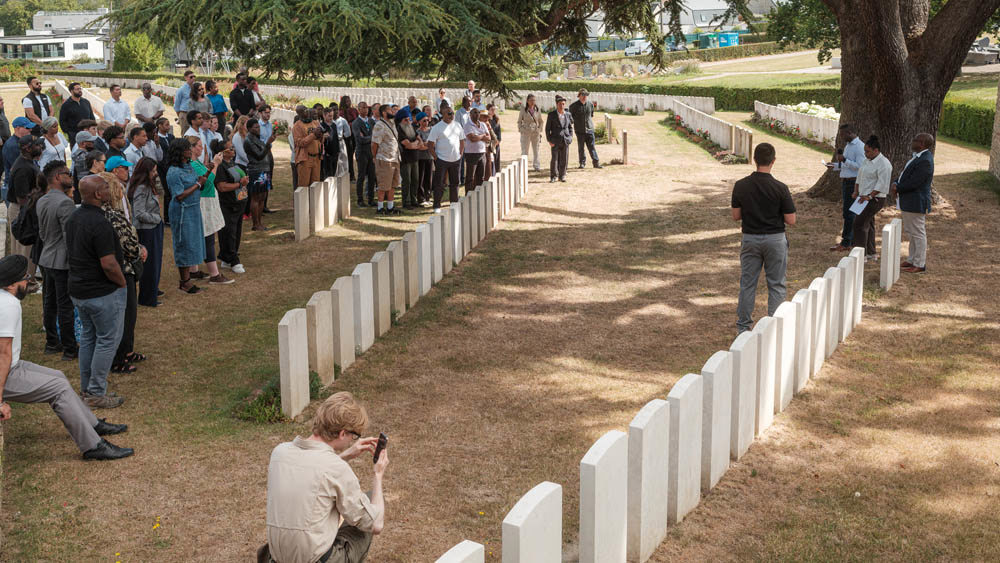
Photo courtesy of George Hay
On our final morning, before returning to the UK, we visited Longuenesse (St. Omer) Souvenir Cemetery.
During the First World War, St. Omer was a vital British military centre, serving as General Headquarters of the British Expeditionary Force until March 1916 and remaining an important logistics, training and medical hub throughout the conflict.
It also hosted the headquarters of the Royal Flying Corps and, later, the Royal Air Force. The town's strategic importance made it a target for German air raids, which caused significant casualties in 1917 and 1918.
Designed by Sir Herbert Baker, Longuenesse (St. Omer) Souvenir Cemetery contains more than 3,300 Commonwealth burials of notable diversity, including five members of the South African Native Labour Contingent. It provided a fitting setting in which to reflect on the service of South African labourers and the discrimination many endured during the war.
Particular focus was given to the sinking of the SS Mendi on 21 February 1917, one of the greatest maritime disasters in South African history. More than 600 members of the South African Native Labour Corps lost their lives when the ship sank in the English Channel.
The story of Reverend Isaac Wauchope Dyobha, who urged the men to face death with courage and dignity, remains one of the most powerful examples of resilience and sacrifice from the First World War. By commemorating the Mendi, the tour reinforced a central theme of the weekend: that remembrance must recognise all who served, regardless of race, nationality or background.
More than a battlefield tour
The Op REFLECT Global Chapter's France and Flanders Tour was far more than a visit to historic sites. It was a journey through a shared history that spans continents, cultures and generations.
At every cemetery, memorial and place of remembrance, participants encountered stories that challenged conventional narratives of the First World War and revealed the truly global nature of the conflict.
From the Chinese Labour Corps at Lijssenthoek to the Indian soldiers remembered at Neuve-Chapelle, from the men of the British West Indies Regiment at Canada Farm to the South African Native Labour Contingent commemorated at Longuenesse, the tour illuminated lives that deserve a fuller place in our collective memory.
These were individuals who travelled thousands of miles to serve a cause not always their own, and whose sacrifices helped shape the modern world.
As the coaches made their way home and the battlefields receded into the distance, the stories remained.
They served as a reminder that remembrance is strongest when it is inclusive – when every voice is heard, every contribution acknowledged and every sacrifice remembered.
In walking these historic landscapes together, participants did more than reflect on the past; they reaffirmed a commitment to ensuring that the legacy of all who served will continue to inspire future generations.
Author acknowledgements
Dr John Burke is a Senior Research Historian at the CWGC. He obtained his PhD from Newcastle University and has published widely on the remembrance and representation of conflict, and on the legacies of British colonialism. He co-authored the 2021 and 2025 reports on historical inequalities in commemoration.