

19 October 2026
Water Use and Responsible Management at the Commonwealth War Graves Commission
In a world of changing climates, responsible water management, including smart irrigation systems, is essential to maintaining CWGC’s global estate.
We are custodians of one of the largest horticultural estates in the world. As such, we face numerous water management and sustainability challenges in a wide variety of climates and ecosystems globally.
Irrigation and smart water use help us protect and preserve our sites where necessary, helping plants and trees establish, ensuring our sites remain beautiful horticulture-rich spaces that inspire, move, and delight.
Here, John Nicholls, CWGC’s Head of Horticultural Standards, guides us through how we tackle the concept of responsible water management.
At a glance: Responsible water management at the Commonwealth War Graves Commission
This article covers responsible water management at the Commonwealth War Graves Commission, including:
What responsible water management means to the CWGC
How climate affects water management and consumption
The effect of local conditions on irrigation and water use
How different irrigation systems work
New irrigation projects in Italy and Tunisia
How tree and plant species selection is linked to water
What does responsible water management mean for the Commonwealth War Graves Commission?
Responsible water management for CWGC means using water only where it is needed to sustain healthy landscapes.
Irrigation is used to support establishment and plant health, not simply to make landscapes greener than the defined standard requires.
Most of our sites are not irrigated, but where the climate is challenging, we do need to adapt our approach.
This involves designing resilient landscapes, using ornamental plants and tree species that are adapted to the prevailing conditions.
The same ethos applies to the lawns, where drought-resilient warm-season turf grass species that can tolerate intense heat are used where temperate cool-season grasses would fail.
Water management and irrigation programmes
Water management is at the heart of good irrigation, so maximum water requirements are calculated, and then water budgets are established within that range; this process is known as deficit irrigation and irrigation programmes and schedules are established to meet the water budget.
This is not always possible as weather patterns are increasingly unreliable, so we monitor water consumption and maintain records of historical water use.
Irrigation systems are complex to design, maintain, operate and replace and staff training is an essential element of the sustainable irrigation objective; there is no better monitor than a competent and knowledgeable horticulturist.
Management & maintenance
Responsible water management also relies on the imperative that our irrigation systems are properly managed and maintained so they are efficient during their entire service life.
This includes the need for a defined replacement cycle so that systems are not retained so far beyond their viable service life to the point where they become unreliable, inefficient, unsafe and costly to maintain.
Why conserving and managing water effectively is important for our sites
Clean, potable water is a precious and finite resource.
I have worked and travelled in many countries where that sentence cannot be overstated.
We have a moral duty to minimise our water consumption, and if there is a cost to the landscape modifications that deliver water conservation in the interest of agriculture and communities, then that is a challenge we must address.
Climate change and water management
In a period of climate change where temperatures are significantly above recent norms, landscape change is increasingly the most viable long-term solution to water conservation and sustainable horticulture.
In many locations, we no longer have the luxury of cheap, plentiful water on demand, and whilst careful management protects plant health and horticultural standards, we are increasingly exposed to high water, energy and maintenance costs.
The environmental impact of water management across our global estate
Any water use, be it from potable supply, abstraction from lakes, streams or boreholes, impacts on the aquifer reserves.
Water treatment (e.g. desalination or soluble iron removal), pumping and distribution all have environmental impacts, including energy use and associated emissions.
Irrigation operations also affect soil chemistry and condition; over-irrigation can lead to soil erosion and pollution.
Blending responsible irrigation and water management with planting
Across the estate, avoiding unnecessary irrigation by ensuring precise and efficient irrigation practices, using climate-resilient planting, improving soil water retention, and monitoring consumption can reduce these impacts.

Want more stories like this delivered directly to your inbox? Sign up for our newsletter for regular updates on the work of Commonwealth War Graves, blogs, event news, and more.
Sign UpHow local conditions affect irrigation and water management
Irrigation demand is shaped by rainfall, temperature, wind, soil type and depth, topography, water quality, supply reliability, plant species and the character of the cemetery.
Different climates and environments; different water management needs
In temperate northern Europe, natural rainfall may meet most needs, and irrigation can be limited to establishment or prolonged dry periods.
In Mediterranean and North African locations, longer hot, dry summers may require permanent systems, but the landscape and irrigated footprint must be carefully designed to reduce demand.
At Coriano Ridge in Italy, the new approach targets selected turf areas with efficient, sensor-informed irrigation while other areas are naturalised, and manual irrigation remains available where needed.
At Medjez-el-Bab in Tunisia, the design substantially reduces irrigated turf, uses drought- and salinity-tolerant plants and turf, and concentrates water on clearly defined priority zones.
Understanding Irrigation
In simple terms, landscape irrigation (as opposed to agricultural or crop-based irrigation) is the planned and measured application of water to the landscape in support of plant health and vitality when natural precipitation is insufficient.
A well-designed and constructed system divides a site into individual zones so that all elements of the landscape, both planted features and the soil itself, receive the correct level of irrigation at the correct frequency.
Electronic irrigation
Electronic irrigation controllers are programmed to autonomously deliver a schedule of irrigation events. They also monitor flow and pressure, check online weather data and use soil-moisture sensors to enable irrigation managers to visualise soil moisture levels.
Controllers that are connected to the internet can also provide detailed insights and performance reports to irrigation managers about the irrigation system in terms of system performance, maintenance issues and resource efficiencies.
Application of the water is generally via a network of underground pipes and a range of emitters such as drip lines, oscillating rotors, and matched-precipitation sprinklers.
Why is irrigation important?
In the context of the global estate, irrigation is not a very prominent feature. Most of our sites do not require irrigation as natural precipitation is sufficient.
However, sites in the Mediterranean, Sub-Saharan Africa and Asia do require support from irrigation.
Without this support, the current landscape designs would not be viable, as the extended periods of drought and elevated temperatures would eventually subdue the planting.
How irrigation helps establishment of plants and horticulture
Establishment is one of the most important uses of irrigation.
Newly planted trees, shrubs, herbaceous plants and turf have limited root systems and need dependable moisture while roots develop into the surrounding soil.
Watering is normally more frequent immediately after planting and then reduced as plants establish.
Species selection, planting season, mulching and good soil preparation all help shorten this period; where appropriate, irrigation can then be reduced substantially or reserved for exceptional drought.
Water management in action: New irrigation systems in Italy
Successful irrigation systems begin with a comprehensive knowledge of the site.
Elements such as soil type, soil infiltration rate, site orientation, turfgrass species and plant species, exposure to wind, shade, average temperature ranges, average rainfall per annum, location of structures, etc.
This knowledge is indispensable to the irrigation system designer.
Replacing the irrigation system at Coriano Ridge War Cemetery
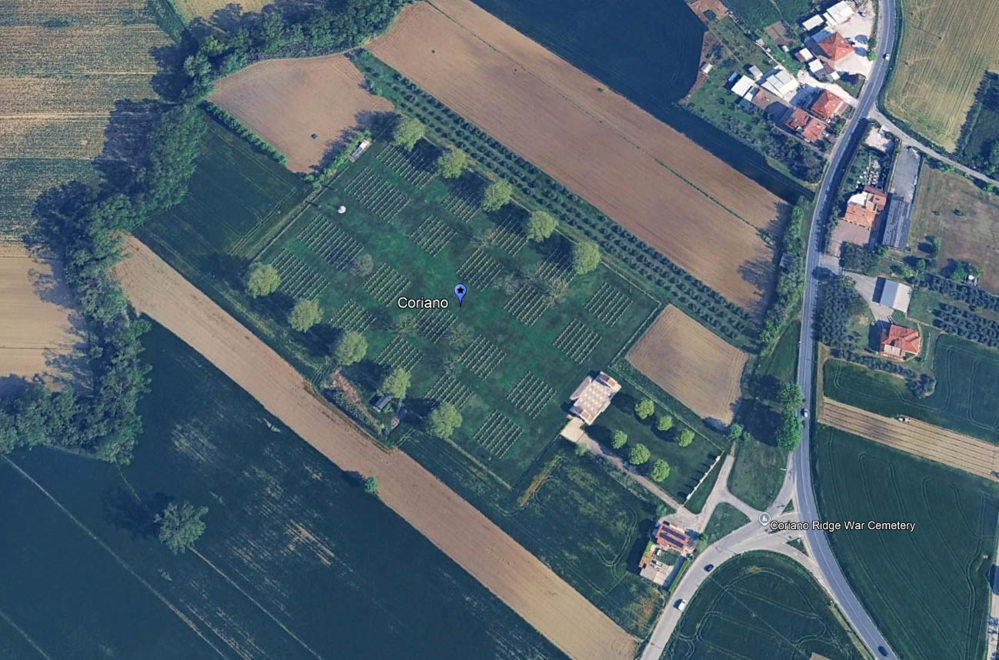 Image: Coriano War Cemetery
The recent replacement of the system at Coriano Ridge War Cemetery in Italy is an excellent example of collaboration between our team at Coriano, who know every facet of the site, our Hort Assistant Manager, Francesco Migliosi and the irrigation system design team.
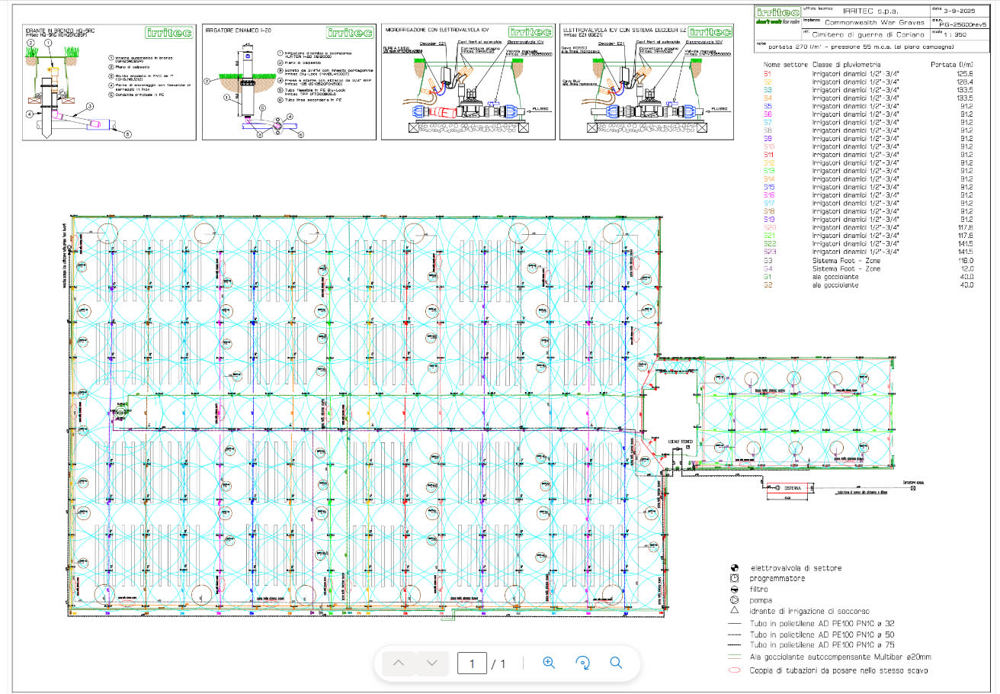 Image: The updated irrigation system at Coriano Ridge War Cemetery
Every new system we install is anticipated to function for twenty-five to thirty years; during this period, technology changes, new innovative features are developed and new devices are invented.
When we design systems that will be in service for a long time, we aim to incorporate the most recent technologies to achieve the greatest efficiencies over the lifetime of the system; and this is what we have done in Coriano.
For example, we have installed decoder solenoid valves that can detect when the electrical current is intended for them; this drastically reduces the underground wiring.
We have installed inverter-driven variable speed pumps; this increases the efficiency of water pumping, as the pumps will only deliver the flow and pressure required by each individual irrigation zone, delivering on electricity savings and greater longevity of the pumps.
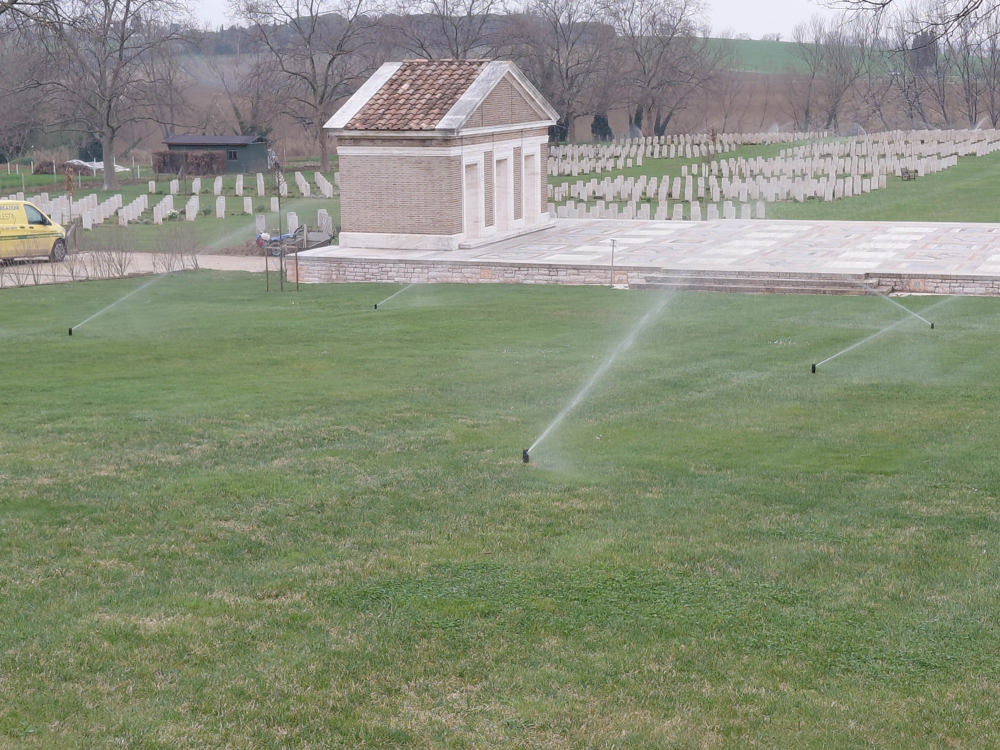 Image: The new Coriano Ridge irrigation system in action
Soil Scout soil-moisture sensors are distributed around the site, enabling the system to be calibrated and fine adjustments to be made that improve efficiency.
Future-proofed irrigation at Faenza, Cesena, and Orvieto
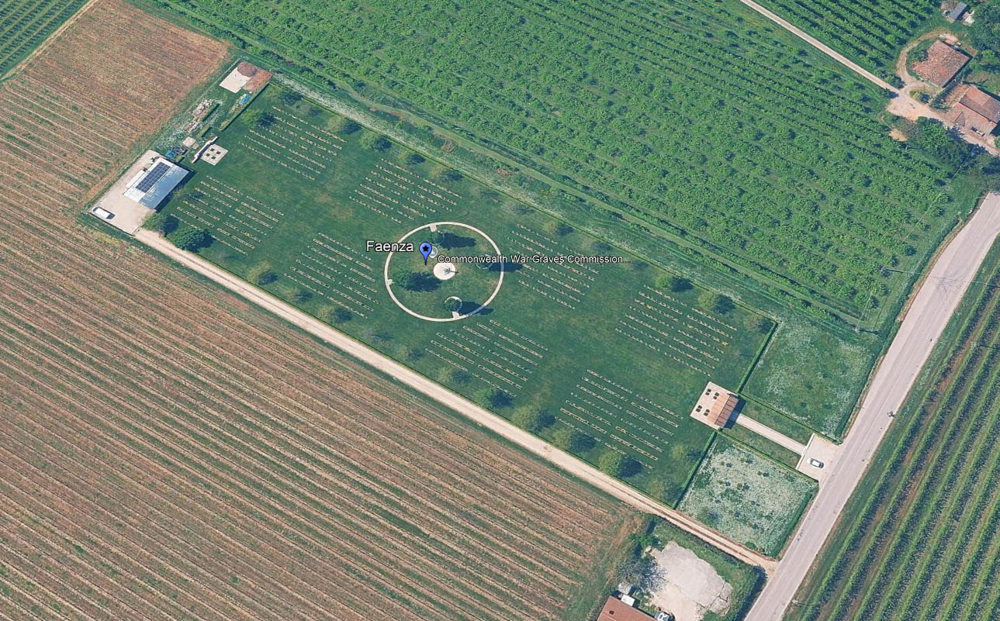 Image: Faenza War Cemetery
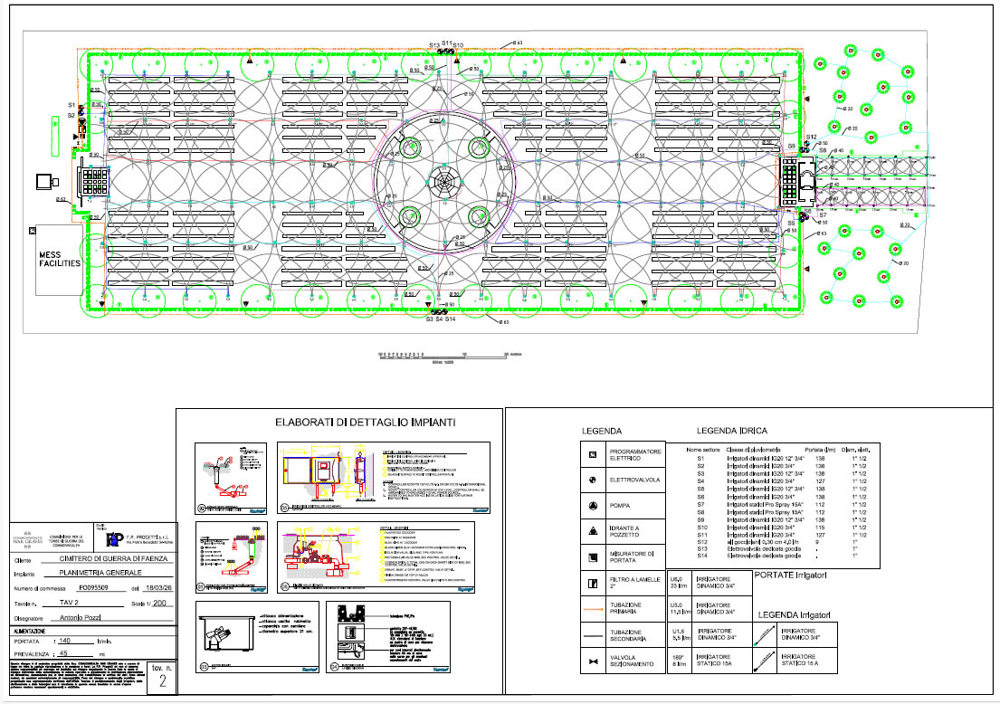 Image: Irrigation system design Faenza War Cemetery
The systems at Faenza and Cesena, date from the early 1990s and we will apply the same future proofing process to these systems as they are designed.
In addition to this, unnecessary perimeter coverage has been removed, valves and pipework have been positioned for safer maintenance and reduced conflict with tree roots, and provision has been made for new-tree establishment and emergency manual irrigation.
At Orvieto, the team has explored a low-irrigation or effectively dry-site approach, retaining targeted drip irrigation for permanent planting and backup irrigation for exceptional conditions.
Pioneering water management in Tunisia
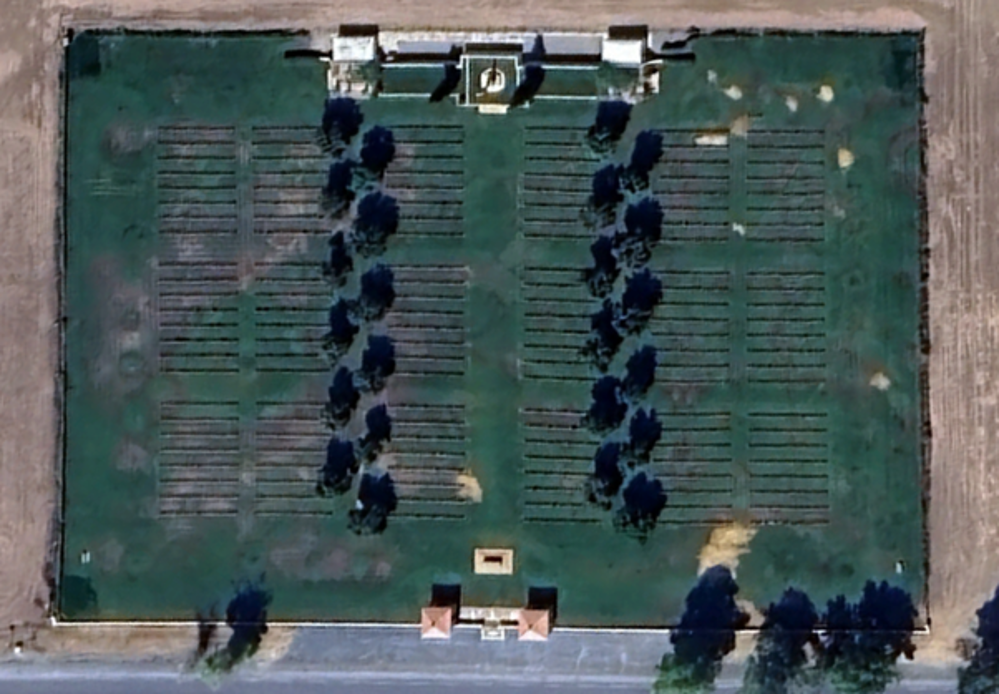 Image: The previous state of Medjez-El-Bab, featuring stressed turf and patchy irrigation
CWGC is removing irrigated turf at Medjez-el-Bab to improve water sustainability.
Medjez-el-Bab is CWGC’s first ‘Pioneer Site’ and the landscape design once completed and established, will show how a traditional cemetery landscape can remain beautiful and recognisably CWGC whilst becoming far more resilient to Tunisia’s climate.
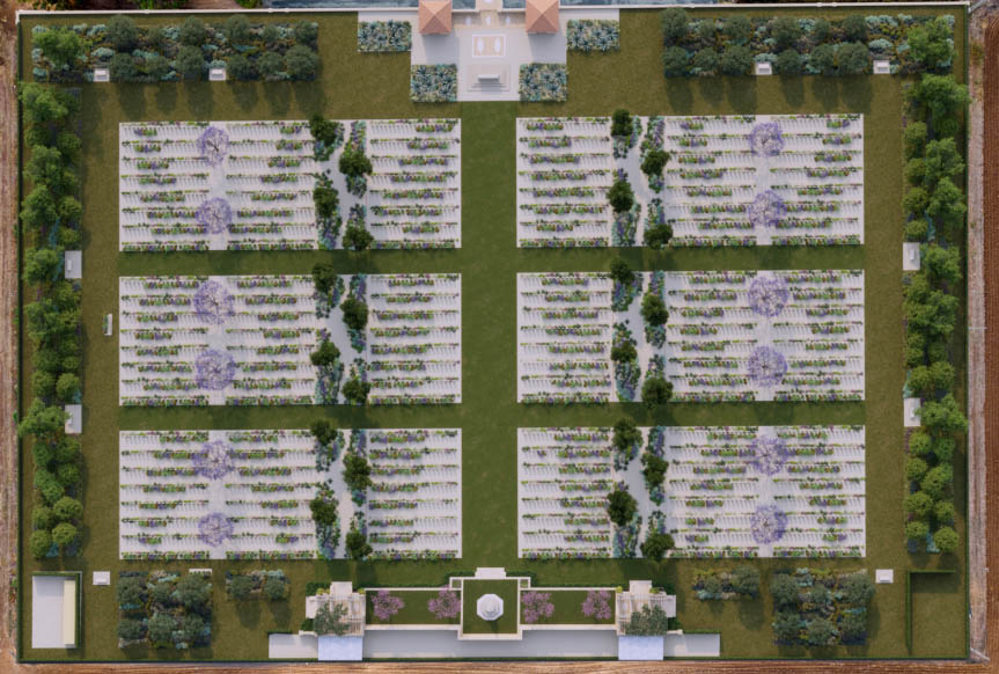 Image: The final design objective: reduction in all inputs, increased biodiversity, improved access and a longer sustainable legacy.
All the managed turf within the burial plots is being replaced by a free-draining aggregate surface and locally appropriate, drought-tolerant planting.
Turf is retained on the principal axes and key vistas, using deep-rooted, salinity-tolerant seashore paspalum, while surrounding areas will be irrigated only if there is a risk to plant health.
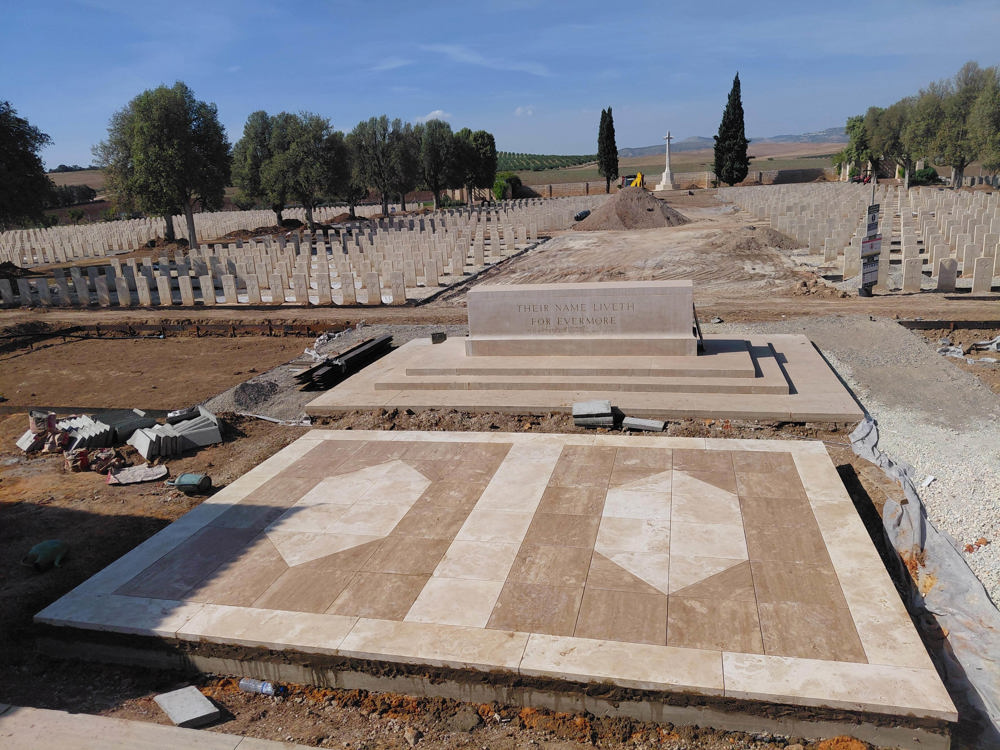 Image: Work in progress at Medjez-el-Bab
The smaller system uses variable-speed pumps, efficient matched-precipitation emitters, remote scheduling and soil sensors monitoring moisture, salinity and temperature.
Water will be concentrated on the seashore Paspalum turf along the main axes and on planting during establishment; following establishment, irrigation will be reduced as drought-tolerant plants and new trees mature.
39,000 Trees for 2039: How do water management needs influence species selection?
Tree selection is influenced by several environmental and horticultural considerations.
This includes elements such as soil type, elevation, prevailing wind, climate and weather patterns and of course the capacity of the selected species to thrive in the location where they are planted, with establishment of young trees and drought tolerance of mature trees being the most important considerations.
In the overall scope of the Commission’s irrigation, the 39,000 Trees for 2039 programme will have limited impact on the volume of water used.
Of course, trees need water to establish, and different species have different irrigation requirements to become established, but ultimately if the correct species has been selected for the correct location, its long-term irrigation requirement is low.
Planting of trees is generally planned for the autumn or winter in temperate climates when cooler conditions and moist soils reduce stress and water demand.
Existing and new systems may be adapted to support tree establishment, but ultimately species and location selection are the key drivers in terms of long-term viability.
The principle of ‘right tree in the right place’, where preference is given to locally suitable, climate-resilient species that can cope with expected heat, drought, soil conditions, pests and diseases, while also supporting the cemetery design and local biodiversity.
Author acknowledgements
John joined CWGC in 1986 as a Gardener Caretaker 1st class and began work in Belgium at Lijsenthoek Military Cemetery, when he was 20 years old.
From there, John took up the post of Head Gardener at St Symphorien, near Mons, and then finally returned to Lijsenthoek as Senior Head Gardener, all of this within 6 years. John then moved from Belgium to France as a Sector Supervisor and was in France until 1994, when he was transferred to Thessaloniki as the Local Supervisor for Greece and the Balkans.
Five years later, John returned to the UK and held the post of District Inspector, based at Brookwood Military Cemetery. Two years later, John was promoted and joined Outer Area as Horticultural Manager Central. This role took him far and wide, from the Middle East to West Africa, Sub-Saharan Africa and all points in between.
After 7 years, John was transferred to Rome as the Horticultural Manager for the Western Mediterranean Area and held that role for about three and a half years before being promoted back to Outer Area as Operations Manager, a role that took him to the Far East, India, and throughout Asia.
In 2018, John was asked to review our global use of pesticides on behalf of what is now called 'Estates'. This took a year to deliver, and at the conclusion of the task, John was asked to join the Estates team as Head of Horticultural Standards, a role which John continues to enjoy to this day.