

31 August 2026
Why Planting and Maintenance Practices Are Adapting
At the Commonwealth War Graves Commission, we are adapting our horticultural and maintenance practices worldwide.
Changing global climates have necessitated altering and adapting to a variety of challenges, all without losing sight of our original mission: caring for the final resting places of 1.7 million Commonwealth World War servicemen and women.
War graves, our memorials, and the people they commemorate are at the core of everything we do.
Changing our horticultural and maintenance practices ensures our sites commemorate these people by name with dignity and respect, while remaining beautiful spaces that inspire and delight.
But with over 23,000 locations in 155 countries and territories worldwide, there is no one-size-fits-all solution to war cemetery and memorial care and maintenance. Planting and maintenance decisions are shaped by local conditions, as well as global standards.
At a glance: What's on this page
This page covers why our horticultural and maintenance practices are adapting in the face of changing climates, including:
Why are practices are changing
What visitors may notice at CWGC sites
How we are rethinking turf use and irrigation
Planting for local conditions
The 39,000 Trees for 2039 Project
How adapting our processes supports commemoration
Why planting and maintenance practices are changing
So, why is cemetery planting changing? Why is Commonwealth War Graves adapting our maintenance practices? The answer lies with the climate.
Changing weather and water availability
“Our commitment to excellent standards of care for cemeteries and memorials hasn't changed, but we are noticing and recording extreme heat and drought, and torrential rain, which will influence how we do things moving forward,” David Richardson, Commonwealth War Graves’ Director of Horticulture, said.
Our practices are being influenced by several factors, including changing weather patterns, water availability, soil health, plant resilience, biodiversity, visitor experience and the long-term protection of sites.
More extreme weather cycles and shifting global patterns have caused us to rethink our planting and care regimes. The combination of longer, drier summers and intense, wet autumns and winters is more common in the UK and Northwest Europe, for example.
Sites in Flanders, Northern France, and the former battlefields of the Western Front, such as Railway Hollow, are becoming susceptible to flash floods as autumns and winters get wetter.
But our global estate covers everything from war graves in the Arctic Circle to steaming monsoon climates, jungles, and hot, arid deserts.
Water scarcity is increasing globally too. We must adopt smarter approaches to irrigation, water storage, and planting to reduce water use across our worldwide estate, particularly in regions such as North Africa.
Caring for landscapes in the long term
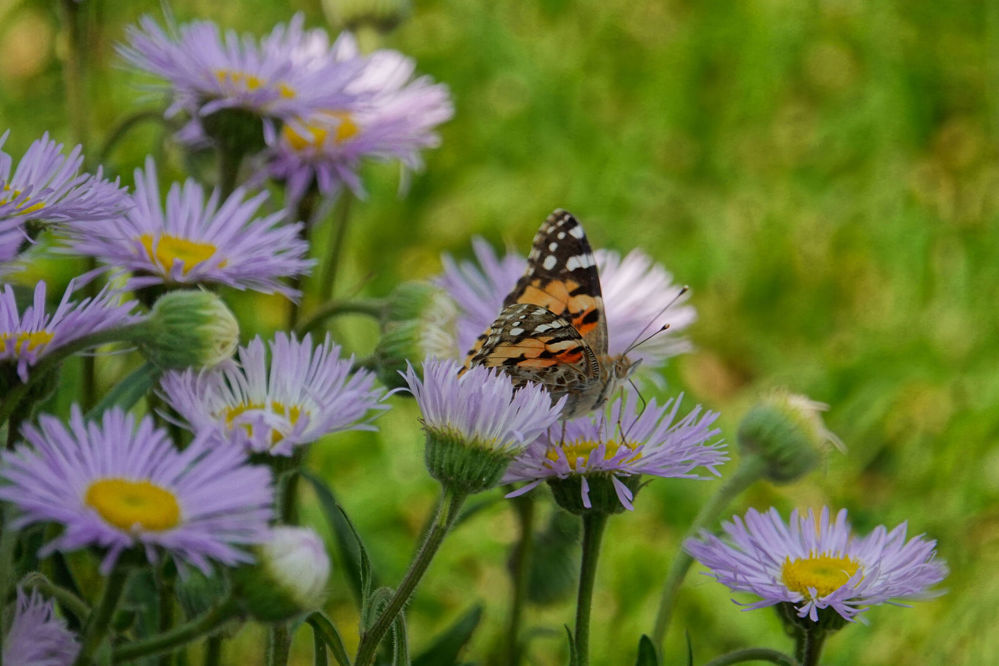
Image: Adapting our horticultural and maintenance practices will allow us to maintain biodiverse, climate-resilient spaces that inspire and delight all visitors, human or otherwise (Ilse De Groof)
The Commonwealth War Graves Commission is charged with caring for and maintaining the war graves and points of commemoration for over 1.7 million men and women who died in military service to the British Empire in the two world wars.
Our goal is to create climate-resilient cemeteries and memorials that fulfil our core mission while remaining beautiful spaces that capture and inspire the imagination.
Sustainability is linked with planting and maintenance. Sustainable cemetery care includes selecting the right plants and trees for the local environment.
Using data, we consider climate projections 30-50 years into the future, which informs which tree species we plant at particular sites.
Ensuring the right species fit the environment helps us with other aspects of plant care, such as water use and soil quality, and integrates them into our wider sustainability commitments.
In doing so, we can create resilient, healthy landscapes that commemorate our war dead in perpetuity.
Adapting without losing meaning
“Adopting an environmentally responsible approach to our work is a vital part of our core mission,” Lise Andreassen, CWGC Head of Environmental Sustainability, said. “Today, our climate is becoming more unpredictable, and biodiversity is in widespread decline, and we need to play our part.”
While the look and feel of some of our cemeteries and memorials might change, their purpose does not: commemoration of the Commonwealth’s War Dead.
Taking a sustainable approach to cemetery and memorial care, interwoven with the correct planting schemes and maintenance practices for each site, helps protect these sites against future climate extremes.
“As world leaders in commemoration and as a significant global employer of expert horticulturists, we want to ensure our cemeteries, memorials and their surrounding landscapes are beautiful, healthy, climate-resilient and biodiverse, whilst remaining places of deep meaning,” David Richardson said.
What visitors may notice at CWGC sites
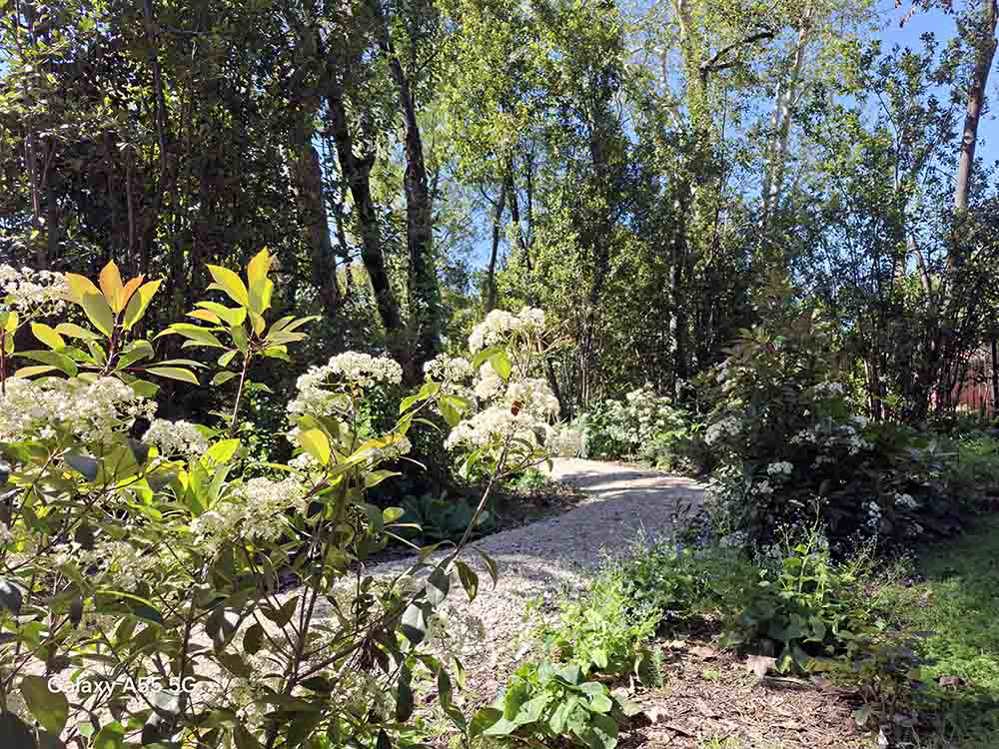
Image: The newly installed sensorial gardens at Rome War Cemetery
Our sites are not static places of commemoration: they are constantly being monitored, maintained, surveyed, and gardened to ensure they meet our high global standards.
The process of adapting our horticultural practices and sites for climate resilience is ongoing. You may see some work at our sites. Here’s what to expect.
Different planting styles
One of the first things you may notice, depending on the site, is different planting styles and potentially layouts.
We are taking a “right ecosystem, right plant, right place, approach to cemetery care. That includes re-evaluating plant species selection and plantings to make sure our sites are as climate-resilient and aesthetically stunning as possible.
For example, the planting at the new Brookwood 1914-1918 Memorial was selected with suitability and sustainability in mind.
Famed garden designer Tom Stuart-Smith explains the Brookwood planting selection: “All the plants we're using are plants that naturally occur around here. We're using things like purple moor grass, we're using heather, we're using native ferns, so that they will be part of that natural succession.”
“We’re planting something with a sort of more rarefied version of what we would expect to find here anyway. So, we would hope that once it's established, the level of maintenance you'd be doing here would be very, very low.”
Less irrigated turf in some places
Limiting water consumption is part of our worldwide sustainability goals at the Commonwealth War Graves Commission.
In practical terms, this means adapting some of our sites to change irrigation.
For example, at Medjez-El-Bab War Cemetery in Tunisia, as much as 85% of irrigated turf will be removed and replaced with more climate-appropriate, less water-intensive species.
We’re replacing much of the lawn with gravel pathways, creating meandering paths beneath olive trees and weaving through the headstone rows, underplanted with resilient local species.
This will allow us to carefully save and manage water while improving the cemetery’s climate resilience.
Meadow and orchard planting
In some sites, particularly those in northern France, we have been experimenting with creating meadows and areas of longer grass. Likewise, future planting schemes and designs have incorporated orchard planting too.
Why? To help foster biodiversity. By embracing lawns with more broad-leaf species such as daisies, clovers, and veronicas, we hope to attract pollinators and bugs to our sites. The insect world loves species like this, and their presence is necessary for healthy, blooming gardens and green spaces.
In terms of planting orchards, these will create spaces of quiet reflection and shade within a cemetery site, such as the olive grove being planted at Medjez-el-Bab.
Planting for local conditions
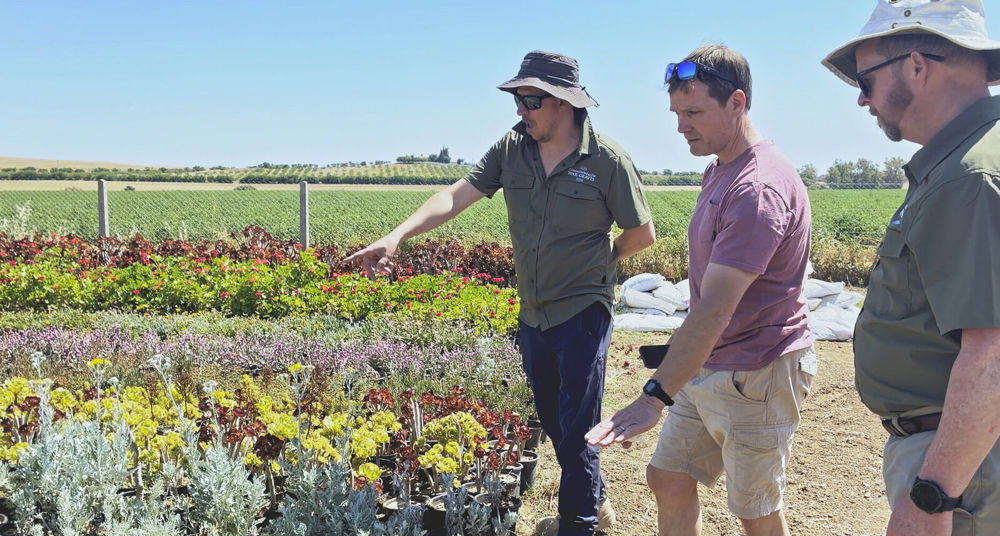
Image: The right plants for the right conditions make all the difference. Here, our team discusses the best varieties to plant in the renovated Medjez-El-Bab War Cemetery, Tunisia
Planting is not just about aesthetics. Our planting choices increasingly need to reflect local climate conditions, water availability, soil, and landscape character.
Right plant, right place
The right plant, right place philosophy drives our planting schemes and species selection.
After all, the planting needs and criteria at El Alamien War Cemetery in Egypt will differ from, say, Tyne Cot War Cemetery in Belgium or Kanchanaburi War Cemetery in Thailand.
Our cemeteries and memorials are in almost every biome you can think of, and so planting will vary from location to location.
We use software like TreeSpotter to review and identify plants that are ideally suited to local conditions.
On major projects, such as 39,000 Trees, we will also collaborate with organisations such as Botanic Gardens Conservation International, The Tree Council, Forestry Commission and Royal Botanic Gardens Kew, as well as partners and designers like Tom Stuart-Smith, to help inform planting.
For example, Tom advised on the plantings at Brookwood for the new 1914-1918 Memorial. Native ferns and heather, purple moor grass, and silver birch are all suited to Brookwood’s soil and climate, potentially lowering the levels of maintenance required.
Plants that need less water
Medjez-El-Bab War Cemetery is a good example of how the planting has been updated with water consumption in mind.
Species that thrive in the nearby Medjira Valley and Thuburbo Majus, such as olive trees, lavender, rosemary, thyme, and local grasses, have been incorporated into the updated cemetery planting scheme.
These plants are perfectly suited for Tunisia’s climate and don’t need much moisture to thrive.
Not only will this result in lower water consumption on-site, but also in a beautiful garden-like cemetery that fits seamlessly into the surrounding landscape.
Respecting local landscape character
As mentioned above, blending a site in with the local conditions serves a dual purpose.
Selecting locally sourced plant and tree species means we are using varieties that already live and thrive there. Theoretically, this should point to lower maintenance and better plant health.
It also means our sites fit seamlessly with their surroundings. Our war cemeteries and memorials sit in landscapes tinged with tragedy and rich in meaning, very often on the former battlefields where soldiers fought and fell.
Blending them in with the local landscape character makes our sites part of these wider, historically significant spaces.
Supporting biodiversity
Biodiversity is key for healthy, beautiful garden spaces. Our war cemeteries and memorials are living spaces, despite commemorating the dead, and we wish to foster rich, biodiverse landscapes to keep them as such.
Right plant, right place ensures we select tree and plant varieties that are suited for their conditions but also foster biodiversity. You will find a rich selection of plant species at CWGC sites, from blooming red roses to massive sequoias, thick grasses, ferns, and nearly every plant variety you can think of.
We support planting by making biodiversity enhancements. Nearly 1,000 were made in 2025, for example, including the installation of insect hotels and bird nesting boxes at select locations.
Trees also provide shade and habitats for a wide variety of species, from birds to bugs, which combine to foster bio-rich landscapes maintained by Commonwealth War Graves.

Want more stories like this delivered directly to your inbox? Sign up for our newsletter for regular updates on the work of Commonwealth War Graves, blogs, event news, and more.
Sign UpRethinking Turf, Water and Irrigation
One of the most visible changes will be alterations to turf and irrigation systems. As global temperatures rise, water scarcity rises with it, and we need to be extra careful about our water consumption going forward.
Why turf can be challenging in some climates
Turf and lawns can require significant maintenance, especially in hot or dry conditions.
Planting and cemetery layouts will likely change around the world, as we look at more ways we can save water.
By removing 85% of the lawns at Medjez-El-Bab, for example, we aim to drastically reduce on-site water usage, but this will change how the cemetery looks and feels. Crucially, however, we will be better placed to maintain and care for that site sustainably, ensuring the final resting places of 2,900 servicemen are cared for in perpetuity.
However, this is not a one-size-fits-all approach to water use or lawn care. In wetter, colder climates, such as Northwest Europe, the familiar CWGC British garden feel will be maintained but with a few changes, such as meadowing and longer grass.
Reducing reliance on irrigation
Reducing reliance on irrigation helps conserve scarce freshwater supplies, lowers energy use, and prevents soil damage.
Here, planting and technology can combine to help lower our water use.
Rome War Cemetery was renovated between 2024 and 2025, overhauling the planting scheme and irrigation systems.
Disease-and-drought-resistant species were planted, requiring little water, while a new efficient zonal irrigation system was installed. The irrigation system at Rome War Cemetery is now linked to a weather station and soil humidity control system.
As such, it is now easier for us to monitor water and moisture volumes at Rome War Cemetery, allowing us to reduce and rationalise how much we use in response to local conditions.
Keeping cemeteries dignified and names legible
All of our horticulture and sustainability measures are all centred on our core mission: commemorating the Commonwealth’s war dead.
Since our founding in 1917, we have been committed to equality in commemoration for all those who died in service to the British Empire during the World Wars.
Planting inspired by the work of horticulturalist and garden designer Gertrude Jekyll has always resulted in stunning, biodiverse landscapes at our sites.
While we may be moving away from Jekyll’s original “English country garden” inspiration, we are keen to ensure her legacy lives on in the beautiful, biodiverse-rich spaces we will continue to create and care for.
Trees, Shade and 39,000 Trees for 2039
As we have touched on in this article, trees are some of the most important features of healthy, visually stunning landscapes and gardens.
Why trees matter at CWGC sites
Trees are important at CWGC sites because they:
Support local wildlife – By providing shelter and food for local wildlife, our new plantings will help ensure rich local biodiversity.
Improve soil health – Trees help improve soil health and quality in numerous ways, such as enriching nutrient content, improving microbial activity, protecting from erosion, and managing water.
Shading – Trees provide cooling shade for visitors – especially important in the face of rising global temperatures.
Choosing trees carefully
One thing we have stressed is the need to choose the correct species for the conditions. For example, we would be unlikely to plant invasive palm trees in Northern France, for example, but they may be suitable for sites in hotter, humid climates.
We use data from TreePlotter and organisations like Botanic Gardens Conservation International to forecast climate change, monitor existing tree species, and select appropriate species for the site.
Tree planting as long-term care
The first 39,000 Trees for 2039 plantings have already taken place with the installation of eight Field Maples in Guillemont Road Cemetery in the Somme, France, and over 50 new trees at Italy’s Coriano Ridge Cemetery.
These plantings are just the beginning.
“We hope that this significant planting target makes our cemeteries and memorials better prepared to deal with the ongoing effects of climate change, remaining stunning places of peace and contemplation and hubs of biodiversity,” David Richardson said.
“As world leaders in commemoration and significant global employers of expert horticulturists, we want to ensure our cemeteries, memorials and their surrounding landscapes are beautiful, healthy, climate-resilient and biodiverse, whilst remaining places of deep meaning.”
Maintenance is adapting too
Our gardeners and horticulturalists do incredible work caring for our global estate, but they are by no means the only skilled craftspeople who look after our sites.
The maintenance teams, including carpenters, stonemasons, and metalworkers, are essential in keeping our sites in top condition.
Much like horticulture, maintenance is adapting and changing in line with our sustainability goals too.
Caring for headstones responsibly
Our headstones have always been a mixture of stone types depending on the environment they were to be placed into, with 30 stone types of differing colours and shades in our catalogue, each rated on their resistance to weathering, pollution and local soil type.
We are currently moving towards a process of enzyme cleaning, which is better for both the environment and the stone, with cleaning only undertaken when necessary, reducing surface wear and water use.
We are also adopting a high temperature/low pressure cleaning process compared to past high-pressure washes.
Dark staining, caused by tiny photosynthetic and fungal organisms, has affected some of our headstones in France and Belgium.
While older chemical-based cleaning products masked the problem and appeared effective in the short term, they did not prevent regrowth and may have made the stone more prone to future staining.
Our current approach avoids harsh chemicals to better protect the stone, but it cannot fully remove the marks.
We are actively committed to finding an effective long-term sustainable solution.
Conservation-based maintenance
Where possible, we take a conservation-led approach to renovation and maintenance.
Where possible, brickwork and masonry will be conserved and repaired using the original materials, for headstone repair, name panel restoration, and other stone-related projects.
Regular inspections are carried out across our sites to ensure legibility of names and to spot any structural and aesthetic issues.
The idea is to preserve as much of our original structures as possible, although interventions will be installed as necessary.
For instance, two of our major memorials, the Menin Gate in Ypres, Belgium and the Thiepval Memorial to the Missing of the Somme, France, recently underwent major renovations.
Where possible, the masonry and brickwork were conserved using the original materials, or small alterations were made using sustainably sourced materials to reduce our environmental impact.
How Adaptation Supports Commemoration
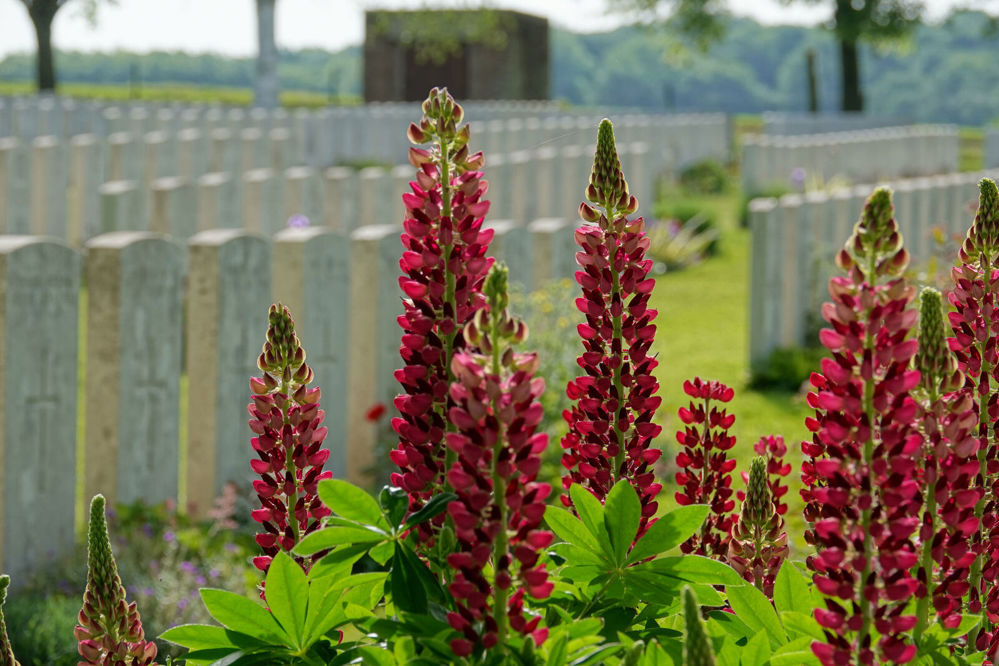
Image: Red blooms at Hooge Crater War Cemetery (Ilse De Groof)
All of the incredible work done by our gardeners, horticulturalists, and skilled craftspeople supports our key commemorative mission.
Names remain central
The work of our stonemasons and craftspeople keeps the names of all 1.7 million men and women we commemorate legible so they can be discovered, read, and remembered forevermore.
The Commonwealth personnel we commemorate remain central. Caring for our sites in a sustainable, responsible way keeps us connected with these now-lost generations, helping us reflect on and appreciate their sacrifices.
Landscapes that support reflection
By adapting our cemeteries and memorials for climate resilience and sustainability, we can also create landscapes that invite pause and reflection.
Designing such spaces was always our intention and interwoven into the look and feel of our earliest, country garden-inspired sites.
But the replacement and reshaping of lawns allow us to experiment with new forms that blend biodiversity, commemoration, and contemplation.
For example, visitors to Brookwood 1914-1918 Memorial will be able to wind through a forest canopy, with Portland stone benches to sit and appreciate the names etched into the memorial’s stone stelae.
As mentioned above, we have redesigned the landscape at Medjez-El-Bab to create gravel paths through the site, inviting visitors to move through the site, from plot to plot, taking in the war graves and names etched upon headstones.
During Rome War Cemetery’s renovation, we reshaped and replanted two existing groves alongside the cemetery’s bordering Aurelian Wall with sensory plants; we have created secret garden-like spaces where we see visitors stop for moments of quiet reflection and peace.
Care that continues into the future
Thanks to the tireless work of our teams and willingness to adapt to challenging conditions, our sites will remain beautiful places that delight and inspire.
Why Planting and Maintenance Practices Are Adapting FAQs
We are changing our planting practices to make our sites more resilient to the effects of changing climates and extreme weather worldwide.
No, this just means we have taken a different approach to the long-term care of certain sites around the world. While the aesthetics may change, all our sites will continue to be cared for in accordance with our high horticulture and maintenance standards.
At some select cemeteries around the world, we will be drastically reducing the level of irrigated turf to conserve water.
Water scarcity will become an ever increasing issue in the future. We are using drought-tolerant planting to lower our water consumption and increase the climate resiliance of our sites.
We use data from TreePlotter and organisations like Botanic Gardens Conservation International to forecast climate change, monitor existing tree species, and select appropriate plant species for the site.
Author acknowledgements
Alec Malloy is a CWGC Digital Content Executive. He has worked at the Commonwealth War Graves Commission since February 2022. During that time, he has written extensively about the World Wars, including major battles, casualty stories, and the Commission's work commemorating 1.7 million war dead worldwide.