

07 May 2026
Fallen Australian First World War aviator's grave rededicated in France
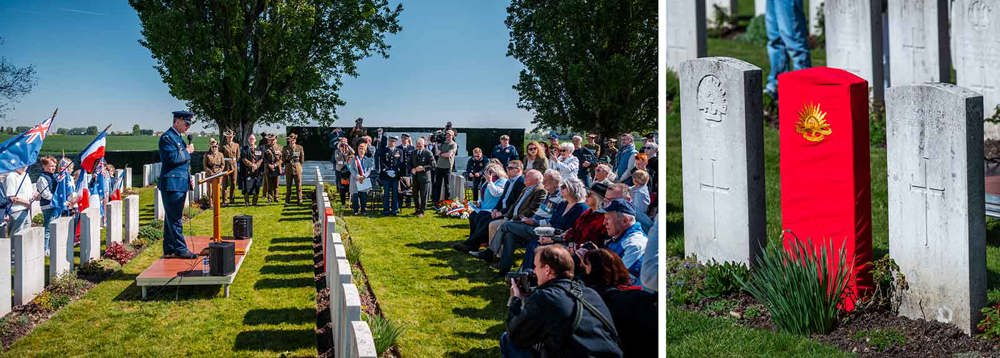
(Photos: CWGC)
The final resting place of Lt Charles Henry Martin, Australian Flying Corps, 4th Squadron, was rededicated in a ceremony at CWGC Rue-David Military Cemetery, Fleurbaix, France on 24 April 2026.
Charles Henry Martin was born in Melbourne, Victoria, Australia on 1 April 1894, the son of Charles Henry and Louisa Rose Martin.
He was educated in State School in Port Melbourne, Victoria where he lived and was a builder before enlisting as a Private in the 6th Infantry Battalion, AIF on 7 February 1916. On completion of training, he embarked for Europe aboard HMAT Themistocles on 28 July 1916.
At the beginning of 1918, he was a pilot serving on the Western Front as a Lieutenant in No.4 Squadron, Australian Flying Corps.
Charles died age 23 on 17 February 1918, flying Sopwith Camel F.1 B5207 in formation with three other aircraft when it suddenly plummeted downwards, its wings folding back as the aircraft disintegrated. No clouds of anti-aircraft were seen, and the event was so remarkable it was later mentioned in the Official history of Australia in the War of 1914-1918.
His body was recovered by German troops, and he was given an honourable battlefield burial near the wreckage of his aircraft about 400 yards south of the village of Prémesques.
His personal effects, including his identity discs, were recovered by the Germans and forwarded to his family in Port Melbourne, Victoria, via the Red Cross. However, by the time his remains were recovered by a war graves unit after the armistice, there was no grave marker or identifying items left on his body, other than the insignia and tunic that identified him as an officer of the Australian Imperial Force (AIF).
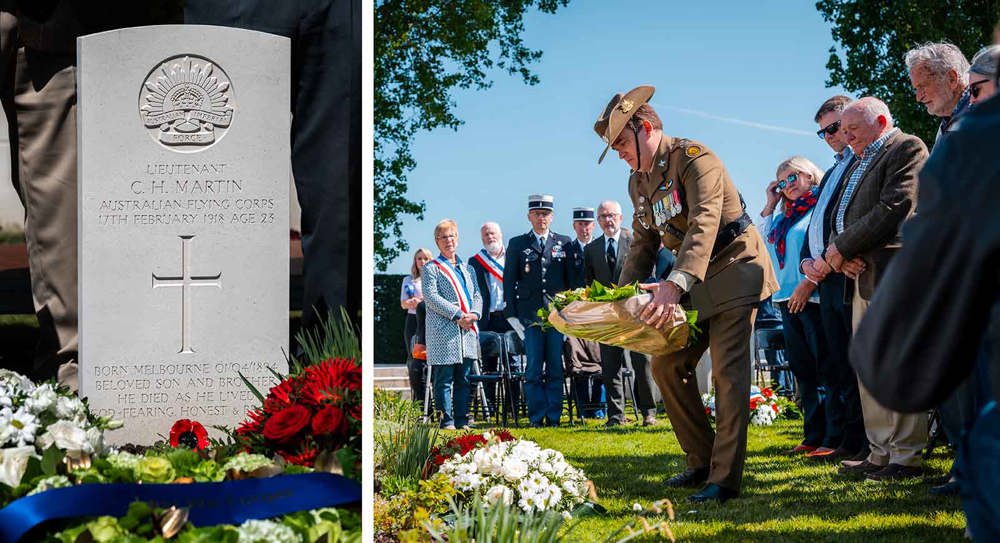
(Photos: CWGC)
Perhaps the saddest and most poignant item that remained was a letter, dated February 18, 1918, from German infantry officer Lieutenant Waldemar Karstens. In a translated version of the letter, he tells the family how Lieutenant Martin’s aircraft had fallen the day before.
“The body will be buried here and respectfully cared for, the same as if he were a soldier of ours,” Lieutenant Karstens wrote.
“We take great pain in the loss of your dear son.”
Post war, Charles was reinterred as an unknown Australian officer in an Imperial, later Commonwealth, War Grave at the Rue-David Military Cemetery in Fleubaix.
A century passed, and his case was reviewed by the CWGC following the identification of five candidates for the remains. Extensive research by the Australian Unrecovered War Casualties – Army (UWC-A) using detailed notes from German archival records identified Charles Henry Martin as the unknown officer.
Dr Aaron Pegram, Manager, Unrecovered War Casualties – Army said: “The formal identification of Lt Charles Martin, more than a century after his death, reflects Army’s ongoing responsibility to those who served and sacrificed their all for the nation. While Army can now formally account for Lt Martin, his identification provides long-awaited assurance and clarity for his family who have lived for generations without knowing where he lay”.
“There is no greater privilege than to be entrusted with the ability to reunite a missing Australian soldier with his identity again. To be able to share this privilege with the Commonwealth War Graves Commission demonstrates our shared commitment in ensuring we remember their service and honour them with the dignity of a named grave”.
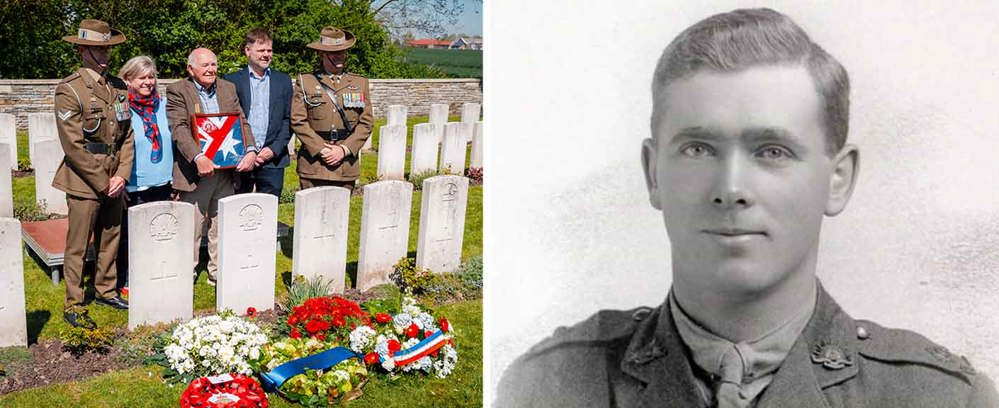
(Photos: CWGC, Lt Charles Henry Martin - Virtual War Memorial Australia)
Charles' final resting place is now marked with a newly inscribed CWGC headstone.
CWGC Commemorations Case Officer, Dr. Daniel Seaton, said: “It was a privilege for CWGC to have supported our partners at Australian Unrecovered War Casualties with the research into this case. We are grateful to the individual who originally submitted the case for Lieutenant Martin’s identification to the Commission, which followed some excellent archival research in Brussels. CWGC has now marked Lieutenant Martin’s grave with a headstone bearing his name and details, which we will care for in perpetuity”.