

11 June 2026
Missing World War One soldiers' graves rededicated in Belgium
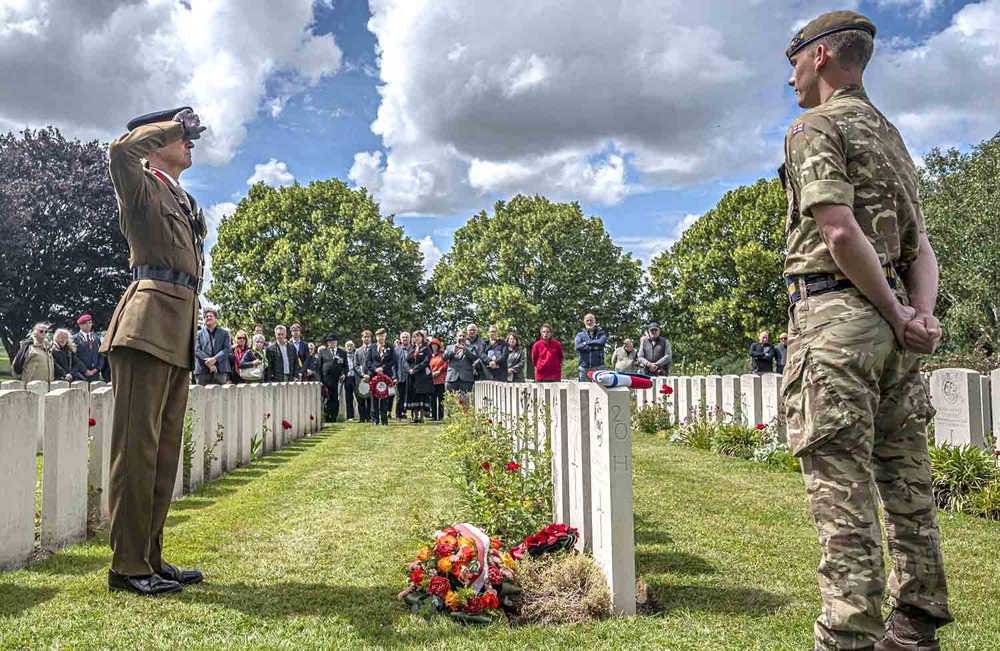
Photo: Eric Compernolle BEM
More than 100 years after their deaths, the graves of two soldiers of the Queens Royal West Surrey Regiment (QRWS) who made the ultimate sacrifice in World War 1 have finally been identified.
A joint rededication service, organised by the MOD’s Joint Casualty and Compassionate Centre (JCCC) was held at the Commonwealth War Graves Commission’s Hooge Crater Cemetery near Ypres, Belgium for both men on 9 June 2026.
Lance Corporal John Edgar Springate MM, from Lambeth, and Serjeant Ernest Albert Stevens, from West Wycombe, Bucks., both joined the Army sometime after the start of 1916. Though neither man’s record has survived to give specific details of their service, by the late summer of 1918 both were serving with 11 Bn QRWS Regiment in Belgium.
On the evening of 1 October 1918, the battalion launched an attack towards the Wervicq – Menin railway and, under very heavy machine gun fire, suffered significant casualties. Overnight, they suffered further losses whilst moving to an assembly point. During those two days the battalion lost 36 men, 15 of whom remained missing following the war.
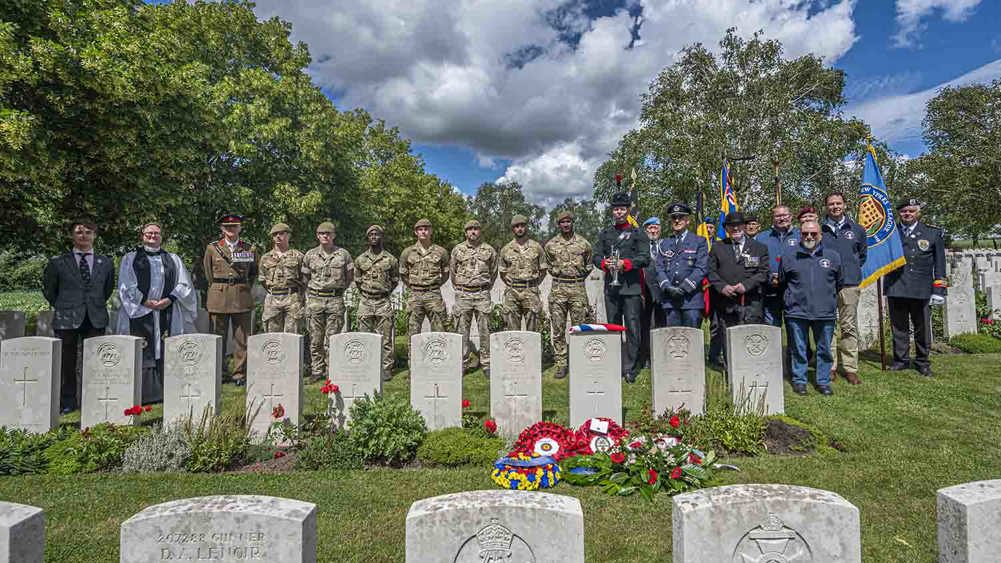
Photo: Eric Compernolle BEM
The names of the missing were listed on the Tyne Cot Memorial. John Edgar Springate and Ernest Albert Stevens were two of these men.
After the war, the remains of an unknown sergeant of the QRWS Regiment were recovered south-west of Gheluwe and north-east of Wervicq. In a separate recovery the remains of an unknown Lance Corporal of the QRWS Regiment were also recovered nearby.
Since both could only be partially identified by rank and regiment, they were buried in graves marked simply ‘Known to God’. Now, following extensive archival research we know that the unknown Serjeant was Ernest Albert Stevens, and the unknown Lance Corporal was John Edgar Springate.
JCCC Caseworker, Alexia Clark, said: “I am grateful to the researcher who originally submitted evidence suggesting the location of LCpl Springate and Sjt Stevens’ graves. In rededicating their graves today, we have reunited their mortal remains with their names, ensuring that their sacrifice will not be forgotten.”
The headstones over both graves were replaced by the CWGC and will care for them in perpetuity.
Sean Phillips, Commemorations Support Coordinator at the CWGC said: “It is with great reverence that, after more than a century, we can now mark the graves of Lance Corporal Springate and Serjeant Stevens with headstones that identify their names and bear the details of their service. The memory of these soldiers is now etched in stone, honouring their sacrifices at their final place of rest in Hooge Crater Cemetery."
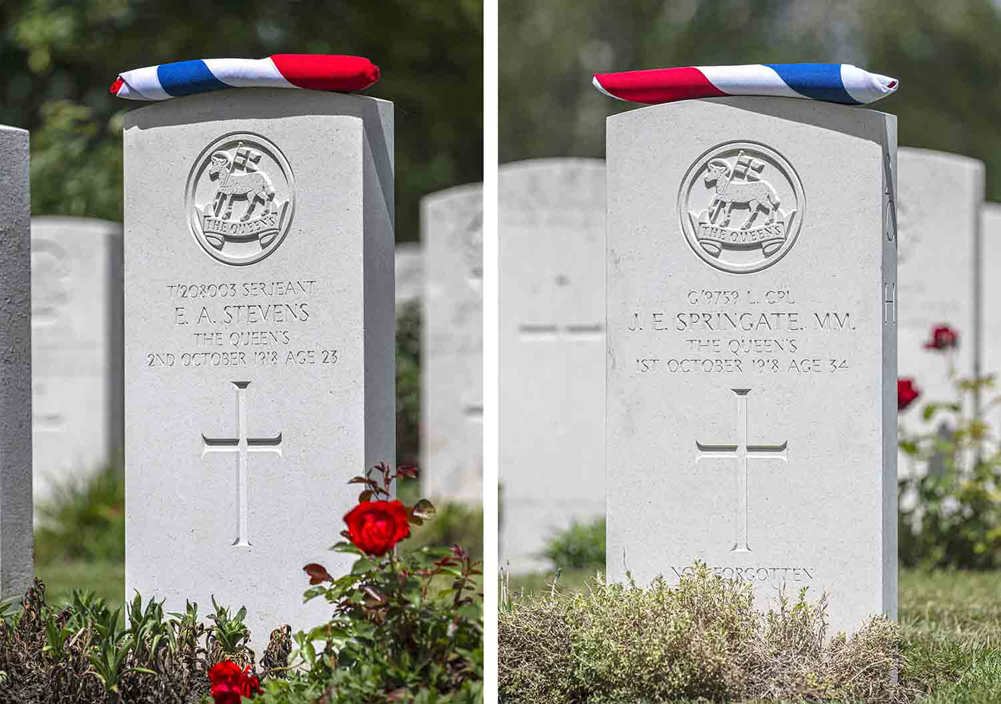
Photo: Eric Compernolle BEM
Lance Corporal John Edgar Springate MM, 2 May 1884 – 1 October 1918
John Edgar Springate was born in Lambeth in 1884 – the fifth of thirteen children born to William Springate and his wife Martha Ann Tiley. William was a general labourer during John’s early years, but later became foreman in a timber yard. Sadly six of John’s siblings died in infancy or early childhood. In 1901 at the age of 16, John was working as an iron monger’s assistant, and he carried this career on until his enlistment in the army.
John’s service record hasn’t survived to tell us about his army career, nor his war service, but his medals indicate that he first saw active service sometime after the beginning of 1916. He seems to have served his whole time as part of the Queen’s Royal West Surrey Regiment. On 28 September 1917 his name appeared in the London Gazette announcing that he had been awarded the Military Medal (MM) – this seems to have been for an expedition with 2Lt Darlington in which they laid tapes to mark the forming up spot for the battalion during an impending attack – they came under heavy fire whilst doing this.
Serjeant Ernest Albert Stevens, 1895 – 2 October 1918
Ernest was born in the summer of 1895 in Buckinghamshire – the oldest of eight children born to Frederick Stevens, a French Polisher (furniture trade) and his wife Emily Vere. By 1911 the family were living in West Wycombe and Ernest was working in the same industry as his father, though he was trained as an upholsterer rather than a polisher.
Ernest’s service record hasn’t survived to tell us about his army career, nor his war service, but his medals indicate that he first saw active service sometime after the beginning of 1916. He seems to have enlisted at Aylesbury, and served with the Oxfordshire and Buckinghamshire Light infantry before transferring over to the Queen’s Royal West Surrey Regiment.