

18 May 2026
RAF Squadron Leader Fidler identified after 86 years
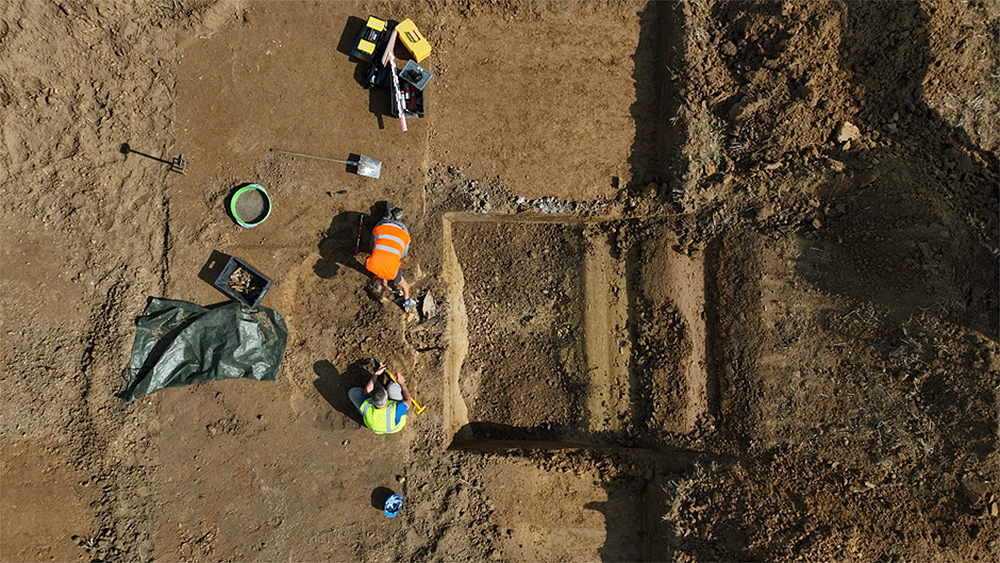
The CWGC Recovery Unit excavate the crash site of Sqn Ldr Fidler.
During preliminary work for a major canal construction in northern France, the remains of World War Two pilot, Squadron Leader George Marley Fidler, were discovered more than 80 years after his aircraft crashed. His journey, from recovery to burial in a Commonwealth War Graves Commission (CWGC) cemetery at Longueval in May 2026, highlights the dedicated efforts of all those involved to identify the fallen wherever possible.
How was World War Two pilot Fidler discovered?
The process of recovering the remains of Squadron Leader George Marley Fidler began four years ago. The CWGC Recovery Unit – a specialist team of forensic archaeologists in France that recovers and investigates remains of war casualties from the First and Second World Wars - was contacted by a local association, to confirm the presence of an aircraft crash site along the route of a new canal, near the town of Oisy-le Verger. An early belief was that the aircraft could be Hurricane P3535, which had been flown by Squadron Leader Fidler of 607 Squadron (Royal Air Force). It had crashed in the area in May 1940, in the weeks following the German invasion of France during the Second World War.
The area surrounding the aircraft was removed, revealing a remaining Hurricane structure, and was followed by the careful recording and documenting of finds and associated artefacts.
The Commission’s Commemorations Team then undertook initial research. This involved confirming the details of the recovery, assessing information determined from the artefacts, summarising anthropological assessments, and reviewing potential candidates recorded within the CWGC casualty database. A report was then shared with the UK Air Historical Branch (AHB) and the Joint Casualty and Compassionate Centre (JCCC) - also known as the “War Detectives” - who conducted further research into the possible identity of the casualty.
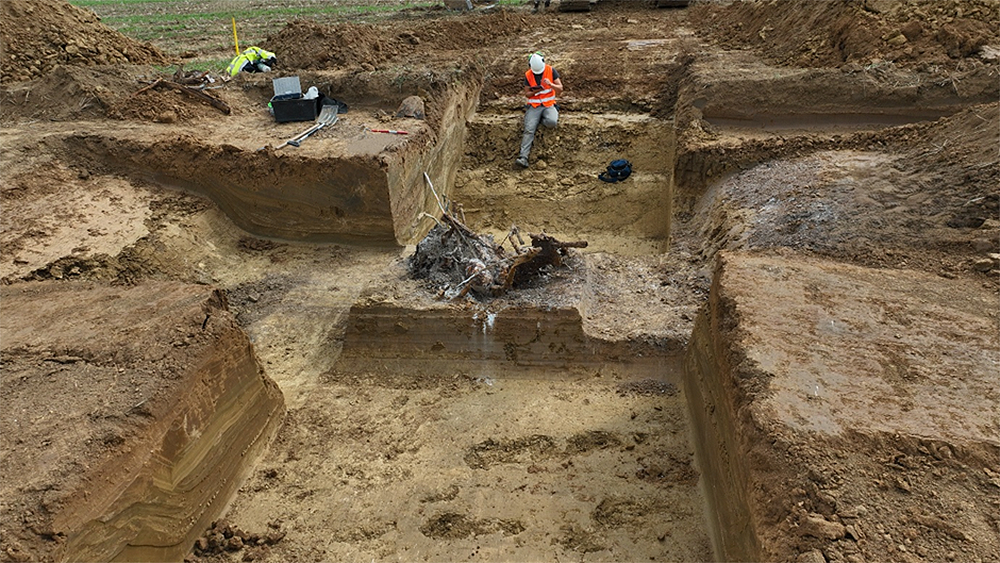
The excavated crash site of Sqn Ldr Fidler.
How was Squadron Leader Fidler identified?
From examination of historical records, combat reports and other investigation files, it was possible to determine that the remains recovered from the Hurricane had to belong to one of four pilots reported missing in that area – Squadron Leader Fidler among them. However, it was not possible to confirm the precise aircraft recovered, as none of the surviving components could be directly affiliated with Hurricane P3535.
JCCC continued investigating via potential DNA analysis. Testing of the descendants of the other three candidates confirmed that they were not a match, leaving only one conclusion: that the remains recovered at Oisy le Verger were those of Squadron Leader George Marley Fidler. As this casualty had no children and his siblings had no surviving descendants, identification became a ‘process of elimination’, in the words of Nicola Nash from JCCC.
What is the historical context of this commemoration?
The case of Squadron Leader Fidler is an unusual commemorative journey, and a good example of the complexities involved in post‑war identification.
After the end of the Second World War, it was believed that his body had been recovered and buried in Bachy Communal Cemetery. His family were informed, with his grave marked by a personal inscription chosen by his mother. For all concerned, this was accepted as his final resting place to be maintained by the Commission.
In 2005, however, the story of Squadron Leader Fidler took a different turn – when metal detectorists discovered wreckage belonging to his aircraft. Evidence now showed that he had, in fact, crashed at Oisy le Verger, approximately 35 kilometres from the previously thought crash location (and the site of his grave at Bachy). A researcher based in France contacted the Commission highlighting this discrepancy, to outline that the grave in Bachy could not belong to Squadron Leader Fidler.
Subsequent research carried out by CWGC, AHB and JCCC confirmed that the researcher’s proposal was correct. It was an unfortunate instance of an error being made in the identification process in the immediate aftermath of the war. With no clarity on what had happened to Squadron Leader Fidler, his commemoration was moved to the Runnymede Memorial (UK), whilst the grave at Bachy was reverted to that of an Unknown Airman of the Second World War.
How will Squadron Leader Fidler be commemorated?
Now that it has been confirmed that his remains have been recovered, CWGC have prepared a grave in a suitable cemetery and arranged a new headstone. Meanwhile JCCC have coordinated a burial ceremony to take place on 19 May 2026 which marks the 86th anniversary of his death.
A new headstone, engraved by CWGC stonemasons in our workshops at Beaurains, will be installed ahead of the burial. The marker will bear the personal inscription chosen by his mother, Christiana, as had originally adorned the grave at Bachy. Its sentiment reflects the depth of emotion felt by a mother at the loss of her son:
SO HE PASSED OVER,
AND ALL THE TRUMPETS
SOUNDED FOR HIM
ON THE OTHER SIDE
The chosen cemetery for his burial is the CWGC’s London Cemetery and Extension at Longueval in the Somme region of France. While some distance from the recovery site, this site is the nearest suitable cemetery with casualties from the same conflict. The Commission will always seek to identify burial locations as close as possible to the place of recovery, with graves of a similar context and from the same conflict. Squadron Leader Fidler will therefore be laid to rest alongside others killed during the Second World War, including fellow airmen.
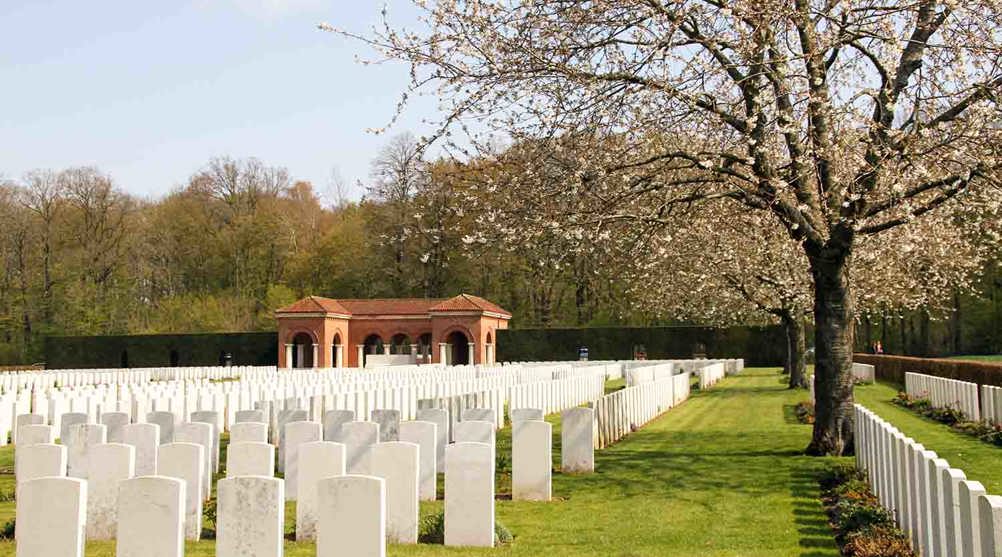
CWGC London Cemetery and Extension, Longueval, France.
A collaborative approach
The case of Squadron Leader Fidler highlights the ongoing work of the CWGC and the meticulous, multi-agency approach to recovering and identifying war casualties.
From investigations into a historic grave in 2006, via a recovery at Oisy-le-Verger in 2022, and now to a ceremony in 2026 – this timeline encapsulates a complex investigative process. It also showcases the longstanding research commitment of all involved, including members of the public, to ensure a thorough, professional and collaborative outcome. Time must always be taken to ensure correct identifications are made, so it is thanks to the combined efforts of individuals and organisations that a confident conclusion has been reached here.