

12 June 2026
Six First World War soldiers identified and laid to rest in Belgium
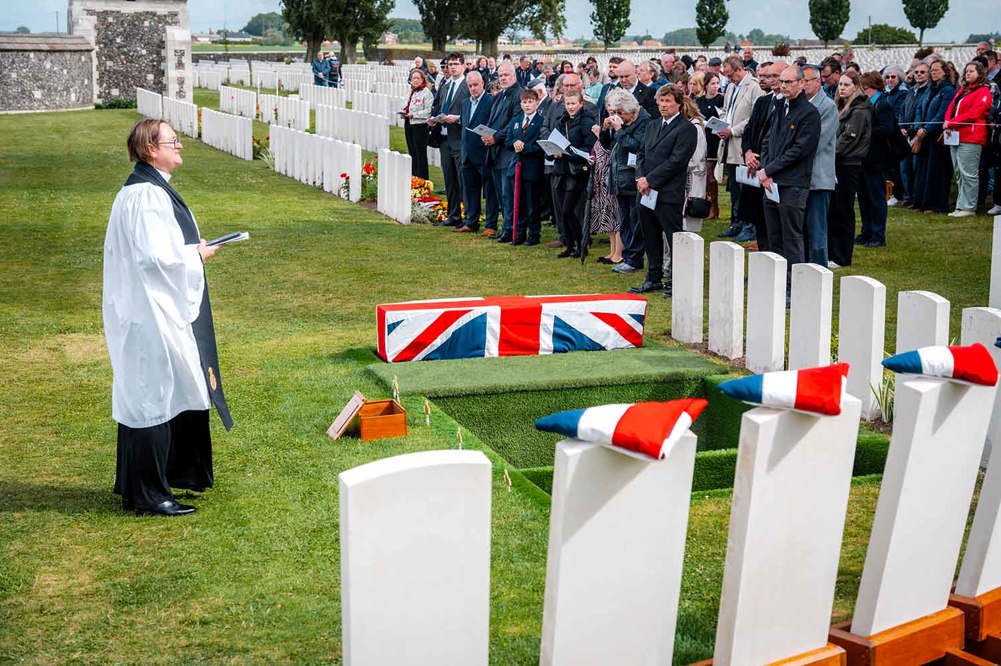
Photo: Thomas Capiaux
Six men from Essex, London, Bradford, Bristol and the Northampton who served and died together, have finally been buried more than 100 years after their death.
The Burial Service, organised by the MOD’s Joint Casualty and Compassionate Centre (JCCC), was held at the Commonwealth War Graves Commission’s Tyne Cot Cemetery, Belgium on 10 June 2026.
They were discovered where they fell during archaeological investigations near Gheluwe, Belgium in the summer of 2020.
The men still wore shoulder titles indicating their affiliation to the Queens Royal West Surrey (QRWS) Regiment, and one was carrying equipment that could be used to repair a Lewis Gun – a machine gun of the era which required several crew members.
From the way they were lying it was clear they had died together - likely in a shell strike. Research of the regimental war diaries showed the following entry in the diary of the 2/4 Bn dated 6th October 1918:
“In the early hours of the morning…the battalion came under heavy trench mortar fire. This resulted in a direct hit on a Lewis Gun team of 6 who were occupying a small trench, killing the whole team and blowing up the gun.”
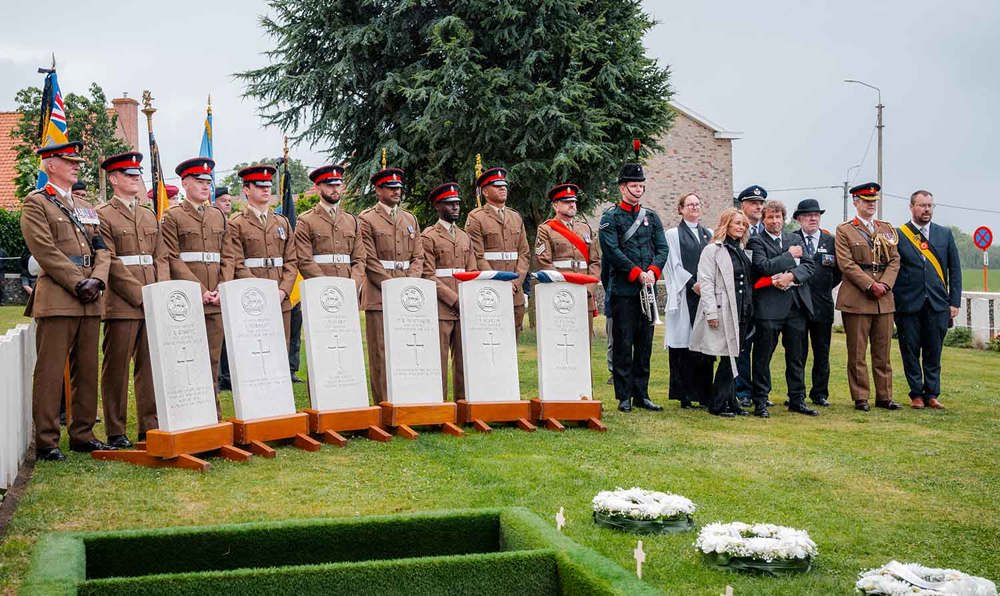
Photo: Thomas Capiaux
Following extensive research of the casualty lists for this period, the MOD’s Joint Casualty and Compassionate Centre (JCCC) created a shortlist of the men who might have been killed in the incident. Six names stood out – Privates Horace Cook, Frederick Martin, Thomas Whitaker, Courtney Hart, Joseph Turnley and Charles Russell.
Tracing and contacting descendants of each of these men allowed the collection of comparative DNA samples, each of which proved a positive match, and after more than 100 years, they were finally laid to rest with headstones bearing their names. All six were previously commemorated on the CWGC Tyne Cot Memorial.
Alexia Clark, MOD JCCC said: “It has been a privilege to research this case, to be successful in identifying these six men and to organise their burial service today. I am delighted that they have now been laid to rest alongside their comrades in a dignified burial which they had been denied for so long. I am extremely grateful to 1st Battalion the Princess of Wales’s Royal Regiment who have provided the bearer party for the funeral, and to the families of the men – both those who have invested in their stories from afar, and those who have travelled to be here today.”
The graves will now be cared for by CWGC in perpetuity.
Dr Daniel Seaton, Commemorations Case Officer at the CWGC, said: "When this case was passed to the Commission by our Belgian partners, I was hopeful that all six casualties might be identified given the specific context of their recovery in a shell hole with Lewis Gun parts and regimental insignia. The Battalion ledger confirmed that these six men were listed as missing on the same day, no other names being recorded alongside them, providing a compelling avenue for further research. Having now been identified, it was a privilege to support their families with their choices for the new headstones, which the Commission will care for in perpetuity."
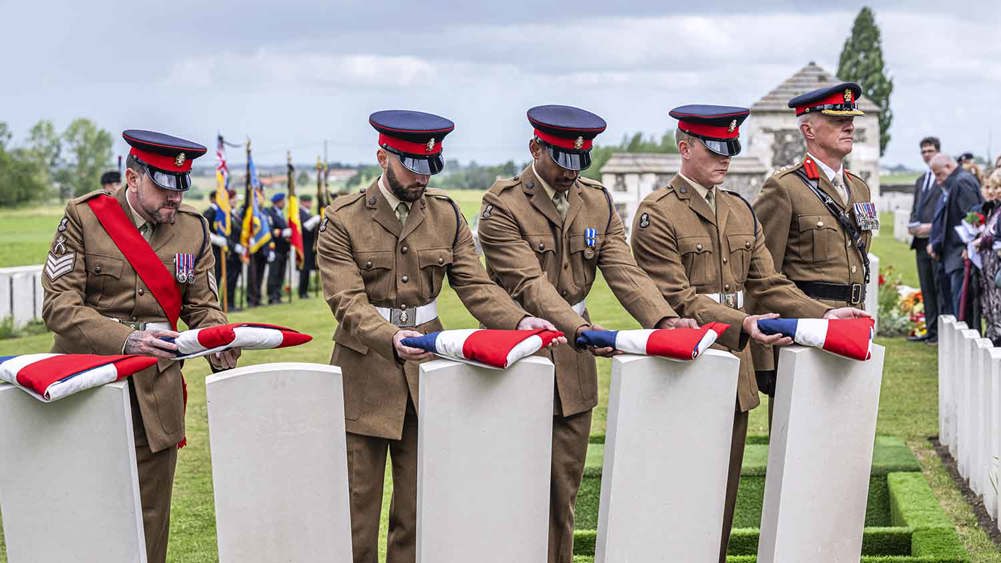
Photo: Eric Compernolle BEM
Private Horace Frederick Cook, 1899 – 8 October 1918
Horace was born in 1899 in Matching, Essex, to Frederick and Jane Cook. He had one older sister called Doris. Horace’s father was a horseman on a nearby farm, and both he, and Horace’s mother, came from long lines of agricultural workers.
Private Frederick Martin, 1895 – 8 October 1918
Frederick was born in Wandsworth, London, in 1895 – one of nine children born to Henry Martin and his two wives Barbara Lewis and Ada Wallage. Henry was a ‘Carman’, a general contractor and dustman and by 1911 Frederick was working as a fishmonger’s errand boy. Several of Frederick’s brothers also saw service in the war. Tragically his brother Albert died just three days after him on 11 October 1918, at Terhand - a few kilometres north of where Frederick died – Albert is named on the Tyne Cot Memorial just as his brother was.
Private Charles Richard Russell, 23 October 1898 – 8 October 1918
Charles was born in 1898 in Rotherhithe, London, the son of Catherine Russell. Sadly Charles’ father, Eugene Russell, had died 6 months before his son was born. Charles had five older brothers – William, Alfred, Frederick, Percy and Walter. All six brothers saw service in the war, and unfortunately William and Alfred also died – Alfred died in January 1917 and is buried at Laventie Military Cemetery in France, whilst William died in July 1917 and is named on the Nieuport Memorial in Belgium. Charles originally enlisted with the Hertfordshire Yeomanry under number 20553, before being transferred to the Queens Royal West Surreys prior to going overseas.
Private Thomas Redvers Whitaker, January 1900 – 8 October 1918
Thomas was born in 1900 in Bradford, West Yorkshire, the son of William and Edith Whitaker. He had one younger brother, Walter. Thomas and Walter’s father was a grocer’s assistant. On the 1901 census William was living with his maternal grandparents at 875 Bolton Road, Bradford – his parents were living at no. 132-134 Bolton Road. By the 1911 census Thomas and Walter were living with both their parents, plus Edith’s father and brother as well as one of William’s sisters. At some point between 1911 and his enlistment in the Army Thomas moved to Newmarket where he became a groom at the stables. He enlisted at Ipswich.
Private Courtney Darvill Hart, January 1900 – 8 October 1918
Courtney – known at home as Jim – was born in 1900 in Northampton, East Midlands, the son of William and Sarah Hart. He had four older sisters – Phyllis, Gladys, Katherine and Grace, and their father was employed in the leather trade. Courtney was educated at Eaglehurst College, and whilst there he had joined the OTC for the Royal Flying Corps. Unfortunately, Courtney did not pass the final medical examination for the RFC and so he transferred to the Queens Royal West Surrey Regiment instead. He was described as a first-class shot and Lewis Gunner, and prior to his army service he had been a Scout on the East Coast of England. He had been in France for around 2 months at the time of his death.
Private Joseph Turnley, 1899 – 8 October 1918
Joseph Turnley was born in Wales, the son of Joseph and Franchetta (Fanny) Turnley. He had one older brother, George. Joseph & George’s father was a commercial traveller selling starch and blue, as well as black lead, and by the time of the 1901 census the family were living in Bristol. Joseph enlisted in Bristol, having some early training with the Hertfordshire Yeomanry Dragoons, before being transferred to the 2/4 Queens Royal West Surrey Regiment.