

03 August 2026
Naval Memorials Guide: What They Are, What They List, and How to Explore a Name
How well do you know the Commonwealth War Graves Commission’s naval memorials?
These sites, most often found in the UK, commemorate by name each Commonwealth sailor who died in military service in the World Wars, but who has no known grave but the sea.
CWGC naval commemoration also covers the sailors who served in the merchant and shipping fleets in wartime.
As naval casualties were often lost at sea, or committed to the deep, they have no known war graves. CWGC naval memorials were built as the permanent point of commemoration for these individuals.
In this article, we’ll examine our major naval memorials, their purpose, who they commemorate, and how you can move from a name on a war memorial to a record or story.
CWGC Naval Memorials at a glance: What's on this page
This page covers CWGC's naval memorials including:
- What a Commonwealth War Graves Commission naval memorial is and their purpose
- The seamen and sailors commemorated by these sites
- How to read memorial name panels
- The major UK naval memorials at Plymouth, Portsmouth, Chatham, and Tower Hill
- Lesser known CWGC naval memorials
What is a CWGC Naval Memorial?
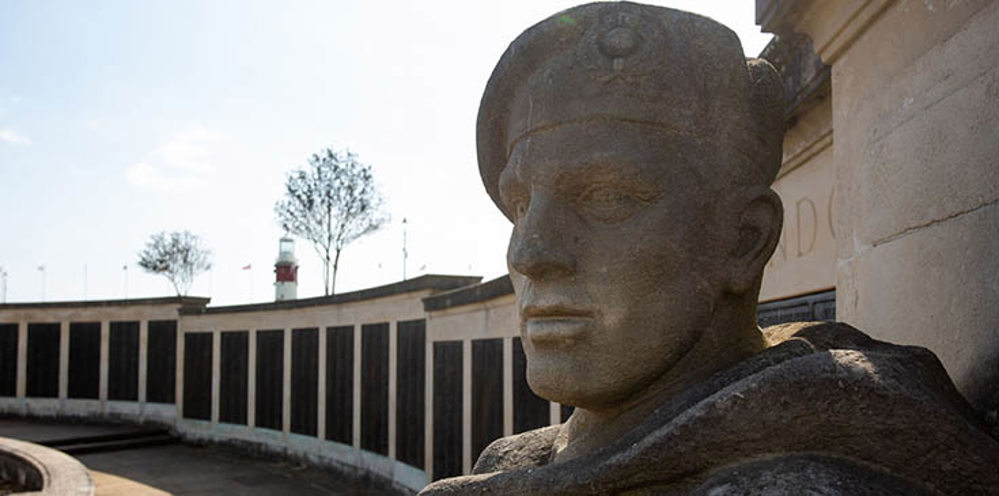
Image: A sailor's statue stands sentinel at Portsmouth Naval Memorial
Approaching the coastal cities of Portsmouth and Plymouth from the sea, or cruising up the Medway towards Chatham, you will inevitably notice great stone obelisks emerging along the coast.
These powerful landmarks, topped with immense stone globes, stand sentinel over the coasts and docks from which Commonwealth seafarers set sail in the World Wars.
These stone monoliths are the Portsmouth, Plymouth, and Chatham Naval Memorials: our chief sites for naval commemoration.
Elsewhere, in the heart of London, next to the iconic Tower of London and Tower Bridge, a bronze hall leading onto a quiet garden skirted by a memorial wall reveals itself: the Tower Hill Memorial, commemorating merchant seamen and fishermen who died serving the war effort in the World Wars.
Commemorated by name when there is no known grave
Naval memorials are not a substitute for commemoration. They are the official points of commemoration for Commonwealth naval personnel.
Together, the three major naval memorials commemorate over 66,500 Commonwealth men and women who served in the Royal Navy or Commonwealth naval forces with no known grave but the sea. Tower Hill adds a further 36,000 names.
The purpose of each memorial is to commemorate, by name, all these lost souls.
A place of commemoration
CWGC war cemeteries worldwide are full of bodies laid to rest in their own war grave. The nature of naval warfare, where seafarers could spend months away from land, often precluded dry-land burials or even recovery of remains.
But, since our 1917 founding, it has always been CWGC’s policy to commemorate all casualties equally, regardless of service branch, nationality, rank, or place of death.
A huge part of this is commemorating servicemen by name. Naval memorials fulfil the function of commemorating sailors and seafarers by name at a permanent point of commemoration.
In the aftermath of the First and Second World Wars, the naval memorials provided a place for families to visit and mourn their lost loved ones.
Today, they still fulfil the same function, becoming focal points for naval commemoration.
What do naval memorial panels list?
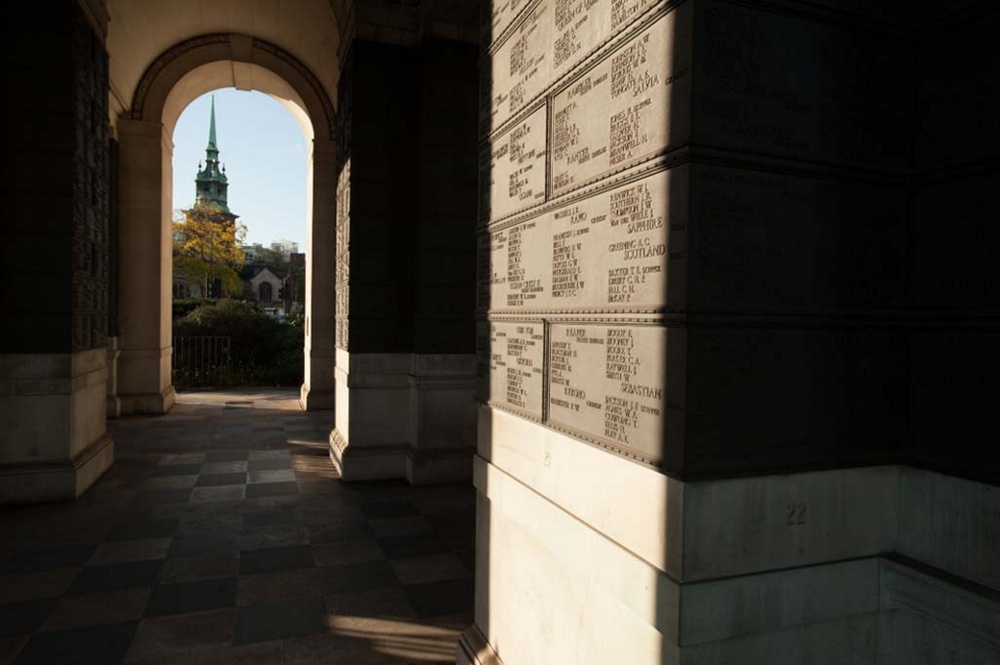
Image: Tens of thousands of names are etched in bronze for ever at the Tower Hill Memorial
While our memorials feature impressive architecture and highly detailed sculpture, arguably their most important features are the name panels.
Names and initials
Names and initials make up the bulk of the text you’ll find on a CWGC naval memorial name panel.
In the case of the major naval memorials, each name is recorded by:
- Surname
- Then initials
Ship, rank and service details
Our naval memorials are arranged by:
- Ship or vessel, alphabetically
- Seniority, alphabetically
Panel and memorial references
On an individual casualty page, or in the on-site memorial registers, you will find references to Panel and Column numbers.
These are to help you locate each sailor’s name on a given war memorial. The panel numbers are inscribed into each panel for ease of location.
For example, if you were searching for Petty Officer William Arthur Neville on the Portsmouth Naval Memorial, you would find his name inscribed at:
- Panel 46
- Column 2
As that suggests, William’s name can be found on the 2nd column of the memorial’s 46th panel.
Memorial plans are also available on each memorial page if you need further information and casualty location assistance.
Why some naval personnel have no known grave
Naval commemoration differs from that of other service branches as naval warfare is wildly different from air and land combat.
Died at sea
Whether convoying supplies across hostile oceans, patrolling beneath the waves in a submarine, or blowing broadsides in ship-to-ship battles, the life of a Commonwealth sailor was a perilous one.
Dangers lurked on, above, and below the seas, both natural and manmade. As well as the enemy, Commonwealth seafarers combated the elements themselves, not always coming out on top.
Over 100,000 Commonwealth naval personnel, including merchant and fishing fleet members, have no known grave but the sea.
Committed to the deep
As sailors could be lost hundreds of thousands of miles from the nearest port, either by accident or sunk in combat, recovering their remains was essentially impossible.
There may have been other reasons why sailors were committed to the deep in wartime.
Merchant and combat vessels often lacked the mortuary facilities to preserve bodies and prepare them for burial. It was not practical or hygienic to stow dead sailors aboard for extended periods.
At other times, it was simply too dangerous to stop or head for land, such as on convoy escort duties or avoiding enemy submarines.
Burial at sea is a longstanding naval tradition. Many sailors actually preferred to be committed to the deep, having spent their careers sailing the world’s oceans.
Commemorated by name
Despite having no known place of burial, the sailors of the Commonwealth’s navies and merchant fleets are all commemorated by name on CWGC naval memorials.
This is in keeping with our policy of equality in commemoration.
The Main CWGC Naval Memorials in Great Britain
There are three major CWGC naval memorials in the United Kingdom, each located in cities and towns with rich naval histories.
They are joined by the Tower Hill Memorial, dedicated to merchant seamen and fishing fleet personnel.
Portsmouth Naval Memorial
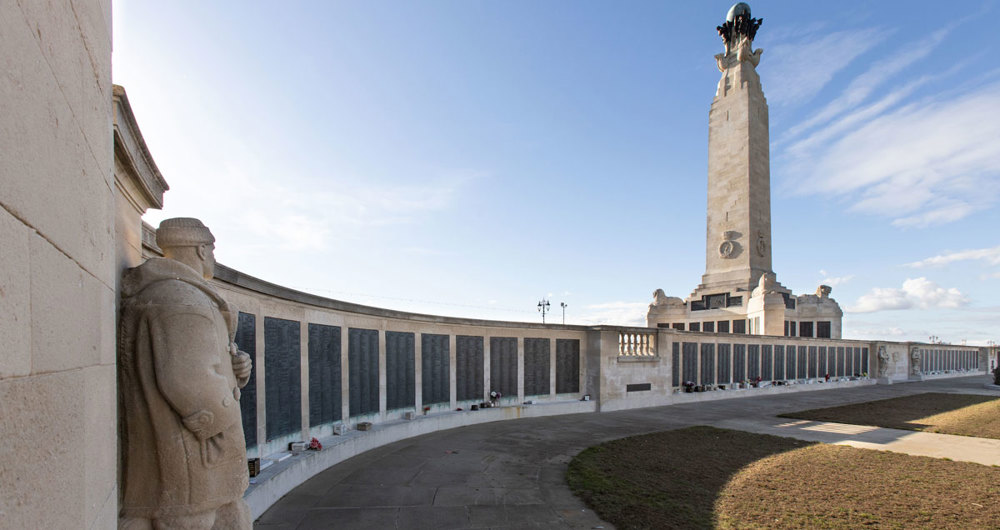
Image: Portsmouth Naval Memorial
Portsmouth Naval Memorial sits on Southsea Common, overlooking the sea approaches to one of Britain’s most substantial ports.
Over 25,000 sailors are commemorated by name on Portsmouth Naval Memorial: 10,000 from the First World War and 15,000 from the Second.
First World War sailors' names are found around the base of the central bronze globe-topped obelisk. Second World War casualties are commemorated on the memorial beneath. The names on both parts of the memorial are arranged by year of death, rank and then alphabetically by surname.
Portsmouth Naval Memorial casualties served in some of the most infamous naval actions of the World Wars. For example, some 3,400 casualties of the Battle of Jutland, the Great War’s largest inter-fleet naval clash, are commemorated here.
Other notable ship crews commemorated at Portsmouth include 785 men lost aboard HMS Royal Oak when she was torpedoed at Scarpa Flow weeks into the Second World War. More than 1,380 sailors of HMS Hood are commemorated here too.
Chatham Naval Memorial
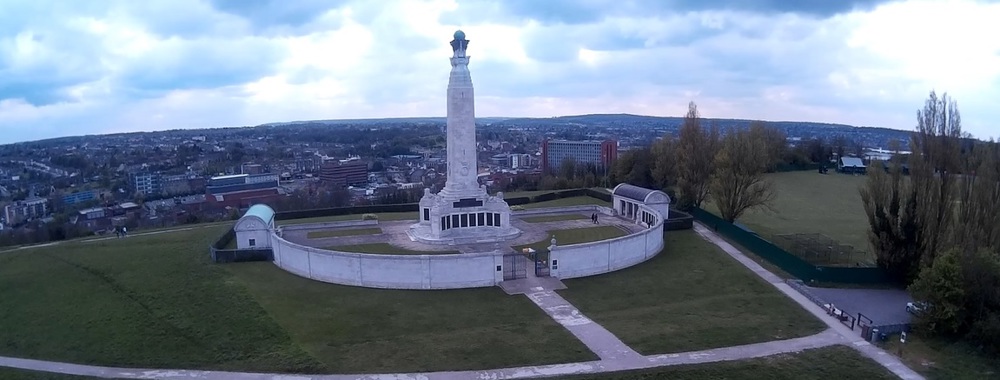
Image: Chatham Naval Memorial
The Chatham Naval Memorial stands sentinel over the naval town of Chatham from a spot high above the Town Hall Gardens, an easily recognisable landmark for sailors to spot as they sail into the Kent harbour.
Over 18,500 Commonwealth sailors of both World Wars are commemorated on its name panels. Many have a sad connection to one of the deadliest combat vessels of the World Wars: submarines.
HMS Pathfinder has the unique distinction of being the first ship in history to be sunk by a torpedo from a submarine. The action occurred off the coast of Scotland on 5 September 1914, scant weeks into the Great War.
September 1914 saw repeated German U-Boat attacks on British ships, ending with the losses of HMS Aboukir, Cressy, and Hogue and almost 2,000 souls. Those men are commemorated at Chatham.
Over a quarter of the Second World War personnel commemorated at Chatham lost their lives when their ships were attacked by U-boats. This includes eight Wrens of the Women’s Royal Navy Service (WRNS) whose transport ship was torpedoed on the way to Gibraltar in August 1941.
A further nine from the sinking of the SS Khedive Ismail are commemorated on Chatham’s name panels too.
Plymouth Naval Memorial
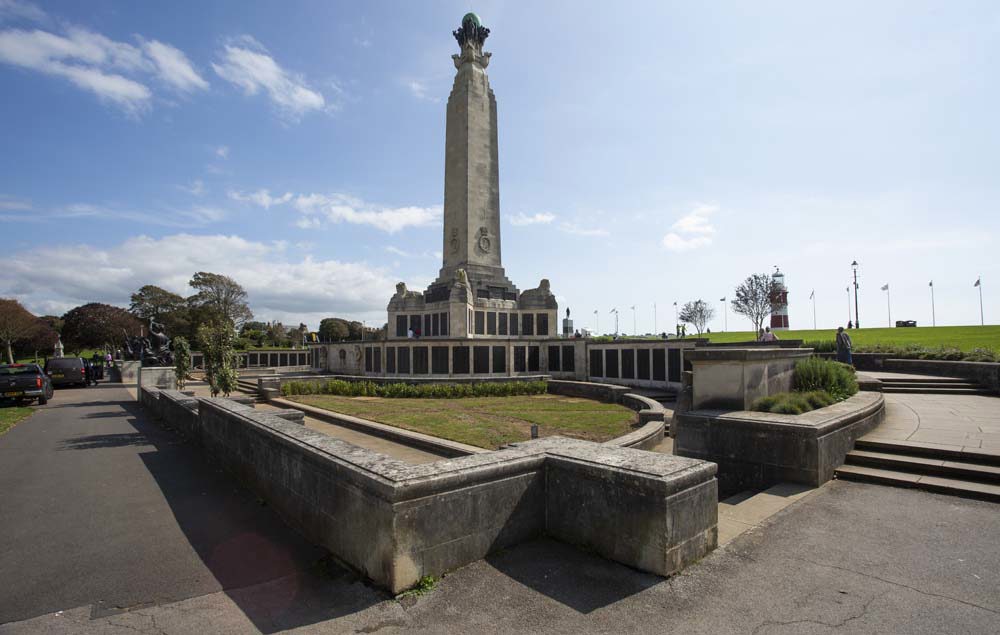
Image: Plymouth Naval Memorial
In the home city of one of England’s most famous sailors, Sir Walter Raleigh, Plymouth Naval Memorial sits on The Hoe, overlooking some of Britain’s most historic waterfront.
Adorning its memorial panels are the names of more than 23,000 Commonwealth sailors of the First and Second World Wars.
Jutland is represented heavily on the Plymouth Naval Memorial. Over a quarter of the total number of men commemorated at Plymouth were lost in these most storied of naval actions.
While no major fleet actions took place between the German Kriegsmarine and the Royal Navy in the Second World War, numerous encounters took place on the world’s oceans.
Norway was the scene of many such actions. It was in Norwegian waters that HMS Glorious was sunk by two German battlecruisers on 8 June 1944. 1,220 Royal Navy sailors were lost, commemorated eternally at Plymouth.
But it was not just German vessels that Commonwealth ships clashed with at sea. In December 1941, the naval war against Imperial Japan began, Commonwealth navies facing off with Japanese ships and aircraft on the Indian and Pacific Oceans.
It started badly for the Royal Navy. Just three days after Pearl Harbour was struck, HMS Repulse and HMS Prince of Wales were sunk off the Malaysian coast. Over 700 lives were lost, but their names are forever commemorated at Plymouth.
Tower Hill Memorial
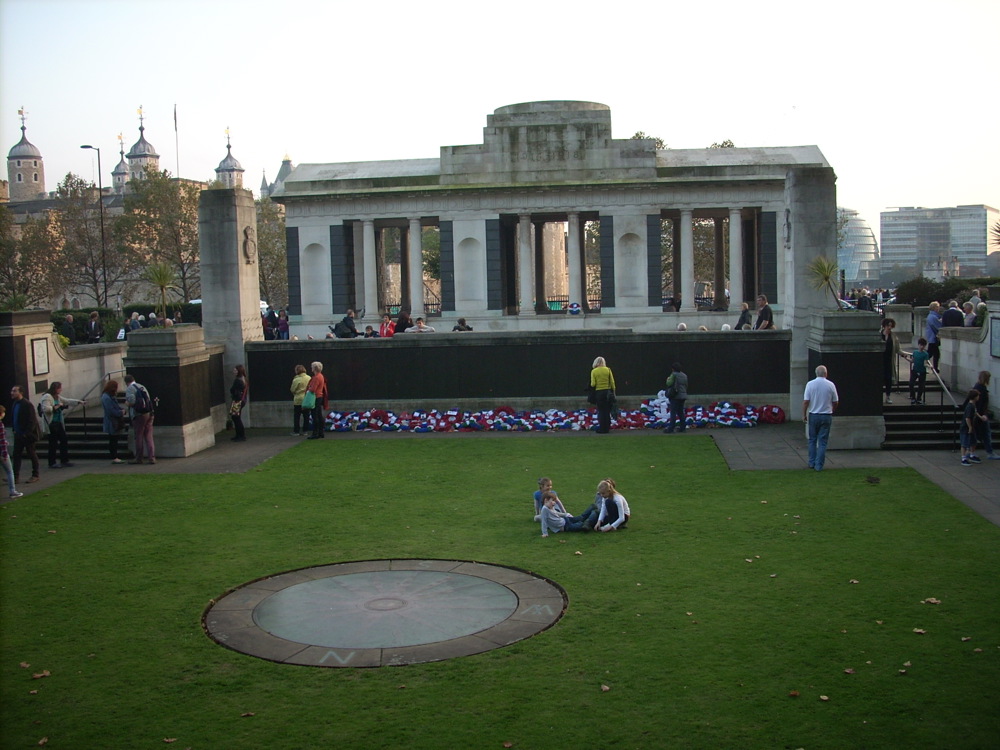
Image: The Tower Hill Memorial
At the time of the World Wars, London was at the heart of the world’s foremost trading empire.
As one of the world’s busiest port cities, London was a centre of global trade and maritime commerce. An appropriate place, then, for the construction of a war memorial dedicated to the lost souls of the Merchant Marine.
The Tower Hill Memorial lies within the beautiful gardens of Trinity House (the seafarer’s charity), close to the Thames, overlooking the Tower of London. HMS Belfast, possibly the most famous British Second World War battleship, lies at anchor close by.
The original First World War memorial takes the form of a bronze and stone hall, lined with memorial panels bearing the names of merchant sailors and fishermen who lost their lives supplying the war effort.
This leads into the Second World War section: a curtain wall bearing bronze name panels around a tranquil garden space.
Sculpture rich in sea and sailing iconography adorns the Tower Hill Memorial.
The contribution of both the merchant and fishing fleets in keeping Commonwealth and Allied forces fed, fuelled, and equipped cannot be overlooked. They faced the same dangers as their Navy comrades, hostile seas and enemy activity, but sometimes without the protections of armour and big guns.
The Tower Hill Memorial commemorates over 36,000 sailors and seafarers.

Want more stories like this delivered directly to your inbox? Sign up for our newsletter for regular updates on the work of Commonwealth War Graves, blogs, event news, and more.
Sign UpOther naval and maritime places of commemoration
While the big three and Tower Hill claim the naval memorial attention, there are other CWGC commemorative sites in the UK worth knowing about.
Lee-On-Solent Memorial
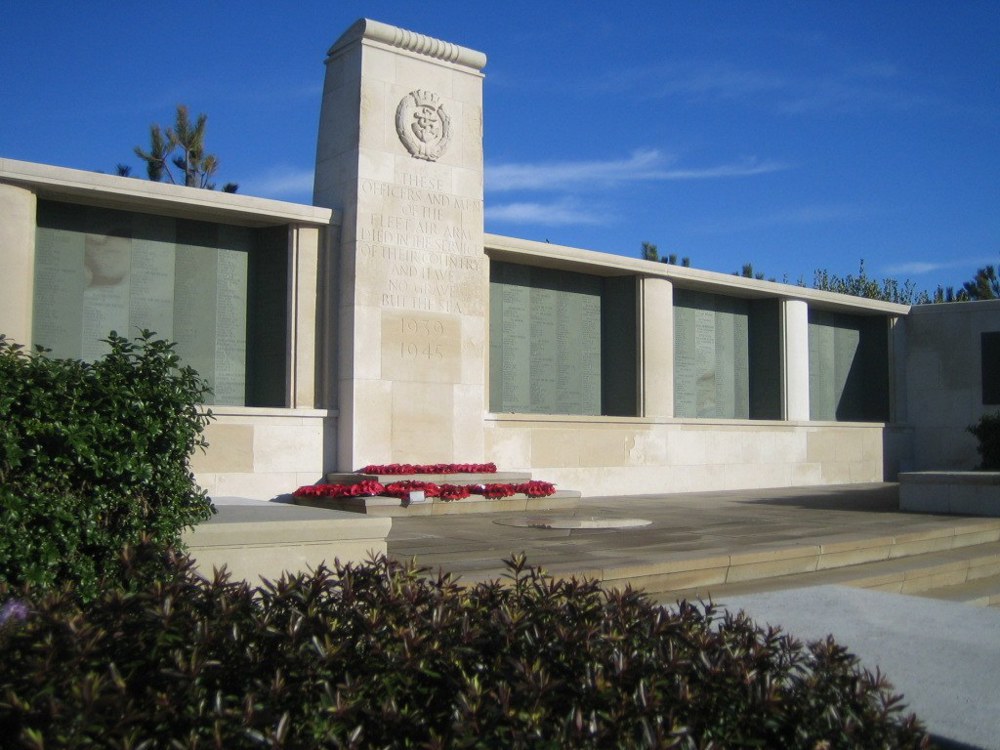
Image: The Lee-on-Solent Memorial
During the Second World War, the Fleet Air Arm served in almost every theatre. In a reconnaissance role, they supported land operations in France, the Netherlands, North Africa, Italy, and the Far East.
Operating from aircraft carriers (seven of which were lost during the war), they were one of the chief weapons against the U-boats in the Atlantic and in support of the Russian convoys.
After the Second World War, the principal base of the Fleet Air Arm, Lee-on-the-Solent, Hampshire, was chosen as the site for the memorial to almost 2,000 men of that service who died during the Second World War and who have no known grave.
Liverpool Naval Memorial
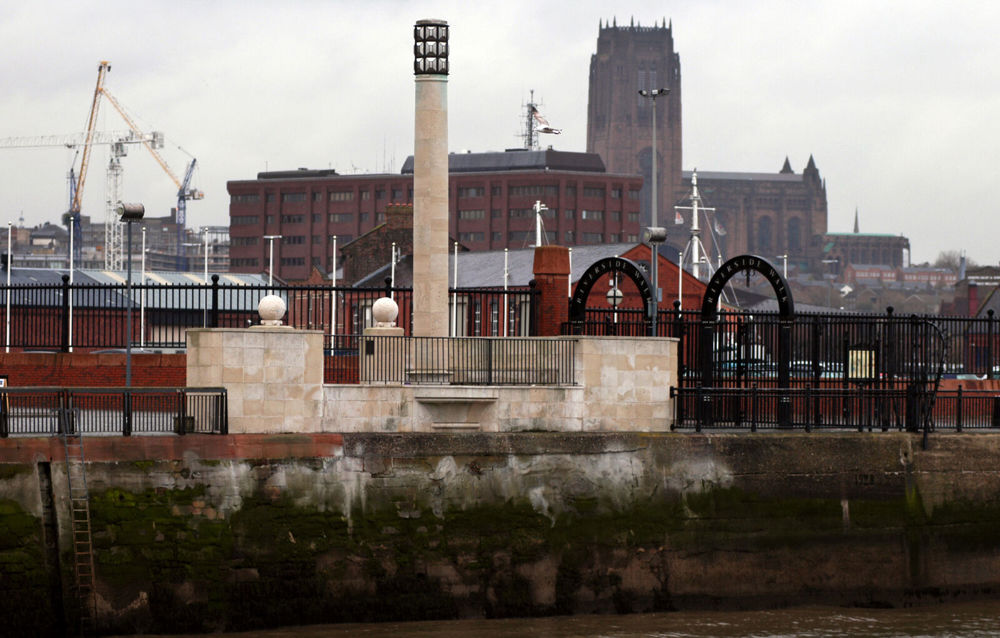
Image: The Liverpool Naval Memorial
At the outbreak of the Second World War, it was evident that the Royal Navy would not be able to man all the auxiliary vessels that would serve with it.
To deal with the shortfall in manpower, several officers and men of the Merchant Navy agreed to serve with the Royal Navy under the terms of a T.124 agreement, which made them subject to Naval discipline while generally retaining their Merchant Navy rates of pay and other conditions. The manning port established to administer these men was at Liverpool.
More than 13,000 seamen served under these conditions in various types of auxiliary vessels, at first mainly in armed merchant cruisers, but also in armed boarding vessels, cable ships, rescue tugs, and others on special service.
The Liverpool Naval Memorial commemorates 1,400 of these officers and men, who died on active service aboard more than 120 ships, and who have no grave but the sea.
Lowestoft Naval Memorial
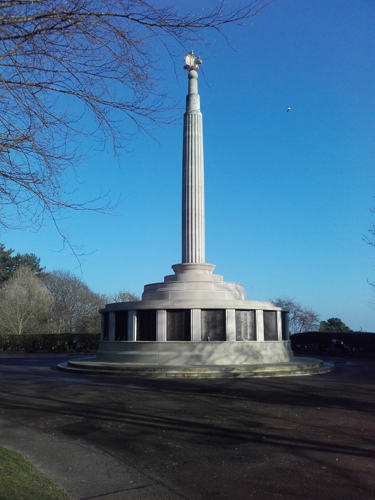 Image: Lowestoft Naval Memorial
Lowestoft was chosen as the site for the Memorial to those men of the Royal Naval Patrol Service who have no other grave than the sea.
This was because it was the Depot for the Royal Naval Patrol Service during the Second World War, developed from the pre-war Royal Naval Reserve Trawler Section Depot.
At the outset of the war, the men of this service were mainly the fishermen of the requisitioned trawlers and drifters used on patrol work, but later it included men from all walks of life and various types of small craft. In the spring of 1944, the Royal Naval Patrol Service reached its maximum strength of some 57,000.
Between 1942 and 1946, new construction ships and craft manned by the Service totalled 1,637, among them minesweepers of various kinds, corvettes, fuel carriers, motor launches and naval seaplane tenders. Their objective was to maintain wartime patrols and safeguard the coasts of Britain.
How to explore a name on a Naval Memorial
Here’s how you can find a name on a naval memorial.
You can use our Find War Dead tool as a starting point. Don’t forget to download our research guides on how to find casualties within our records!
Start with what you know
Start with the details that you have, be that the individual’s name, their vessel or ship, Navy or Merchant Marine, and so on.
The Find War Dead tool also includes a field for point of commemoration. If you know they are commemorated on a naval memorial, you can search for that site. On a memorial page, you will find a link that lists all of the individuals commemorated by name at that site.
Search CWGC records
Our database contains the names and place of commemoration for more than 100,000 Commonwealth navy and Merchant Navy casualties of the World Wars.
The Find War Dead tool allows you to browse for all of these.
A typical casualty search may include:
- Name – First, surname, and initials search fields are available. Records use a combination.
- Service number – Commonwealth servicemen were issued with a unique service number during their time in uniform, which can be useful in refining your casualty search. These will be available in the records of each Commonwealth navy, medal indexes, and other archives containing naval documents. Merchant Seaman numbers can be found similarly, while also including crew lists, registers, and discharge records.
- Served with (country) – Do you know which Commonwealth nation they served under during wartime? Merchant seamen are typically recorded as serving with the United Kingdom in our records
- Served in (army, etc.) – Which service branch did they serve in? As we are looking for a navy casualty, we would choose either Navy or Merchant Navy as our options.
- War – Did they lose their life in the First or Second World War?
Additional fields are available to refine your search, including:
- Country commemorated in
- Cemetery or memorial
- Unit – This is where you can search for individual ships and vessels, i.e., if you wanted to see all the men lost in the sinking of the HMS Prince of Wales, you would search “Prince of Wales” in the “Unit” additional search field
- Rank
- Date of death
- Age at death
- Honours & awards
Your search will return all casualties that meet your criteria. You can then click on an individual’s name to go through to their casualty page. Here you will find all the information we have on that casualty in our records, such as:
- Name
- Rank
- Ship or vessel
- Service number (if available)
- Row and plot number or memorial panel and column number - This can help you locate naval war graves within our cemeteries, or individual names on memorial name panels.
- Place of Commemoration – Not every naval casualty’s war grave is unknown. Many are buried in CWGC cemeteries, local burial grounds, and churchyards around the world.
Additional information (such as names of relatives) - Personal inscriptions – If the casualty has a war grave with a CWGC headstone, they may have a personal inscription, chosen by a relative to remember their lost loved one.
Use the memorial panel reference
Each CWGC naval memorial features memorial panels listing naval casualties by name.
Each panel has its own reference number. These are to help visitors locate names on each memorial, which, given there are tens of thousands of names on our major naval memorials, can be quite daunting.
Memorial panel references are available on each casualty page, in our apps, and in the memorial registers available on-site.
Check spelling and service details
Please be aware that many of our naval casualties are commemorated by initials, i.e., J.B. Smith.
Be sure to check spellings of first and last names when browsing CWGC naval records. You can search for exact phrases and spellings to refine your search; otherwise, the search fields listed above should point you to the correct casualty.
Planning a visit to a naval memorial
Want to visit a CWGC naval memorial? Here are some tips on how to find them, how to plan, and what to do when you’re there.
Check the site page first
Use the Find War Cemeteries and Memorials tool to find our naval memorials.
Be sure to check each memorial page before you visit. On here, you will find important information such as:
- A map
- Directions
- Opening hours
- Accessibility information
- Historical context
- Memorial plan
Each memorial page may also display messages and alerts, such as details on maintenance work, closures, and events. Check these ahead of time as there may be some disruption on-site.
Bring the memorial reference
If you are searching for an individual casualty on one of our naval memorials, don’t forget to note their memorial panel reference and column number. This will help you locate them on the memorial.
Memorial registers are available on-site with the panel locations of each casualty too. You can also find this information on each casualty’s page on our website.
Allow time to find the panel
The major memorials at Plymouth, Portsmouth, Chatham, and Tower Hill commemorate tens of thousands of Commonwealth naval personnel. They are major, impressive memorials to the missing.
Take time to find the memorial panel. Use the memorial register or our website to locate the particular panel you are looking for.
Taking time will also let you appreciate the site, notice the sculpture and small details decorating each memorial, and take in the sheer number of names lost to the seas in the World Wars.
Contemplation and commemoration are intertwined, so why not stay a while in the beautifully kept gardens surrounding each memorial to think on the people behind each memorial’s names.
Visit with care
Here are some tips for visiting our naval memorials with care and appreciation.
- Quiet reflection - These are spaces for quiet contemplation, so please be mindful of others when visiting.
- Respect memorials - We ask you to please not sit, stand or climb on headstones or memorials. Normally, our larger memorials will have seating.
- Tributes - Small tributes are acceptable, such as fresh flowers, poppy crosses, although we will remove these after a while. Please do not leave permanent items, such as glass vases, ceramic plates, or plastic tokens. Please do not attach anything directly to name panels.
- Litter - Please take any litter you have with you when you leave.
- Photography - Photography is encouraged, and we love seeing your photos of your sites. We ask you to please consider others when taking your photographs.
From a naval memorial name to a story
The names on our naval memorials are just the starting point. Each name represents a real person, with their own rich lives, families, likes and dislikes, hobbies and so on.
Search beyond the naval record with For Evermore
For Evermore: Stories of the Fallen is our digital storytelling platform and archive.
Here, we share family World War stories of those we commemorate, including hundreds of First and Second World War Commonwealth naval personnel.
We encourage you to browse and explore these inspirational, moving, and thrilling stories to get to know the real people behind their names.
CWGC Naval Memorials FAQs
A CWGC Naval Memorial commemorates Commonwealth sailors and seafarers of the World Wars who have no known grave but the sea. This includes Naval personnel, Merchant seamen and members of other commercial and fishing fleets.
Commonwealth Naval personnel are listed on CWGC naval memorials, including members of the merchant fleet, Fleet Air Arm pilots, fishermen, and auxiliary services personnel.
The nature of naval warfare meant many Commonwealth sailors were either lost at sea or committed to the deep, making recovery of their remains impossible. CWGC naval memorials are the points of commemoration where these people are commemorated by name.
CWGC naval memorial name panels contain the following information:
- Ship or vessel name
- Crew commemorated by name
- Ranks
- Panel and column referance numbers
The memorial panel reference and column number will help you locate names when on-site. These are available in our records on individual casualty page and Find War Dead search results pages.
Each memorial page has links to see and download the names of all the war dead commemorated there. Likewise, you can also search by place of commemoration in our Find War Dead tool to discover all the war dead commemorated at particular naval memorials.
Yes, our main naval war memorials at Plymouth, Portsmouth, and Chatham are free to visit all year round but may be closed for special events and./or maintenance work.
You can use our Find War Dead tool to search for Royal Navy, Commonwealth Naval Forces and Merchant Seamen. Each individual casualty page will tell you where they are commemorated.
CWGC naval memorials matter because they are the physical points of commemoration for tens of thousands of naval personnel who have no known war grave. They are reminders of the scale of loss endured by the Commonwealth in the world wars, and indicate that those conflicts were not just fought on land, highlighting the importance of the navy and merchant fleets in wartime.
Author acknowledgements
Alec Malloy is a CWGC Digital Content Executive. He has worked at the Commonwealth War Graves Commission since February 2022. During that time, he has written extensively about the World Wars, including major battles, casualty stories, and the Commission's work commemorating 1.7 million war dead worldwide.