

13 July 2026
Tolkien and the Somme: His wartime experience and how the First World War influenced Middle-earth
J.R.R. Tolkien is one of the most important literary figures of the 20th century, but did you know his story is tied to the Battle of the Somme?
The author is best known for his groundbreaking fantasy works, The Hobbit and The Lord of the Rings, which laid the foundations for the fantasy genre. He was also a renowned philologist and scholar, holding Professorships in Anglo-Saxon and English Language and Literature at Oxford University.
But before Tolkien’s success as an author, linguist, and educator, he served on the frontlines as a young officer with the Lancashire Fusiliers at one of the Great War’s most infamous campaigns: The Battle of the Somme.
Like millions of young British men in the early 20th Century, Tolkien’s experiences were tinged with tragedy. He lost close friends in military service, including on the First Day of the Somme. His wartime service can help us understand loss, commemoration, and Great War memory.
Still, debate continues over how much his wartime experiences influenced his later fantasy work.
Learn more about J.R.R. Tolkien’s military service and how the Battle of the Somme affected one of the greatest writers of the 20th century.
At Glance: What's on this Page
This blog looks at J.R.R. Tolkien's military service, including:
- Tolkien's early years as a scholar at King Edward's School and Oxford University
- Tolkien's enlistment in the Lancashire Fusiliers
- The role of a Signals Officer
- Tolkien's illness and evacuation
- The close friends of Tolkien who died in the Great War
- How The Battle of the Somme and the First World War influenced Tolkien's Middle-earth legendarium
- How Tolkien is an entry point for commemoration and understanding the loss of the Somme
- How to explore the Somme beyond Tolkien using CWGC records
- Tolkien and the Great War Freqently Asked Questions
Tolkien Before the Somme
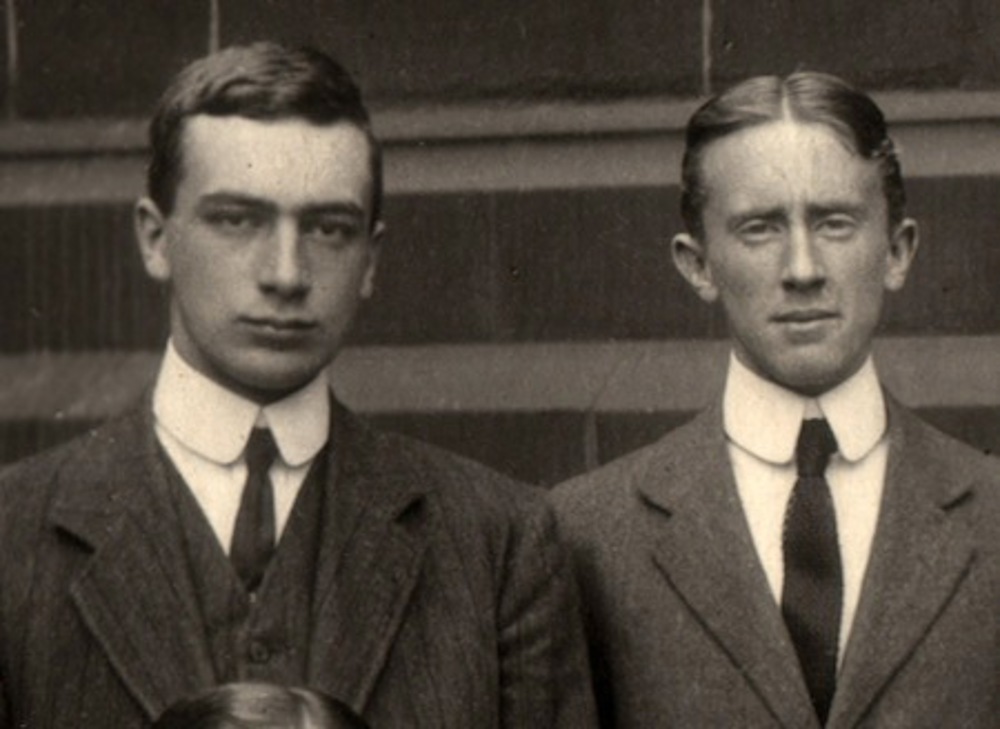
Image: A young J.R.R. Tolkien with his close friend Robert Quilter Gilson (King Edward's School)
Before the Somme, Tolkien was a young scholar, linguist and writer whose friendships and imagination were already deeply important to him.
A young scholar before the war
The young Tolkien studied at King Edward’s School, Birmingham. At King Edward’s, he formed the Tea Club and Barrovian Society (TCBS) with three close friends, a crucial step in his creative and literary development.
Joining Tolkien in the Tea Club were Robert Gilson and Geoffrey B. Smith, two close friends who would later serve in uniform.
Tolkien arrived at Exeter College, Oxford University, in 1911. His time there would be formative, where his passion for languages blossomed. At first studying Classics, Tolkien soon shifted towards English language and literature, which would shape his later legendarium.
Friendship, language, and early writing
At Oxford, Tolkien had a busy social life, forming and joining several literary circles, joined by many of his pre-university friends. Tolkien’s undergraduate circle consisted of Classics and English students who shared his enthusiasm for languages, literature, and debate.
Tolkien continued to experiment with poems and literature, alongside deep examinations of classical languages, particularly the Germanic tongues.
In 1915, Tolkien had some of his work published for the first time, the fairy poem Goblin Feet, in the Oxford Poetry anthology. Tolkien’s first Middle-Earth writing is thought to be the poem The Voyage of Éarendel the Evening Star, written in September 1914.
Joining the Lancashire Fusiliers
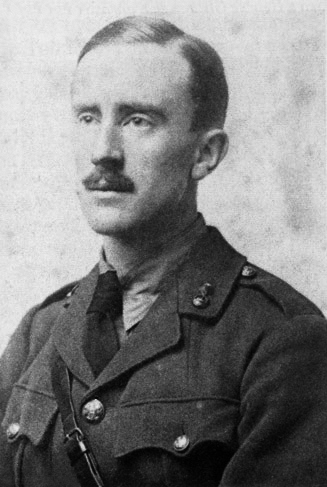 Image: Tolkien in 1916 as a young officer with the Lancashire Fusiliers
Unlike many of his peers, Tolkien did not immediately volunteer for military service straight away. According to Tolkien biographer John Garth, Tolkien lamented that “not a single man I know is up except Cullis”, referring to his close friend Colin Cullis, in his final year.
His other friends, including Gilson and Smith, had already enlisted by the end of 1914.
Instead, Tolkien completed his studies, earning a First Class Degree. He had, in the meantime, also enrolled in the Oxford Officer Training Corps in 1914. Finally, upon the completion of his studies and after pressure from friends and family members, he joined up.
Tolkien was commissioned as a Temporary Second Lieutenant with the Lancashire Fusiliers on 15 July 1915. Garth relates that Tolkien decided to apply for a commission with the Lancashires as this was his close friend G.B. Smith’s regiment.
Tolkien spent 11 months training at Rugley Camp in Cannock Chase, complaining in letters about the lack of “gentlemen” among the ranks.
He was selected as his battalion’s signals officer, essentially responsible for communications, involving what Professor John Bourne and Andy Johnson describe as “about miles and miles of underground, overground and airline cables, telephones, power buzzers, signal lamps, flags, human messengers (runners) and even pigeons.”
In June 1916, after receiving missives from his friends at the front, Tolkien received the news that his unit was heading for France, just in time for the Battle of the Somme.
Tolkien at the Battle of the Somme
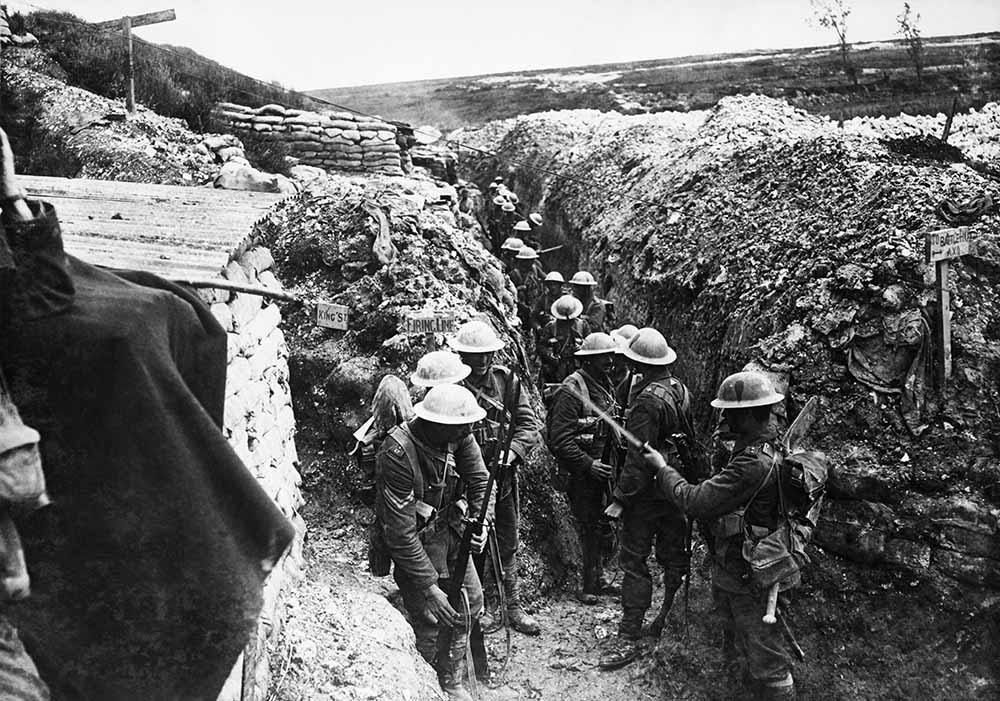
Image: Men of the Lancashire Fusiliers preparing to go over the top on the Somme (Wikimedia Commons)
The northern Somme
The Battle of the Somme began at 7:30 am on the morning of 1 July 1916. With close to 60,000 casualties, including over 18,500 killed, this remains the darkest day in British military history.
Tolkien’s battalion did not reach the frontlines of the Somme until July 3, 1916. They were sent to the Northern Somme sector, one of the most bitterly contested parts of the Somme battlefield.
The 11th Lancashires arrived at Bouzincourt on 3 July. Between 6 and 8 July, Tolkien was able to meet with his old friend Geoffrey Smith, with the two winding down the hours discussing their old passions of literature and creative writing.
That peace would not last. Between 14 and 16 July, Tolkien’s battalion was in action on the frontline at the Battle of Ovillers.
For two weeks since the start of the battle, the British had attacked Ovillers relentlessly, taking tens of thousands of casualties. Tolkien’s unit arrived towards the end of the Ovillers attack, when it was finally captured on 16 July.
Following the battle, Tolkien was appointed Battalion Signals Officer on 21 July.
A Signals Officer’s Role
Signals officers were responsible for establishing and protecting lines of communication between the rear and the front line during battles.
Tolkien’s duties, which frequently put him in harm’s way at the front, included:
- Field communications: Laying and repairing telephone wires across shell‑torn ground, often under bombardment.
- Runner coordination: Dispatching runners when lines were cut. Often exposed and under fire, runners were frequently killed.
- Visual signalling: Using signal lamps, flags, or carrier pigeons when telephones failed.
Signals Officers moved frequently between unit headquarters and the front line, leaving them exposed to shell fire, gas, machine-gun bullets, and snipers. Many were sadly killed in action.
Middle-Earth takes shape
It appears the Great War had a galvanising effect on Tolkien’s writing. In downtime, he found relief from the boredom, chaos and reality in his own writings, pouring out poems, sketches and stories “in grimy canteens, at lectures in cold fogs, in huts full of blasphemy and smut, or by candlelight in bell-tents, even some down in dugouts under shellfire.”
“A real taste for fairy-stories,” Tolkien once explained, “was wakened by philology on the threshold of manhood and quickened to full life by war.”
Over time, these scraps of poetry, watercolour sketches, snatches of verse, and pieces of prose would coalesce into one of the world’s most beloved and groundbreaking fantasy worlds.
But the Somme and his First World War experiences appear to have had a large effect on Tolkien. As we’ll discuss later, there are several key areas of Tolkien’s legendarium that scholars argue show clear references to the First World War.
Illness and evacuation
Tolkien remained on the Somme until October, moving from the north into the Central Somme sector.
He fought at some of the most significant actions of the later Battle of the Somme, including the attacks on Leipzig Salient, the Battle of Thiepval Ridge and the Capture of Regina Trench.
His battalion took heavy casualties, but bullets, gas, and shellfire weren’t the only hazards facing Commonwealth soldiers on the Somme.
Despite troops being frequently rotated in and out of the front, conditions in the trenches were still very tough. Troopers regularly fell ill from a variety of maladies, including trench fever, brought on by lice lurking in Tommies’ uniforms.
Tolkien contracted trench fever at some point in late October 1916. He reported himself sick on the 27th and left his battalion the following day. Tolkien was hospitalised in La Touquet, and by 7 November, he was on a hospital ship bound for England and a long recovery.
A now weak and emaciated Tolkien was declared unfit for general service. He spent the remainder of the war bouncing around various hospitals and garrisons.
During recovery, Tolkien started work on The Book of Lost Tales, starting with the mythic tale “The Fall of Gondolin”. These are some of the earliest writings in his Middle-earth Legendarium and would blossom into his life’s work and one of the most important pieces of 20th-century Western literature.
Tolkien was promoted to Temporary Lieutenant in January 1918 and was finally taken off active duty in July 1919.
While succumbing to sickness was something to avoid among soldiers, Tolkien’s bouts of fever may have saved his life.
The 11th Lancashire Fusiliers had been all but annihilated by the end of the Battle of the Somme in November 1916.
Tolkien had avoided his comrades’ fate while convalescing at home. Sadly, many of his comrades in arms, and several close friends, would not survive the Battle of the Somme.

Want more stories like this delivered directly to your inbox? Sign up for our newsletter for regular updates on the work of Commonwealth War Graves, blogs, event news, and more.
Sign UpFriendship, Loss and the People around Tolkien
Over 150,000 Commonwealth soldiers lost their lives during the Battle of the Somme. Some 72,000 have no known war grave, such was the intensity of the fighting.
The importance of friendship
Tolkien's closely formed school and university groups blossomed into close platonic relationships, often mirrored in the interactions between the hobbits in The Lord of the Rings. Close friendships appear very important to Tolkien, and it seems that the camaraderie among ordinary soldiers was highly influential on Tolkien’s later work.
Certainly, the close relationship between the Lord of the Rings’ hobbit heroes Frodo Baggins and Samwise Gamgee was drawn on comradeship and mateship, as Tolkien wrote in one of his letters:
“My Sam Gamgee is indeed a reflection of the English soldier, of the privates and batmen I knew in the 1914 war and recognised as so far superior to myself.”
Together, Sam and Frodo endured terrible hardships but forged a strong bond over the course of their quest, just as the horrors of the Western Front forged close relationships amongst the men in the trenches.
However, while the First World War had a transformative effect on the men who survived, there were millions who sadly never made it back, as Tolkien himself wrote:
“To be caught in youth by 1914 was no less hideous an experience than to be involved in 1939 and the following years. By 1918, all but one of my close friends were dead.”
The people Tolkien knew
Mentioned earlier, among the pre-war friends Tolkien lost were Robert Gilson and Geoffrey Smith.
Lieutenant Robert Quilter Gilson
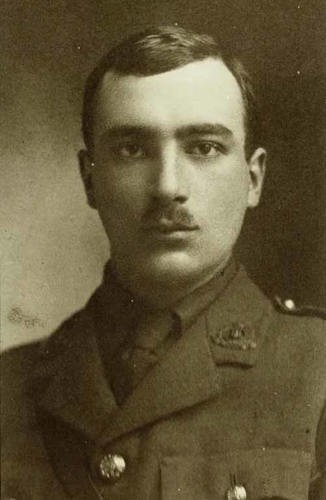 Image: Robert Gilson (King Edward's School)
Robert Gilson was among Tolkien’s close friends from his days at King Edward’s School, Birmingham, as was a member of the Tea Club and Barrovian society.
Rather than Oxford, the thoughtful, talented young artist attended Trinity College, Cambridge, still keeping in contact with Tolkien through letters and correspondence.
Like his Oxford-bound friend, Robert chose to complete his undergraduate degree instead of enlisting right away. At the same time, he trained through the Cambridge Officer Training Corp, gaining a commission as a Second Lieutenant in the 11th Battalion, Suffolk Regiment, also known as the Cambridgeshires.
Robert and his unit arrived in France in January 1916. He took the time to write to Tolkien, describing life on the front:
“Guns firing at night are beautiful – if they were not so terrible. They have the grandeur of thunderstorms. But how one clutches at the glimpses of peaceful scenes. It would be wonderful to be a hundred miles from the firing line once again.”
At 7:30 am, on the First Day of the Somme, Gilson led his men over the top at La Boisselle. When the Cambridgeshires advanced, German guns opened fire, scything through the advancing British.
A fellow soldier reported that Gilson walked calmly and steadily forward in front of his men, briefly taking charge after the senior commanding officers were cut down. Robert himself perished on 1 July 1916, after he was killed by a shell burst. His body was recovered and he was later buried at Becourt Military Cemetery.
Robert Gilson was the first of Tolkien’s close friends to die in the First World War. He would sadly not be the last.
Lieutenant Geoffrey Bache Smith
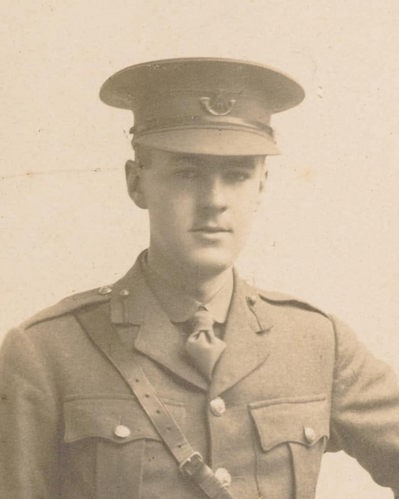 Image: G.B. Smith
An extremely talented academic all-rounder, Geoffrey Bache Smith was one of the four core members of the Tea Club and Barrovian Society, alongside Tolkien, Gilson, and Christopher Luke Wiseman.
Together, the “immortal four” shared a conviction that they would somehow change the world through art, literature, poetry and creative expression. The four remained close, even when separated by their going off to higher education.
Like Tolkien, Geoffrey attended Oxford University but decided to enlist ahead of his close friend. He joined the University Officer Training Corps in October 1914, applying for his commission two months later.
Geoffrey’s application was accepted, and he became a Second Lieutenant in the 8th Oxford and Buckinghamshire Light Infantry. In April 1915, he transferred to the 19th Lancashire Fusiliers, also known as the 3rd Salford Pals. Geoffrey was promoted to Lieutenant and was in France by November 1916.
Despite surviving the worst of the Battle of the Somme, Geoffrey would not survive the war. He was struck by enemy shrapnel fire near the village of Souastre, succumbing to his wounds on 3 December 1916, aged 22.
Geoffrey’s body was recovered and today he rests in a CWGC war grave in Warlincourt Halte British Cemetery.
Shortly before he was killed in action, Geoffrey wrote Tolkien an impassioned letter tinged with tragedy:
“My chief consolation is that if I am scuppered tonight – I am off on duty in a few minutes – there will still be left a member of the great T.C.B.S. to voice what I dreamed and what we all agreed upon. For the death of one of its members cannot, I am determined, dissolve the T.C.B.S. Death can make us loathsome and helpless as individuals, but it cannot put an end to the immortal four! May God bless you my dear John Ronald and may you say things I have tried to say long after I am not there to say them, if such be my lot.”
Following the war, Tolkien published a collection of G.B. Smith’s poetry titled “A Spring Harvest”.
Names that can still be traced
The extensive collection of correspondence and letters between Tolkien and his close friends highlights the real relationships behind the names.
These were intelligent, inspired, confident and creative young men, sadly cut down before they could achieve their lofty goals.
While their names could have been lost, we ensure the likes of Gilson and Smith are commemorated forever, with their names etched in stone on headstones and memorial name panels.
Tracing the names of the fallen is achievable through CWGC records. We list, by name, every one of the 1.7 million Commonwealth men and women who died in military service during the two World Wars.
Use our records to trace names and find their points of commemoration via our search tools.
From private grief to public commemoration
The loss of some of his closest friends deeply affected Tolkien, but it was an experience shared by millions of young men across the Commonwealth in wartime.
Like Tolkien, the average Tommy would have lost dear friends and comrades in the trenches and the chaos and carnage of a global war.
In particular, the loss of the Pal’s Battalions, units drawn from villages, towns, and even factories and organisations across the UK, has come to symbolise the futility of war, and the UK’s shared loss.
While Tolkien and millions of others grieved privately, they were linked by our shared loss, which still connects the Commonwealth to this day.
CWGC cemeteries and memorials, such as Thiepval, are powerful focal points for commemoration, reminding us of the loss endured by millions worldwide, including Tolkien and his dead friends.
Tolkien and the Great War: Allegory and Influence
Tolkien’s First World War no doubt greatly affected the author, but a lively literary debate remains around the extend the Middle-Earth Legendarium was influenced by the Somme and the Great War.
Not an allegory for the First World War
While there are some clear Great War inspirations in Tolkien’s work, he was clear to stress neither The Hobbit nor The Lord of the Rings were allegorical tellings of the conflict.
In the foreword to The Lord of the Rings, Tolkien wrote:
“I cordially dislike allegory in all its manifestations and always have done so since I grew old and wary enough to detect its presence. I much prefer history – true or feigned– with its varied applicability to the thought and experience of readers. I think that many confuse applicability with allegory, but the one resides in the freedom of the reader, and the other in the purposed domination of the author.”
Writing in Letter 226 to Professor L.W. Forester in December 1960, Toklien mused on the influence of the wars on his work:
"The Lord of the Rings was actually begun, as a separate thing, about 1937, and had reached the inn at Bree, before the shadow of the second war. Personally, I do not think that either war (and of course not the atomic bomb) had any influence upon either the plot or the manner of its unfolding. Perhaps in landscape. The Dead Marshes and the approaches to the Morannon owe something to Northern France after the Battle of the Somme."
The Somme and Great War influences in Middle-Earth
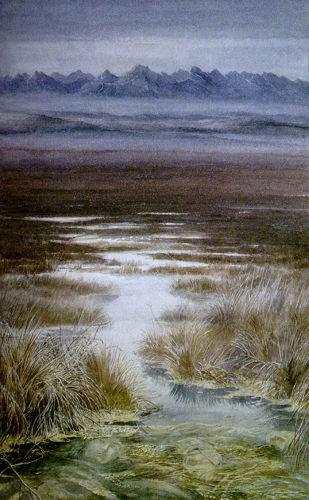 Image: The Dead Marshes by Alan Lee (Tolkien Gateway)
Despite the author's own words, many Tolkien scholars believe there is a clear First World War influence in the places, mood, and characters of The Lord of the Rings and Middle-earth.
Tolkien and the Somme seem inextricably linked, despite the author’s lack of allegorical intent, but the key part of the above quote is landscapes.
Perhaps the most obviously inspired by the Somme landscapes is The Dead Marshes: festering, bog fen pitted with deep pools where dead things have dwelt after a battle millenia passed. Frodo, Sam and their nefarious guide Gollum navigate the tricky landscape, but are nearly sucked under and swallowed up by the hostile land.
Elsewhere, the forboding Morannon mountain pass and the shadowy land of Mordor, home of the Dark Lord Sauron, are described as bleak, smoky, and poisonous, where the air is hot with fumes and heat.
Together, the two landscapes seem heavily inspired by the war-torn battlefields of the Somme, where Tommies sank beneath the mud, and the industrial effects of modern warfare churned the landscape into a nightmare.
But other Tolkien scholars have noted further Great War influences in Tolkien’s writing.
We have touched upon the relationship between Sam and Frodo, resembling the mutual beneficial relationship between ordinary soldiers and officers and the comradeship that entails, but there are further parallels to be drawn and further influences to be seen.
But we can clearly see a distaste for “industrialised evil”. Saruman, with his “mind of metal and wheels”, is at odds with the bucolic, agrarian life enjoyed by the Hobbits of the Shire, and there are hints at the war machines Tolkien may have witnessed on the Somme.
For example, Smaug, the massive, fire-breathing dragon from The Hobbit, recalls the trench-clearing flamethrowers employed on the Somme, according to Tom Shippey.
Metal machines conveying orcs also show up in the earliest drafts of the Fall of Gondolin, reinforcing this, while Rachel Kambury argues that the screeching Ringwraiths swooping, screaming from the heavens on their Fell Beasts may represent the scream of incoming shells.
Others see parallels between returning Tommies struggling to process their trauma and the Hobbits' return to the Shire at the end of The Lord of the Rings. Frodo and Sam, alongside comrades Merry and Pippin, are haunted by what they’ve been through, and can never feel the same kind of innocence enjoyed by their countrymen.
This is only a brief outline of the many Great War influences. For further reading, consider Tolkien and the Great War: The Threshold of Middle-earth by John Garth.
From a famous name to commemoration: Tolkien and beyond
Tolkien makes a great entry point for learning more about the Battle of the Somme, the Western Front, and the First World War in general.
Why Tolkien is only the starting point
Tolkien and the Great War are closely linked, but there is more to explore. His storied name makes a great entry point to the Somme yet also allows us to learn more about lesser-known servicemen whose experiences are no less valid than the pioneering fantasy author’s.
Robert Gilson and G.B. Smith are two names tied directly to Tolkien but offer other starting points to explore, read, and understand Somme and First World War stories and commemoration.
Finding names in CWGC Records
Commonwealth War Graves Commission records hold the names of 1.7 million Commonwealth service personnel commemorated by us around the world.
You can use them as a starting point to learn more about a person’s service history, the circumstances of their death, and their final resting place or place of commemoration.
Start with our Find War Dead tool. You can search by name, regiment, country of service, country of burial, date of death, and many more metrics to discover the people we commemorate.
Tolkien’s unit was present in the northern and central Somme sector. Here are some locations you may wish to check out if planning a Tolkien-themed battlefield trip:
- Thiepval, including the Thiepval Memorial
- Ovillers
- Beaumont-Hamel
- Serre
- Auchonvillers
- Bouzincourt
- Delville Wood
You can search by country and location using our Find War Cemeteries and Memorials tool, including the Somme department. Each cemetery and memorial page contains directions, visitor information, and history notes on each site, helping you plan your journey.
Reading Somme stories on For Evermore
Tolkien made it home from the Somme, but hundreds of thousands of Commonwealth soldiers sadly didn’t.
We are trying to capture, share, and preserve the stories of the Commonwealth’s Somme fallen on our online storytelling platform For Evermore: Stories of the Fallen.
Today, we have hundreds of Somme family stories shared on For Evermore, sharing moving, inspirational, and interesting tales of those we commemorate who fought and Fell on the Somme.
But we need your help to expand our stories collection!
Do you have a story from the Battle of the Somme you’d like to share, perhaps a close friend of Tolkien’s lost to the Great War's battlefields? Share it today on For Evermore.
Tolkien and the Battle of the Somme
To commemorate the 110th anniversary of the Battle of the Somme, this new resource covers JRR Tolkien's experience of the Somme and the effect on his subsequent writing. Specifically designed to be delivered in one lesson and adaptable to any age or stage, but probably most suited to ages 10-14, this offers an exploration of a little known part of Tolkien's life to students who will best know him through his books. Discover a range of History and English activities and lots of extension possibilities.
Tolkien and the Somme Frequently Asked Questions
Yes, Tolkien was present at the Battle of the Somme from Early July to October, serving as Signals Officer for the 11th Battalion, Lancashire Fusiliers. Tolkien's first battle was the Battle of Ovillers between 14 and 16 July 1916. After that, he served across the northern and central Somme front, inlcuding at Thiepval, before contracting an illness and returning to England to recover.
Tolkien served with the 11th Lancashire Fusiliers during the Battle of the Somme. It is speculated he requested to join this regiment as his close friend G.B. Smith was also serving as an officer with the Lancashires. The two met briefly on the Somme before being separated once more by the chaos of war.
While Tolkien was not wounded, he contracted an illness known as "Trench Fever" and was invalided back to Britain to recuperate. While in recovery, he began work in earnest on the earliest Middle-earth writings. He spent the rest of the war mostly on garrison duty in the UK, as his health was too fragile for active service.
In a letter dated December 1960, Tolkien wrote:
"The Lord of the Rings was actually begun, as a separate thing, about 1937, and had reached the inn at Bree, before the shadow of the second war. Personally I do not think that either war (and of course not the atomic bomb) had any influence upon either the plot or the manner of its unfolding. Perhaps in landscape. The Dead Marshes and the approaches to the Morannon owe something to Northern France after the Battle of the Somme."
However, many Tolkien scholars have noted deeper parallels and influences from the Somme and his military service on Tolkien's work. The relationship between Sam and Frodo was inspired by the relationships between officers and enlisted men, particularly their Batmen servants, with the two mutually relying on each other across boundaries of class.
Others have seen a clear influence in some of the landscapes of Middle-earth as Tolkien himself asserts in the above quote. The fetid Dead Marshes, for instance, closely resemble shell-marked, muddy, crater-filled Somme battlegrounds where soldiers could slip into filthy water-filled craters never to come out.
Yes, the places where Tolkien served and potentially inspired the geography of Middle-earth can be visited year round. Some of the locations Tolkien served include:
Here are some locations you may wish to check out if planning a Tolkien-themed battlefield trip:
- Thiepval, including the Thiepval Memorial
- Ovillers
- Beaumont-Hamel
- Serre
- Auchonvillers
- Bouzincourt
- Delville Wood
You can use the CWGC Find War Cemeteries and Memorials tool to search through all our sites on the Somme.
Yes, you can find Lieutenant Robert Quilter Gilson and Lieutenant Geoffrey Bache Smith using our Find War Dead tool. You can search directly by name but also refine your search by date of death, place of burial, country of service, and so on. Each casualty in our database can be found in this way.
Tolkien experienced the loss of two of his closest friends during the First World War. He is a famous name, and makes a great entry point it understanding the scale of the Battle of the Somme, the enormous sense of loss, and where and how his fallen friends are commemorated by the Commonwealth War Graves Commission.
Author acknowledgements
Alec Malloy is a CWGC Digital Content Executive. He has worked at the Commonwealth War Graves Commission since February 2022. During that time, he has written extensively about the World Wars, including major battles, casualty stories, and the Commission's work commemorating 1.7 million war dead worldwide.