

12 October 2026
Four Lancaster crewmembers identified and rededicated in the Netherlands
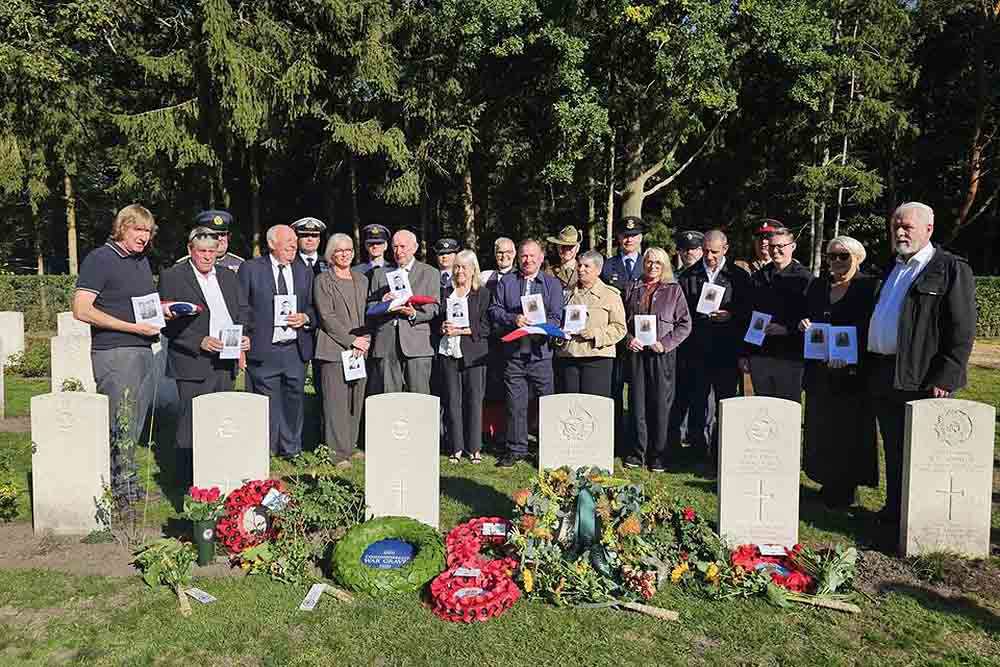
(Photo: Crown Copyright)
Four airmen who died when their Lancaster bomber crashed in Germany in December 1944 were finally honoured by name after an 82-year search uncovered the truth behind one of Bomber Command’s wartime mysteries.
A Rededication Service was held for Flying Officer (Fg Off) Leslie Markland Hough, Royal Australian Air Force (RAAF); Pilot Officer (Plt Off) John Henry Tales, Royal Air Force Volunteer Reserve (RAFVR); Sergeant (Sgt) Henry Charles Burnside RAFVR and Sgt John Lawson RAFVR at the CWGC Venray War Cemetery in the Netherlands on 7 October 2026. The four airmen had lain in graves marked ‘unknown’ for decades following a series of post-war administrative errors.
On the morning of 8 December 1944, the Lancaster PD374 of No. 218 Squadron RAF departed RAF Methwold in Norfolk as part of a force of more than 130 tasked with attacking the Neerbeck oil plant at Homberg in Germany’s Ruhr region. From the seven man Lancaster crew; three escaped by parachute and were taken as Prisoners of War and the other four lost their lives.
JCCC Caseworker, Tracey Bowers, said: "Today we honour the British and Australian airmen who served and died together during World War 2. To have so many families present here today has made this occasion especially poignant, and seeing them interacting with members of the local community who have adopted these graves incredibly moving."
Plt Off Tales, born in Attercliffe, Sheffield, on 31 December 1917 was one of eleven children. He worked as a poster writer before enlisting in the RAF in September 1939 where he built an exemplary service record. Despite having already completed a full operational tour, he volunteered to return to frontline operations and joined No. 218 Squadron in August 1944.
John Tales, nephew of Plt Off Tales, who attended the service with other family members said: "It has been an extremely poignant occasion and we are honoured and quite overwhelmed to have been here. It has been wonderful to learn more about our Uncle John and we would like to thank all those who have made this possible."
The Captain of Lancaster PD374 was Australian airman Fg Off Hough RAAF. Eyewitness accounts suggest Hough remained at the controls of the burning aircraft to give others the opportunity to escape.
The two other crew honoured were Sgts Burnside and Lawson. Burnside was known for his professionalism and immaculate appearance, while Lawson, affectionately known as “Geordie”, came from a mining family in County Durham.
Thurston Lawson, nephew of Sgt Lawson who attended the service with his cousin John Lawson said: "Fantastic day and incredibly memorable. So moving to see so many people here and everyone has been so kind and represented their organisations brilliantly."
The rededication service was conducted by Reverend (Group Captain) Ruth Hake, who said: "It is my immense privilege to conduct the ceremony for Fg Off Hough, Plt Off Tales, Sgt Burnside and Sgt Lawson today. They gave their lives in defence of our nation, and in dedicating their graves today with their names rightfully in place, we are able finally, to honour that debt that we all owe to them and their loved ones."
Today’s service, held more than eight decades after these men lost their lives, means the crew of Lancaster PD374 will finally be commemorated under their own names, marked with newly-inscribed CWGC headstones.
Dr Daniel Seaton, Commemorations Case Officer at the CWGC, said: "I am delighted that, after so many years, the final resting place of these brave airmen has finally been identified. Their family members, of whom so many were here today, can now visit their known graves in perpetuity. The Commission is pleased to have assisted with this process and will continue to maintain their graves with the utmost care and respect."
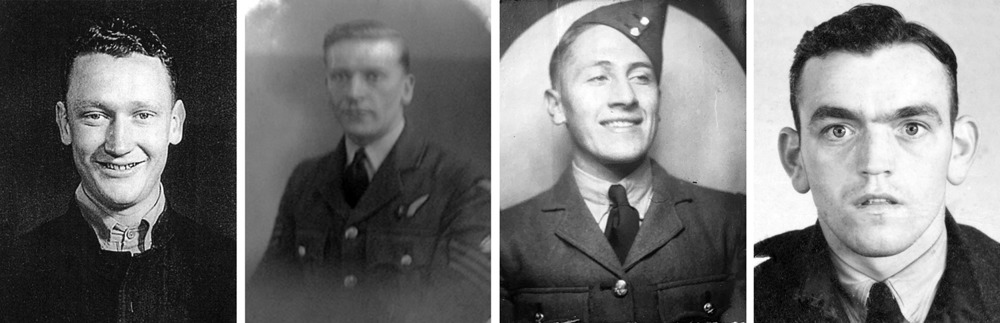
Photos (left to right): Flying Officer Leslie Markland Hough, Pilot Officer John Henry Tales, Sergeant Henry Charles Burnside, Sergeant John Lawson (Copyright: all unknown).
Flying Officer Leslie Hough
Leslie was born on 26 November 1917 at Waverley, New South Wales. Raised largely in North Adelaide (South Australia), he completed his Intermediate School Certificate and worked as a clerk and booking manager prior to military service. A Methodist by faith, he initially enrolled in the Royal Australian Air Force Reserve on 25 September 1941 before enlisting for pilot training in the Royal Australian Air Force on 25 April 1942.
Hough undertook his initial military training at No. 4 Initial Training School, Victor Harbour, South Australia. He then completed pilot training at No. 1 Elementary Flying Training School, Parafield, followed by No. 6 Service Flying Training School, Mallala. He was awarded his Flying Badge on 5 March 1943 and commissioned as a Pilot Officer on 10 March 1943. His promotions subsequently included Flying Officer on 11 September 1943.
Pilot Officer John Tales
Sheffield-born Tales enlisted into the RAF in September 1939 and spent time at RAF Cardington. His service records show he was 5ft 6ins with fair hair and grey eyes. His religion is recorded as Church of England. Tales’ conduct throughout his 5-year service was “very good”. He was promoted to Sergeant in Dec 1942 and Flight Sergeant a year later when he was also authorised to wear flight engineer insignia - known as brevets or wings on their uniforms, this embroidered half-wing badge was sewn on the left breast above medal ribbons and can be clearly seen in his photograph.
Tales married his wife Megan Stringer on 27 Jul 1940 at St Serf’s Church, Glasgow. On their marriage certificate Megan’s occupation is described as a Comptometer Operator, they were 22 years old. He had been stationed at 209 Sqn in Scotland; it is possible this is where they met. Sadly, Megan died exactly one year later on 27 Jul 1941 at home in Glasgow with her father present, of Pulmonary Tuberculosis. At the age of only 23 Tales was a widower.
Tales moved to 149 Sqn in Suffolk as an instructor and here he volunteered to join the crew as a Flight Engineer. Tales was experienced and competent but was discouraged as he had already completed a full tour of operation, but he explained his whole life had been tied up with the RAF and they were now his family. He was posted to 218 Sqn on 22 August 1944.
Sergeant Henry Burnside
Henry Burnside was born on 14 July 1922 in Brentford to Robert Burnside and Winifred Hobbs. His father was born in Durham but moved to London when he was 16 years old. He had two sisters Winifred and Mabel. Prior to his enlistment into the RAF on 9 May 1942, aged 20, he was a shop assistant.
He attended AGS (Air Gunner School) in October 1943 where he would have been trained in defensive combat, target tracking and operating powered gun turrets. In Mar 1944 he was posted to No 26 Operational Training Wing in Buckinghamshire where he would have undergone intensive night bombing and cross-country training. From here Burnside transitioned to a 6-week Heavy Conversion Unit at RAF Wratting Common in Suffolk to learn to fly four-engine heavy bombers such as the Stirling. Burnside was posted to 218 Sqn in August 1944 and allocated to “C” flight.
Sergeant John Lawson
John Lawson was born on 15 February 1923 in Houghton, Durham to Robert Lawson and Isabella Bryce, he had four brothers. His father was a Coal Miner Trolleyman and John followed his father into this industry. John’s father died young and his mother Isabella remarried in 1941.
Lawson enlisted into the RAF in July 1943. Lawson was posted to No 26 Operational Training Wing in Buckinghamshire where he would have undergone intensive night bombing and cross-country training. From here he transitioned to a Heavy Conversion Unit to learn to fly four- engine heavy bombers such as the Lancaster.
He was posted to 218 Sqn in summer 1944. His role was as an Air Gunner. The Stirling aircraft were by this time virtually obsolete following heavy losses and had been principally used to drop supplies to the French resistance. Lawson along with the rest of the crew started flying the Lancaster at Feltwell in mid-July 1944.