

20 May 2026
Yorkshire pilot buried in France on 86th anniversary of his death
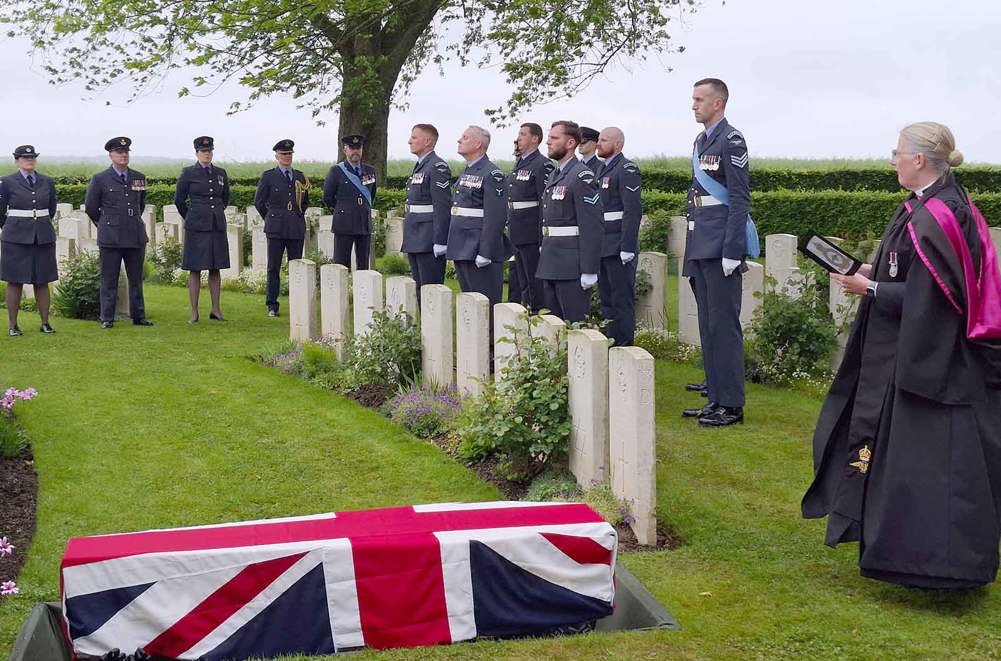
A Burial Service with full military honours has been held at CWGC London Cemetery and Extension, Longueval, France for Second World War Hurricane pilot, Squadron Leader George Marley Fidler from Great Ayton, North Yorkshire.
The service took place on 19 May 2026 and was organised by the MOD’s Joint Casualty and Compassionate Centre (JCCC).
Sqn Ldr Fidler joined the Royal Air Force (RAF) in 1934 and spent several years in Egypt, with brief spells in Cyprus and India. He was described as an ‘exceptional’ pilot by his superiors and in February 1940, he joined 607 Squadron. On the afternoon of 19 May 1940, as Hurricanes from 607 Squadron were patrolling the skies above Cambrai, Sqn Ldr Fidler’s plane was shot down.
Initially, Sqn Ldr Fidler’s remains were believed to have been recovered and buried in the French village of Bachy. However, in 2005 metal detectorists discovered wreckage 35km away in Oisy-le-Verger one piece of which had a serial number ‘P3535’, suggesting it came from his Hurricane.
This prompted the Ministry of Defence (MOD) to investigate the grave in Bachy to determine if it was really that of Sqn Ldr Fidler. It was soon discovered that authorities at the time had failed to consider the loss of two RAF Sergeants who died on the same day meaning they could not be certain it was Sqn Ldr Fidler who had been buried there. So, the headstone in Bachy was changed: the name was removed and replaced with ‘unknown Airman’. Sqn Ldr Fidler’s name was then added to the Runnymede Memorial to the missing.
However, his story did not end there. In 2022, work on the Seine-Nord Canal at Oisy-le-Verger in northern France, unearthed a Hurricane with the pilot still inside near to where Sqn Leader Fidler’s aircraft was last seen. The CWGC Recovery Unit – a specialist team of forensic archaeologists in France recovered his remains and DNA testing then proved this pilot was Sqn Leader Fidler. You can read more on his recovery using this link: RAF Squadron Leader Fidler identified after 86 years.
Nicola Nash, MOD(JCCC) said: “Sqn Ldr Fidler has been buried today 86 years after he was killed. His story has been known to us since his grave was ‘unnamed’ many years ago. It has been wonderful to finally find him and be able to put him to rest. Today we honour him and the sacrifices he made all those years ago.”
Squadron Leader Fidler's final resting place is now marked with a newly-inscribed CWGC headstone to be cared for in perpetuity.
Dr James Wallis, CWGC Head of Commemorations said: “It is an honour for the Commission to pay our respects to Sqn Ldr Fidler, following the 2022 discovery of his Hurricane along the route of the future Canal Seine-Nord Europe. That another commemorative service will be held today at his local church - in Great Ayton, Yorkshire - shows the power and impact of his war experience eight decades on. Now resting amongst fellow airmen at London Cemetery and Extension, Longueval, his grave will be cared for in perpetuity.”

Members of RAF Halton, 607 Squadron and a Trumpeter of the Band of the Royal Air Force College stand behind Squadron Leader Fidler’s headstone (Crown Copyright), Squadron Leader George Morley Fidler (copyright unknown).
Squadron Leader George MArley Fidler, 30 September 1912 – 19 May 1940.
George, known to his family and friends as ‘Marley’, was born on 30 September 1912 to George Fidler and Christiana Gertrude French. He was born in North Yorkshire, at Roseberry House, Guisborough Road, Great Ayton. George had an elder brother and sister, twins Harold and Joan.
Tragically, whilst working at a military hospital, Joan contracted a serious illness and died in April 1940, the month before her younger brother. George was educated locally at the British School and the Friends’ School. As a young man he joined the family business for a few years, but his real passion was for flying, and in 1934 he joined the Royal Air Force.
After two weeks basic training at Uxbridge, he was posted to Egypt, where he learned to fly in an Avro 504K. He gained his wings in June 1935 and was described as ‘a sound and reliable pilot, excellent on ground subjects’.
He then joined 45 Squadron at their base just outside Cairo. He remained in Egypt for almost three years, with brief spells in Cyprus and India, where he was promoted to Flying Officer. George would often visit his home town of Great Ayton on leave, sometimes arriving by aircraft, looping-the-loop over ‘The Grange’ and landing in a field behind Yarm Lane.
In 1938, he was assessed as ‘exceptional’ and promoted to Acting Flight Lieutenant. He returned to England in 1938, posted to Louth in Lincolnshire, and was promoted fully to Flight Lieutenant in February 1939.
When war was declared in September 1939, George went to France as part of the Air Component of the British Expeditionary Force, sent to assist France resisting the German threat. He was flying Tiger Moths well behind the front line on administrative duties.
In February 1940, he joined 607 Squadron. As the Germans pushed through Europe, 607 Squadron found themselves in the middle of intense aerial combat. During their first day of action, 607 Squadron claimed eighteen enemy aircraft for the loss of three Hurricanes, but this early success was not to last long.
On 19 May 1940, Hurricanes from 17 and 607 Squadron, including that of (now) Squadron Leader Fidler, were patrolling the skies above Cambrai. At 4pm they encountered a Dornier bomber with an escort of Messerschmitts. In the ensuing air battle, George’s Hurricane was shot down. George was 27 yeas old when he died.